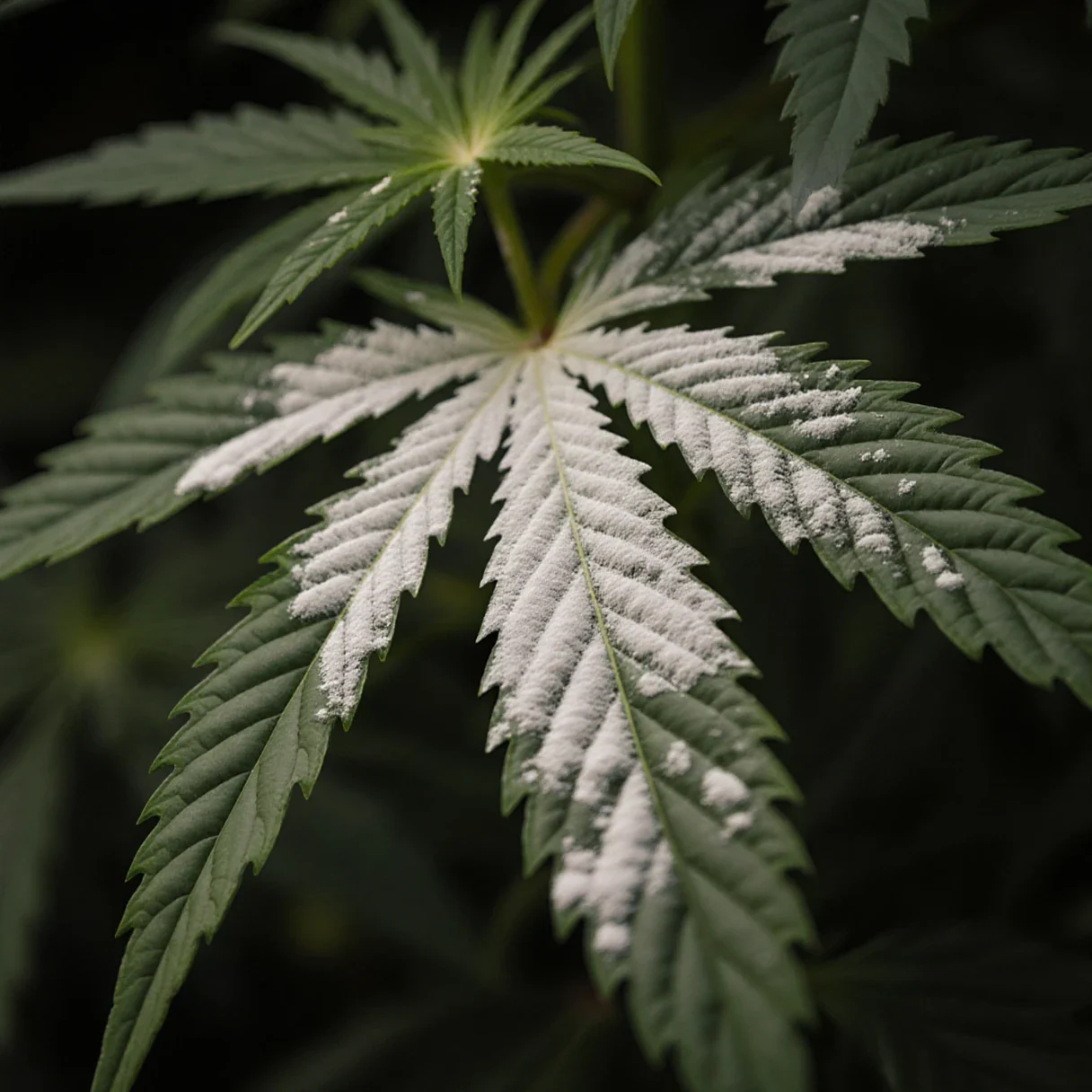
You walk into the tent, tilt a fan leaf toward the light, and there it is — a dusty white patch sitting on top of the leaf like someone flicked flour at it. That is cannabis powdery mildew, and the reason it catches so many growers off guard is that it breaks the rule everyone learns first. Mould needs wet. This one doesn’t.
Most grow advice treats cannabis powdery mildew as just another fungus, the same problem with the same answer: dry it out, move some air, done. Half of that is right. The other half is why people keep wiping leaves clean in week four and finding the same spots again in week six.
The fungus behind it on cannabis is almost always Golovinomyces ambrosiae. A 2026 genome paper in BMC Genomics puts it plainly: the only powdery mildew species affecting cannabis are G. ambrosiae and P. macularis, the second being the one that normally lives on hops. The Pacific Northwest extension handbook names the same two for hemp.
The important word is biotroph. This fungus cannot feed on dead tissue. It needs a living plant, and it takes what it needs by pushing feeding structures called haustoria into the cells of the leaf surface while the rest of it sits on the outside.
That outside-in habit is the whole personality of the disease. The PNW handbook notes that most powdery mildew fungi grow on the surface of the plant host — which is why cannabis powdery mildew wipes off with a finger, and why wiping it off changes nothing. You removed the visible growth. The haustoria are still in the leaf.
It also explains the speed. Where conditions suit it, that handbook says the infection cycle can repeat in as little as three days — a figure for powdery mildews generally, not one measured on cannabis. Even treated as a best case it is faster than most people check their plants.
This is the section worth reading twice, because one specific thing about cannabis powdery mildew is inverted — and it isn’t the thing most growers assume.
Bud rot is Botrytis. It needs moisture — dew, rain, condensation in a dense cola — and it eats the flower from the inside out. Cannabis powdery mildew is the mirror image. UC IPM’s guidance is unusually blunt about it: powdery mildew spores require no external moisture for germination, while most other fungi require free water for germination and infection, and conidia of powdery mildew die in water.
Read that last part again. Free water kills the spores.
So the conditions that set up cannabis powdery mildew are humid air with dry leaves. UC IPM puts the favourable range at moderate temperatures of 68–86°F (20–30°C) with high relative humidity above 95%, and adds that shade or low light intensity favours it too. The same page notes that at leaf temperatures above 90°F (32°C) some mildew spores and colonies are killed.
Do not take that as a strategy. Cooking your canopy to 90°F to kill a fungus trades one problem for heat stress, which costs you more than the mildew would. It is useful as an explanation for why the problem tends to fade in a hot dry spell, not as a treatment.
Be precise about what’s actually opposite, though, because it is narrower than “opposite weather”. The inversion is leaf wetness specifically. On everything else the two line up: both are favoured by high humidity and still air, and the room-level fixes below — airflow, spacing, opening the canopy, pulling humidity down — are very nearly the same programme you’d run against bud rot. That’s good news. You are not choosing between two regimes.
The practical consequence: a grow can sit at a perfectly reasonable temperature, never see a drop of standing water, and still be an ideal home for cannabis powdery mildew. If your humidity is high and your air is still, you have built the habitat. We covered the temperature-and-humidity arithmetic in our VPD guide — that post owns the targets, and it’s the one to work from once you’ve read this.
The PNW hemp entry describes the start of cannabis powdery mildew as whitish, powdery spots on the upper leaf surface. That “upper” is your first diagnostic fork.
Spider mite stippling shows up as damage you see from the top but caused by something living underneath — flip the leaf and you find the animal. Cannabis powdery mildew is the reverse: the growth is on top, and flipping the leaf shows you nothing new. If you’re unsure which you’re looking at, our pest guide covers the arthropod side properly, including the rule-out step.
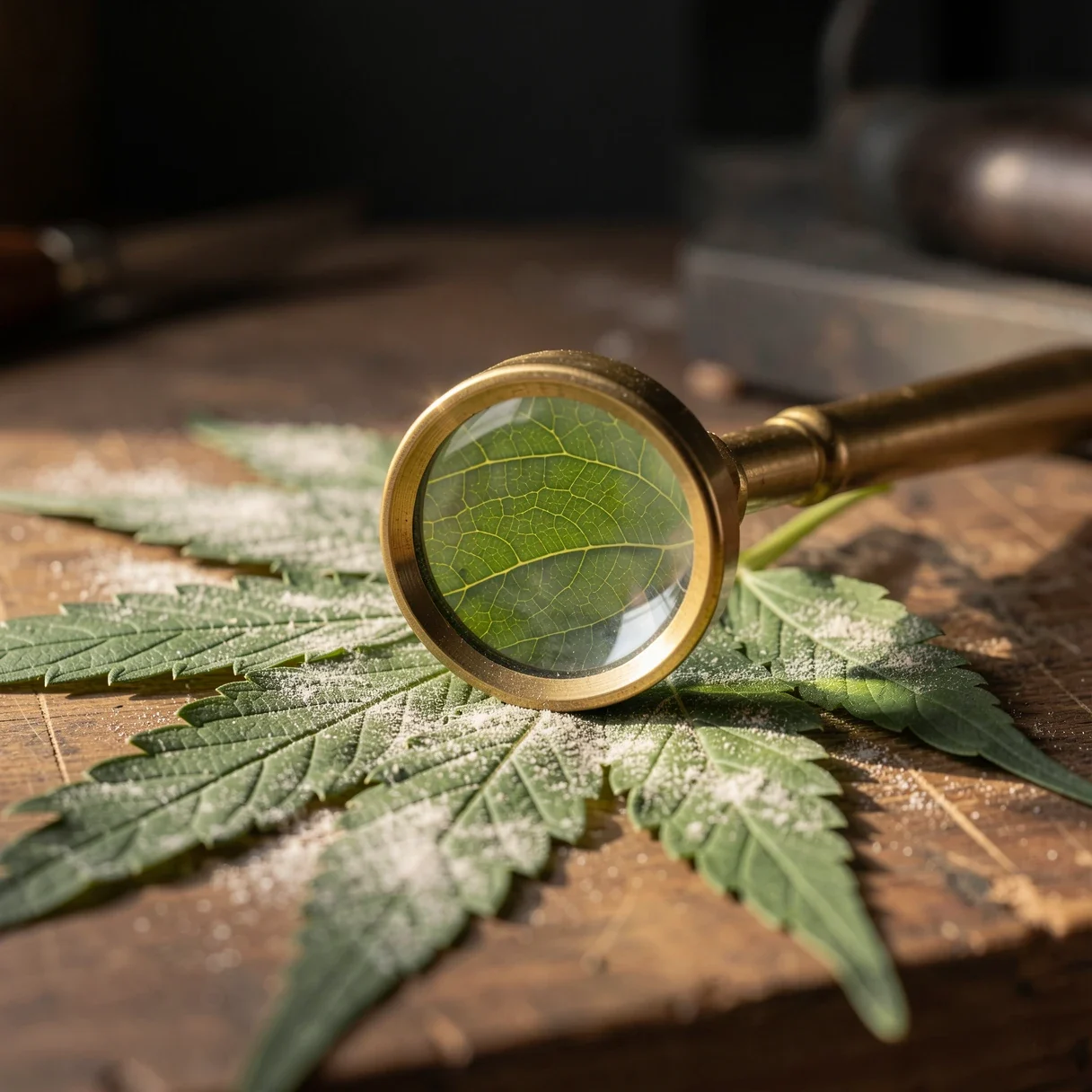
Early colonies are small, round and diffuse — not the solid dusty sheet people picture. Left alone they merge into the sheet everyone recognises as cannabis powdery mildew, and the handbook notes entire leaf surfaces can end up covered, with leaves and buds affected at all growth stages.
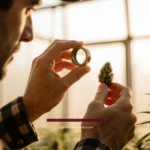
Three habits catch it in time:
None of these are products. Every one of them takes something away that cannabis powdery mildew depends on, and they’re all changes to the room. Two come verbatim out of the cannabis-specific extension guidance, three more rest on general powdery-mildew research or follow directly from it, and two (numbers 2 and 7) are our own practice rather than published guidance — labelled as such below so you can weigh them differently.
Notice what isn’t on that list: a spray. That’s an editorial choice, and we should be straight about it — the extension handbooks do cover chemical and biological control at length, and the PNW entry says chemical and cultural controls together can help keep disease levels low, particularly before plants begin flowering. We leave products out because pesticide and fungicide rules for cannabis vary enormously by jurisdiction and change often, so naming one would be useless or wrong for most readers. Check your local rules and follow the label.
It’s worth knowing the research is candid about the limits here too. The 2025 Frontiers in Plant Science paper on resistance notes that in countries with legal cannabis markets, use of agrochemicals and biological products is tightly controlled by regulatory agencies, and the few available products often exhibit limited protection.
Order of operations matters more than heroics, and the first hour after finding cannabis powdery mildew is where most people make it worse.
Remove the worst leaves first, carefully. Bag them at the plant. Carrying an infected fan leaf across the room, shedding spores the whole way, is how one plant becomes six.
Then fix the room — airflow and canopy humidity, in that order. Removing leaves without changing the conditions just gives the fungus fresh tissue to colonise.
Then decide about the flowers. This is the hard call. The BMC Genomics authors note the presence of the pathogen on cannabis flowers can severely impact market access and regulatory approval — that’s written about licensed producers, but the underlying point is the same at home. Mildew on a leaf is a growing problem. Mildew in a finished bud is a quality problem you can’t fix later, and harvest timing becomes a real decision rather than a schedule.
Less than anyone selling seeds would like, and we’d rather tell you that than dress it up.
Genuine resistance exists and has been mapped. That 2025 Frontiers in Plant Science study identified PM2, a single dominant resistance locus on chromosome 9 that strongly suppresses infection and sporulation. Real resistance, real gene, dominant inheritance.
Here’s the number that matters: the team screened 510 cannabis genotypes and found two carrying it.
Two. Out of five hundred and ten, inside a commercial breeding collection.
Be careful what you take from that, because it’s a statement about PM2 specifically and not about resistance in general. The same study found a spread of partially resistant plants, and suggested that most resistance in cannabis is quantitative — lots of loci, each contributing a little. So it isn’t that cannabis has no defences. It’s that the clean, single-gene, breed-it-in kind of resistance is genuinely rare, which is why we don’t market anything in our catalogue as mildew-proof and why you should be sceptical of anyone who does.
What genetics does give you is a smaller target. Open, airy, sativa-leaning structure stays ventilated on its own in a way a dense squat plant doesn’t — Durban Poison, Green Crack, Columbian Gold and Acapulco Gold all grow that way. And a shorter run is simply less time exposed, which is the honest case for a short-flowering auto like Mandarin Cookies Autoflower at 7-8 weeks or White Widow Autoflower at 8-9, against the 10-12 weeks a long-season sativa like Columbian Gold wants. Tough, forgiving staples like White Widow, Afghani and Northern Lights Skunk won’t resist the fungus either, but they’ll take the airflow and the pruning you need to do without sulking.
That is an edge against cannabis powdery mildew, not a solution to it. Same conclusion we reached about pests: the room beats the seed.
Browse the full feminized seed collection or the autoflower range if you’re planning a run around an airy canopy.
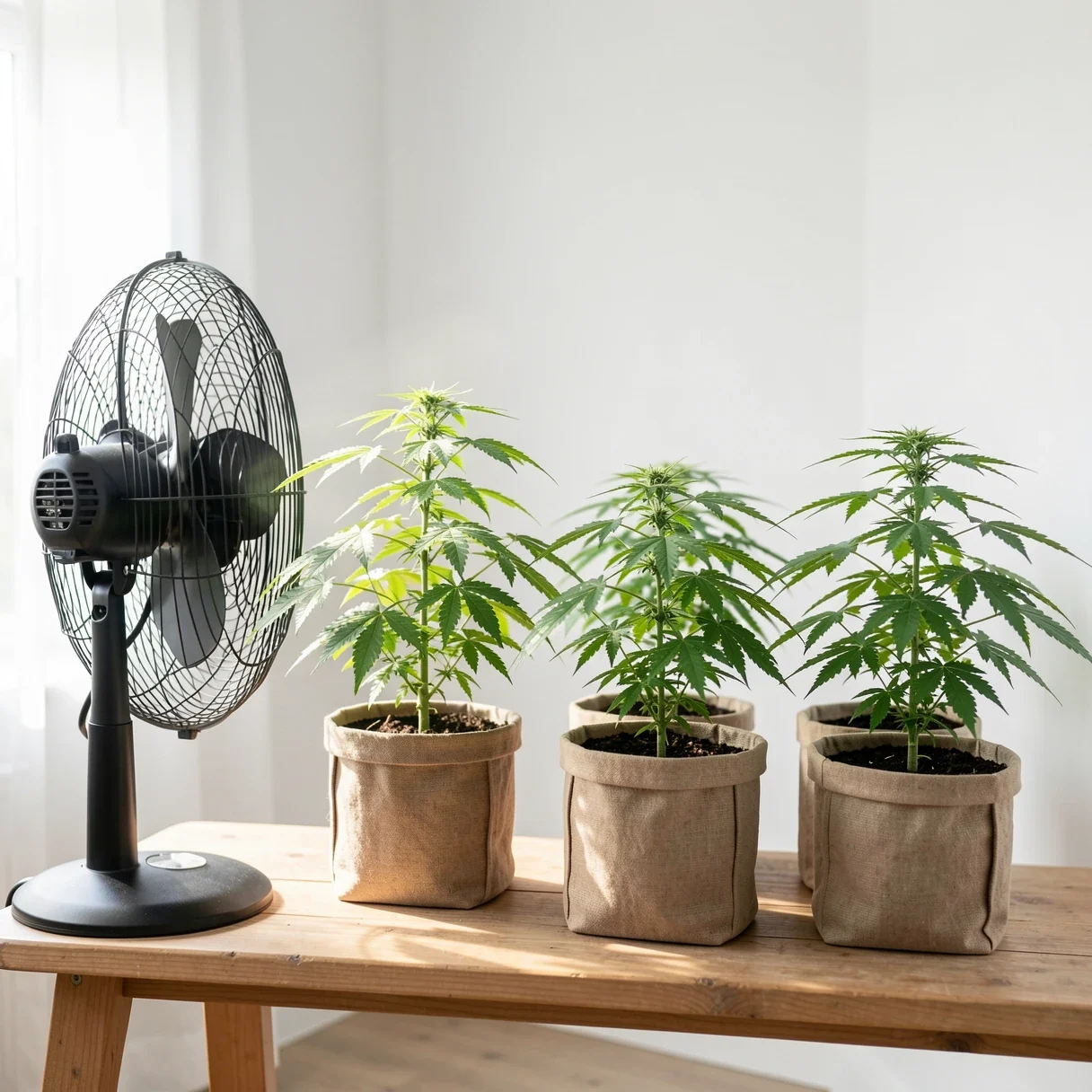
Honest answer: cannabis powdery mildew usually arrives on something living that you brought in, or on air you don’t control.
It’s common enough that a Canadian survey reported in the BMC Genomics paper found the pathogen at 100% of locations surveyed — licensed production sites sampled between 2013 and 2017, not a study of ambient air, but a fair signal of how widespread it is. If you grow outdoors or crack a window, you are not going to keep spores out, and a plan built on exclusion will fail.
Indoors the realistic entry routes are cuttings, clothing and shared equipment. Outdoors it’s simply the air, which is why outdoor growers lean harder on site choice and plant spacing than on anything else — and why the indoor-versus-outdoor decision changes which of these seven fixes you actually have available.
One thing we won’t claim: that soil biology prevents it. A healthy living soil bed grows a sturdier plant, and a sturdier plant handles pruning and airflow better. Nobody has shown it stops this fungus.
Silica is a more interesting case, and it’s worth being precise because the marketing is not.
There is a hemp-specific trial here. The PNW handbook lists silicon applied to the roots among its cultural measures, citing work published in Plant Health Progress in 2022 (Dixon and colleagues, vol. 23, pp. 260-264) that found root-applied silicon significantly reduced powdery mildew severity in the upper and mid canopy of hemp grown in soilless systems. Hemp is the same species you’re growing, so that counts.
Two caveats before you reach for a bottle. The rates in that work are agricultural — 660 to 1,322 lb per acre (roughly 740 to 1,480 kg per hectare) applied to the root zone, not a cap of something in your res. And the same handbook notes a foliar silicon product that University of Tennessee studies did not find significantly better than untreated plants. Root-applied and foliar are not the same intervention, and only one of them has the hemp result behind it.
We went through the wider question of what silica does and doesn’t buy a cannabis grower in our silica post. Read that before you spend money on a mildew claim. The short version: silicon is a defensive input with a real mechanism, the evidence is thinner than the labels suggest, and nothing about it replaces moving air.
You can remove what you see, and it will come back, because the feeding structures are inside the leaf while the visible growth sits on the surface. Removing badly infected leaves is worth doing — as a first step, not as the treatment.
No — but the difference is narrower than it sounds. Bud rot is Botrytis and needs moisture, rotting the cola from inside; this is a surface fungus whose spores die in water. That one inversion is real. Everything else lines up, though, and most of the room-level fixes are the same for both. Our bud rot guide covers that one in full.
It helps, and on its own it isn’t enough to stop cannabis powdery mildew. The often-quoted “above 95% humidity” threshold comes from ornamental-crop guidance rather than from cannabis work, so treat it as a direction to move in rather than a line you’re safely under. Shade and still air favour the fungus too — which is why airflow, spacing and light in the lower canopy do as much work as the dehumidifier.
We won’t tell you it’s fine. Mildew on finished flower is a quality and safety judgement, not a horticultural one, and it’s the reason to act while it’s still a leaf problem.
A dominant resistance locus called PM2 has been mapped, but it turned up in only two of 510 genotypes screened in a commercial collection. Nothing in our catalogue is sold as resistant, and you should be sceptical of anything that is.
Some spores and colonies die above leaf temperatures of 90°F (32°C), which is why outbreaks fade in hot dry weather. It’s a poor control strategy indoors — you’d be swapping mildew for heat stress.
Cannabis powdery mildew is an environment problem wearing a disease costume. It doesn’t need your leaves wet, it needs them humid, shaded and still — and most of the list above is you taking one of those three away — the other two fixes work a different way, by making the tissue less worth colonising and by keeping new spores out in the first place.
Stop looking for the spray. Move the air, open the canopy, get light into the bottom third, ease the nitrogen, and look at your plants once a week with a loupe and a torch held at a low angle. That’s the core of it, and it’s built for a fungus that can turn a cycle around in days rather than weeks.
And if you’re choosing what to run next season, pick for structure rather than for a resistance claim. Airy plants and short flowering windows are the edge that actually exists — the rest of it is down to the room you put them in. There’s more of this thinking across our cannabis growing guides.
Shop All Seeds | Cannabis Bud Rot | Cannabis Pests | VPD for Cannabis
Want to keep learning? Browse our full library of guides to growing cannabis — everything from germination to harvest, in one place.
Ready to grow? Browse premium seeds from Lighthouse Genetics:
Designed & Built by Wynne Web Design