Nothing in a grow room goes from fine to finished as fast as a reservoir that has turned. You checked the bucket on Tuesday and the roots were white and stringy. By Friday they are tan, the water has gone slightly cloudy, and there is a smell coming off the lid that you will recognise instantly the first time you meet it. That is cannabis root rot, and in a recirculating system it moves at a speed soil growers never have to think about.
The good news is that cannabis root rot is almost entirely an environment problem, not a luck problem. It needs warm, low-oxygen water to get going. Take that away and the pathogens that cause it mostly sit there doing nothing.
Most cannabis root rot in a hydro system is caused by Pythium — a group of oomycetes, or water moulds, which despite the name are not true fungi at all. That matters for a practical reason: several Pythium species produce swimming zoospores, so a recirculating reservoir is not just where the problem lives, it is how the problem travels.
The cannabis-specific work here is solid. A survey of pathogens affecting Cannabis sativa by Punja and colleagues recovered five Pythium species from infected roots — P. dissotocum, P. myriotylum, P. aphanidermatum, P. ultimum and P. catenulatum — and described the resulting symptoms as root browning, discoloured crown and pith tissue, stunting, yellowing and in some cases plant death. Sutton and colleagues, reviewing hydroponic root rot generally, report that zoospores can be found in nutrient solution through most phases of an outbreak — and Punja’s cannabis work makes the practical point that recirculating solution without treating it moves pathogen spores around a facility.
Fusarium turns up on cannabis roots too, and it produces a broadly similar-looking collapse. For a home grower the distinction rarely changes what you do next, so this post treats cannabis root rot as the one problem it looks like from the outside.
One thing it is definitely not: bud rot. Different organism, different part of the plant, completely different fix. If your damage is inside a cola rather than under the lid, read our guide to cannabis bud rot instead.
Roots go first and the canopy lags, which is why cannabis root rot so often gets diagnosed as something else for a week before anyone lifts the lid. Nothing on the plant says cannabis root rot as plainly as the roots themselves do.
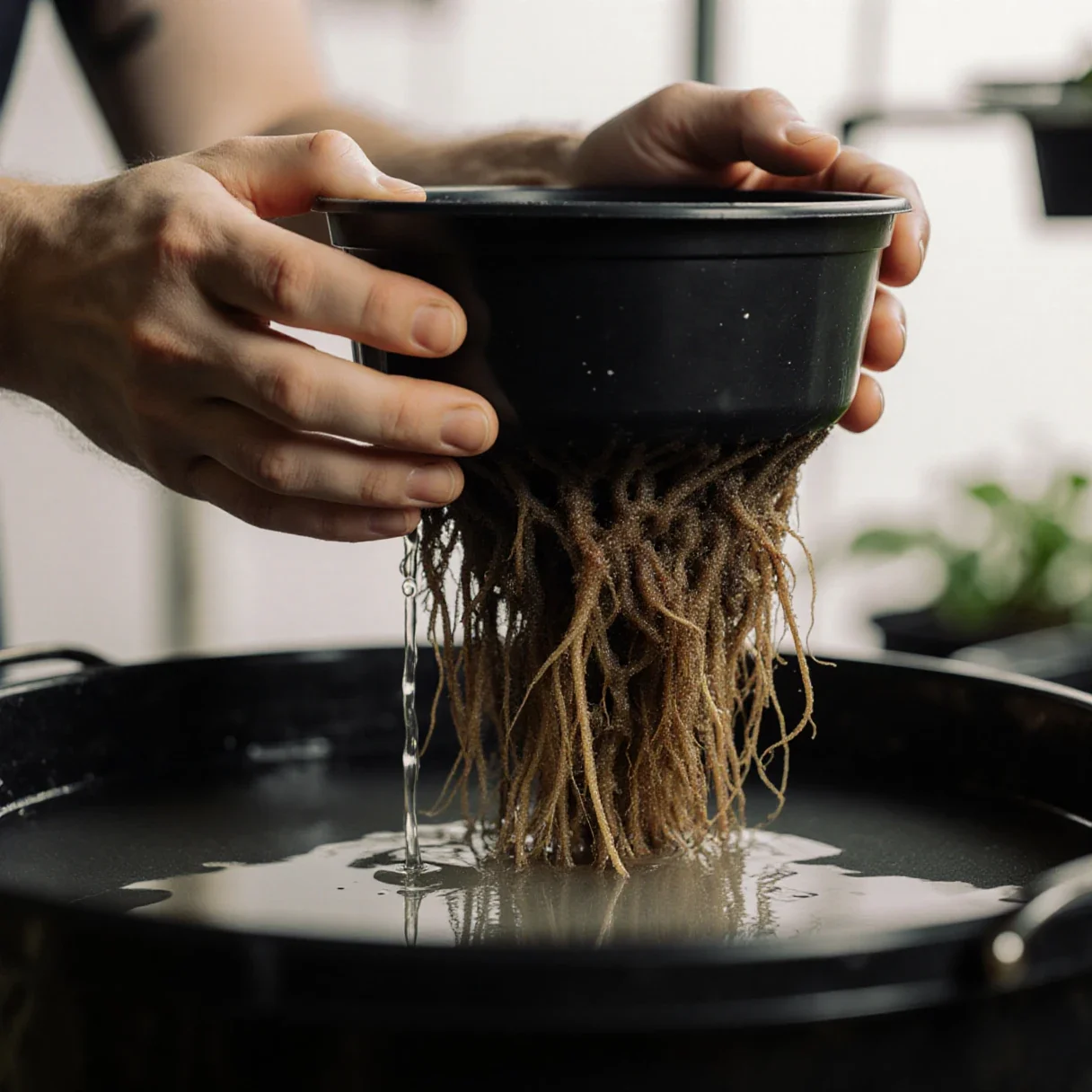
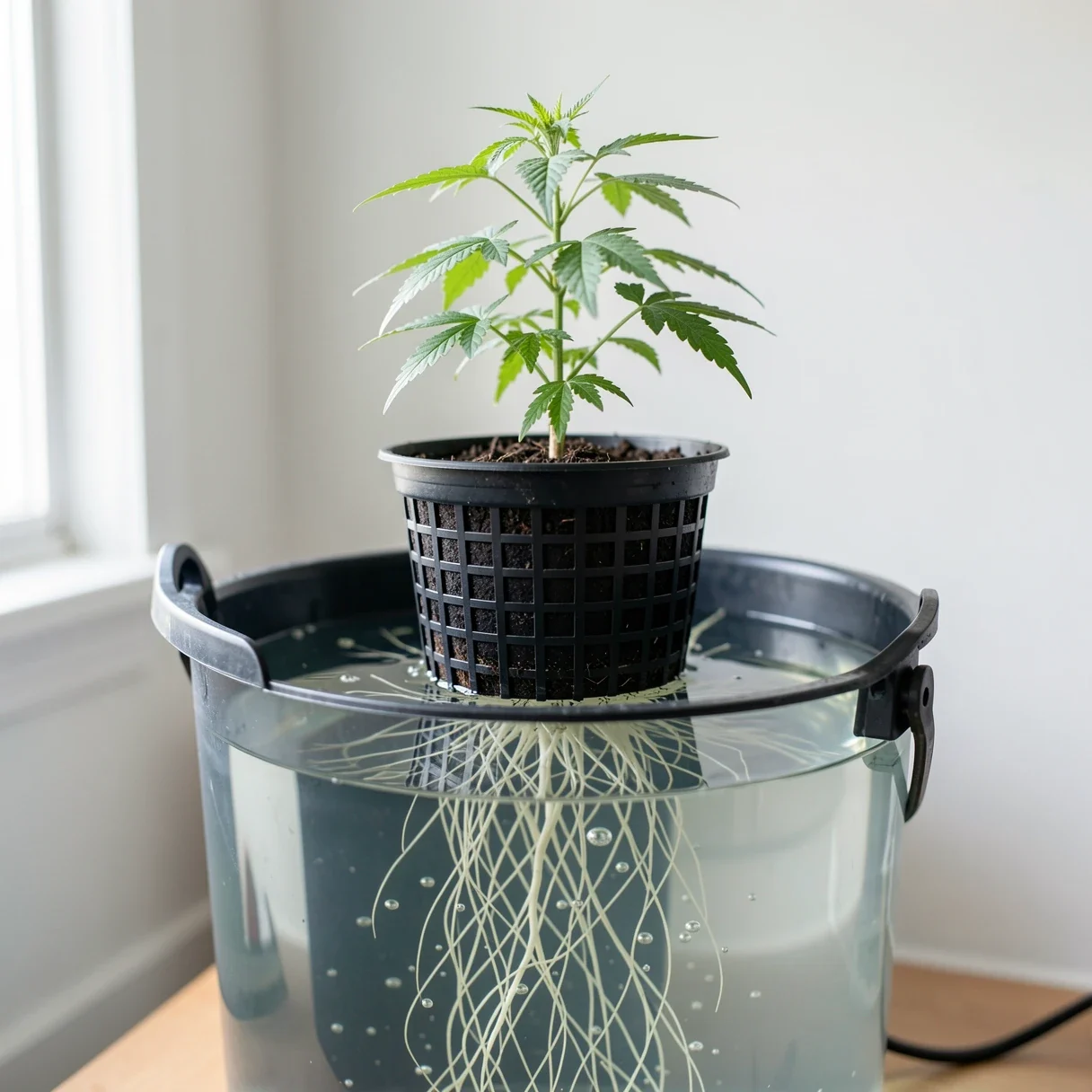
Look at the roots themselves. Healthy hydro roots are bright white to cream, separated, and they move in the current. Sick ones discolour — tan, grey-brown, reddish-brown — and the outer layer starts to feel slippery, then slides off between your fingers leaving a stringy core behind. Sutton and colleagues, reviewing the etiology of Pythium root rot in hydroponic crops, describe exactly that pattern of brown discoloration along with stunted, stubby root architecture.
Then use your nose. Clean nutrient solution smells of almost nothing. A reservoir with cannabis root rot in it smells swampy — stagnant pond, wet drain. Growers argue about colour charts. Nobody argues about that smell.
Up top, the tells are boring and easy to misread: droop that does not come back after lights-on, pale new growth, a plant that has simply stopped putting on size. The giveaway is the contradiction — a plant wilting with its roots sitting in full water. That is not thirst. That is a root system that can no longer drink, and it is the same signature we describe for cold roots in root zone temperature, which is one reason the two get confused.
Before you tear the system down, rule out the cheap stuff. Nutrient burn and lockout look like a sick plant too, and they are fixed with a meter rather than a bucket swap — start with pH for cannabis and nutrient deficiencies. But if the roots are brown and the water smells, stop diagnosing. You have your answer.
If you only fix one thing after reading this, fix your water temperature.
Two mechanisms stack. First, the physical one: cold water holds more dissolved oxygen than warm water — the relationship is inverse and it is not negotiable. Warm your reservoir and you have less oxygen available to the roots whether you like it or not. We cover what low oxygen does to a root system in the root zone temperature guide, so this post will not re-derive it.
Second, the biological one: the pathogens get faster. The Sutton review notes that P. aphanidermatum causes severe root rot at moderate-to-high root zone temperatures in the region of 23–27°C (roughly 73–81°F), and that in chrysanthemum trials symptoms became progressively more severe as temperature climbed from 20°C to 32°C (68°F to 90°F). That is another crop, and it should be read as direction rather than as a cannabis threshold. The direction is unambiguous: warmer water, worse outcome.
The same review recommends keeping a minimum of 5 mg of oxygen per litre of nutrient solution — 5 mg/L, which is what a dissolved-oxygen meter shows as 5 ppm, and reports that root rot increases when oxygen levels are low. Low oxygen and warm water are the same event described twice.
So aim to hold the solution at or below about 20°C (68°F), and treat anything from the low twenties Celsius — low seventies Fahrenheit — upward as the zone where you are actively growing the problem. We would rather see a grower with a thermometer in the bucket and no other equipment than a grower with a shelf of additives and no idea what the water is doing.
This one is free to fix, and it is the first thing we would check in someone else’s tent.
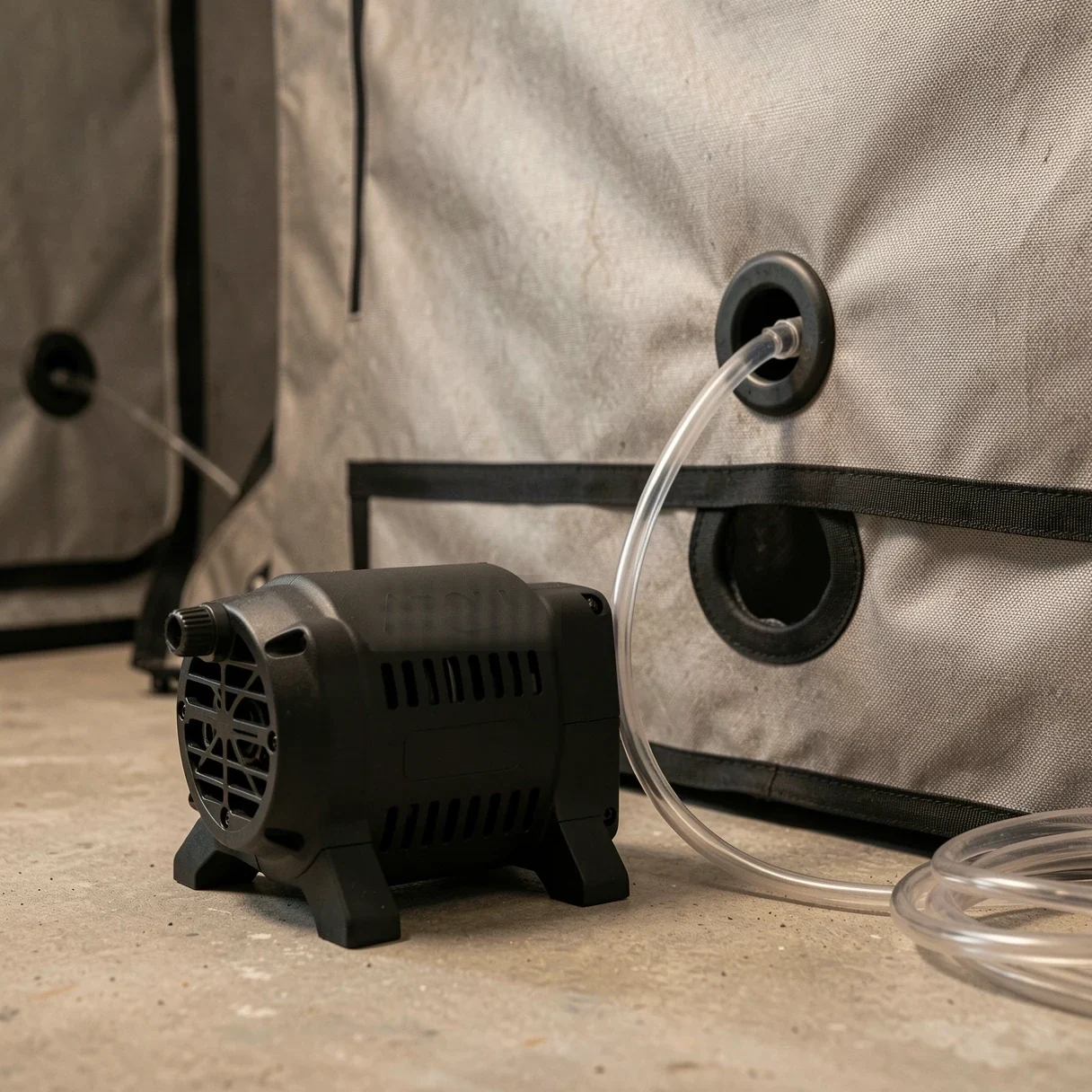
An air pump does not make cold air. It takes in whatever air is around it and pushes that into your water through the stone. Site the pump inside the tent and you are feeding warm, lamp-heated tent air straight into the reservoir, continuously, for as long as the lights are on. The pump’s own motor runs warm on top of that.
In our experience this is one of the quiet causes of cannabis root rot in otherwise tidy grows — the res creeps up, the grower blames the room, and the aeration they installed to prevent the problem is helping cause it. Put the pump outside the tent, on the floor rather than on a shelf if the room stratifies, and run the airline in. Check valves stop back-siphoning if the pump ever sits below the water line.
We would not claim a number for how much this shifts a reservoir — it depends on your tent, your lights and your air exchange, and nobody has measured it for your room. But it costs nothing to change and it only ever moves in the right direction.
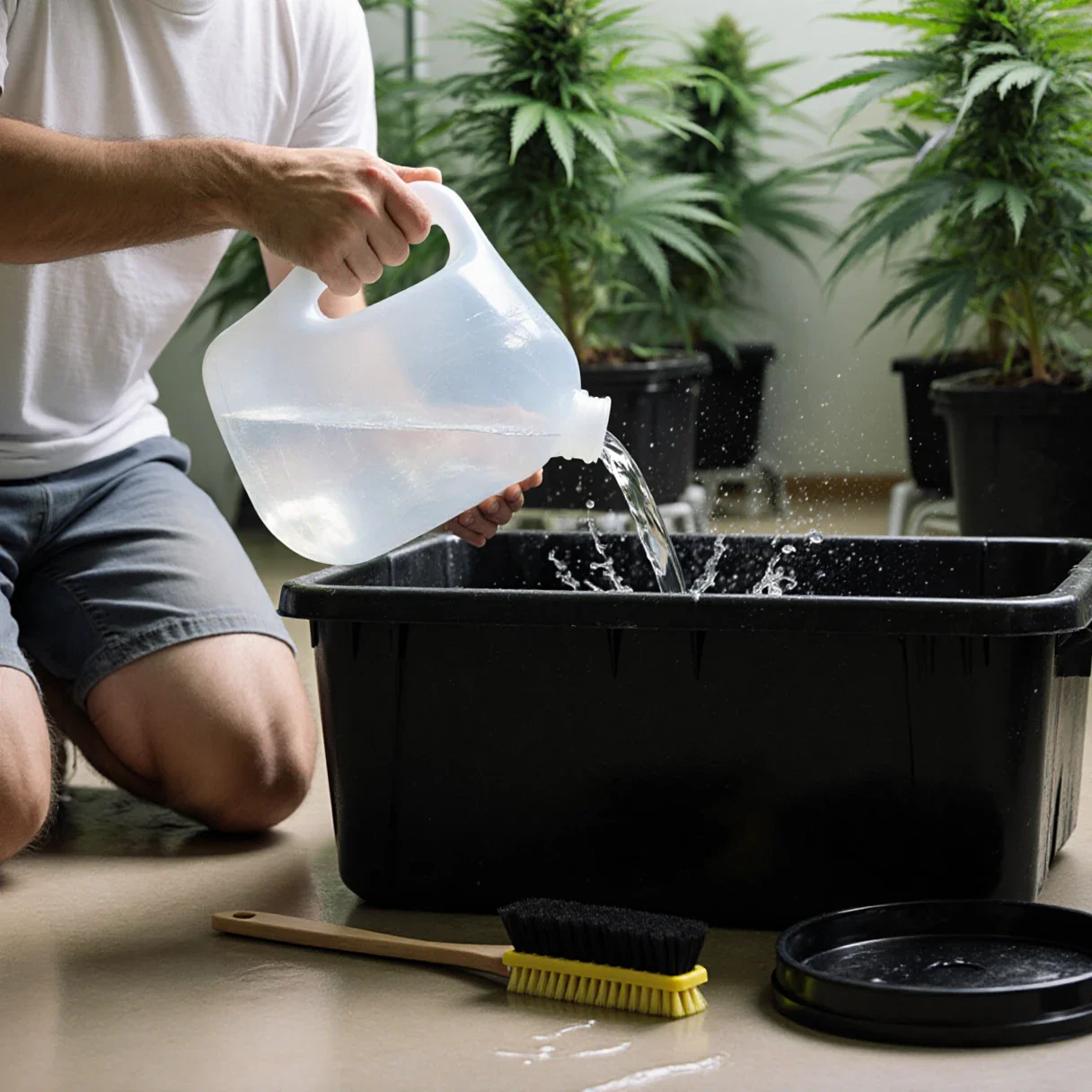
Cannabis root rot in a running system is a triage job, and speed matters more than elegance. You are not trying to fix the grow in one pass — you are trying to stop the water from working against you. Working order that has served us well:
Be realistic about the odds. A seedling or a small plant that loses most of its root mass to cannabis root rot usually is not worth nursing. A large plant in early flower with damage confined to the lower roots often pulls through if the water gets cold and stays cold. Deciding fast is worth more than deciding perfectly.
Growers run two opposite strategies against cannabis root rot. One keeps the reservoir effectively sterile — peroxide, chlorine-based products, UV — so nothing lives in the water. The other seeds it deliberately with beneficial microbes so the pathogen has competition. Both have people swearing by them as the answer to cannabis root rot, and mixing them cancels the second one out: an oxidiser cannot tell your inoculant from the Pythium.
What is actually evidenced for cannabis is narrower than the marketing suggests. Reviewing emerging cannabis diseases, Punja describes products based on Trichoderma harzianum, T. asperellum and Gliocladium catenulatum being evaluated in his lab against Fusarium damping-off on cannabis cuttings, with Bacillus products in the same tested set. That is a real result on a real crop — but it is a different pathogen, in unrooted cuttings rather than an established root system, and nobody should sell it to you as proof against cannabis root rot in a bucket. The same review lists avoiding excessive watering and root injury among the practical controls, which is unglamorous and correct.
Our position: pick one lane and run it properly. If your discipline is good — cool water, clean gear, tight lids — sterile is simpler and more predictable. If you would rather build a living system, do it from day one on healthy roots rather than as a rescue on a rotting one. Beneficials are a much better prevention story than a cure story. There is a related discussion of root-zone biology in our guide to mycorrhizae and cannabis yield, though that is a soil-side conversation, not a reservoir one.
Preventing cannabis root rot is unusually cheap, which is what makes losing a plant to it so annoying in hindsight. Most of what follows costs nothing but an afternoon.
Yes, but it looks different and it moves slower. In a pot there is no recirculating solution carrying zoospores to every plant in the room, so damage tends to stay local — one overwatered plant with a sour-smelling medium, roots browning in a pot that never dries out.
The cause is the same shortage: waterlogged medium means no air in the root zone. Fix it with pot size, drainage and a real wet-dry cycle rather than with products — start at watering cannabis plants. And if you have not chosen a medium yet, soil vs coco vs hydro is honest about the trade you are making: hydro is fast, and it is the medium where a mistake becomes cannabis root rot in three days instead of three weeks.
That is also our standing advice for a first grow. Learn in soil or coco, where the medium forgives you, then move to hydro when checking the reservoir every day sounds like a pleasure rather than a chore.
There is no strain in our catalogue — or anyone else’s — that we would sell as resistant to cannabis root rot. We have not seen cannabis-specific evidence that any cultivar shrugs off Pythium in a warm reservoir, and a claim like that would be easy to make and impossible to keep.
What genetics buys you is margin. A vigorous, fast-rooting plant recovers from a bad week better than a slow, fussy one, and the strains our catalogue rates Easy are the ones we would put in a first hydro run. White Widow Feminized Seeds and Northern Lights Skunk Feminized Seeds are the usual suggestions for exactly that reason, and Afghani Feminized Seeds is another sturdy, forgiving option. On the autoflower side, White Widow Autoflower Seeds (8–9 weeks) and Mandarin Cookies Autoflower Seeds (7–8 weeks) are both rated Easy in our catalogue and finish fast, which limits how long any one plant is exposed to a reservoir you are still learning to run.
If you want more root mass to play with before flower, longer-vegging photoperiods like Big Bud Feminized Seeds, Green Crack Feminized Seeds and Durban Poison Feminized Seeds give you the time to build it. Mac’s own Blue Monkey Dick Feminized Seeds is a Lighthouse original for growers who want something that is not in every other tent. Browse the full feminized cannabis seeds and autoflower cannabis seeds ranges if you would rather pick on flavour and effect.
Often, if you catch it early and the water gets cold. Established plants with damage limited to the lower root mass frequently push new white roots within a week or two of a full reset. Seedlings and small plants that lose most of their roots usually are not worth saving — start again and fix the reservoir first.
Peroxide is an oxidiser — it will knock down what is in the water at the time and add a little oxygen as it breaks down, but it does not stay in the reservoir and it does not fix the warm water that caused the problem. Treat it as part of a sterile-reservoir strategy, not as a cure. It will also wipe out any beneficial inoculant you are running.
There is no single threshold at which cannabis root rot switches on, and anyone quoting one is guessing. The pattern in the hydroponics literature is that severity climbs as solution temperature rises through the mid and high twenties Celsius, with the more aggressive Pythium species associated with the warmer end. Holding the solution at or below about 20°C (68°F) stays comfortably on the right side of that.
No. Roots stain. Some nutrient lines — particularly ones with heavy iron or humic content — tint roots tan or brown with nothing wrong. The difference is texture and smell: stained roots are still firm and the water smells clean, while cannabis root rot makes the outer tissue slimy and the reservoir smell stagnant.
Not necessarily. Move the pump out of the tent, increase reservoir volume, keep light off the water and change it on schedule — that is enough for a lot of rooms. A chiller is what you buy when the room itself runs hot and the free fixes have not held the temperature.
Cannabis root rot needs a pathogen, but what decides whether you ever meet it is your water. The organisms are already around — in the room, on gear, on incoming plants. Whether they ever amount to anything comes down to a reservoir that is warm and short of oxygen, or one that is cool and moving.
So buy the thermometer before the additives. Get the air pump out of the tent tonight. And if you are still choosing where to grow, the rest of our cannabis growing guides will get you there with fewer buckets of dead roots than we managed.
Shop cannabis seeds |Root Zone Temperature | Soil vs Coco vs Hydro | Cannabis Growing Guides
Want to keep learning? Browse our full library of guides to growing cannabis — everything from germination to harvest, in one place.
Ready to grow? Browse premium seeds from Lighthouse Genetics:
Designed & Built by Wynne Web Design