Ask any grow forum what causes a cannabis hermie and you’ll get a confident list: heat, light leaks, pruning, drought, a late harvest. It sounds settled. It isn’t. When we went looking for controlled tests of those triggers, most of the list turned out to be untested, and the few tests that exist are small and mostly found nothing clear.
That doesn’t make hermies a myth. They’re real, they show up in professional grow rooms, and a single cannabis hermie can put seeds through buds you spent months on. What it means is that the useful advice is narrower than the usual list, and a couple of the most repeated “rules” have far less behind them than you’d think.
Below is what the research shows about the cannabis hermie: how often it happens, which suspected causes have real evidence, why genetics is where the evidence points, and what to do the day you find one. If you need help telling a cannabis hermie from a male in the first place, our guide to male vs female cannabis plants covers identification. This post is about causes and prevention.
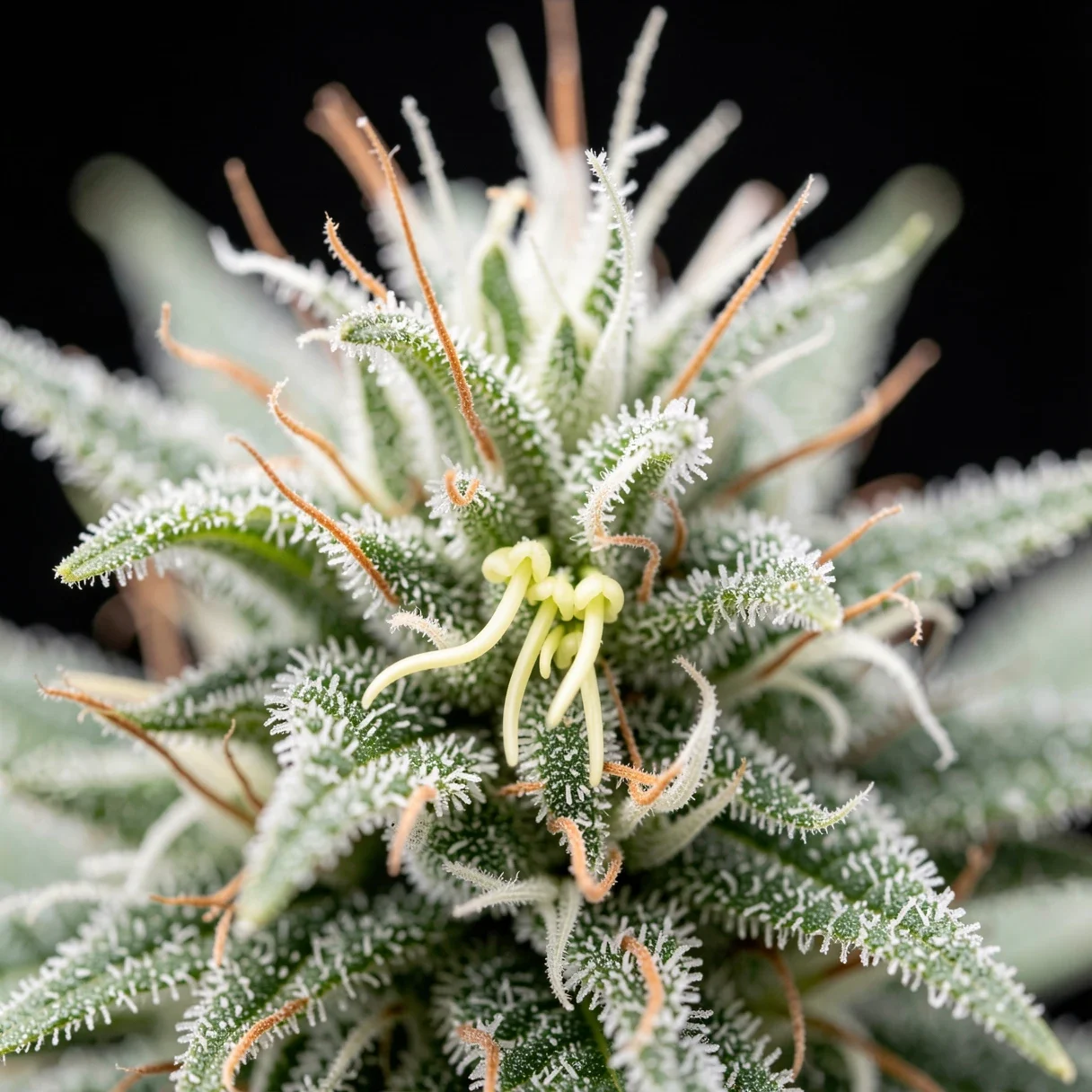
Cannabis normally grows as separate male and female plants. Females carry two X chromosomes; males carry an X and a Y. A cannabis hermie is a genetically female plant that grows male flowers anyway, either as separate male flowers or as anthers inside its own buds.
That ability isn’t a defect. It’s built into the plant’s chemistry. Ethylene, a plant hormone, keeps female flowers female. Block it — breeders do this deliberately with silver thiosulfate, a silver spray — and a female plant grows fertile male flowers. That’s how feminized seed is made. Because the plant has no Y chromosome to pass on, its pollen carries only X, and the seeds it sets are genetically female.
So every female cannabis plant has the machinery to make pollen. The question is what makes one actually use it.
The most detailed look at this comes from a licensed Canadian indoor facility studied by British Columbia researchers. Zamir Punja and Janesse Holmes, publishing in Frontiers in Plant Science, examined around 1,000 plants across three strains over two production cycles. No stress treatment was applied. They just watched normal production.
Anthers turned up on 5–10% of the plants. In two of the 1,000, an entire bud was taken over by anther clusters instead of pistils. The rest were smaller: bright yellow clusters 2–3 mm (about 0.1 inch) long, sitting inside the bract tissue next to the stigmas, often replacing a pistil. They appeared from around week 4 of a 6–7-week flowering period and stayed until harvest.
Two cautions on that number. It’s one facility and three strains, and the authors themselves say the proportion of hermaphrodites in cannabis populations generally “is unknown.” So don’t read 5–10% as an industry rate. Read it as proof that a cannabis hermie isn’t only a beginner’s problem: it happens in licensed, professionally run rooms too.
A smaller undergraduate study at another Canadian commercial facility found male flowers or anthers on 6.9% of 403 plants, and there every one was on the stem or on small buds low on the main stem rather than up in the top colas. Scout both places.
Here’s every common cannabis hermie trigger we could find tested, or looked for and didn’t find. “No controlled test” doesn’t mean the trigger is harmless. It means nobody has shown it causes a cannabis hermie, so anyone who tells you it does is guessing.
| Suspected trigger | What’s been tested in cannabis or hemp | What it found |
|---|---|---|
| Light leaks in the dark period | One undergraduate study of door leaks in a commercial facility | No link found, but it couldn’t measure light below 1 µmol·m⁻²·s⁻¹ — inconclusive |
| Schedule shock | A week of 24-hour light or 24-hour dark, then 12/12 (3 plants per group) | No male flowers on untreated plants |
| Very short days | A 1954 hemp study (via a 2026 review) vs a 2018 hemp study | Mixed: 25–45% of females made male flowers at 8- and 11-hour days in 1954; untreated plants at about 8 hours stayed female in 2018 |
| Cold | The same 1954 hemp study | About 55°F (13°C) before flowering raised the share of females with male flowers by about 26 points vs about 70°F (21°C) |
| Heat | Nothing in cannabis | No controlled test found |
| Drought | One study saw females herm on reduced water | No fully watered comparison group, so cause not shown |
| Hard pruning | Plants cut back to two nodes (12 plants) | No significant increase in male flowers |
| Nutrient stress | Nothing controlled | No test found |
| Late harvest (“rodelization”) | Nothing | No published study found |
Most of those sample sizes are small. But small tests that found nothing are still more than the forum list ever had behind it.
Light leaks are the cannabis hermie trigger everyone names first, and here the honest answer has two parts.
The part that’s proven: a flowering plant is counting unbroken darkness. In a 2025 University of Connecticut study, a single hour of light in the middle of a 12-hour night kept cannabis from flowering. And the light doesn’t need to be bright to matter. In a North Carolina State study, light as dim as 1 µmol·m⁻²·s⁻¹ — the lowest level they tested, a tiny fraction of a grow light’s output — stopped one cultivar from fully flowering when it was used to extend the day. We found no test at anything dimmer, so there is no known “safe” leak.
The part that isn’t proven is that a leak causes a cannabis hermie. The one study that looked, the Guelph undergraduate report, found no link between how close a plant sat to a grow-room door and how many male flowers it grew. But its own author says the leaks there were probably too faint to test the question, and that it “cannot confidently evaluate” it.
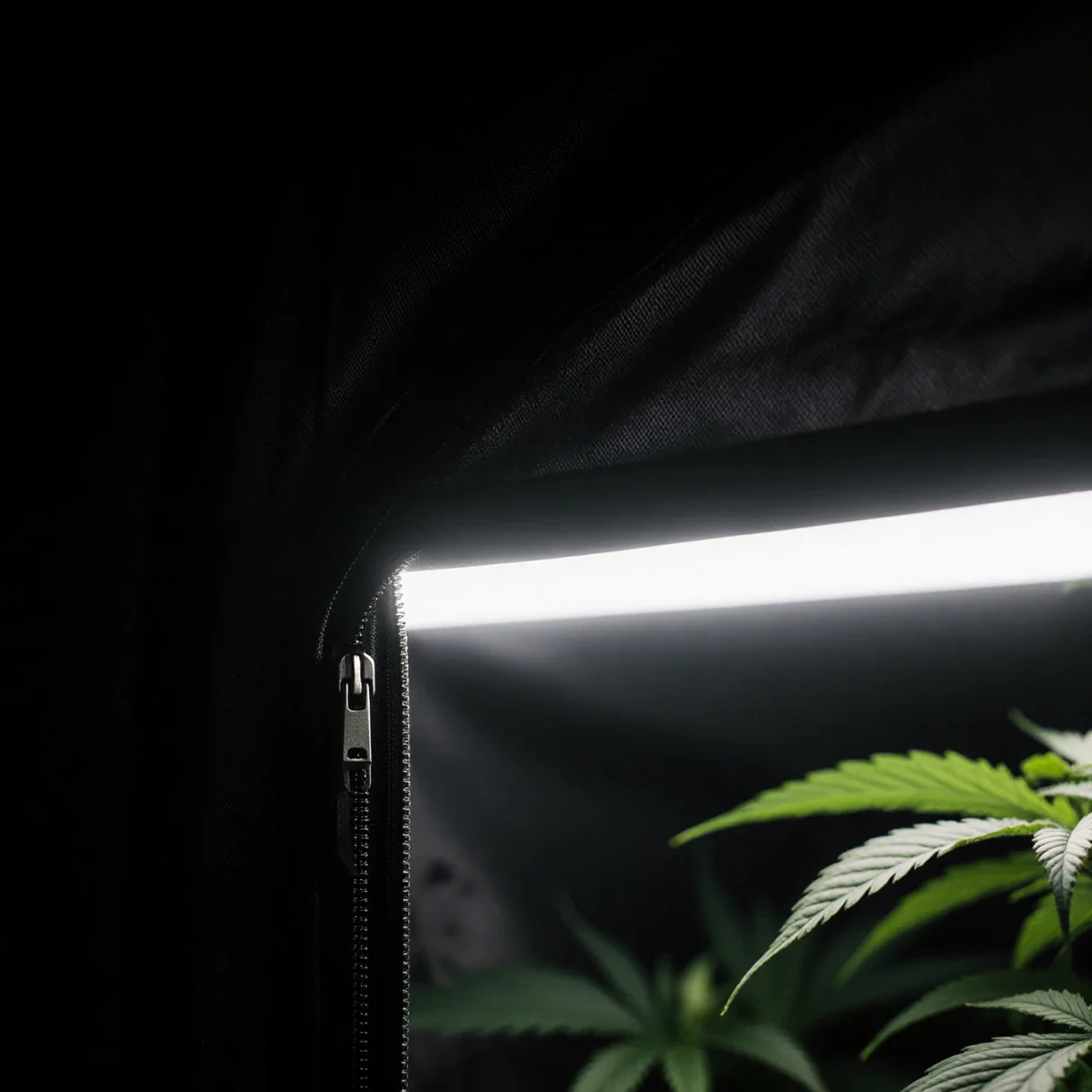
Our take: fix light leaks anyway. A leak doesn’t have to cause a cannabis hermie to cost you. Something that can stall flowering is reason enough to seal the room. Our grow tent setup guide covers sealing a tent, and our 13-hour photoperiod post looks at how far a flowering schedule can be pushed.
Green headlamps are sold as the way to check plants at night without disturbing them. We couldn’t find a cannabis study on it. In Michigan State research on other short-day plants, green light used for 7 hours to extend the day delayed flowering in every short-day plant tested as its intensity was raised up to 25 µmol·m⁻²·s⁻¹. In one short-day species, marigold, dim green at 2 µmol worked as well as a white-and-red mix. Green light is not invisible to plants. If you must check at night, keep it dim and brief, and don’t leave a green light on.
Heat is the second trigger everyone names. We dug into it for our post on growing cannabis in heat: a hermaphroditism paper often cited for it never mentions heat. The only cannabis temperature data point the other way. It’s a 1954 hemp study, quoted in a 2026 review, where cooler conditions before flowering raised the share of females growing male flowers. Avoiding cool temperatures — around 55°F (13°C) — in the run-up to flowering is the one temperature rule with any cannabis data behind it, and even that rests on one old study.
The drought case for a cannabis hermie is weaker still. A 2023 study of a CBD hemp cultivar did see seven females herm after the researchers cut their water, but every female in it got the reduced water, so there was nothing to compare against.
Rough handling is another common suspect. In a 2021 study, researchers tested exactly that, cutting young plants back to their first two nodes because growers had recommended it as a way to force male flowers. It didn’t work. The cut plants showed no significant increase in male flowers over untouched ones — though a few male flowers turned up on the untouched plants too, which the authors said could be spray drift from treated plants or a spontaneous cannabis hermie. That was one hard cut at the switch to flower, not mid-flower defoliation, so it doesn’t clear every kind of handling. But there’s no evidence that sensible low stress training or defoliation turns plants into hermies.
Rodelization is the grower name for anthers appearing on unpollinated buds left too long. We found no published study using the term or testing the idea. In the BC facility study, cannabis hermie anthers showed up from about week 4 of a 6–7-week flowering period, well before harvest. Harvest when the plant is ready, for the reasons in our harvest timing guide, not out of fear of a cannabis hermie.
Where the research does point somewhere, it points at genetics. A 2026 review of the science describes sex expression in cannabis as “highly genotype dependent”, and genetics is where the variation shows up between plants in how easily a female becomes a cannabis hermie.
You can see that variation in how differently plants respond to the same treatment. In one hemp study, a low dose of silver thiosulfate turned 91% of the flowers on the top buds male in one strain and only 42% in another — though at a tenfold higher dose every strain converted almost completely. That’s a deliberate chemical push, not a spontaneous hermie, but it shows how differently strains can react. In the Guelph student’s study, the facility’s own scouting records showed the rate of male flowers varying widely between cultivars, though conditions and scouting weren’t held constant between rooms. In hemp, whether a variety tends to carry both flower types is strongly heritable.
Repeated inbreeding makes it worse. In a 2026 study, hemp lines self-pollinated generation after generation developed more abnormal flowers from about the fourth selfed generation on. “Abnormal” there covers any misformed flower, hermaphrodite flowers included. In one line — a monoecious hemp line that normally carries both flower types — abnormal flowers rose from 0.4% to 13.7% by the sixth generation. The same authors list “fixing a plant’s ability to produce hermaphroditic flowers” as a risk of inbreeding through females, which is the route feminized seed takes. Six generations of selfing hemp is not one round of making feminized seed, but the concern is on the record.
What nobody has shown is a named drug-type strain with a confirmed tendency to herm. A 2026 review of the research says so in as many words. So treat any list of “hermie-prone strains” as anecdote.
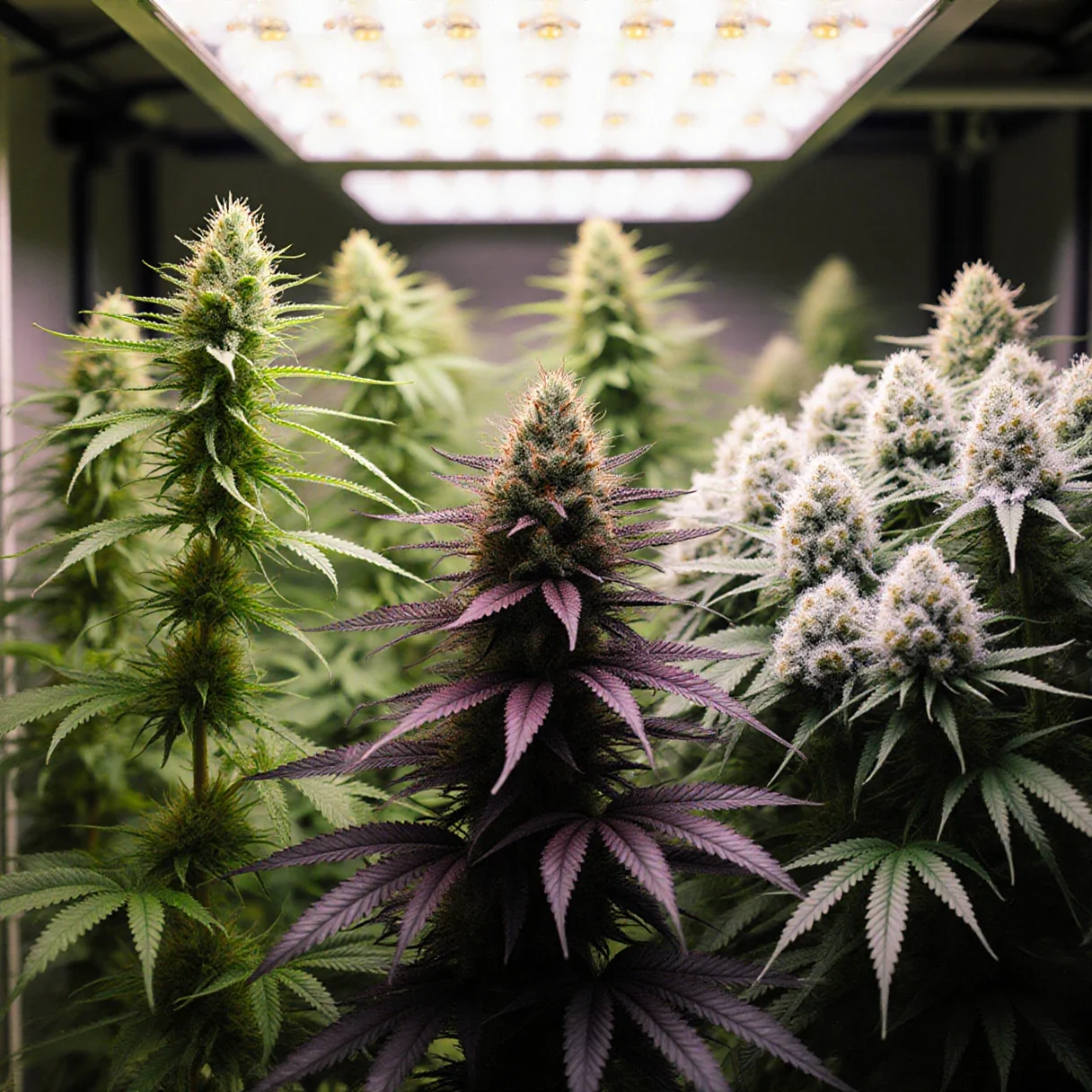
They can. A feminized seed can still grow into a cannabis hermie. Nothing makes seed hermie-proof, and anyone selling it that way is overselling. The Canadian Seed Growers’ Association’s guidelines for certified feminized hemp seed allow up to 5 plants with both flower types per 10,000 in a certified lot, and say outright that a lot with none “may, however, be practically impossible.” Utah State University Extension notes that plants from feminized seed have a greater chance of producing male and hermaphrodite plants than clones of a known female do.
Whether feminized seed herms more or less than regular seed hasn’t been tested — we found no study comparing them. Our autoflower vs feminized seeds and regular cannabis seeds guides cover what each seed type actually gets you.
What you can do is buy from people who select their lines over several generations and tell you how they were bred. Mac’s originals — Neptune’s Wedding, Blue Monkey Dick, Grape Skunk, Acapulco Gold Skunk and Freaky Queen, which took four generations of selection — were all built that way. Our F1–F4 explainer covers what those generations do. That’s selection for the traits on each strain’s page. We won’t tell you it makes them hermie-proof, because no study could back that up for any strain, ours included.
True autoflowers flower on their own clock. A Cornell study found plants carrying two copies of the autoflower gene flowered even under 24-hour light. So a light leak can’t stall an autoflower’s flowering the way it can a photoperiod plant’s — that’s our inference from how they work, and it’s why our autoflower light schedule post treats the dark period differently. Whether autos are less likely to become a cannabis hermie hasn’t been studied. If a sealed dark room is hard for you to manage, White Widow Autoflower or Mandarin Cookies Autoflower take the schedule out of the equation. Just don’t expect them to be immune.
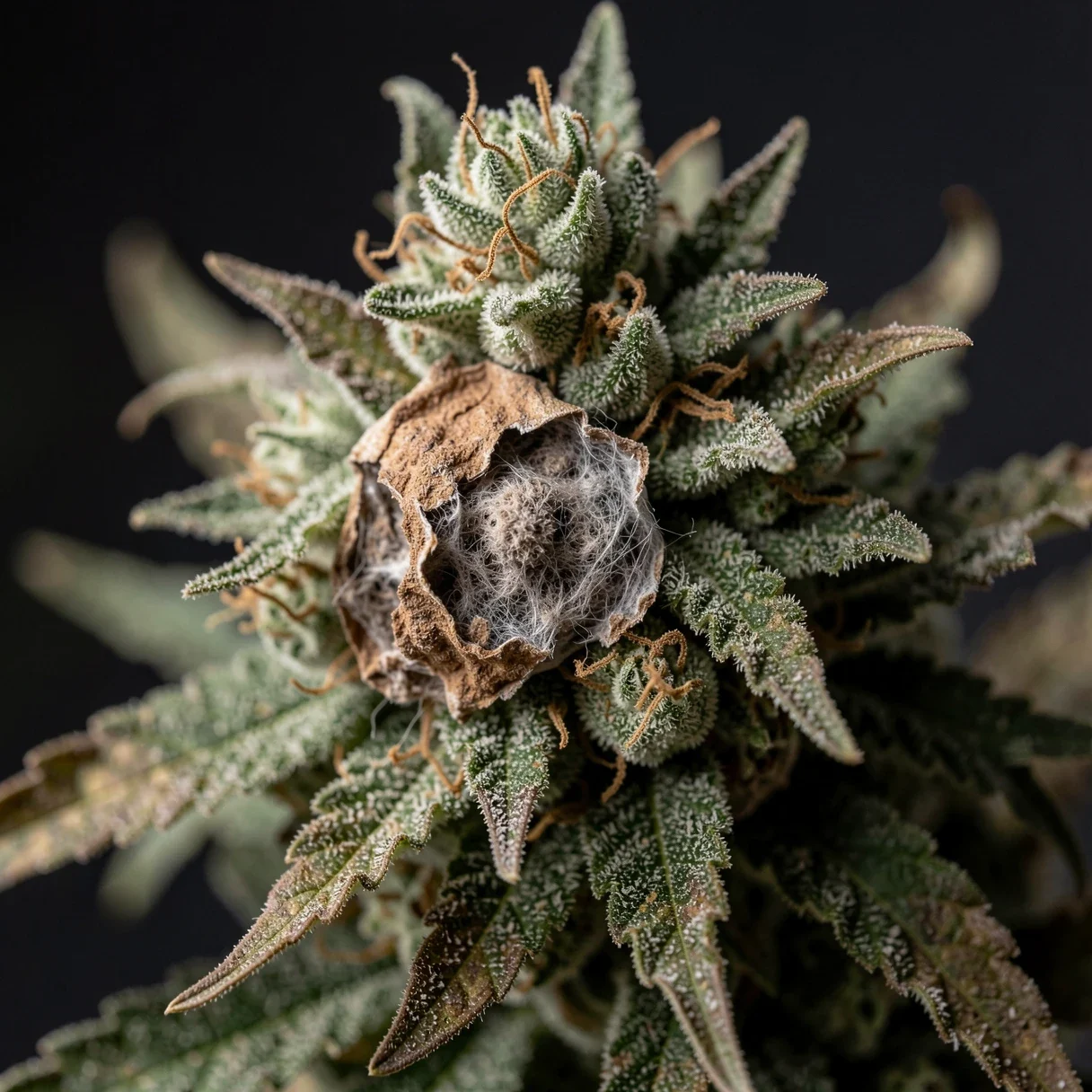
A cannabis hermie is not a cosmetic problem. In the BC study, pollen from hermaphrodite anthers germinated at 10–30% in the lab, and seeds formed inside the affected buds before harvest. Three seeded buds gave 34, 48 and 22 seeds, and 90–95% of those seeds sprouted.
There’s a little good news. A hermie releases far less pollen than a true male — in a 2023 study of one CBD hemp cultivar, true males produced 223% more total pollen than hermaphrodite plants. The BC researchers estimated herm pollen probably travels only a few metres (a few yards) indoors. The same BC authors caution, though, that a hermie probably seeds its own buds efficiently despite making less pollen, since its pollen doesn’t have to travel. And individual pollen grains don’t last: kept at 72°F (22°C), cannabis pollen stopped germinating within about two weeks. But a plant keeps opening new anthers, so the supply of fresh pollen keeps coming until you deal with it.
The real cost is what seeds do to the flower. In a 2021 study, flowers that were fully pollinated carried 60–75% less total cannabinoid than seedless flowers from the same clone. That was heavy, deliberate pollination in a closed chamber, so a few stray anthers won’t cost that much. It shows which way the damage goes.
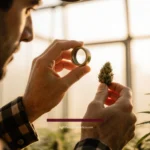
Finding a cannabis hermie early starts with looking properly. The BC researchers checked buds weekly with a hand lens, and Oregon State University Extension describes hemp farms scouting weekly and every three to four days as harvest gets close, because pollen is “most problematic near harvest when canopies are dense and female plants have many flowers.” Check inside the buds and low on the main stem.
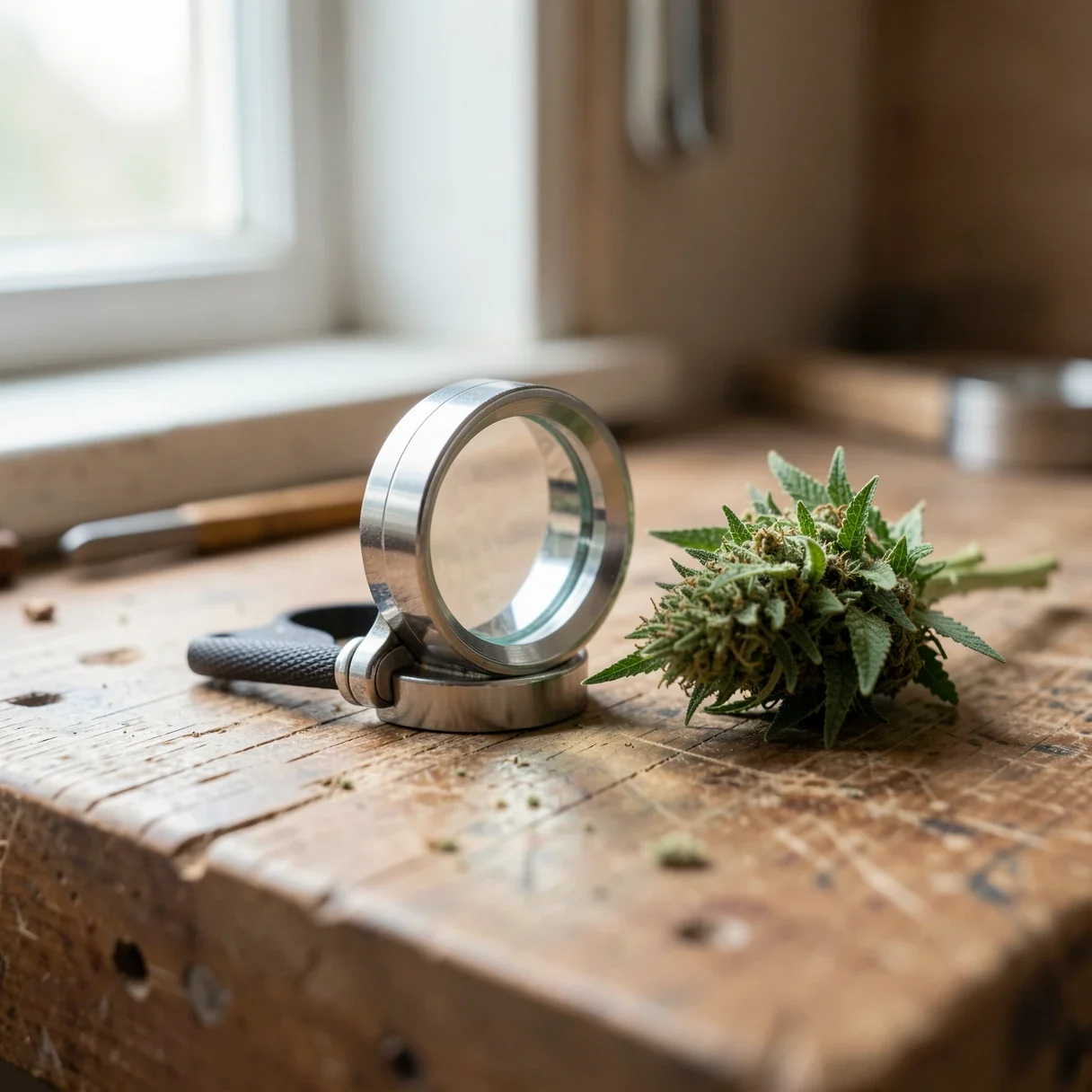
If a cannabis hermie is throwing male flowers or open anthers through its buds, remove it. Oregon State’s guidance for hemp farms is to cut the plant at the base, bag and seal it before carrying it out, and change gloves and clothing afterwards, because pollen moves on hands and clothing, not only on air.
If you find a handful of anthers late in flower on an otherwise good plant, a lot of growers pick them off with tweezers and keep a close eye on the plant. That’s grower practice, not something we found tested. Our call on a late cannabis hermie: with other plants in the room still weeks from harvest, the safe move is to pull it. If it’s alone, or the whole room is a week or two from harvest, picking off the anthers and watching closely is a reasonable gamble.
None of these is a guarantee, because no step has been shown to prevent hermies. They’re the cheap, sensible steps that fit what’s actually known.
Most of what you’ve heard about the cannabis hermie is grower lore that has never been tested, and the few tests that exist are small and mostly found nothing clear. What holds up is short. Genetics is where the variation shows up, a truly dark dark period keeps flowering on track, and a weekly look at your buds is what catches a problem early.
So spend your effort there: traceable seed, a sealed dark room, a timer you trust and a weekly scout with a loupe. For the rest of the season, our guides to growing cannabis cover each stage from seed to cure.
Shop Cannabis Seeds | Male vs Female Cannabis Plants | Growing Cannabis in Heat | Regular Cannabis Seeds
Yes. Canada’s seed certification guidelines for feminized hemp allow up to 5 plants with both flower types per 10,000, and say zero “may, however, be practically impossible.” No seed is hermie-proof.
Not proven either way. Light during the dark period clearly disrupts flowering, even at very low levels, but the one study that looked for a hermaphrodite link found none and couldn’t measure faint light well. Seal leaks anyway.
If the plant pollinated itself, genetically yes. In the BC study, seedlings from hermaphrodite seeds all tested female. Whether those plants go on to herm themselves wasn’t tested, and a stray male in the room could have pollinated some of them instead, so we wouldn’t grow them out for a crop.
Not automatically. A cannabis hermie makes much less pollen than a male, and anthers caught before they open haven’t shed anything yet. Left to shed for weeks in a shared room, it can seed the plants around it.
Keep reading
Browse all cannabis grow guides by topic, from germination to harvest.
Ready to grow? Browse premium seeds from Lighthouse Genetics:
Designed & Built by Wynne Web Design