Every cannabis grower wants stronger buds. But maximizing THC potency is not one thing — it is seven things working together, from the genetics you start with to the exact hour you cut the plant down. Miss any one of them and you leave potency, or harvest weight, on the table.
The difference between a disappointing harvest and a great one is rarely a single mistake. It is a stack of small decisions — light intensity, nutrient timing, environmental control, harvest window — that compound over the entire grow cycle. Get them all right and the plant does what its genetics allow. Get them wrong and the best genetics in the world will underperform.
Here is what actually moves the needle when you are focused on maximizing THC potency, with specific numbers and practical advice you can act on today.
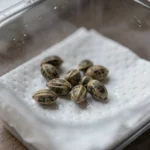
No amount of perfect lighting or precise nutrient schedules will push a 15% THC strain to 28%. Genetics set the ceiling: in controlled studies, more light, drought and other stresses did little or nothing to raise THC percentage, and the strain made the bigger difference. Everything else you do as a grower determines how close to that ceiling you actually get.
This is why strain selection is the single most important decision for maximizing THC potency. If you want high-THC flower, start with genetics bred for it.
Strains with proven high-THC potential from our catalog:
| Strain | THC Range | Type |
|---|---|---|
| Gorilla Glue #4 | 25–28% | Feminized |
| Godfather OG | 25–34% | Feminized |
| Bruce Banner | 24–29% | Feminized |
| Ghost Train | 25–28% | Feminized |
| Frosted Grape Shoes | 22–26% | Feminized |
| Alaskan Thunder Fuck | 18–24% | Feminized |
| Train Wreck | 18–25% | Feminized |
Most of these sit somewhere between the high teens and the low 30s. Treat any very high THC number with some caution, wherever you see it: when researchers re-tested retail cannabis in Colorado, about 70% of samples came in more than 15% below the THC on the label (Schwabe et al. 2023), and different labs can report different numbers for similar flower. Your own plants will vary from phenotype to phenotype and grow to grow. Health Canada notes that the average THC in dried cannabis is around 15% today, with some strains averaging as high as 30%, which is why understanding your genetics matters more than chasing headline numbers.
If you are not sure how to evaluate genetics before you buy, we cover that in detail: How to Choose Cannabis Seeds for Your Setup.
THC is made in the trichomes, and light is the engine that powers the whole plant. More light, up to a point, means more bud, and more bud means more total THC from your space. What it doesn’t do is raise the THC percentage: in two University of Guelph trials, brighter light grew heavier harvests but didn’t change cannabinoid concentration (Rodriguez-Morrison et al. 2021a; Llewellyn et al. 2022).
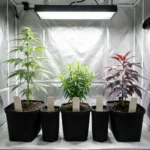
Target PPFD for flowering: 800–1,000 µmol/m²/s. Below about 600 you’re leaving weight, and with it total THC, on the table. Past roughly 1,000 in a typical tent without added CO2, many growers start to see bleaching and light stress. Most modern LED panels can hit this range — the key is measuring it with a PAR meter, not guessing based on wattage.
Spectrum matters less than most marketing suggests. A quality full-spectrum white LED is the usual choice for flower, and many growers run a warm white around 3000–3500K. In controlled trials on high-CBD medical hemp, changing the share of blue light didn’t change THC or CBD concentration (Westmoreland et al. 2021). Intensity is the bigger lever.
UV-B is a long shot. Some growers add UV-B bars in the last few weeks of flower, hoping they help with maximizing THC potency. The modern research doesn’t back it up: in University of Guelph trials, including UV added only in the final 20 days, UV didn’t raise THC (Llewellyn et al. 2022), and at higher doses it damaged plants and lowered THC in one strain (Rodriguez-Morrison et al. 2021b). We dig into the full story in does UV light increase THC. Spend that money on raw PPFD instead.
Light schedule: 12/12 is the standard flowering schedule for photoperiod strains, and it’s a safe default. It isn’t the only option: in a 2024 University of Guelph trial, a 13-hour day grew 35–50% more bud without lowering cannabinoid levels (Ahrens et al. 2024), but going much longer can backfire, and 14 hours of light cut THC concentration in two high-THC strains in an Australian study (Peterswald et al. 2023). We cover it in our 13-hour photoperiod breakdown.
Autoflowers: for strains like Gorilla Glue Autoflower, the timer doesn’t trigger flowering at all; 18/6 and 20/4 are both common, and there’s no good evidence that extra hours raise THC percentage. We explain the differences in Autoflower vs Feminized Seeds.
Cannabis makes THC in its trichomes, and scientists think the resin likely helps defend the plant, possibly against insects and UV, though its exact job is still being worked out. Stress isn’t a reliable shortcut to maximizing THC potency, either: most studies that stressed plants found little or no change in cannabinoids, and the one well-known positive result was a small bump from a single, carefully controlled dry-down (see our post on drought stress and THC).
When it comes to maximizing THC potency through nutrition, more is not better.
During flowering, plants still need phosphorus and potassium (PK). Most bloom formulas are already PK-heavy, but more isn’t better for potency. In Israeli trials on drug-type cannabis, raising phosphorus or potassium beyond modest levels actually lowered THC concentration in the buds, even as yield held up or rose (Shiponi & Bernstein 2021; Saloner & Bernstein 2022). If you use a PK booster, go light, and remember that overfeeding causes its own problems.
Don’t overdo nitrogen in flower. In a University of Guelph trial, bud yield peaked around 194 mg/L of nitrogen in the feed and dropped off above it (Bevan et al. 2021). We cover the numbers in how much nitrogen cannabis needs in flower. Very dark green, clawing leaves in flower are a common sign you’re giving too much.
Flushing in the final 1–2 weeks is popular but not proven. Many growers switch to plain pH-balanced water for the last 7–14 days, hoping for a cleaner smoke. In the one blind trial we know of, flushing made no difference to THC or terpenes, and the blind taste panel found no real difference either, with what preference there was leaning toward the unflushed buds (Rx Green Technologies). A light taper at the end is fine and saves money on nutrients, but it does nothing for maximizing THC potency. We dig into the evidence in should you flush before harvest.
Heat costs you potency. In a 2025 Wageningen University chamber study, flowering at 31°C (88°F) days and 27°C (81°F) nights lowered total cannabinoid levels compared with 25°C (77°F) days and 21°C (70°F) nights, including in a THC-dominant strain (Holweg et al. 2025). If you are growing in a hot room with no climate control, you are fighting your own environment; see growing cannabis in heat.
Flowering temperature targets:
Humidity in late flower: 40–50% RH. Above about 50% you raise the risk of bud rot (extension guides advise keeping greenhouse humidity below 50% to prevent grey mould, per the PNW Plant Disease Handbook), and dense, chunky colas on strains like Godfather OG or Bubba Kush are often the first to rot. In a damp basement or a humid summer, a dehumidifier in the flower room is often a must. Outdoors, cool, rainy September weather is prime bud-rot season; we cover climate strategies in Growing Cannabis Outdoors in Canada.
Airflow matters. Stagnant air around the canopy traps heat and moisture at the bud sites — exactly where you do not want it. Oscillating fans below and above the canopy keep air moving without blasting the tops directly.
Plants use CO2 for photosynthesis. More CO2 means more photosynthesis, which means more growth and more bud. But CO2 supplementation mainly pays off when light intensity is high enough for the plant to use it.
The math: Outdoor air now holds about 427 ppm of CO2. Raising it to roughly 1,000–1,200 ppm during flowering, paired with strong light, can meaningfully increase yield in a sealed room; in Utah State University research, 1,200 ppm raised yield by about 40% (Westmoreland 2024). Whether it raises THC percentage hasn’t been shown, so expect more bud rather than stronger bud.
If you are serious about maximizing THC potency from your space, meaning more total THC per harvest, CO2 is worth considering, but only after light, nutrients, and environment are already optimized. CO2 only makes sense in sealed grow rooms where you control the intake and exhaust. In a tent with a carbon filter exhausting constantly, you are just pumping CO2 straight out the vent. For a deeper look at CO2 strategy, read our full guide: CO2 for Cannabis — Increase Yield with Carbon Dioxide Supplementation.
This is where many growers lose potency. Harvest too early and the trichomes haven’t finished filling. Leave it too long and the trichomes start to break down: over-mature resin heads turn brown, and earlier research suggested they hold less THC (cited in Punja et al. 2023).
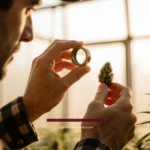
What to look for: Forget the pistils. Watch the trichomes. You need a jeweller’s loupe (30x–60x magnification) or a digital microscope aimed at the calyxes — not the sugar leaves, which mature faster and give a misleading read.
The harvest window for maximizing THC potency:
For a fast-finishing strain like Super Skunk that flowers in 6–7 weeks, the window is tight. Check trichomes daily starting around week 5. For longer-flowering sativas like Mexican Haze (9–11 weeks), you have more time, but the same principle applies — watch the trichomes, not the calendar.
You cannot increase THC after harvest. But you can lose quality fast. A rushed, hot dry strips terpenes, the compounds behind smell and flavour, and a damp, slow one invites mould. THC itself is sturdier, but light and air wear it down over months of storage (Fairbairn et al. 1976), and rough handling knocks trichomes off.
Drying: Hang whole plants or individual branches in a dark room at about 15–20°C (60–68°F) and 50–55% RH. Drying usually takes a week or two. If your buds are crispy in 3 days, the room is probably too warm or too dry, and if it was the heat, you have lost terpenes. Cool is the goal. Our drying temperature guide has the details.
Curing: Once small stems snap cleanly (not bend), trim and jar the buds in glass mason jars, filled about 75% full. Burp the jars once or twice a day for the first week or two, then every few days after that, for at least two weeks in total. Growers cure because it smooths the smoke and brings the aroma forward, and kept cool and dark, cured flower holds its THC well for a long time. More in how to cure cannabis.
A proper cure does not add THC, but it protects what you grew. Skip it and you get harsh, hay-smelling bud. When it comes to maximizing THC potency, the dry and cure are where careless growers give back what they earned during flower.
If maximizing THC potency is the primary goal, these are the strains we would start with. All are available in our catalog.
Best overall for potency: Bruce Banner Feminized — routinely tests between 24 and 29% THC, a sativa-dominant hybrid with remarkable resin production. Its potency ceiling is among the highest in our catalog.
Best indica for potency: Godfather OG Feminized — can reach 25–34% THC, an indica-dominant hybrid that produces dense, trichome-caked buds. Manageable plant size, 8–10 week flower. The “Don of all OGs” for a reason.
Best for beginners chasing potency: Gorilla Glue #4 Feminized — typically 25–28% THC, and one of the most forgiving high-THC strains to grow. Sturdy plants and massive resin. Your scissors will be glued shut by harvest.
Best Lighthouse Genetics original for potency: Frosted Grape Shoes Feminized — 22–26% THC, Mac’s original creation. Grape Skunk x Cement Shoes, bred through multi-generation selection for consistent trichome production and terpene expression. Cool-night flowering brings out deep purples under a frosty white trichome layer.
Browse the full selection: Feminized Cannabis Seeds | Autoflower Cannabis Seeds
Not necessarily. The biggest gains come from choosing high-THC genetics and nailing the harvest window — neither requires expensive gear. A quality LED, a jeweller’s loupe, and a hygrometer are the essentials. CO2 supplementation is a nice-to-have that adds yield once the basics are locked in, and UV-B lights haven’t been shown to raise THC.
Modern autoflowers can absolutely hit 20%+ THC. Strains like Gorilla Glue Autoflower and Apple Fritter Autoflower are bred from high-THC photoperiod parents, and our Apple Fritter Autoflower typically reaches 22–25% THC. The usual trade-off is yield: with a shorter, fixed life cycle, autos generally produce less than photoperiod plants. Their key advantage is speed: those two go from seed to harvest in about 10 to 12 weeks.
No. There’s no good evidence that flushing increases THC. In a controlled trial, flushed and unflushed plants tested the same for THC and terpenes, and blind tasters found no real difference in taste. Tapering nutrients near the end is fine and saves money, but skip the long flush if you’re doing it for potency.
12/12 is the standard for photoperiod strains in flower, though some research shows a 13-hour day can raise yield without lowering THC in some strains; see our 13-hour photoperiod post. For autoflowers, 18/6 or 20/4 are the usual choices, and there’s no good evidence that extra light hours raise THC percentage. We cover light schedules in depth: How to Grow Cannabis from Seeds.
Maximizing THC potency is not one technique — it is getting seven things right at the same time. Genetics give you the ceiling. Light and CO2 decide how much bud you grow; feeding, environment, harvest timing, and the dry and cure decide how much of that genetic potential survives to the jar.
Most growers who are disappointed with their potency are not doing anything dramatically wrong. They are just slightly off on two or three of these factors: overfeeding in flower, harvesting a few days early, drying too warm. Fix those and the same genetics will give you better flower.
Start with the right seeds. Dial in your environment. Watch your trichomes. Cure properly. The THC is already in the genetics — your job is to not leave it behind.
Best Autoflowers for Beginners | How to Choose Cannabis Seeds | CO2 for Cannabis | Maximizing Yield
Want to keep learning? Browse our full library of our cannabis growing guides — everything from germination to harvest, in one place.
Ready to grow? Browse premium seeds from Lighthouse Genetics:
Designed & Built by Wynne Web Design