Ask ten growers how to raise cannabis yield and you’ll get ten favourite tricks. Bloom boosters, defoliation, CO2 bags, a secret feeding schedule. Most of them move the scale a little. A few move it a lot. And a couple of the popular ones move it barely at all.
This guide ranks the levers by what the research says they’re worth. Where a controlled study put a number on one, you’ll see it, along with what kind of plant it was measured on, because most cannabis yield studies use a single cultivar, and many of those are high-CBD. Where nobody has measured a lever, we say so rather than invent a percentage. Each section is short and links to our full guide on that topic.
If you only read one section, read this one. Here’s the order we’d work in to raise cannabis yield:
The rest of the post explains each one, with the numbers behind it.
Light is the raw energy every gram of bud is built from, so it sets the upper limit on cannabis yield in any indoor grow, and cannabis can use far more of it than most tents deliver. In a University of Guelph trial, cannabis yield rose in a straight line from 116 to 519 g/m² (about 0.38 to 1.7 oz/ft²) as light intensity went from 120 to 1,800 µmol/m²/s, with no plateau in sight (Rodriguez-Morrison et al. 2021). Working from the paper’s endpoints, that comes to roughly 24 g/m² more for every extra 100 µmol of light. That’s our arithmetic, not a figure the authors give.
Two limits matter. The study used one CBD-dominant cultivar in ordinary room air, and potency didn’t change with light. So more light meant more bud at the same strength, not stronger bud. That trade still favours the grower: more grams at the same potency is more total cannabinoid per harvest.
In practice, aim for 800–1,000 PPFD across the canopy in flower before you spend money on anything else on this list. A cheap PAR reading at the corners usually shows why yields disappoint. Our cannabis light intensity guide covers the targets by stage, and how to check your own.
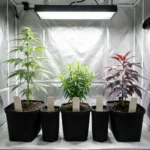
No technique pushes a plant past what its genes allow, which makes strain choice the cheapest cannabis yield decision you’ll make. In Belgian trials run for the national science policy office, four strains grown in the same room, under the same 600 W lamps and the same feed, produced anywhere from 517 to 843 g/m² (about 1.7 to 2.8 oz/ft²) (YILCAN synthesis, Vanhove 2011). The best out-yielded the worst by about 1.6 times, on choice of strain alone.
Rankings shift between line-ups, though. In the project’s first trial, Big Bud and Super Skunk out-yielded White Widow and a Northern Light × Haze cross. In the later trial that produced the 517–843 g/m² spread, Big Bud came last of the four, behind Silver Haze #9. Strain choice matters a lot, but no single name wins every room. We carry Sensi Seeds’ Big Bud (rated 500–600 g/m² indoors in our catalog) and Super Skunk (450–500 g/m²). Among the heaviest-rated strains we carry, White Rhino is rated 700–900 g/m² and Great White Shark 500–800 g/m². Mac’s own Neptune’s Wedding is rated 500–650 g/m² indoors.
Catalog ratings are breeder potentials under good conditions, not trial results. Treat them as a ranking, not a promise. Our high-yield cannabis strains list compares the heavy producers we carry side by side.
Here’s the part most yield advice gets backwards. Cannabis yield per plant and yield per square metre are different things, and only the second one fills your jars from a fixed tent.
The density studies we found agree on one point: more plants in the same space means less bud on each plant.
Per square metre, the studies don’t fully agree. In the Belgian trials, running 9 to 20 plants per m² made no difference at all to g/m². The extra plants just split the same light. At very low density, more plants clearly help: going from one to two big plants per m² raised yield per area by 28–44% in most treatments of an Israeli greenhouse study (Danziger & Bernstein 2022).
A German greenhouse trial with one CBD cultivar under fairly low light found a different result from the Belgian trials: area yield rose from 119 to 247 g/m² as density went from 12 to 36 plants per m². Lengthening veg from one week to four took the same cultivar from 295 to 571 g/m² (Schober et al. 2024).
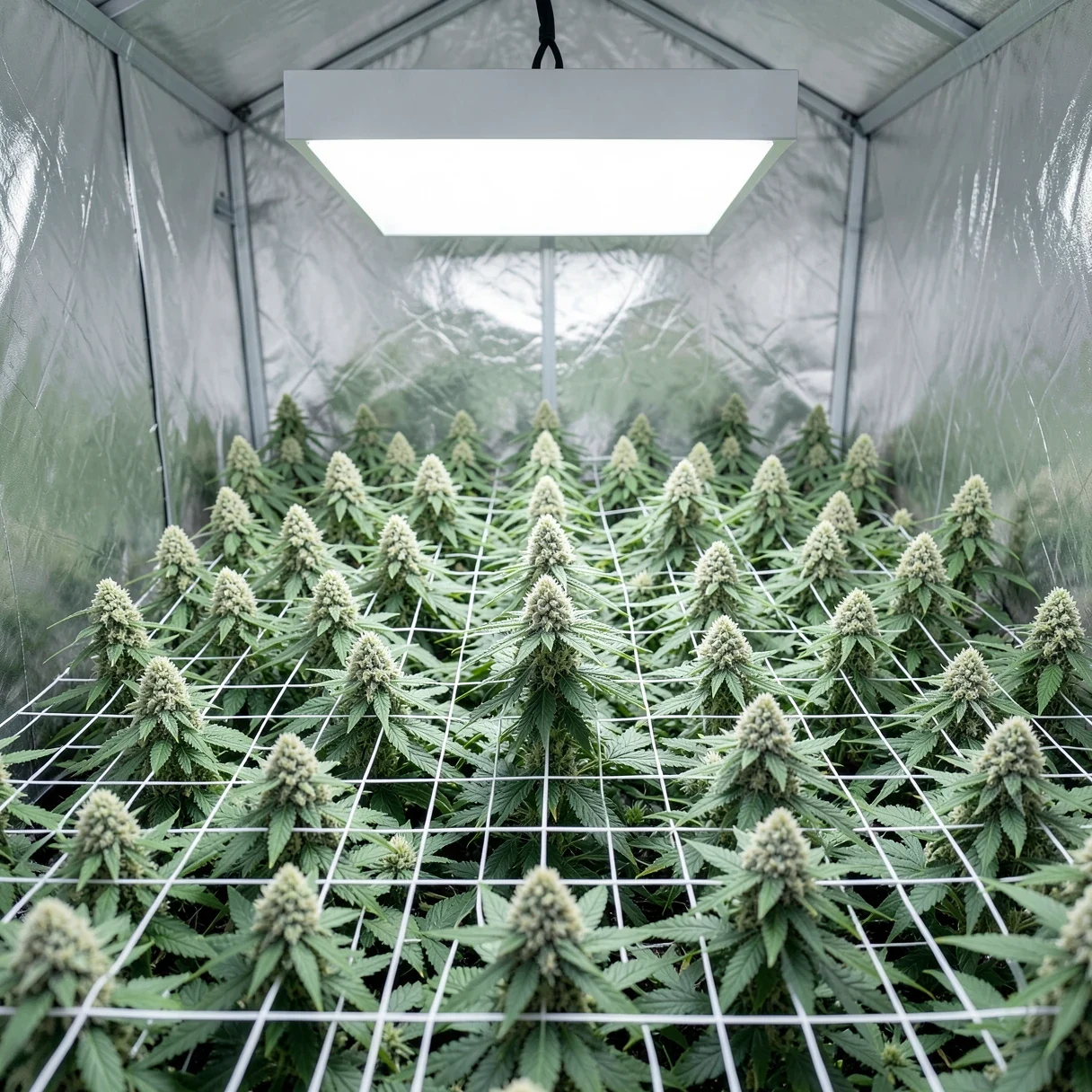
So the research doesn’t hand you a magic plant count. What every study supports is a flat, full canopy at the right distance from the light. You can get there with more plants and a short veg, or fewer plants with a longer veg and training. Pick whichever suits your space and your patience. A ScrOG screen is the most reliable way to fill a tent with one or two plants.
On feeding, running short costs far more cannabis yield than overdoing it gains. A Guelph study grew a THC-dominant cultivar hydroponically with one nutrient removed at a time. Every deficiency except iron and manganese cut flower yield by 33–72% (Llewellyn et al. 2023). Nitrogen and phosphorus shortages were the worst.
The other half of the story is just as useful. A Utah State team raised phosphorus from 15 to 90 mg/L, and in the same trial doubled the whole nutrient strength from an EC of 2 to 4 mS/cm. Neither raised cannabis yield or quality (Hershkowitz et al. 2025). That’s a hard result for the bloom-booster aisle. Extra phosphorus in flower is the whole pitch, and in that trial it bought nothing.
The practical rule: keep pH in range so the plant can actually take up what you give it, catch deficiencies early, and don’t chase heavier feeds. Our nutrient deficiency guide shows how to tell a true deficiency from pH lockout, which is the more common culprit.
Temperature and humidity rarely add cannabis yield on their own. What they do is take it away, fast. In a study led from Colorado State University–Pueblo on one CBD-dominant cultivar, a room held at 78–98% relative humidity cut flower weight by about 71% and delayed flowering by three weeks, compared with plants at 37–58% (Corredor-Perilla et al. 2025). That’s an extreme, near-saturated room, not a typical tent. But it shows how much a wet room can cost before bud rot even enters the picture.
Hold a lights-on temperature of roughly 21–27°C (70–80°F) and steer humidity by VPD rather than by gut. Our VPD guide has the ranges by stage. We found no study that measured a cannabis yield gain from hitting a VPD target, so think of it as insurance, not a booster.
The root zone works the same way. Warm, airless roots invite rot, and rot wipes out a crop. Root-zone temperature control has raised yields in lettuce and peppers, but nobody has measured it in cannabis yet. Our root zone temperature guide covers what is known.
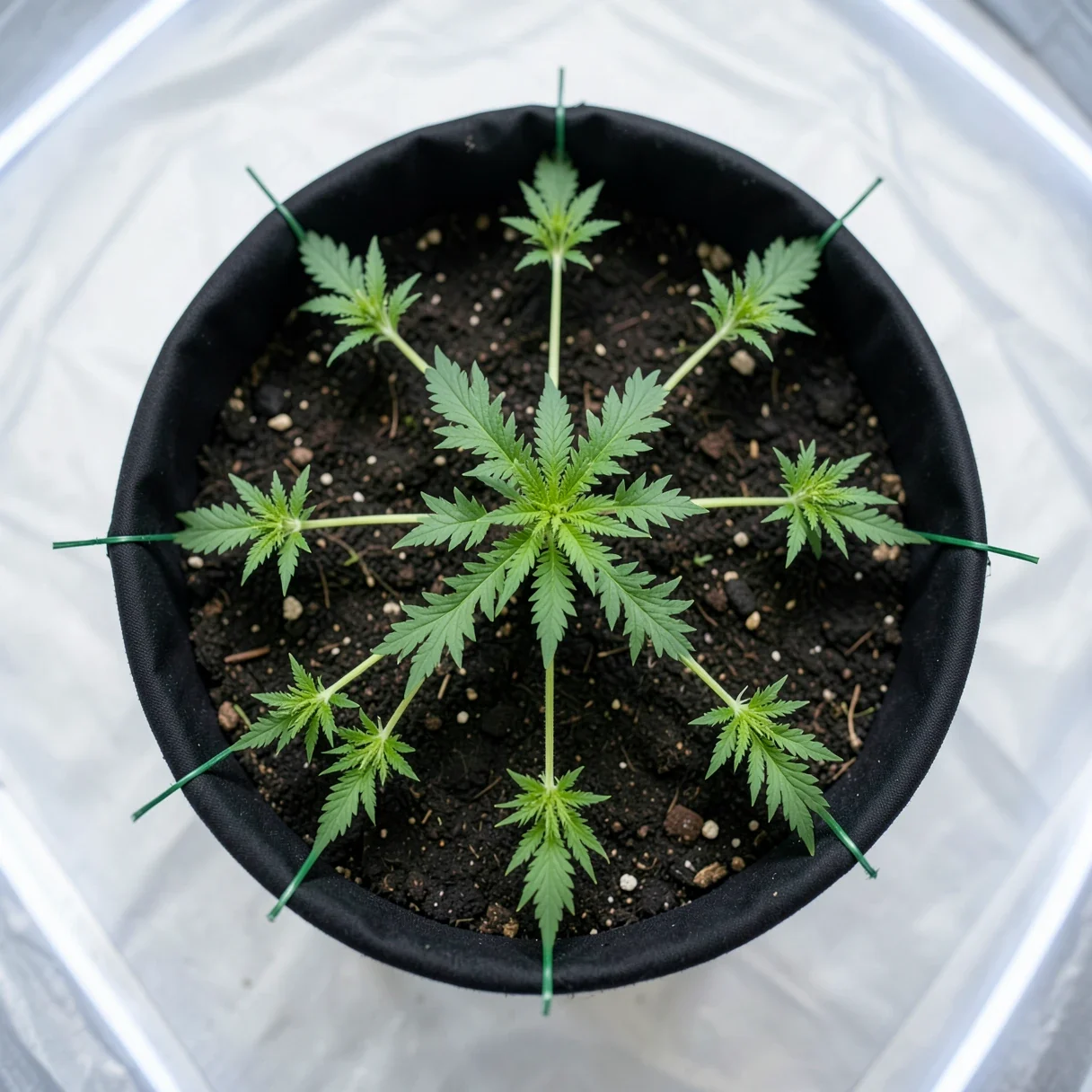
The old version of this page promised that training adds “up to 30%”. We couldn’t find a study behind that number, so it’s gone. Here’s what the trials actually measured:
Training earns its place in cannabis yield by filling the canopy and evening it out, so more bud sites sit in strong light. That links it straight back to the canopy section above. For the how-to, see topping vs FIMming and our low stress training guide. Strip leaves for airflow if you need to, not for weight. Our defoliation post covers when it helps.
Buds keep putting on weight late in flower. In the German topping study, average dry flower per plant climbed from 7.7 g (about 0.27 oz) at week five of flowering to 25.1 g (about 0.89 oz) at week eleven, while CBD concentration stayed flat (Crispim Massuela et al. 2022). That’s one CBD genotype on its own timeline, so the exact weeks won’t transfer to your strain. The direction will. Pulling early to get a harvest in the jar is one of the quietest ways to lose cannabis yield.
Judge ripeness by the trichomes and the strain’s expected flowering time, not the calendar alone. Our guide on when to harvest cannabis walks through what to look for under a loupe.
CO2 can add a big chunk of cannabis yield, but only at the end of the list. Raising it to 1,200 ppm increased yield by about 40% in high-CBD plants, according to a Utah State PhD dissertation (the abstract is all that’s public). It’s a real effect, but it comes with conditions. It only pays off once light is already strong. The room has to be sealed, because a tent exhausting through a carbon filter vents the gas as fast as you add it. And the public summary doesn’t report what it did to potency.
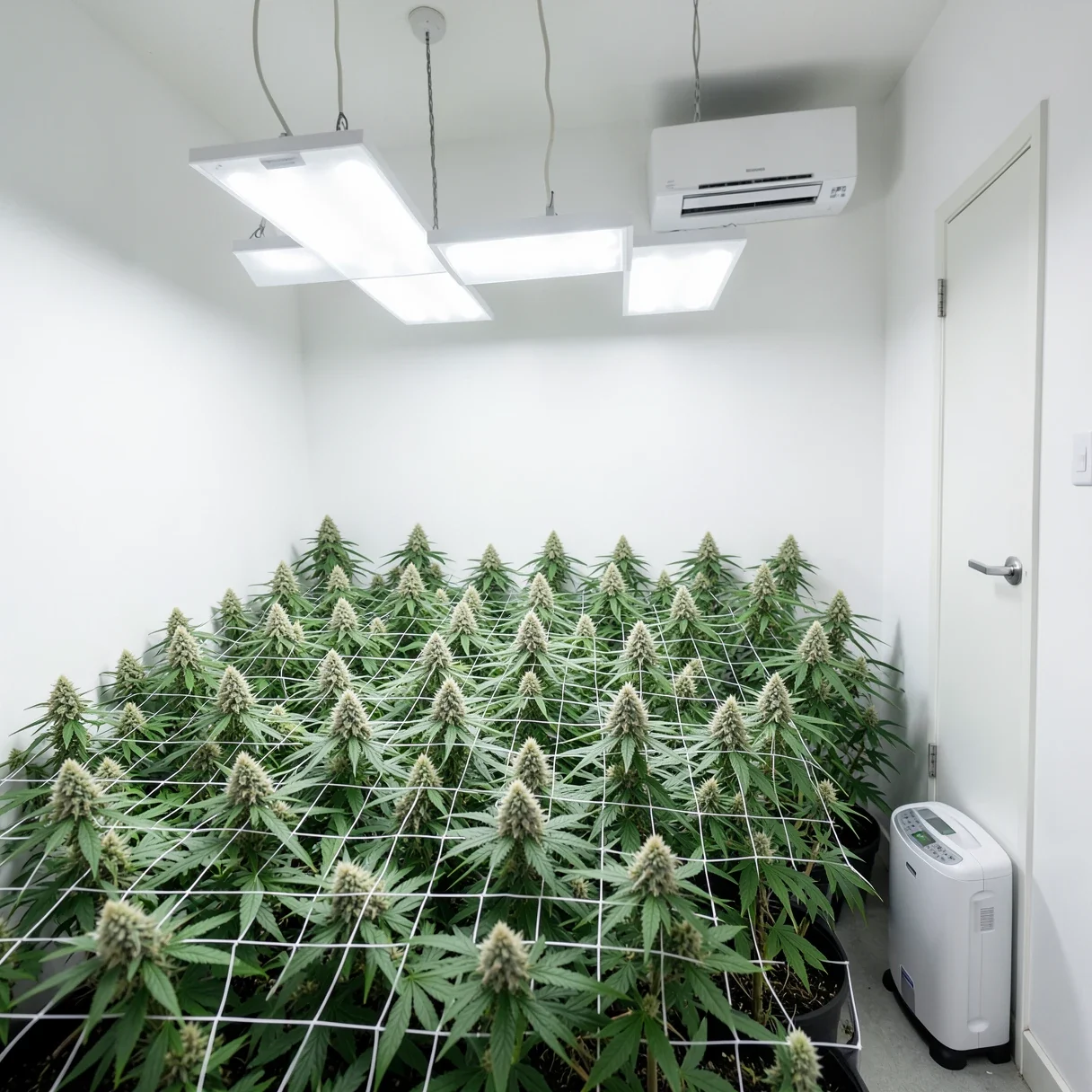
If you have a sealed room and the light to match, our CO2 for cannabis guide covers target levels, the equipment and the safety limits. If you’re in a tent, put the money into light first.
| Lever | What the research measured | Cost to fix |
|---|---|---|
| Light | 116 → 519 g/m² as PPFD rose 120 → 1,800 | Medium to high |
| Genetics | 517–843 g/m² across strains, same room | Low |
| Canopy fill | +28–44% per m² going from 1 to 2 big plants | Low |
| Deficiency | −33% to −72% flower yield | Low |
| Extra feed | No gain from doubling EC or raising P | Saves money |
| Humidity | About −71% flower weight at 78–98% RH | Medium |
| Topping | About +13.5% per m² | Free |
| Defoliation | No significant change | Free |
| Harvest timing | 7.7 → 25.1 g/plant from week 5 to 11 | Free (patience) |
| CO2 | About +40% at 1,200 ppm (high-CBD plants) | High (needs a sealed room) |
Each cannabis yield number in the table comes from a different study, with different plants and conditions, so don’t add them up. The table shows which levers are big and which are small, not what your own grow will get.
Add light, if your canopy is under about 800 PPFD in flower. It’s the biggest measured cannabis yield lever. In the Guelph trial, yield rose in a straight line with light up to 1,800 µmol/m²/s. For most tents, a stronger fixture or a lower hanging height is the single biggest upgrade.
We found no evidence they do. A Utah State trial raised phosphorus from 15 to 90 mg/L and saw no difference in yield or quality. Feed enough to avoid deficiencies and skip the boosters.
Not in the one controlled trial we found. Defoliation made lower buds more even in potency but didn’t significantly change total yield. Pruning twice did raise yield in that study, and removing all the main side branches cut it badly.
Enough to fill the canopy. Between about 9 and 20 plants per m² (roughly 1 to 2 per square foot), yield per m² didn’t change in the Belgian trials. Fewer, larger plants work too if you veg longer and train them to fill the space.
Usually, per plant, because autos can’t be vegged longer to fill space. Plant more of them per square metre to make up for it. Our catalog ratings for each strain are on the product pages.
Not in the Guelph light trial. Potency stayed flat while yield rose, so more light meant more bud at the same strength. That still means more total cannabinoids per harvest.
Big harvests come from the boring levers: strong light, heavy-yielding genetics, a canopy with no empty floor, and plants that are never short of food or stuck in a wet room. Training and CO2 are worth having, but they come after those. Most of the things sold as yield boosters sit at the bottom of the list or aren’t on it at all. Get light and genetics right first and your cannabis yield will show it at harvest. For the full set of topics, browse our guides to growing cannabis.
Shop cannabis seeds | High-yield cannabis strains | Cannabis light intensity guide
Want to keep learning? Browse our full library of cannabis grow guides — everything from germination to harvest, in one place.
Ready to grow? Browse premium seeds from Lighthouse Genetics:
Designed & Built by Wynne Web Design