A screen does not make light. It only decides which bud sites get to stand in the light you already paid for. That is the whole idea behind SCROG cannabis growing, and it is worth saying plainly up front, because most of what gets written about screens implies the net itself is doing something magic.
It isn’t. The net is a jig. You are the one moving the plant.
This post is about canopy-level training — the screen, the net, the number of plants you put under a light. The per-plant cuts and bends live elsewhere on this site and I’ll point you at them as we go. What I want to do here is give you the honest version: what the research actually supports about SCROG cannabis canopies and plant density, what nobody has tested, and how to run a screen without wrecking your grow in week four.
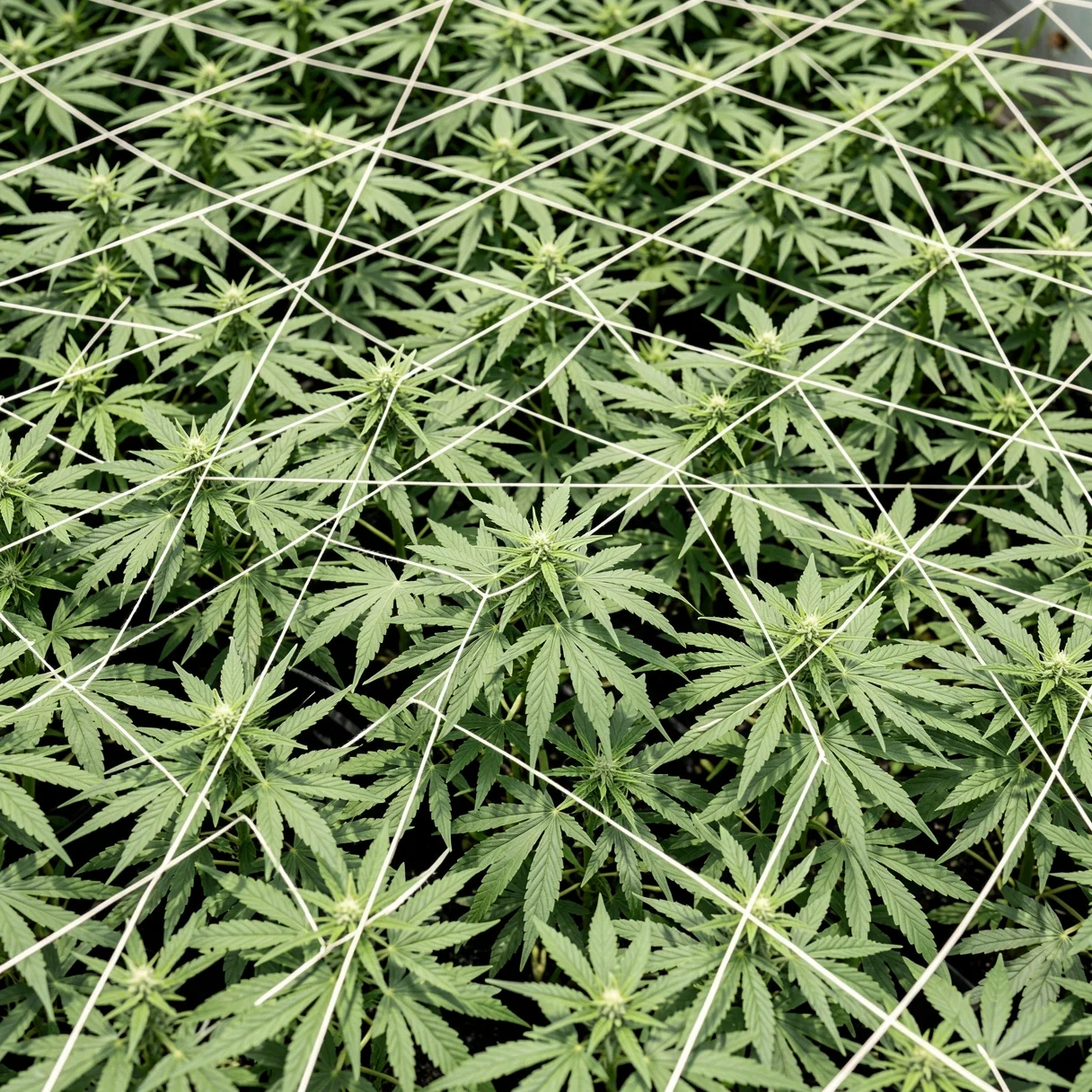
SCROG is short for Screen of Green. You stretch a net — usually 5 cm (2 inch) squares — horizontally over your pots, and as the plant grows up through it you tuck the shoots sideways under the mesh instead of letting them climb. Branches that would have become a tall centre cola with a stack of shaded runts underneath get spread out flat, each one occupying its own square, each one ending up at roughly the same height.
Why does that matter for a SCROG cannabis grow? Because the difference between the top of a cannabis plant and the bottom of it is much bigger than most growers assume.
Danziger and Bernstein measured it. In a 2022 greenhouse trial published in Frontiers in Plant Science, they sampled inflorescences from five locations on each plant and found that cannabinoid concentrations in the axillary inflorescences at the bottom of the plant were up to 90% lower than in the apical inflorescence at the top. In their untouched control plants, moving from one plant per square metre to two knocked all six detected cannabinoids at the bottom of the plant down by 71–76%. They attribute the drop to light not getting through the canopy, and they measured light penetration to confirm it.
One caveat that matters, and I’d rather give it to you than bury it: their model plant was a type III cultivar — high CBD at 8–16%, THC under 1%. It is not a high-THC drug-type plant. So read that 90% figure as what it is, a light-distribution result, not a potency promise about the strains you’re likely growing.
Still, the shape of the finding is the case for a screen. The lower a bud site sits, the less it is worth. A SCROG cannabis setup doesn’t create new bud sites. It relocates existing ones into the top layer where the light is.
Here is the part the grow guides skip.
There is exactly one peer-reviewed ScrOG grow study we could find, and it has no comparison group. New Zealand’s Crown forensic science institute ran three cycles of six plants under a screen, published in 2010, to work out what a typical indoor hydroponic operation actually produces. It reported an average of 687 g (24 oz) of dry flower per plant across the 18 plants.
Do not read that as what a screen gets you: it is a forensic yield estimate from a grow deliberately set up to mimic the hydroponic operations commonly encountered by New Zealand Police, the authors call their own numbers conservative because the growers hit problems in all three cycles, and since every plant in the study was screened, nothing in it isolates what the net contributed. Nothing was grown alongside them without one.
So we could not find a controlled trial that grew cannabis with a screen and without one and compared the yields — which is the comparison you’d actually want. The rest of the evidence for SCROG cannabis training is indirect: we know light falls off sharply through a canopy, we know lower buds are chemically poorer, and we know from the same research group’s 2021 work that deliberately reshaping a plant changes how uniform its flower is. Stringing those together into “a screen raises yield” is a reasonable inference. It is not a measured one, and any SCROG cannabis yield percentage you’re quoted is unsupported by any controlled comparison.
That is not a reason to skip a SCROG cannabis screen. It is a reason to be honest about what you’re buying: a more even canopy, more usable flower per plant, and far fewer larf-grade popcorn buds at trim time. If you want the measured evidence on leaf removal specifically, we went through it in does defoliation actually increase cannabis yield.
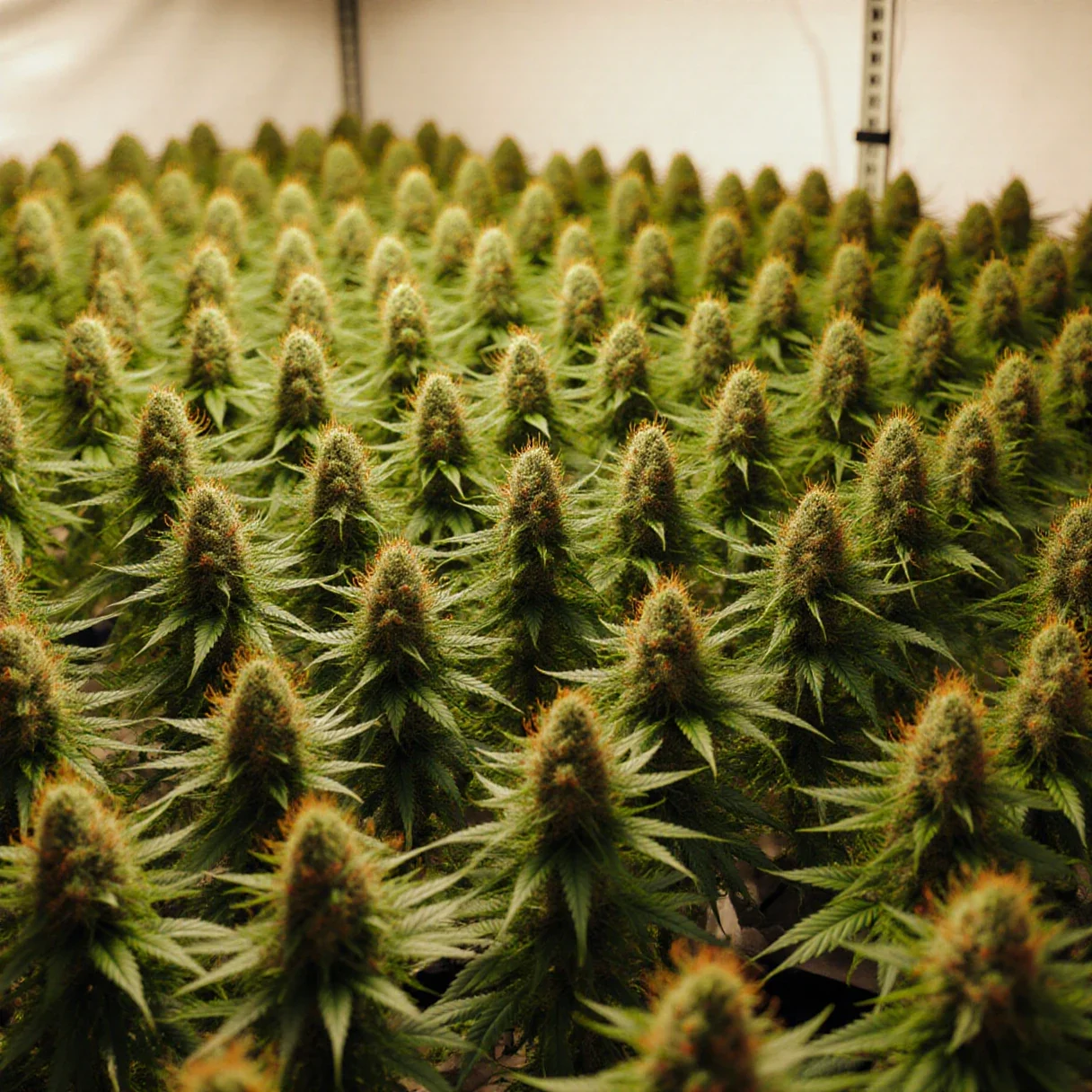
Sea of Green, or SOG, solves the same problem from the other direction. Instead of training one plant to fill a square metre the way a SCROG cannabis screen does, you put several small plants in that square metre, veg them barely at all, and flip. Each plant gives you one main cola. The flat canopy comes from plant count rather than plant training.
It is genuinely faster. A SOG run can be flipped after one to two weeks of veg, which pulls weeks off the calendar compared to filling a screen. If you’re running back-to-back cycles, that is real money.
What it does not reliably buy you is more weight per square metre — and this is where the research gets interesting.
The same 2022 trial found that doubling density from one to two plants per square metre reduced yield per plant but increased yield per area by 28–44% in most treatments. Good news for SOG. But in the same paper, cannabinoid yield per cultivation area — the milligrams of active compound coming off each square metre — was not affected by density or by architecture treatment. More bulk. Not more of the thing the bulk is for.
Then there’s the wider literature. Backer and colleagues pooled what published cannabis yield data they could use in a 2019 meta-analysis in Frontiers in Plant Science — only three studies cleared their bar, because nothing else reported growing conditions in enough detail — and found that increasing plant density reduced yield per watt and THC per square metre, and that plant density “was not an effective predictor of yield per square meter.” Their conclusion recommends low density — 12 plants per square metre or fewer — for yield per square metre and per watt.
The authors are careful about one thing, and so should we be: in their dataset, density was so tightly correlated with maximum growing temperature and with the length of the vegetative photoperiod that the three effects cannot be separated. So this isn’t proof that crowding plants hurts. It’s a fair warning that the density lever is not the free money it looks like.
Worth noting that a home-scale SOG of four or five plants per square metre is still comfortably inside the low-density band that meta-analysis recommends — the number it lands on is 12 per square metre or fewer, so four in a tent is not what it is warning about.
My read, and it is a read rather than a finding: SOG buys you speed and simplicity. SCROG cannabis training buys you better flower off fewer plants. Neither one conjures grams out of nothing.
| SCROG | Sea of Green | |
|---|---|---|
| Plants per m² | 1–2 | 4 or more |
| Veg length | 4–8 weeks | 1–2 weeks |
| Seeds needed | Few | Many |
| Best seed type | Stretchy photoperiod | Compact photoperiod or auto |
| Main cost | Your time, weekly | Seed spend, every cycle |
| Fails when | You flip too late | Airflow dies in the crowd |
Legal plant limits usually settle this argument before horticulture gets a say. Canada allows four plants per household, with Quebec the one province that still bans home growing outright; US limits vary by state and are commonly around six. If you’re capped at four plants, SOG’s throughput advantage largely disappears — you can’t run enough plants to get it — and a SCROG cannabis screen is the obvious answer. We broke the plant-count maths down in how many cannabis seeds should you buy.
Too low and you’re weaving seedlings that have no side branches yet. Too high and the plant builds a tall bare stem under the net that does nothing for you. Twenty to thirty centimetres above the top of the pot is the range most growers settle on, and it gives you room to get a hand underneath.
This is the rule people break, and the advice you’ll find is all over the place — plenty of guides say wait until the net is nearly full, and none of it is research-backed either way. Err low.
Here is the arithmetic behind that. Cannabis puts on roughly 1.5–2× its height after the flip if it’s a balanced hybrid, and 2–3× if it leans sativa, and every centimetre of that stretch goes into filling the rest of your net.
Flip a full SCROG cannabis screen and that new growth has nowhere to go but up — there are no empty squares left to tuck it into — and by the end of week three Rule 4 closes the window for good. Wait until the screen is packed before flipping and you’ll spend week three fighting a canopy sitting 30 cm (12 inches) above the mesh. We covered the timing and the size of the jump in the cannabis flowering stretch.
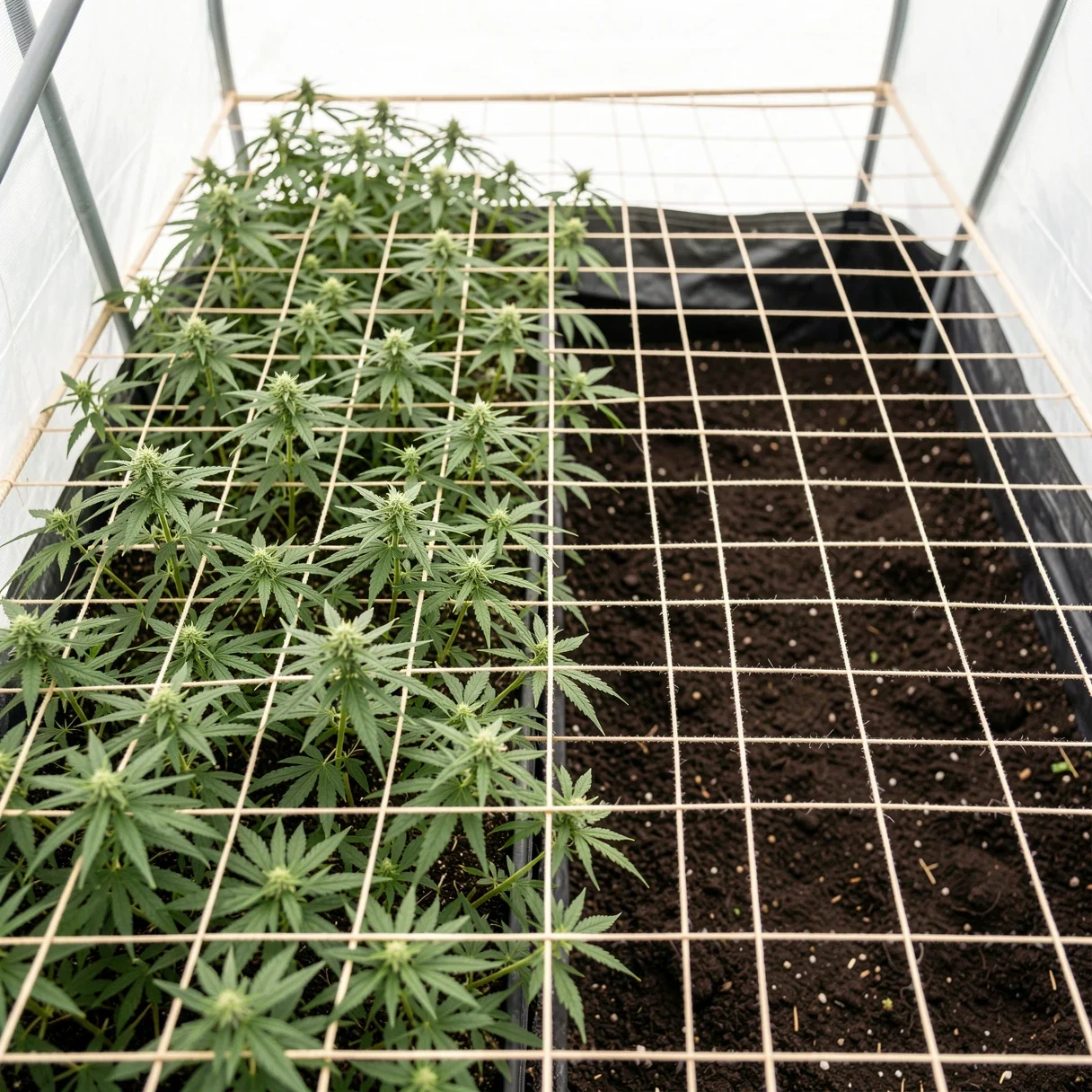
Take each growing tip and tuck it under the mesh into the next empty square, so the plant is held down by the net rather than by string. Do it every two or three days during veg — soft green growth bends without complaint, woody stems snap. This is low stress training applied to a whole canopy, and it is most of the week-to-week work in a SCROG cannabis grow, and the technique itself is covered properly in low stress training cannabis. The free green 90° clips that ship with most Lighthouse orders work well for the first few bends before the screen takes over.
Once the stretch finishes — usually around week three of flower — the shoots are setting flower and the stems are stiffening. Keep pushing them around and you’re breaking branches for no gain. Let the canopy do what it’s going to do.
Anything below the net in a SCROG cannabis canopy is in permanent shade and will produce larf. Strip it. This one has direct support for the quality half of it — the same paper found no change in cannabinoid yield per square metre, so this is about what the flower you keep is worth rather than about total output. In the 2022 density trial, every treatment except one lost cannabinoid concentration in its low inflorescences when density doubled. The exception was the treatment that stripped leaves, branches and flowers off the bottom of the plant: those low inflorescences came out 25–90% higher at the crowded density than at the sparse one. Cleaning out the basement isn’t just tidiness.
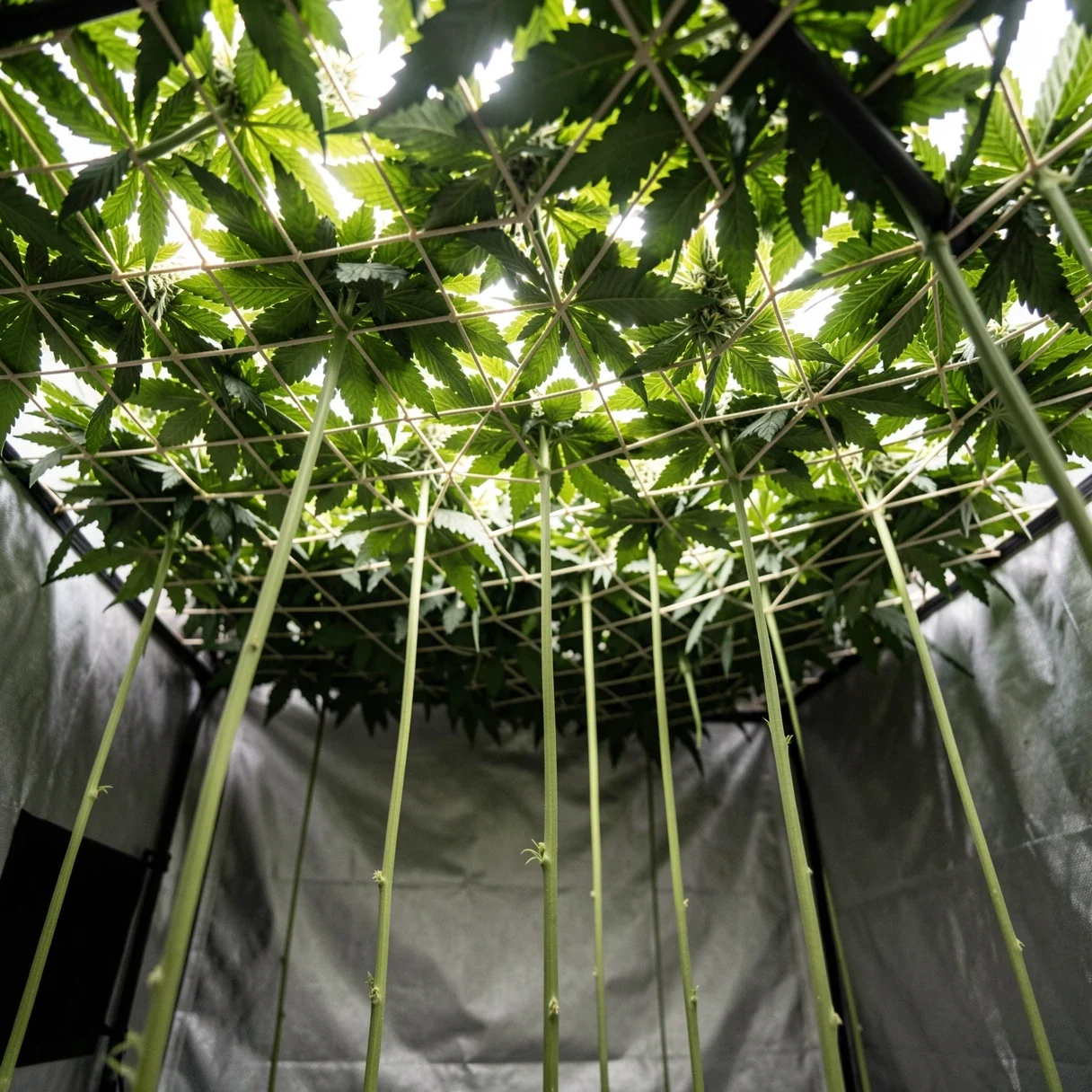
One vigorous photoperiod plant will fill a 1 m × 1 m (3 ft × 3 ft) SCROG cannabis screen if you give it six to eight weeks of veg. Two will do it faster. Four will do it faster still and then fight each other for root space and airflow, which is how bud rot gets started in a dense canopy — see cannabis bud rot for what that looks like before it’s too late.
An autoflower runs on a fixed clock. It will start flowering whether or not your screen is full, so you can’t extend veg to finish the job, and a plant that’s 70 cm (28 inches) tall at harvest was never going to fill a metre of mesh anyway. Gentle bending on a young auto is fine. A SCROG cannabis screen is not. The height ranges and why they’re fixed are in autoflower plant height.
Seed choice decides half of this before you unroll a net.
A SCROG cannabis screen wants a plant that stretches and branches — the kind that would otherwise give you one enormous cola and a lot of shaded understory. Durban Poison is listed at 90–400 cm (3–13 feet), a pure sativa that is genuinely difficult to grow indoors without something holding it down. Super Skunk Silver Haze runs taller still at a listed ceiling of 450 cm (15 feet).
For something easier to live with, Blue Dream at 150–180 cm (59–71 inches) and 500–650 g/m² indoors is about as good a first screen plant as we stock, and Gorilla Glue #4 at 120–200 cm (47–79 inches) takes training well. Train Wreck and White Amnesia Haze both stretch hard enough to be worth netting.
Sea of Green wants the opposite plant: short, fast, one dominant cola, minimal side growth to waste energy on. White Widow Autoflower at 50–80 cm (20–31 inches) is about as compact as we carry. Mandarin Cookies Autoflower stays under 100 cm (39 inches) and finishes in 7–8 weeks of flower, and Kush XL Autoflower runs 60–100 cm (24–39 inches) on a similar clock. If you’d rather keep photoperiod control and still run tight, Bubba Kush tops out around 100 cm (39 inches) and Blackberry Kush sits at 60–100 cm (24–39 inches).
Browse the full feminized cannabis seeds and autoflower cannabis seeds ranges if you want to filter by height yourself — the listed plant height on every product page is the number that matters here.
Probably, but no controlled cannabis trial we could find has measured it. What is measured is the light gradient a screen is meant to fix: bottom inflorescences carrying dramatically lower cannabinoid concentrations than the top of the same plant. A SCROG cannabis canopy attacks that gradient. Expect better quality per plant and less popcorn, and treat any specific percentage you read as unsupported.
One or two per square metre for a SCROG cannabis grow. A single healthy photoperiod plant will fill a 1 m × 1 m (3 ft × 3 ft) net given six to eight weeks of veg. Adding plants shortens veg but crowds the root zone, and the density research doesn’t support the idea that more plants automatically means more weight per square metre.
Not usefully. The fixed clock means you cannot hold veg long enough to fill a screen, and most autos finish too short to reach one anyway. Use gentle bending instead while the plant is young.
Around 5 cm (2 inch) squares is the grower convention, and it works because it’s roughly the width of a hand’s worth of shoot spacing. Nothing peer-reviewed sets this number — it’s practice, not research.
No. Most people do both: top once or twice in early veg to get multiple mains, then use the screen to spread those mains out. The two techniques answer different questions, and the cutting side is covered in topping cannabis vs FIMming.
If you’re limited to a handful of plants — which most legal home growers are — the screen is the better tool. SOG’s advantage is throughput, and throughput only pays if you’re allowed to run enough plants to get it.
But keep the claim modest. A SCROG cannabis canopy does not manufacture yield. It takes the light you already bought and stops wasting most of it on buds that were never going to be worth trimming. On that narrower claim the research is on your side, and that is enough reason to string a net.
Start with a plant that wants to stretch, hang the screen low, and flip earlier than feels right.
Shop Feminized Seeds | Low Stress Training Cannabis | Maximizing Yield in Cannabis | More cannabis growing guides
Want to keep learning? Browse our full library of guides to growing cannabis — everything from germination to harvest, in one place.
Ready to grow? Browse premium seeds from Lighthouse Genetics:
Designed & Built by Wynne Web Design