You flip the lights to 12/12 expecting buds. What you get instead is three weeks of a plant that seems to have forgotten the plan entirely — internodes pulling apart, the main stem climbing, side branches reaching for the ceiling. That’s the cannabis flowering stretch, and it is the single most under-planned phase of an indoor grow. Growers who lose a crop to burnt tops usually didn’t lose it in week eight. They lost it the day they flipped.
The cannabis flowering stretch is not a problem to be fixed. It’s the plant building the frame that will hold your harvest. What ruins grows is being surprised by it — flipping a plant that’s already half the height of the tent, or waiting until the colas are two inches from the diode before doing anything about it.
Photoperiod cannabis is a short-day plant. Long uninterrupted nights tell it that summer is ending, and it switches from making leaves to making flowers. But the switch isn’t instant, and it isn’t clean.
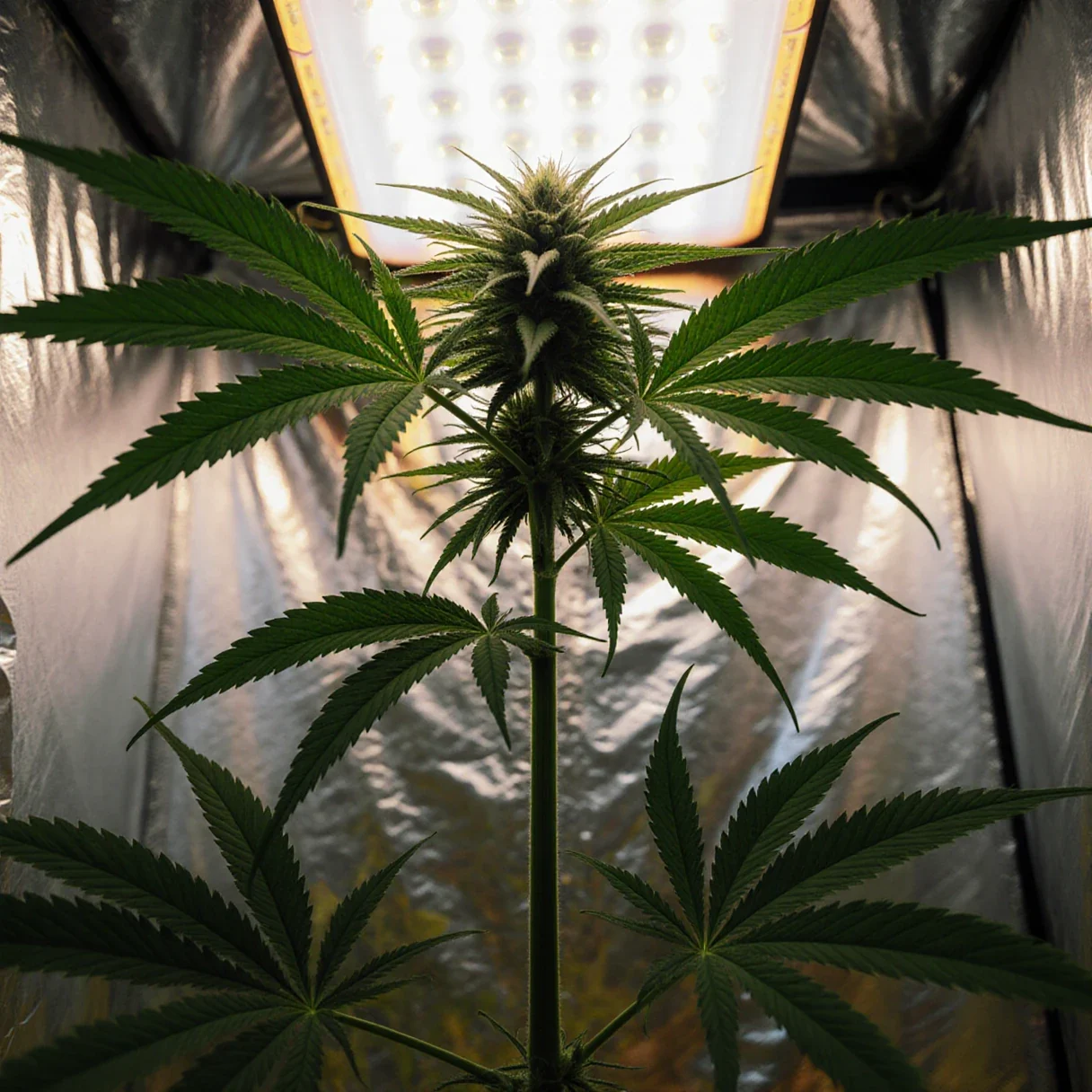
For roughly the first two to three weeks after the flip, the plant does both jobs at once. It’s still running the vegetative program — pushing new nodes, extending stems, spacing branches out — while it starts converting growing tips into flower sites. That overlap is the cannabis flowering stretch. Botanically it’s stem and internode elongation, and it happens because the plant is racing to get its future bud sites up into good light before it commits everything to flowering.
Two things drive how hard a plant runs through the cannabis flowering stretch. The first is genetics, and it’s by far the bigger lever. The second is your environment — light intensity, spectrum, temperature swing, how crowded the canopy is.
One thing to be clear about: autoflowers do this too, just quietly. An auto goes through its own compressed stretch as it enters bloom on its internal clock, but because the whole plant is smaller and the window is shorter, most growers never notice it. Everything below about controlling the cannabis flowering stretch is aimed at photoperiod plants, where the flip is yours to time.
Here’s the part that should make you relax a little: the cannabis flowering stretch has a hard stop built into it.
A 2024 study in Horticulture Research tracked exactly what short days do to female cannabis plants at the shoot apex, and found the response splits into two distinct phases. In the first, from about day 5 to day 10 under short days, there’s rapid elongation of the internodes and main stem. In the second, elongation of newly formed internodes simply ceases, and the apex condenses into an inflorescence — a bud. The same work found flowering onset needed at least three consecutive short days to trigger, and that short days had to keep coming; plants returned to long days had their inflorescences start to disassemble.
Read that again, because it changes how you plan. The plant is not going to stretch forever, and it is not going to stretch at a steady rate. There’s a front-loaded burst and then it’s over. In a real tent, with bigger plants and slower environmental response than a research chamber, growers typically see that burst spread across weeks one through three rather than days five through ten — but the shape is the same. Front-loaded, then done.
Which means every intervention you’re going to make during the cannabis flowering stretch has a deadline. Miss the window and the height is permanent.
Most growers repeat the rule that plants double in height after the flip. It’s a decent average and a terrible planning number, because the spread around it is enormous. A 90% indica that finishes near a metre and a pure sativa listed up to four metres are not doing the same thing.
The honest version of the rule, based on what growers consistently report:
| Plant type | Typical stretch | What that means in a tent |
|---|---|---|
| Indica-dominant | ~1.25–1.5× | Easy. Flip at half tent height and you’re fine. |
| Balanced hybrid | ~1.5–2× | Flip at roughly one-third to 40% of usable height. |
| Sativa-dominant | ~2–3× | Flip early, train hard, expect to be surprised anyway. |
| Haze / landrace sativa | 3×+ | Not a small-tent plant without serious training. |
| Autoflower | Brief and small | Effectively self-managing. Don’t intervene. |
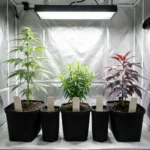
Better than any rule of thumb: read the listed height on the actual seeds you bought. Our catalog gives a finished height range on nearly every strain, and the spread tells you the story before you plant. Bubba Kush is listed at up to 100 cm — a 90% indica that behaves itself. Durban Poison, a pure sativa, is listed at 90–400 cm. Super Skunk Silver Haze, 90% sativa, is listed up to 450 cm. Those three plants do not get the same flip date, and no generic cannabis flowering stretch advice covers all of them.
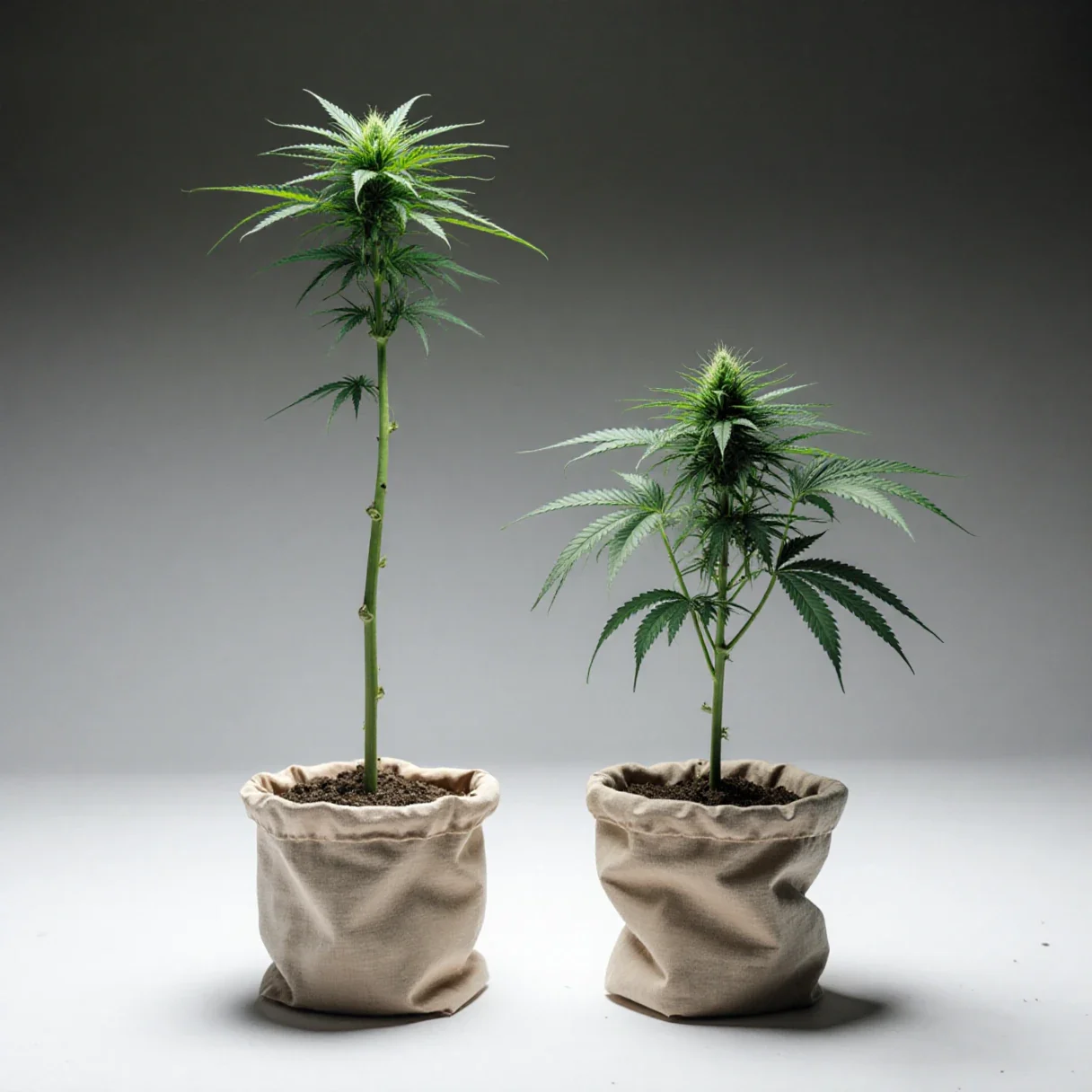
Week one of the cannabis flowering stretch is quiet. The plant keeps growing like it’s still in veg, because functionally it is. You may see nothing bud-like at all. This is the week most growers do nothing — and it’s actually the best week to act, while stems are still soft enough to bend. Preflowers start showing at the nodes toward the end of it; if you’re growing regular seeds, this is when sexing your plants gets easy.
This is usually the steepest part of the cannabis flowering stretch. Internodes pull apart visibly day to day, and the plant can add serious height in 48 hours. Check your light distance every single day this week. White pistils appear in clusters at the tops — the first real sign the flowering program is running.
The cannabis flowering stretch winds down here. Vertical growth slows and then largely stops. Those clusters of pistils start thickening into recognisable bud sites. By the end of week three the frame is set, and anything you didn’t fix is now permanent. From here the plant spends its energy filling out rather than reaching up — which is when flowering nutrition starts to matter more than training does.
1. Flip earlier than feels comfortable. This is the whole game. For a balanced hybrid, flip when the plant is around a third to 40% of the height you can actually use — measured to the light, minus the clearance the light needs. For a sativa, flip earlier still. Almost every “my plants hit the light” post starts with someone who vegged two weeks too long.
2. Buy for your ceiling. A four-foot tent and a haze is a fight you picked at checkout. If height is your constraint, choose compact genetics — Blackberry Kush (60–100 cm), California Dream (~100 cm), or Grape Skunk (80–120 cm) will never put you in that position.
3. Do your cutting before the flip. Topping and FIMming are veg techniques. Cutting the plant during the cannabis flowering stretch costs recovery time in the only weeks the plant will ever spend building its frame, and the stall shows up in your final weight.
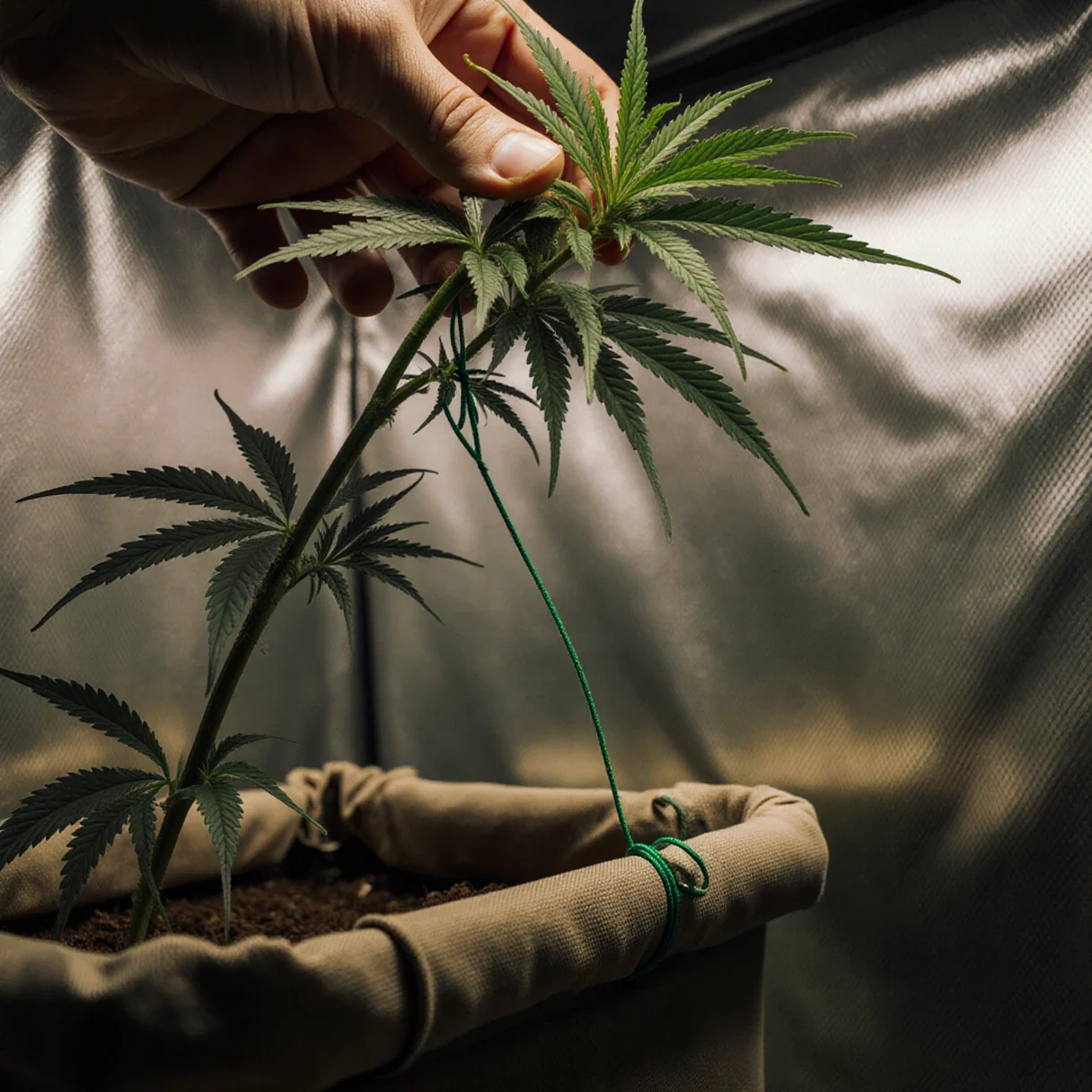
4. Bend instead. Low stress training is the right tool during weeks one and two, precisely because stems are still pliable and still elongating. Tie down the tallest colas, level the canopy, and let the plant even itself out. After week three, stems are woody and you’ll snap them.
5. Raise the light on a schedule, not on a scare. Check hanging height daily through week two. Don’t chase the plant — get ahead of it. If you’re not sure what distance you’re aiming for, our guide to cannabis light intensity covers the PPFD targets that actually matter in flower.
6. Shrink the day/night temperature gap. Warm days with cool nights promote stem elongation; narrowing that gap suppresses it. Greenhouse growers have used this deliberately for decades — it’s a standard non-chemical height-control method in floriculture. Keeping night temps closer to day temps through the cannabis flowering stretch is a free lever most home growers never touch. Just don’t wreck your VPD targets chasing it.
7. Watch your spectrum. Far-red light pushes plants to stretch — it’s the shade-avoidance response, and cannabis has it. A 2025 Scientific Reports study found that adding far-red produced significantly taller plants across every genotype tested. Useful if you want more height. If you don’t, that end-of-day far-red button is not your friend.
The plant is still building leaves and stems during the cannabis flowering stretch, so cutting nitrogen the day you flip is a mistake. It still needs nitrogen to build the frame; the taper belongs later in bloom, not at the flip. We covered the actual numbers in how much nitrogen a cannabis plant needs.
Humidity is the other half of the climate job. As the canopy closes up through the cannabis flowering stretch up and buds start forming, airflow through the middle of the plant gets worse fast — and dense, damp, still air in early bloom is how bud rot gets started weeks before you’d ever see it. Get your fans sorted while you can still see the stems.
One more thing worth saying plainly: don’t strip the plant bare to “let light in” during the stretch. Heavy leaf removal in early bloom is popular and mostly unsupported — the evidence on whether defoliation actually increases yield is a lot weaker than the internet suggests. Pull the leaves that are genuinely blocking a bud site. Leave the rest.
If your ceiling is fixed, pick genetics that agree with it. These are the ones from our catalog that don’t punish a small space:
And if you have the vertical room and want to use it, the stretchers are worth growing on purpose — Blue Dream (150–180 cm), Acapulco Gold (150–250 cm), and Mexican Haze (150–200 cm) all turn a big cannabis flowering stretch into a lot of bud sites. Browse the full feminized seed collection or the autoflower range and check the listed height before you buy, not after.
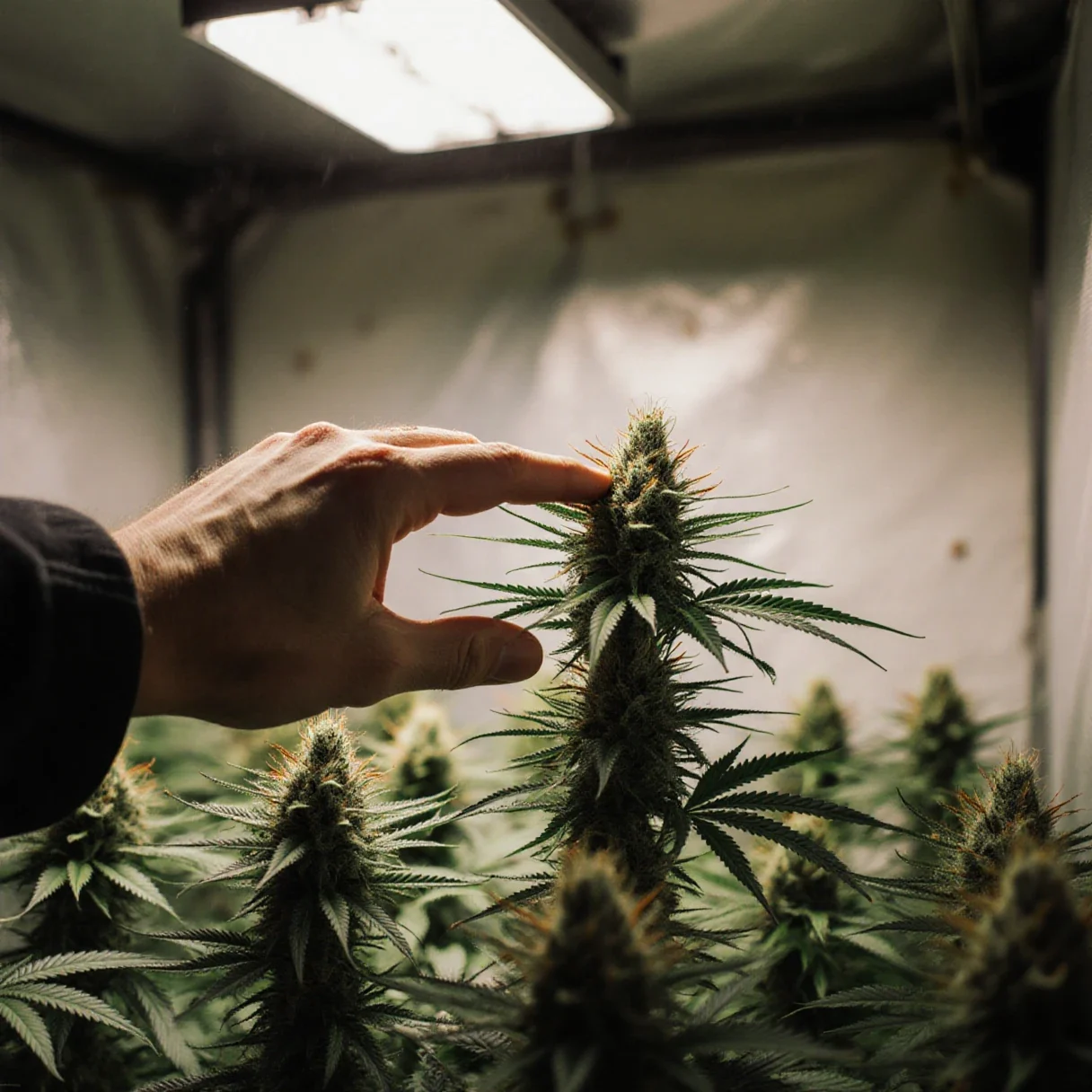
Two to three weeks in most tents, with the fastest growth in week two. The research shows the elongation phase is front-loaded and then stops outright once the shoot apex converts to an inflorescence — it doesn’t taper off gradually over the whole bloom.
You can, but don’t. Cutting during the cannabis flowering stretch stalls the plant in the only weeks it will ever spend building bud sites. Bend instead, or top before the flip.
Raise the light if you have any room left, then tie the tallest colas down and sideways — even at week three you can usually gain several inches before stems get truly rigid. Supercropping the worst offender is a last resort but works. Next round, flip two weeks earlier.
Autoflowers run their own cannabis flowering stretch, but it’s short, small, and self-limiting, and there’s no flip date to get wrong. Leave them alone.
It can change the whole flower phase — there’s real research suggesting a 13-hour photoperiod outperforms 12/12 on biomass. That’s a separate lever from the stretch, but it’s the same flip you’re timing.
The cannabis flowering stretch is decided almost entirely before it starts. Genetics set the multiplier, and your flip date sets the starting height — everything after that is damage control. Growers who never fight the cannabis flowering stretch aren’t better at training; they just flipped at the right height with the right seeds.
So plan backwards. Take your usable height, divide by the stretch factor for what you’re growing, and flip there. Bend through the first two weeks of the cannabis flowering stretch, stop by week three, then leave the plant to fill out and start watching trichomes instead of tape measures.
Sources: Alter et al., Inflorescence development in female cannabis plants is mediated by photoperiod and gibberellin, Horticulture Research 11(11), 2024. Peterswald et al., The effects of far-red light on medicinal Cannabis, Scientific Reports 15:17435, 2025.
Shop Cannabis Seeds | When to Harvest Cannabis | More cannabis growing guides
Want to keep learning? Browse our full library of guides to growing cannabis — everything from germination to harvest, in one place.
Ready to grow? Browse premium seeds from Lighthouse Genetics:
Designed & Built by Wynne Web Design