Walk into any grow shop and you will find a wall of bottled nutrients promising explosive yields, record-breaking potency, and bud the size of your forearm. Every brand has a feeding chart. Every chart is different. None of them will tell you the actual science-based number your plants need. So the real question is — how much nitrogen for cannabis flower, in actual milligrams per liter, based on peer-reviewed research? Not a brand’s chart. Not a forum post. The data. Here is exactly how much nitrogen for cannabis flower modern plant science has measured, and why most growers are feeding either way too much or not quite enough.
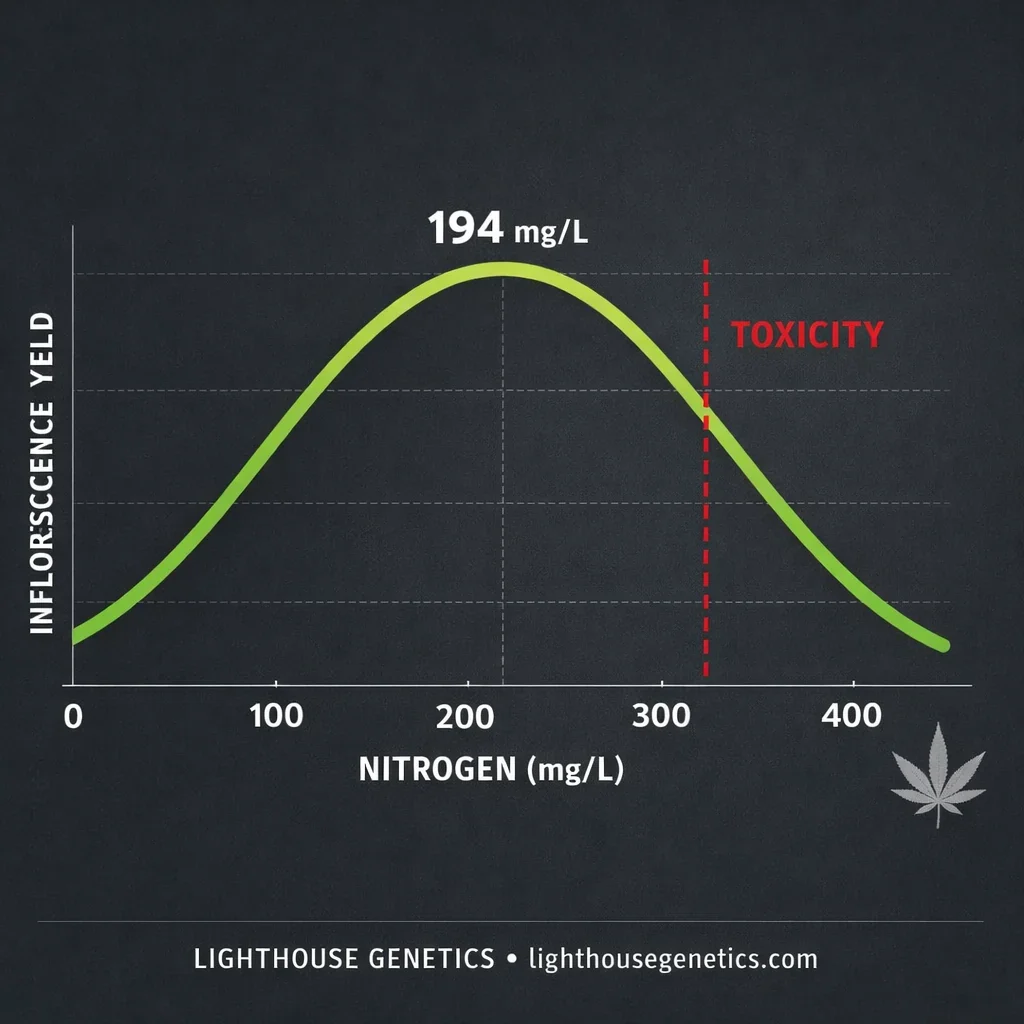
Peer-reviewed research from the University of Guelph (Bevan, Jones, and Zheng, 2021) found the optimal nitrogen for cannabis flower is approximately 194 mg/L (ppm) in the nutrient solution. Phosphorus was optimized at roughly 59 mg/L. Potassium, notably, did NOT produce a significant yield response across the tested range of 60-340 mg/L — meaning reasonable K levels are forgiving in a way N and P are not.
This is significantly lower than what most commercial nutrient lines recommend on the label. If you are asking about nitrogen for cannabis flower and getting answers in the 250-350 ppm range, you are probably overfeeding. Let us break down exactly where that 194 mg/L number comes from and what it means for your grow.
In 2021, researchers at the University of Guelph’s Cannabis Research lab published a paper in Frontiers in Plant Science titled “Optimisation of Nitrogen, Phosphorus, and Potassium for Soilless Production of Cannabis sativa in the Flowering Stage Using Response Surface Analysis.” They grew drug-type cannabis across a grid of N, P, and K concentrations in soilless media, then measured inflorescence yield, cannabinoid concentration, and plant health at each combination. This is proper experimental design — not a feeding schedule written by a fertilizer brand, but a full response surface mapping the sweet spot.
Their finding: inflorescence yield responded quadratically to nitrogen AND phosphorus — the classic inverted-U. Yield went up as N increased, peaked at around 194 mg/L, and then went DOWN as nitrogen pushed higher. Phosphorus followed the same pattern, peaking at about 59 mg/L. Too little limits growth, too much becomes toxic. Potassium was the outlier — no significant yield effect across the 60-340 mg/L range they tested.
If you are wondering how much nitrogen for cannabis flower, the honest answer backed by research is: around 150-200 mg/L in the solution you feed. Anything above 250 mg/L starts reducing yield on many cultivars. Anything below 100 mg/L shows classic nitrogen deficiency — pale lower leaves, slow growth, premature yellowing.
194 mg/L is a concentration in the nutrient solution you are pouring into the media. Here is how to translate that:
If your system uses EC as a proxy (as most commercial growers do), a full-strength feed of EC 2.0-2.4 mS/cm with a balanced veg/bloom ratio typically lands in the research-optimal zone for nitrogen. Going above EC 3.0 during flower usually pushes nitrogen for cannabis flower past the productive range.
Almost every new grower feeds too much. The reason is simple: the bottles on the shelf cost money, and manufacturers want you to use them. Their feeding charts are built to sell product, not to match the actual peer-reviewed response curves. A typical commercial bloom chart calls for 300+ ppm N in week one, sometimes 400+ at peak — well past the point where the Guelph data shows yield declining.
The telltale signs of overfed cannabis during flower:
These are all signs that the answer to “how much nitrogen for cannabis flower” in your grow is “less than you are giving.” Cutting back by 25-30% often produces denser buds and stronger terpene expression within one or two weeks.
The Guelph study measured nitrogen response across the flowering stage as a whole. In practice, nitrogen requirements shift slightly within the 8-10 week bloom cycle:
The common “flush for two weeks” practice is more about pushing stored nitrogen out of the plant tissue for taste than about plant need. There is ongoing debate about whether flushing actually improves smoke quality — the peer-reviewed evidence is thin. What is clearer: not spiking nitrogen above the optimal range during mid-flower is what actually matters.
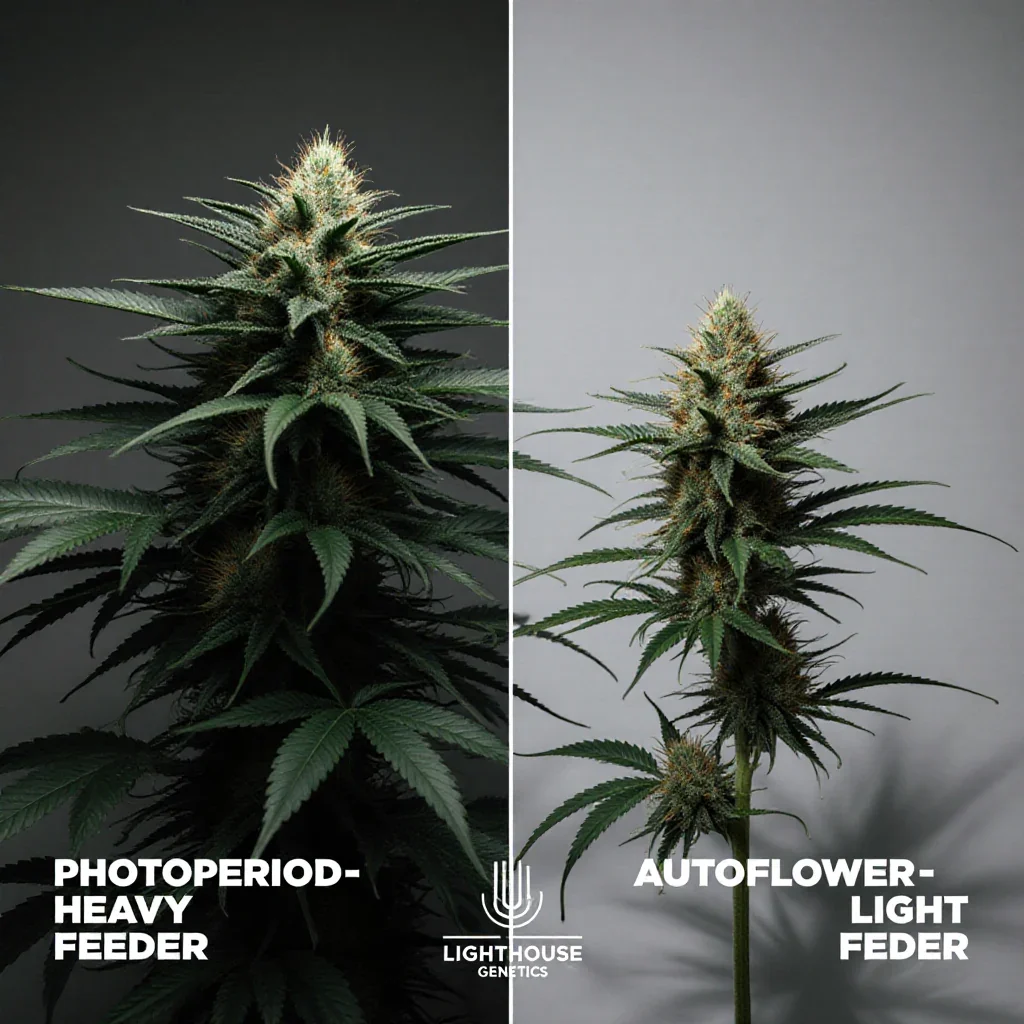
The Guelph study used specific cultivars, and results vary by genetics. Heavy-feeding indica-dominant strains like Cement Shoes and Gorilla Glue #4 tolerate — and sometimes benefit from — nitrogen for cannabis flower at the high end of the optimal range (190-220 mg/L). Light-feeding landrace sativas and most autoflowers prefer the lower end. A strain like Bruce Banner Autoflower or Gorilla Glue Autoflower at 150-175 mg/L will often out-perform the same strain at 220 mg/L.
General rule of thumb: autoflowers need 20-30% less nitrogen for cannabis flower than photoperiod strains throughout flower. Their compressed life cycle means less total nitrogen uptake, and their root systems are smaller. Feeding autos like you feed photos is a common path to nitrogen toxicity.
If you are not sure which genetics you have or how they feed, our guide to choosing cannabis seeds walks through strain selection by grow style, and our autoflower vs feminized guide covers the basic genetics differences.
Peer-reviewed research from Guelph (Bevan, Jones, & Zheng, 2021) found the optimal nitrogen for cannabis flower is about 194 mg/L, which is equivalent to 194 ppm N. Anything in the 150-200 mg/L range is in the productive zone. Above 250 mg/L, yield starts declining.
Flushing is debated. The peer-reviewed evidence that flushing improves taste is thin. What is clearer is that not overfeeding nitrogen for cannabis flower during mid-flower is what actually matters for final quality. A short 7-10 day flush with low-EC water at the end is fine and cannot hurt. Two-week aggressive flushes may reduce yield slightly without measurable quality gain.
A little yellowing in the bottom fan leaves during weeks 6+ is normal and expected — the plant is mobilizing stored nitrogen into the buds. If the entire plant starts yellowing rapidly from the top down, that is a problem. Proper nitrogen deficiency in bottom leaves late in flower actually correlates with good ripening.
For the plant, nitrogen is nitrogen — it gets converted to nitrate or ammonium either way. Organic sources release slower and are harder to overdose, which is forgiving for beginners. Synthetics let you dial in exact concentrations but require more attention to avoid toxicity. Neither is objectively better; pick what fits your grow style.
Pale green to yellow lower leaves spreading upward, slow growth rate during early flower, reduced overall plant size, and thin stems. True nitrogen for cannabis flower deficiency during weeks 1-5 is rare because most growers overfeed. If you see these signs in early flower, bump feed up by 15-20% and check response over a week.
Bloom boosters are usually high in P and K with low or no N. They are fine as an addition, but they do not replace the need to manage nitrogen. Following a “bloom booster” chart blindly while also running full-strength base nutrients is how a lot of growers end up overfed.
How much nitrogen for cannabis flower, according to the best published research? About 194 mg/L in the feed solution during peak flowering, with a range of 150-200 mg/L across the bloom cycle. That is the Guelph response-surface number and it matches what careful commercial growers have converged on independently. If you are feeding significantly higher than this — which most growers are if they follow a commercial chart at full strength — you are almost certainly reducing yield and quality.
The real art is not finding a new magic number. It is dialing back from the manufacturer’s recommendation, watching your plants, and trusting the data. Clean green growth without claw or dark bluish tones means you are in the zone. Combine that with the right light spectrum and intensity and solid genetics from our full catalog, and you have the real formula for maximum yield and potency. Starting fresh with your next grow? Our germination guide and seed storage guide are the place to start.
Want to keep learning? Browse our full library of cannabis grow guides — everything from germination to harvest, in one place.
Ready to grow? Browse premium seeds from Lighthouse Genetics:
Designed & Built by Wynne Web Design