You spend three or four months on a plant. Then you cut it down, and about ten minutes later you hit the first real decision of harvest day: strip the leaf off now, or hang the whole branch and deal with it in a week? That is the wet vs dry trim question, and growers argue about it harder than they argue about nutrients.
Both methods work. Both produce good weed. But they produce slightly different weed — and there is now lab data on that difference instead of just forum opinion. Here is what wet vs dry trim actually changes, which one suits your room and your climate, and seven things that make either method go better.
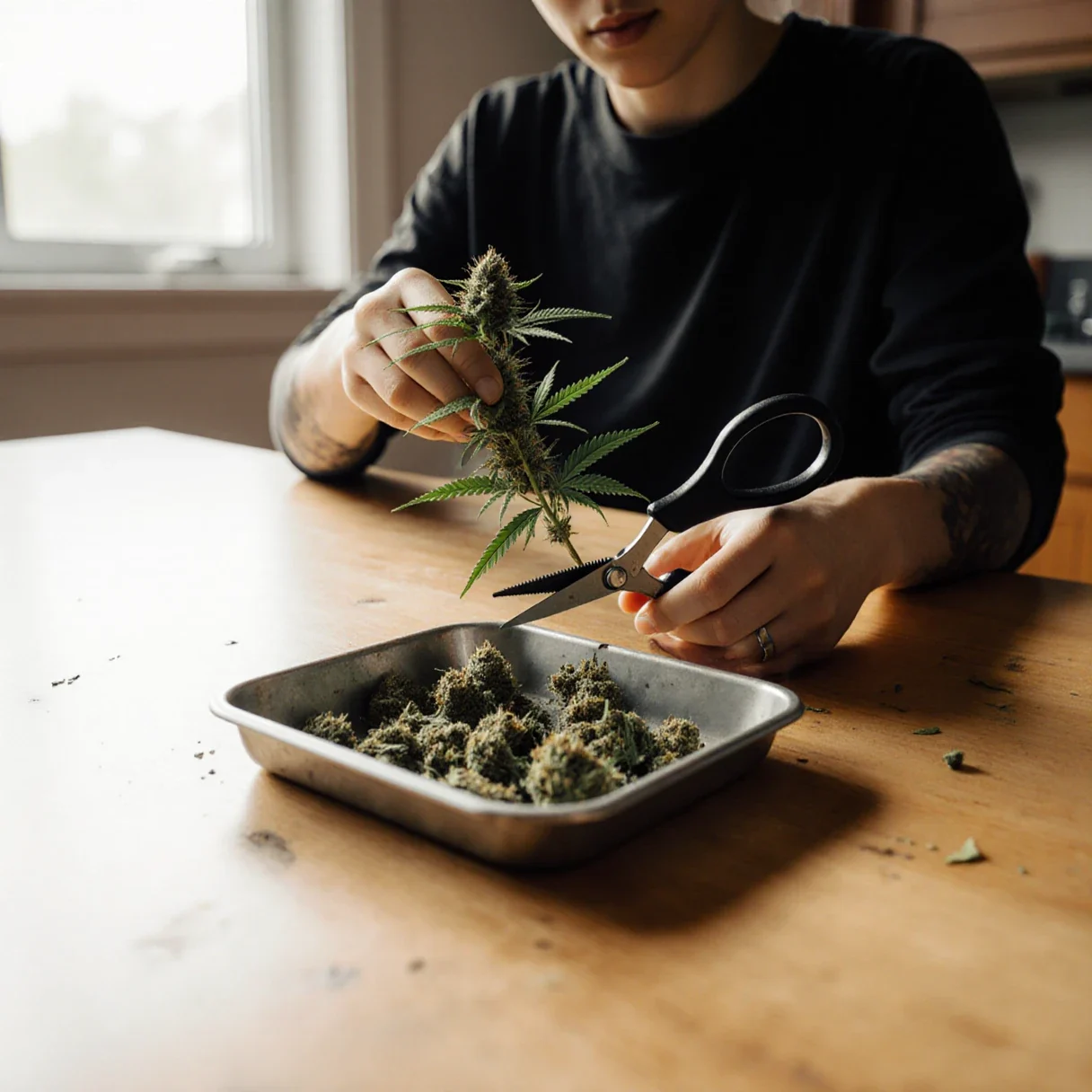
Start with the mechanics, because the wet vs dry trim labels describe timing and nothing else. A wet trim happens within hours of the chop. The plant is still full of water, the sugar leaves stand out stiff from the flower, and you cut them away before anything goes on the line. What gets hung — or laid on a rack — is already manicured.
A dry trim flips the order. Whole branches hang for roughly a week to two weeks first, and you only pick up the scissors once the small stems snap instead of bend. By then the leaves have curled in tight around the flower and you’re cutting stiff, brittle material rather than soft green.
That’s the whole wet vs dry trim split: same scissors, same plant, different moisture content. Everything else — how fast it dries, how it smells, how much resin ends up on your fingers instead of in the jar — falls out of that one timing choice. Where the trim sits in your harvest sequence matters too: it lands between knowing when to harvest and the dry-and-cure stage, and it changes how the dry behaves.
Most of the wet vs dry trim debate online is preference dressed up as fact, and it has been that way for years. In 2024 a team at Israel’s Volcani Institute actually measured it — Brikenstein and colleagues published a trimming-technique study in Medical Cannabis and Cannabinoids comparing three approaches on the same cultivar.
They ran a mild wet trim (sugar leaves cut back halfway before drying), an aggressive wet trim (leaves removed entirely before drying), and a dry trim (aggressive, done after a six-day controlled dry). Then they put all three through chromatography.
The split was clean, and for a wet vs dry trim decision it’s the most useful thing anyone has published:
The authors’ own conclusion is that you have to pick: optimising for cannabinoids and terpenes at the same time looks difficult. So the honest framing of wet vs dry trim isn’t “which one is right.” It’s “which do you care about more — a slightly stronger number, or a jar that smells louder when you open it.”
Two caveats, because this matters. That study used one hybrid chemovar and a commercial controlled-atmosphere dry at 15 °C — not a tent in a spare bedroom. And a 4% cannabinoid difference is real but small. Nobody is going to notice it the way they’d notice a mouldy jar or a dry that took two days. Treat the study as a tiebreaker on wet vs dry trim, not as an instruction.
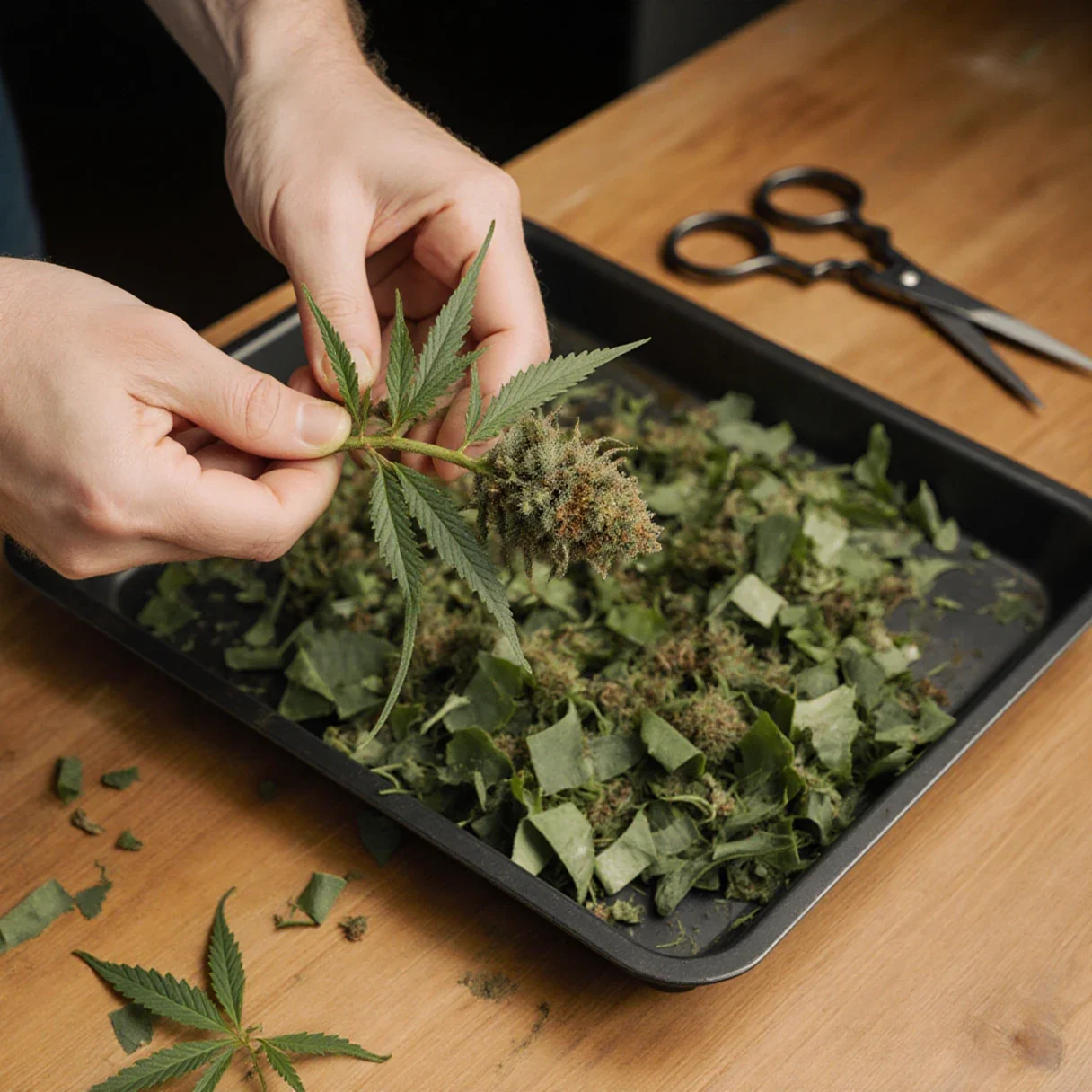
Of the two halves of wet vs dry trim, wet trimming is the easier job by a wide margin. Turgid sugar leaves point away from the flower, so you can see what you’re cutting and the scissors do less searching. A wet trim also strips out much of the surplus water-holding leaf before anything goes on the line, so the dry runs faster and the drying space stays less humid.
That last point is the real argument for it. If you’re harvesting into a damp autumn, or drying in a basement that sits at 65% humidity on a good day, less wet leaf hanging in the room means less moisture pumped into the air and a lower chance of bud rot finding your best cola after it’s already cut. Mould after the chop is not a hypothetical: a separate 2024 study on drying conditions found open-air drying produced significantly more mould contamination than controlled drying.
The costs of a wet trim are honest ones. Resin gums up the blades fast, so you’ll be cleaning scissors repeatedly through the session or working with two pairs. And because a wet-trimmed harvest dries quicker, it’s easier to overshoot into a rushed, harsh dry — you have to manage the room rather than let it ride. Our guide to drying temperature and terpene loss covers the numbers to hold.
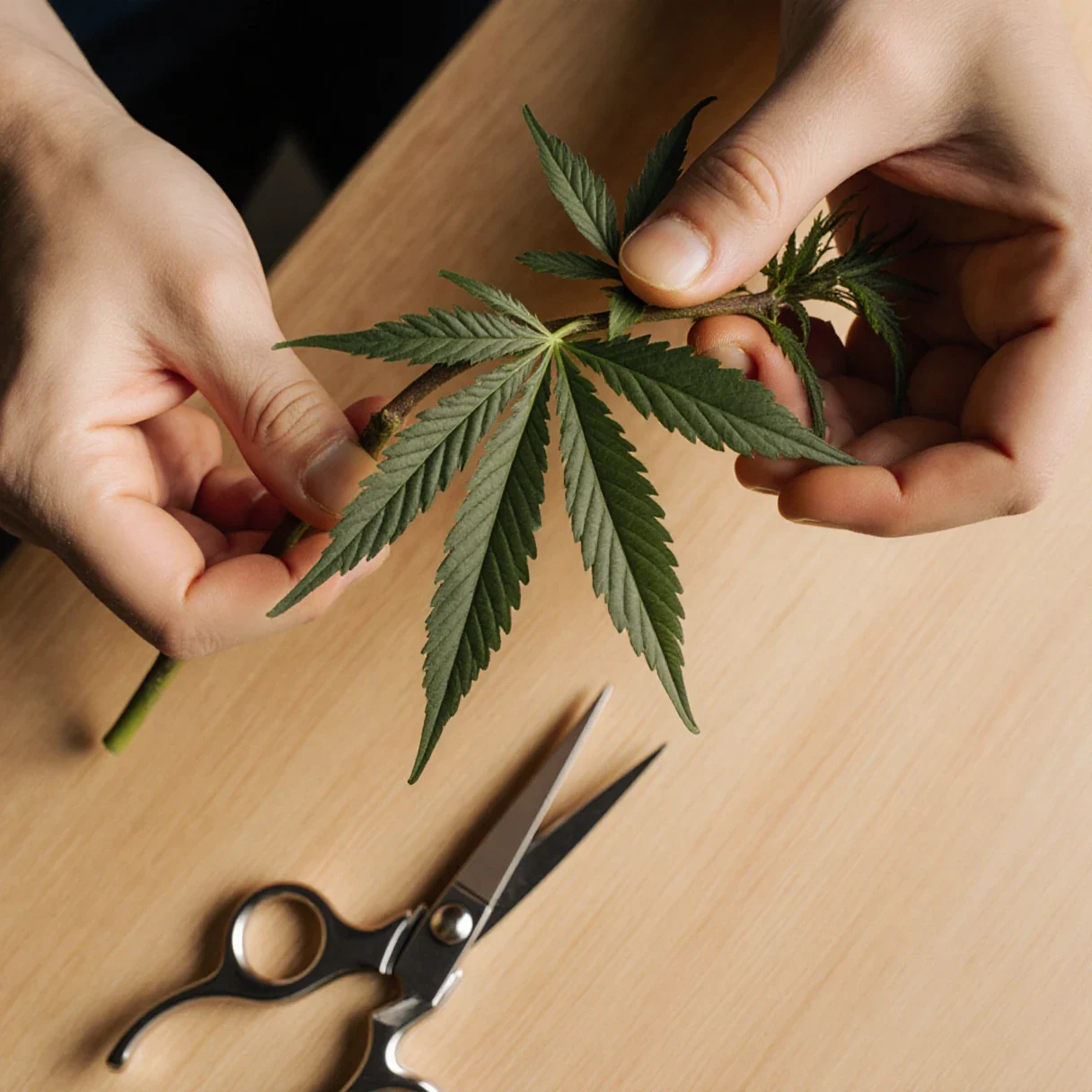
Take the other road through wet vs dry trim — hang first — and the leaves do you a favour. As the branch dries, the sugar leaves curl inward and wrap the flower like a shell. That extra material slows moisture loss, which stretches the dry out, and a slower dry is one of the best things you can do for aroma. Separately — and for reasons the researchers don’t pin on drying speed, since every group in that study got the same six-day dry — the trimming study measured higher terpene content in the dry-trimmed group.
A dry trim also gives you a buffer. A wet trim locks you into whatever the room does next; a dry trim lets a fast room run a couple of days longer before the flower is exposed.
The downsides of a dry trim are physical. It’s slower and more tedious work, because you’re picking curled leaf out of tight flower instead of snipping obvious stems. Branches need real hanging space for one to two weeks. And dried trichomes are brittle — handle a finished branch by the stem, not by the flower, or you’ll leave a good part of what you grew on the trim tray. If you want the aroma payoff you’re trimming for, the cure after the dry matters as much as the trim itself, and our post on what terpenes actually are explains why they’re the first thing you lose.
Here’s the whole wet vs dry trim comparison stripped down to the parts that actually change your decision:
| Factor | Wet Trim | Dry Trim |
|---|---|---|
| When you do it | Hours after the chop | After a 7–14 day hang |
| Ease of the work | Easier, faster | Slower, fiddlier |
| Dry speed | Faster | Slower |
| Space needed | Less | More — whole branches hang |
| Mould risk in a humid room | Lower | Higher |
| Terpene retention (2024 study) | Lower | Higher |
| Cannabinoid content (2024 study) | Higher, if trimmed mildly | Slightly lower |
| Trichome handling | Resin sticks to blades | Brittle — knocks off easily |
| Best for | Damp climates, big harvests, tight space | Dry climates, small harvests, aroma |
Everything above is the theory of wet vs dry trim. This is the part that decides it in practice. If you take one thing from this post, take this: your room settles the wet vs dry trim argument more than your preference does.
Humid room, damp season, basement dry? Wet trim. Removing leaf before the hang is a mould-prevention move first and a quality choice second, and a jar that smells slightly less loud beats a jar you have to throw out. Outdoor growers finishing into a wet autumn are squarely in this camp.
Dry room, heated house in winter, arid climate? Dry trim. When the air is already pulling moisture out faster than you want, leaving the sugar leaves on is free insurance against a three-day crash dry — and you collect the terpene benefit while you’re at it.
Somewhere in the middle, which is most people? A mild wet trim is the sensible default. Cut the big fan leaves and take the sugar leaves back partway, but don’t shave the flower bare — that’s the treatment that measured best for cannabinoids in the 2024 study, and it splits the difference on drying speed.
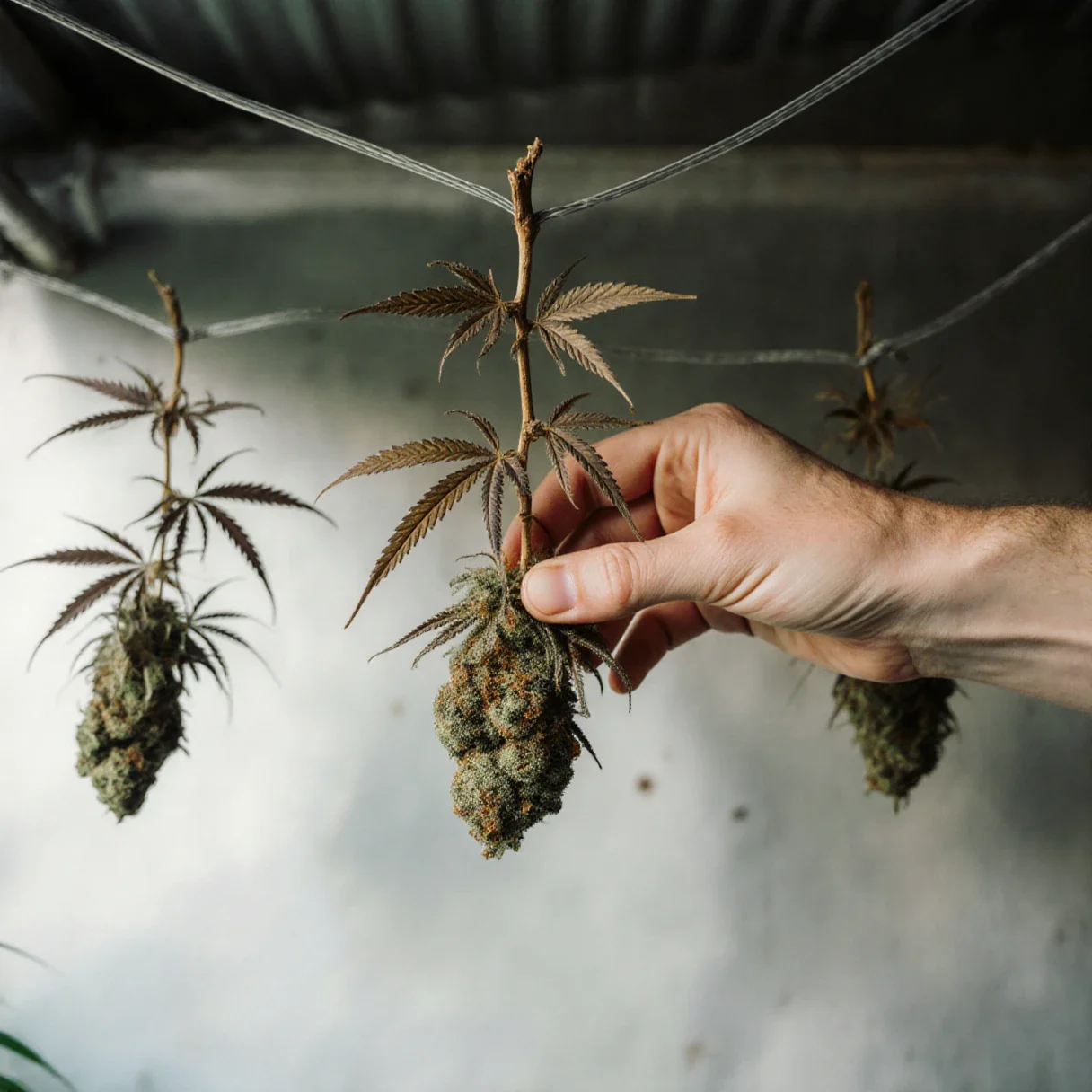
Whichever side of wet vs dry trim you land on, these are what separate a good harvest from a mediocre one:
Genetics don’t decide the wet vs dry trim call outright, but bud structure and resin load push it hard in one direction. Dense, heavy indica-leaning flower holds moisture in the middle and dries slowest — those are the plants where a wet trim earns its keep, especially in a damp space.
Big Bud is the obvious example: 85% indica, 7–9 weeks of flower and up to 800–1200 g per plant outdoors, which is a lot of dense material to get dry. Great White Shark and Bubba Kush (90% indica, listed at 9 weeks) sit in the same bracket, and hardy Afghani finishes at 7–8 weeks with the chunky landrace structure to match.
Airy sativa-leaning plants dry faster on their own, so the slower dry trim suits them. Durban Poison is a pure South African landrace sativa at 8–9 weeks; Acapulco Gold (80% sativa) and the long-running Columbian Gold at 10–12 weeks are the same shape. Leaving the leaf on these slows a dry that would otherwise finish too quickly.
Then there are the resin bombs, where handling is the whole game. Gorilla Glue #4 and Godfather OG are both rated Very High THC (25–30%+) in our catalog — trim those gently, by the stem, and expect to clean your scissors twice as often on a wet trim.
Small autoflower harvests make the wet vs dry trim question mostly academic. White Widow Autoflower yields around 60–140 g per plant outdoors and Gorilla Glue Autoflower finishes in 70–75 days — at that scale a dry trim is a single relaxed evening, not a weekend of labour. Browse the full feminized seeds and autoflower seeds ranges to compare structure before you buy.
For quality, it’s a real but modest difference — the measured cannabinoid gap between methods was around 4%. For workload and mould risk it’s a much bigger deal, and that’s usually what should decide it.
Dry trimming, and it’s the clearest result in the whole wet vs dry trim comparison. In the 2024 trimming study, only post-drying trimming significantly raised levels across more than 80% of the terpenes measured — β-myrcene being the exception. That result came out of a controlled dry that was identical for every group, so it’s the trim timing being measured, not a slower dry.
Less than dry trimming does — one of the few places where wet vs dry trim runs counter to what growers assume. Fresh resin is soft and sticky, so it transfers to blades and gloves rather than shattering. Dried trichomes are brittle and break off with rough handling — which is why dry-trimmed branches should be held by the stem.
Usually 7 to 14 days, depending on your room, and that hang is the whole cost of choosing dry over wet.
The test is physical, not a date: small stems should snap rather than fold. Trim before that and the flower is still too wet to jar; leave it much longer and it gets crumbly.
Yes, and plenty of growers do. A mild wet trim at harvest — fan leaves off, sugar leaves cut back partway — followed by a quick tidy-up after the dry gets you most of the mould protection and most of the cosmetics. It’s the middle path through the whole wet vs dry trim argument.
Stop treating wet vs dry trim as a quality contest with one winner. It’s a trade, and the lab work backs that up: a mild wet trim measured best for cannabinoids, a dry trim measured best for terpenes, and neither result was large enough to outweigh losing a harvest to mould.
So settle wet vs dry trim with your room, not with a forum thread. Damp space or a big dense harvest — wet trim, and keep it mild rather than shaving the flower bare. Dry space, small harvest, aroma is what you’re chasing — hang it whole and trim it dry. If you genuinely can’t call it, the mild wet trim is the safest default I’d give anyone, and it’s the one the data liked best on the cannabinoid side.
And whichever way you go on wet vs dry trim, the trim is one step in a chain. Cut at the right ripeness, dry slow, cure properly, and a decent trim job will look after itself.
Shop Cannabis Seeds | When to Harvest Cannabis | How to Cure Cannabis | Our Cannabis Growing Guides
Want to keep learning? Browse our full library of cannabis grow guides — everything from germination to harvest, in one place.
Ready to grow? Browse premium seeds from Lighthouse Genetics:
Designed & Built by Wynne Web Design