Most autoflowers finish somewhere between knee height and chest height. Across the autoflower seeds we currently stock, the listed autoflower plant height ranges run from 50 cm at the low end to 180 cm at the very top — roughly 20 inches to just under six feet — and the large majority never get close to that ceiling. If you want one number to plan around, plan around a metre — a bit over three feet.
That is the useful answer, but it isn’t the whole one, because autoflower plant height is the one trait a grower has the least control over. With a photoperiod plant you decide when it stops growing up and starts growing buds. With an auto, the seed decides. This post covers what the real numbers look like, why the plant makes that call instead of you, and the handful of levers that genuinely move the needle.
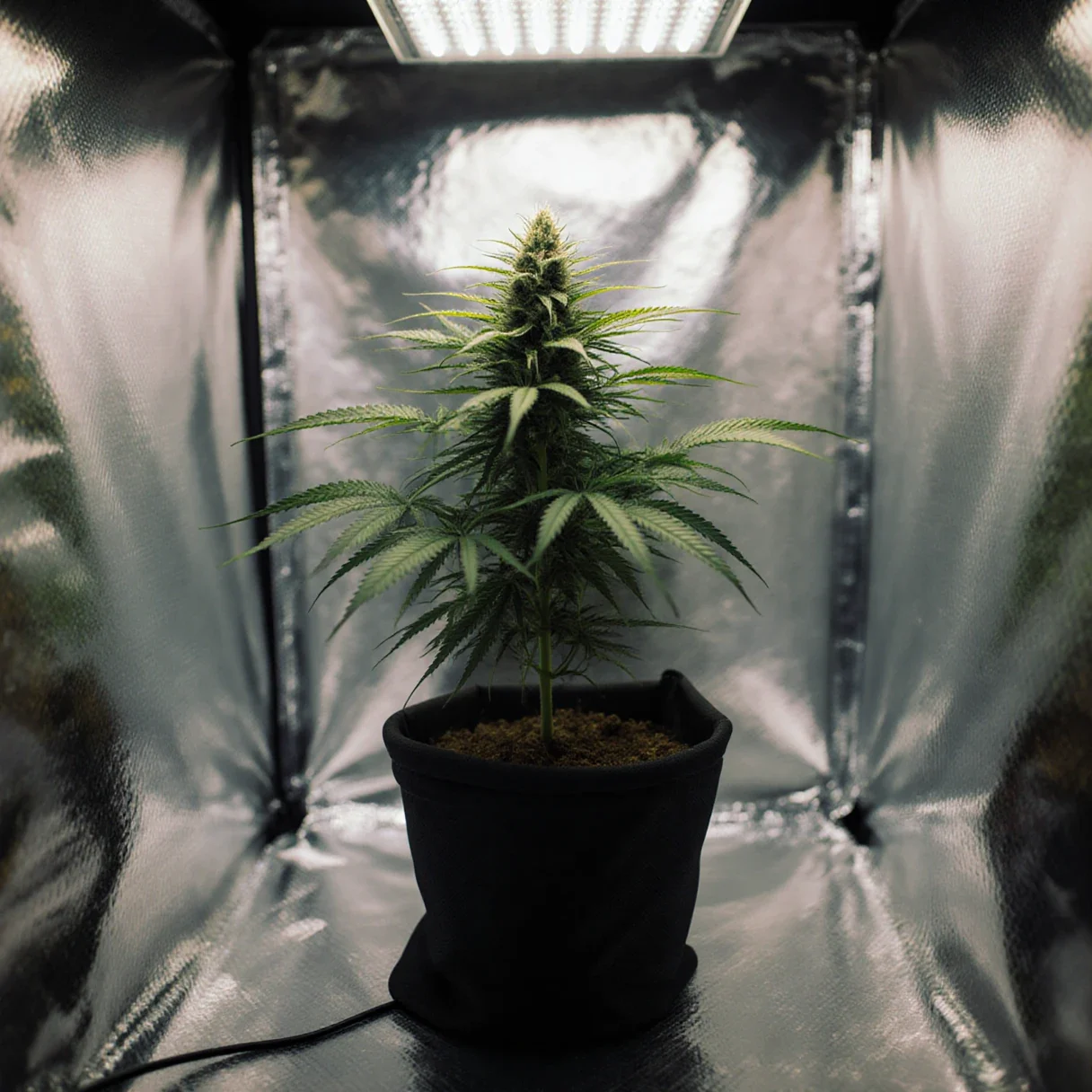
We list an autoflower plant height range on every product page, so rather than repeat the internet’s usual “2 to 4 feet” guess, here is what our own catalogue says. Of the 29 autoflower strains in stock, 28 carry a numeric range and one is listed simply as under 100 cm (39 inches).
The lowest floor across those ranges is 50 cm (20 inches). The highest ceiling is 180 cm (about 5 ft 11 in). The median range lands at roughly 60–120 cm (24–47 inches), and 19 of the 28 top out at 120 cm (about 47 inches) or less. Eight of them top out at 100 cm (39 inches) or less.
So the honest summary of autoflower plant height is this: a bit over a metre is the normal outcome, half a metre is realistic for the compact ones, and the six-foot monster is a single strain grown well, not a typical result.
| Height band | Roughly | How many of our 28 ranged autos |
|---|---|---|
| Tops out at 100 cm or less | About 3 ft 3 in or less | 8 |
| Tops out at 101–120 cm | Up to about 4 ft | 11 |
| Tops out at 121–150 cm | Up to about 5 ft | 7 |
| Tops out above 150 cm | 5 ft and over | 2 |
A photoperiod cannabis plant flowers when the days get short. Until that happens it keeps building stem, so its final height is largely a decision you make — you veg it longer, you get a bigger plant.
An autoflower ignores day length entirely, and that single difference is what caps autoflower plant height. Researchers at Cornell mapped the trait to a single recessive locus they named Autoflower1, on chromosome 1, and confirmed it behaves the way growers always assumed it did: it segregates like a simple recessive gene and it confers photoperiod insensitivity across a wide range of cannabis germplasm. The same work noted that plants carrying one copy came out intermediate for flowering date, height and biomass — the gene that sets the clock tracks with how big the plant gets.
That is the mechanism behind every short autoflower, and the reason autoflower plant height is so consistent within a strain. The plant starts flowering on age, the upward growth tails off shortly after, and whatever structure it built before that point is the structure it finishes with.
It is worth seeing the size of the lever you’re giving up. In a 2024 German trial on photoperiod medical cannabis, plants given four weeks of vegetative growth reached 100.7 cm (39.6 inches), while the one-week treatment came in about 35% shorter — the relationship was linear, at roughly 11.8 cm — about 4.6 inches — of final height for every extra week in veg.
Those were photoperiod plants under an 18-hour day, not autos, so the numbers don’t transfer. What transfers is the principle: veg length is the main height dial in cannabis, and an autoflower keeps that dial for itself. Autoflower plant height is genetics plus growing conditions, minus the one lever you’d most like to have.
This is also why running autos on 20 hours of light instead of 18 doesn’t make them flower sooner or later. More light hours can feed a slightly bigger plant, but the flowering clock isn’t listening.
Strain choice is the single biggest predictor of autoflower plant height, and it’s the one you get to make before anything is in soil. These are the listed ranges from our own product pages, not rounded estimates.
White Widow Autoflower is listed at 50–80 cm (20–31 inches), the lowest ceiling on any autoflower we currently stock, and it finishes in 8–9 weeks. Kush XL Autoflower runs 60–100 cm (24–39 inches) on a 7–8 week flowering time, and Mandarin Cookies Autoflower is listed as staying under 100 cm (39 inches).
Grape Ape Autoflower and LA Kush Autoflower both sit in that same 60–100 cm (24–39 inch) band, which is the autoflower plant height sweet spot for anyone working under a low basement ceiling. In a short starter tent you’d want to keep one of these trained, since the top of that band will run out of headroom.
Gelato Autoflower and Mazar Autoflower are both listed at 70–100 cm (28–39 inches), and Animal Cookies Autoflower at 70–110 cm (28–43 inches). Green Crack Autoflower spans 60–125 cm (24–49 inches) on a quick 7–8 week bloom. If you assume any of these will land near the middle of its range, you’ll usually be close.
Chunky Monkey Autoflower is listed at 90–180 cm (35–71 inches), the highest ceiling of any auto we stock. Devil XXL Autoflower starts higher than anything else at 110–160 cm (43–63 inches), so it is the one strain here that won’t give you a compact plant even if conditions are tight.
Bruce Banner Autoflower carries the widest listed spread of the lot at 50–150 cm (20–59 inches) — a metre, or about three feet, of uncertainty, which is worth knowing before you commit tent space. Moby Dick Autoflower and NYC Sour Diesel Autoflower both reach 150 cm (59 inches), and the sativa lean in those two shows up as height.
You can browse all our autoflower seeds and check the listed autoflower plant height on any product page before you buy. If speed matters more to you than stature, our roundup of the fastest strains to finish ranks the same catalogue by flowering time instead.
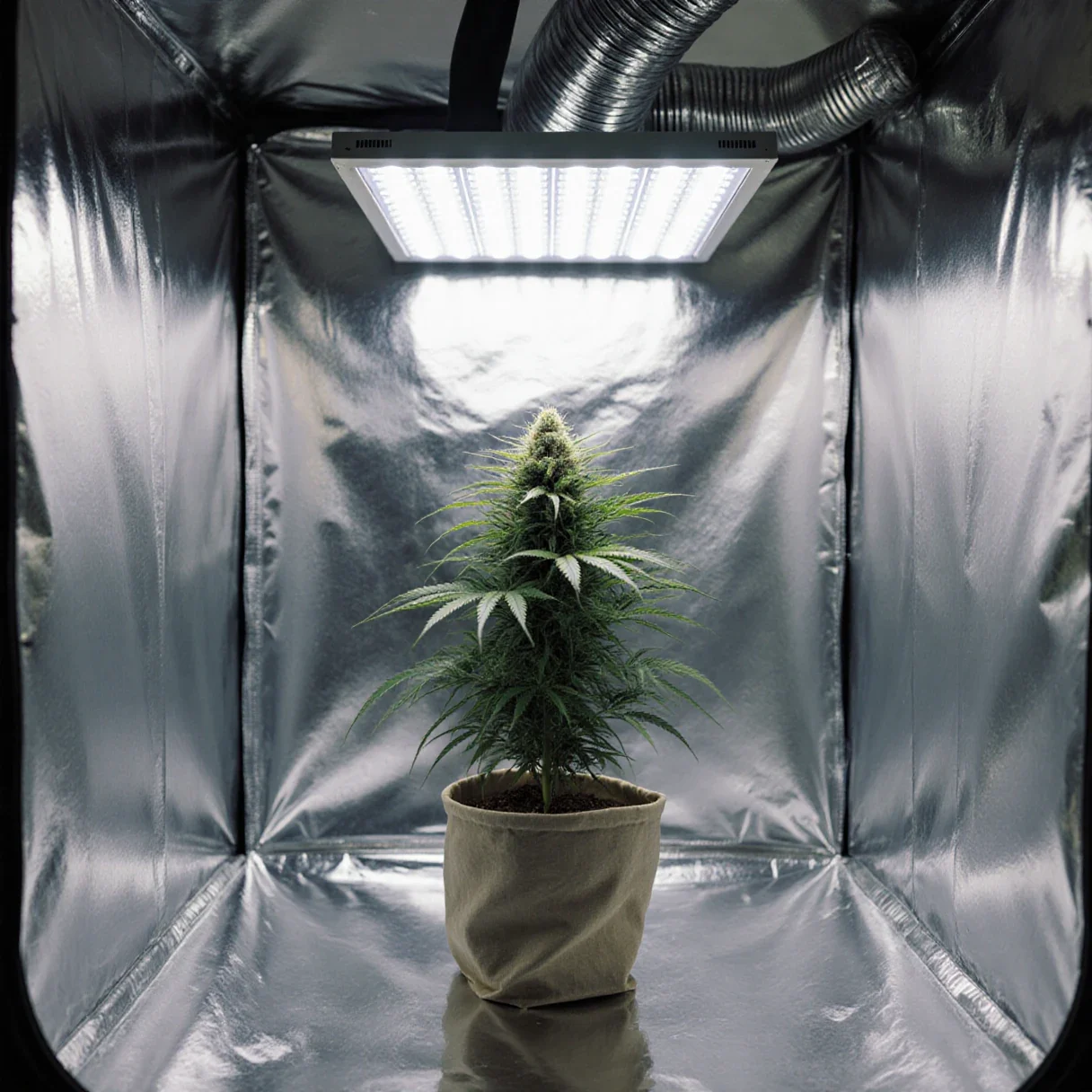
Two seeds from the same pack can finish noticeably different autoflower plant height — growers routinely report 20 cm — 8 inches — or more between siblings. Some of that is normal genetic variation between individual plants, and some of it is the grow. Both halves are worth separating, because only one of them is yours to change. These are the factors that decide where in the range you land.
If your seedlings are going lanky in the first fortnight, that’s a light problem rather than a genetics problem, and it’s fixable — see getting through the first two weeks for the diagnosis and the rescue.
This is where a lot of first-time auto growers go wrong. Topping works beautifully on a photoperiod plant: you cut the growing tip, the plant splits into two leaders, it comes back shorter and wider, and it takes all the time it needs to recover because you control when it flowers.
An autoflower gets no such patience. Cutting the top costs the plant several days of recovery, and those days come out of a fixed budget — it will start flowering on its own schedule whether it has healed or not. Use topping to manage autoflower plant height and the usual result isn’t a shorter plant, it’s a smaller harvest.
Reach for low stress training instead. Bending the main stem over and tying it down achieves the same thing — a lower, wider, flatter plant — with no wound, no recovery period, and no lost days. It is the right height lever for a plant on a clock, and our guide to low stress training walks through the technique. Every Lighthouse order ships with green LST clips for exactly this job.
There is a narrow case where topping an auto can work — a vigorous, fast strain, topped early, once — and we lay out that judgement call in topping versus FIMming. But it’s a yield bet, not a height fix, and it is not the tool to pick if your problem is a low ceiling.
The mistake is measuring the tent and comparing it to the strain’s height range. The plant is not the only thing in there.
Work down from the top: the lamp and its hanging hardware take a chunk, then you need clearance between the light and the canopy, and at the bottom the pot lifts everything up by another 25–30 cm (10–12 inches). In a 1.5 m (5 ft) tent that leaves you somewhere around 75 cm — 30 inches — of actual plant, so even an 80 cm (31 inch) auto is at the limit.
The practical version: subtract your pot height and about 40–50 cm (16–20 inches) of lamp and clearance from your tent height, and whatever’s left is your real budget. Match that number to the top of the strain’s listed autoflower plant height range, not the middle — planning for the best case is how plants end up pressed against a light. If you’re still putting the space together, our grow tent setup guide covers what goes where.
Outdoors, none of this applies and autos behave differently again — there’s no ceiling to run into, a compact plant is far less conspicuous than a two-metre photoperiod, and the short life cycle means multiple runs in one season.
Around a metre. Average autoflower plant height is easiest to read straight off the product pages. Across the autoflowers we stock, the median listed range is roughly 60–120 cm (24–47 inches), and about two-thirds top out at 120 cm (47 inches) or below. Anything over 150 cm (59 inches) is the exception rather than the rule, so a metre is the autoflower plant height to budget for.
Yes, but by shaping it rather than shrinking it. Low stress training lays the plant sideways and keeps the canopy low. Keeping the lamp at the right distance stops it stretching in the first place. What you can’t do is extend or cut short the vegetative period the way you would with a photoperiod plant — that decision isn’t yours.
Usually early stress, not bad seed. Autos flower on age, so any check to growth in the first three weeks — overwatering, a rough transplant, weak light, a cold room — permanently costs you size, because the plant doesn’t get extra time to make it up. A small plant that’s healthy and flowering on time is still going to produce.
They do, but it isn’t the dramatic doubling people describe with photoperiod plants, and it isn’t a separate stage you trigger. It runs straight on from vegetative growth as part of one continuous cycle.
It helps up to a point. Most growers find that root room supports a bigger plant overall, and because autos generally go into their final container at the start, it’s a decision worth getting right early. It won’t turn a compact strain into a tall one, though — genetics sets the autoflower plant height ceiling.
Of the ones we carry, White Widow Autoflower has the lowest listed ceiling at 50–80 cm (20–31 inches). It’s also rated Easy, which makes it a sensible pick for a first grow in a small space — as are the rest of our beginner autoflower picks.
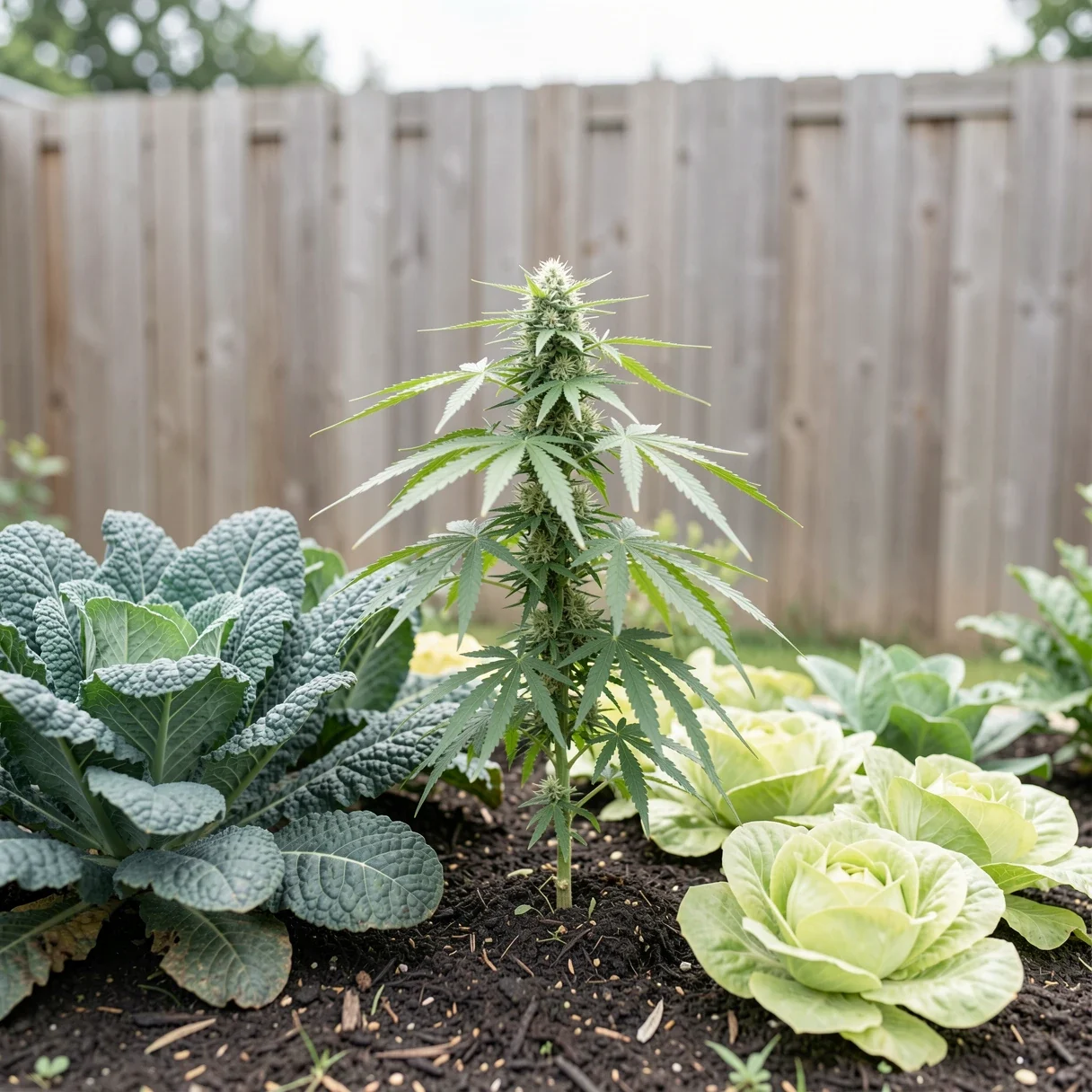
Autoflower plant height is decided mostly at the checkout, not in the tent. Pick a strain whose listed ceiling fits your space, give it strong light close enough that it never has to reach, get the pot right the first time, and use low stress training rather than a pair of scissors if you need it lower.
Everything else people try — light schedules, feeding harder, topping — is either working on the wrong variable or costing the plant days it can’t spare. The plant’s clock is not negotiable, and once you stop fighting it, autoflower plant height becomes the easiest thing in the grow to plan around: read the range on the product page, plan for the top of it, and you’ll never be surprised.
If you’re weighing autos against photoperiods in the first place, our autoflower versus feminized comparison covers the full trade-off, and the seed-to-harvest timeline shows where the height comes on.
Shop Autoflower Seeds | Low Stress Training Guide | More cannabis growing guides
Want to keep learning? Browse our full library of cannabis grow guides — everything from germination to harvest, in one place.
Ready to grow? Browse premium seeds from Lighthouse Genetics:
Designed & Built by Wynne Web Design