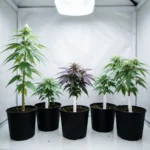
Not every grower has the luxury of a long, lazy season. Maybe your outdoor summer is short and the frost comes early. Maybe you’re indoors and you’d rather harvest in two months than four. Maybe you just don’t have the patience to babysit a plant until Halloween. Whatever the reason, fast flowering cannabis exists for exactly this — strains that finish weeks sooner than the slow ones.
This is a rundown of quick-finishing seeds we carry, split into the two ways a plant can finish fast: autoflowers that sprint through their whole life on a fixed internal clock, and short-flowering photoperiod strains that wrap up their bloom faster than the average. Every flowering time below is the one listed on that strain’s product page, not rounded down to sound impressive. If you want the broadest selection of fast flowering cannabis in one place, the autoflowers are where you’ll find it.

There are two different things people mean by fast flowering cannabis, and the difference matters when you’re choosing seeds.
The first is autoflowers. These carry an autoflowering trait, usually credited to Cannabis ruderalis (genomic studies question that origin), which lets them flower based on age rather than the light schedule. A photoperiod plant only starts blooming when nights get long (or you flip the lights to 12/12); an autoflower just starts on its own after a few weeks no matter what the light does. That fixed clock is why autoflowers finish so fast — there’s no long vegetative wait, so the whole grow is often done in around two to three months from sprout.
The second is a short-flowering photoperiod — a regular feminized strain whose bloom phase is simply shorter than average. Most photoperiod strains in our catalog flower in 8–10 weeks; the fast ones sit at or below the bottom of that range, while long-season sativas and hazes can run well past it. In our catalog, indica-leaning strains tend to list the shortest bloom. For a short outdoor season, picking a fast flowering cannabis photoperiod can be the difference between a ripe harvest and a frost-killed one.
Here’s how the two approaches to fast flowering cannabis stack up at a glance:
| Factor | Autoflowers | Short-Flowering Photoperiods |
|---|---|---|
| Total time from seed | ~2–3 months | 3–4 months indoors; longer outdoors |
| Flowers based on | Age (fixed clock) | Light schedule |
| Plant size | Compact | Full size |
| Yield per plant | Smaller | Larger |
| Second outdoor round | Possible in long seasons; untested in trials | No |
| Best for | Speed, short seasons, beginners | Yield, training, cloning |
Neither approach is “better” — it’s a trade. Autoflowers give you raw speed and a small, simple plant; fast photoperiods give you a bigger, trainable harvest that still finishes ahead of the slow strains. The right kind of fast flowering cannabis depends on whether you’re racing the calendar or just trimming a few weeks off a full-size grow.
If pure speed is the goal, autoflowers win. They’re the heart of any fast flowering cannabis lineup because the entire plant — not just its bloom — is built to finish quickly, and most of the autos we carry are rated Easy. The first three below list 8 to 11 weeks from seed, and Banana Sherbert’s 8–9 is among the quickest we stock; Gorilla Glue and Green Crack add the group’s highest THC listing and a daytime option. Each comes with the time its product page gives (effects are as described there, and they vary from person to person).
Banana Kush Autoflower is listed at 8–10 weeks from seed. It’s listed as mostly sativa and rated Easy; for the photoperiod Banana Kush, Leafly users most often report feeling relaxed and happy, though this auto is a separate cross and won’t always feel the same. That’s a fast flowering cannabis harvest in about two months.
Banana Sherbert Autoflower and Chunky Monkey Autoflower are listed at 8–9 weeks and roughly 8–11 weeks from seed; Chunky Monkey’s figure is an estimate from the autoflowering versions of its listed parents. Banana Sherbert is rated Easy and Chunky Monkey Easy to Moderate; both are indica-dominant.
Gorilla Glue Autoflower is listed at 70–75 days (about 10 weeks) from seed and carries the highest THC listing of this group, in our Very High bracket. That’s the product page’s rating, not a lab result for your plant. It’s a little slower than the picks above, so choose it when potency matters more than the last week of speed.
Green Crack Autoflower wraps up in 9–10 weeks from seed and is rated Easy. It’s a fast flowering cannabis hybrid listed at 55% sativa and 45% indica, and Green Crack is known as a daytime strain: for the photoperiod version, Leafly users most often report energetic, happy and uplifted effects, though an auto won’t always feel exactly the same.

Want a wider shortlist with an eye on ease rather than pure speed? Our guide to the best autoflower strains for beginners goes deeper, and you can browse the whole autoflower seed collection to compare flowering times yourself.
Autoflowers aren’t the only fast flowering cannabis option. If you prefer photoperiod plants — for bigger yields, cloning, or training — you can still get a fast flowering cannabis harvest by choosing strains that bloom on the short end. The rule of thumb: lean indica, avoid long-running hazes, and check the flowering time before you buy (AK-47, below, is a sativa-dominant exception).

Super Skunk is listed at 6–7 weeks of flower and California Hash Plant at 45–50 days (about 6–7 weeks), tied for the shortest of any photoperiod in our catalog. Both are indica-dominant and rated Easy. California Hash Plant lists much lower THC (8–12%).
Afghani flowers in 7–8 weeks and is rated Easy. One caution from its own product page: its buds are dense and can hold moisture, so keep humidity down late in flower to avoid bud rot, which matters most outdoors in a wet fall. AK-47, with the same Easy rating, is listed at 8–9 weeks and is sativa-dominant, so a quick bloom isn’t only an indica trait.
Northern Lights Skunk and Bubble OG are both listed at 8–9 weeks of flower. Northern Lights Skunk is rated Easy. Bubble OG is rated Moderate and finishes outdoors from late September to early October, so check it will come in before your first autumn frost.
Outdoors is where finishing speed really earns its keep, and where fast flowering cannabis is worth the most. If your season is short or your autumn turns wet and cold, a slow strain can get caught by frost or rot before it ripens. Fast flowering cannabis lowers both risks by being done sooner.
Autoflowers are the ultimate short-season outdoor play: because they don’t wait for the nights to get long, you can start them late and finish them early, and in long-season states like Georgia, University of Georgia Extension sees the promise of more than one auto crop a year. For photoperiod growers up north, sticking to the quick photoperiods above and getting plants out early gives them the best shot at ripening. Either way, finishing before the damp sets in lowers the risk of bud rot, and our region guides — growing cannabis outdoors in Canada and the Eastern US — cover the timing in detail.

The seed sets the pace with fast flowering cannabis, but a few habits keep a quick strain on schedule. Start autoflowers in their final pot: University of Georgia Extension notes that even slight root restriction can push autoflowering hemp into flower early. Skip heavy training too, since the same source notes that autoflowering hemp is very sensitive to stress early in growth. Give plants strong light and stable conditions so they never stall.
And know what ripeness actually looks like so you harvest your fast flowering cannabis at the right moment rather than guessing — our guide on how long cannabis takes from seed to harvest lays out the full timeline. Choosing genetics is step one; matching them to your setup is the rest of the job, and our how to choose cannabis seeds guide helps with that.
By listed time, Super Skunk and California Hash Plant are our quickest photoperiods, both at about 6–7 weeks of flower. Among autos, Banana Sherbert Autoflower (8–9 weeks from seed) is among the quickest we list, with Banana Kush Autoflower (8–10 weeks) and Chunky Monkey Autoflower (roughly 8–11 weeks) a little behind.
For total time from seed, almost always yes. An autoflower runs its whole life on a fixed clock and skips the long vegetative wait, so the entire grow is often done in around two to three months. A photoperiod plant spends weeks in veg before it even starts to flower, so even a fast-blooming one takes longer overall.
Yield per plant, usually yes: in a University of Georgia field trial, photoperiod hemp out-yielded autoflowering hemp in both years. Potency is less clear. Listed THC for our autos is about the same as for our photoperiods, but those are product-page figures, not lab results, and in one published greenhouse study two autos tested about 10% THC against roughly 15–18% for the photoperiods (one farm, autos from seed, photos from clones). Fast flowering cannabis mostly costs you plant size, and possibly some potency.
That’s exactly what they’re for. Autoflowers are ideal because they ignore the light cycle and finish on their own schedule, letting you start late and harvest before frost. Among photoperiods, stick to the shortest-flowering strains and get them outside early.
With autoflowers, possibly. Because they flower on age rather than day length, University of Georgia Extension sees the promise of more than one auto crop a year in long-season states like Georgia, though it takes care. Outdoor photoperiods flower when the nights lengthen, so a second round doesn’t work for them. In a University of Wisconsin field trial, autoflowering hemp sown in late June was cut in mid-to-late September, seven weeks into flower as the trial’s protocol set, and in a University of Georgia field trial, autoflowering hemp planted later in spring (April into late May) yielded less.
If finishing fast is the priority, start your search for fast flowering cannabis with autoflowers — they’re the core of the category, and several we carry, like Banana Sherbert Autoflower, are listed at around 8–9 weeks from seed. If you’d rather grow photoperiods, lean toward the shortest-flowering strains like Super Skunk, California Hash Plant and Afghani, and check the flowering time before you buy. Speed mostly costs you plant size (and possibly some potency), which is a fair trade when the calendar (or your patience) is the real constraint.
Ready to pick one? Browse the full autoflower seeds and feminized seeds ranges, or work through our cannabis growing guides to plan the grow around your season.
Shop Cannabis Seeds | Best Autoflower Strains for Beginners | Autoflower vs Feminized | All Cannabis Growing Guides
Keep reading
Browse all guides to growing cannabis by topic, from germination to harvest.
Ready to grow? Browse premium seeds from Lighthouse Genetics:
Designed & Built by Wynne Web Design