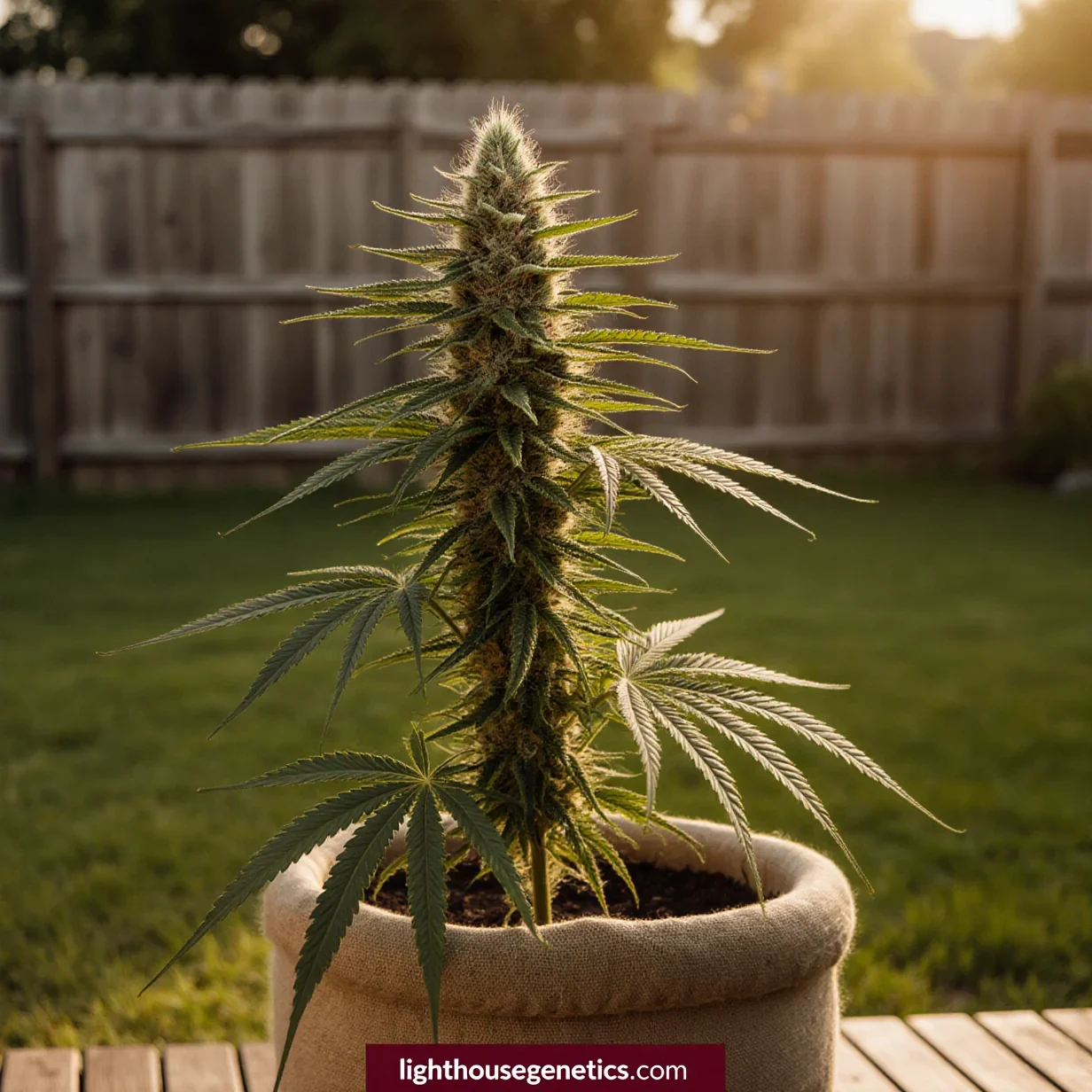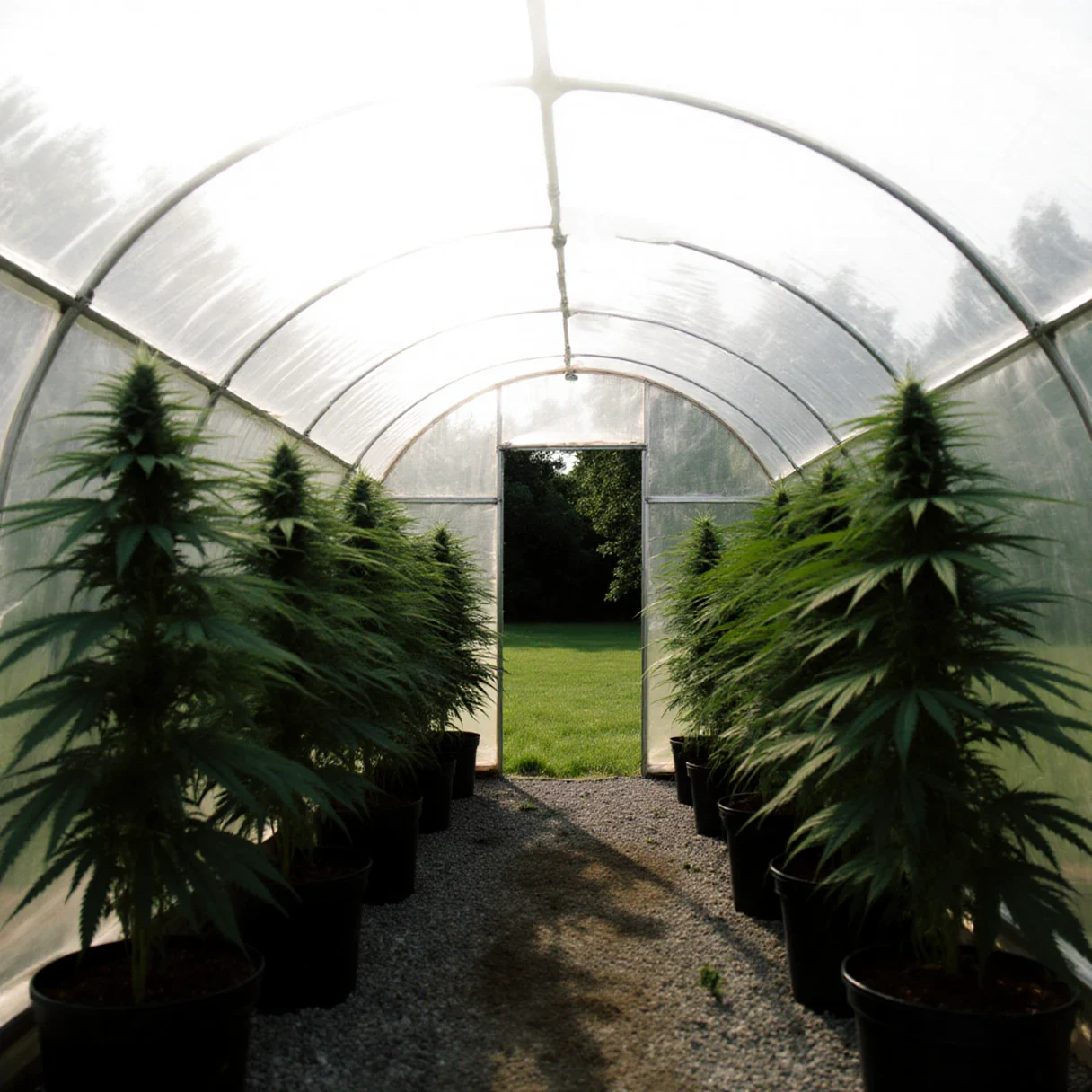
Cannabis loves sun. That is exactly why a desert summer is such a trap. The light is fantastic, but the heat and the bone-dry air come with it, and a plant can’t take one without the others. Growing cannabis in heat means spending the whole season trading light against temperature and water.
Our Canadian outdoor guide and our Eastern US guide are both built around one enemy: wet, humid autumns and the bud rot that follows. This post covers growing cannabis in heat — the other half of the map. Arizona, Nevada, inland California, west Texas, the high desert. Places where the problem isn’t too much water in the air. It’s too little, in places where a summer can bring dozens of 100°F (38°C) days.
Below is what the research actually says heat does to cannabis, what a hot, dry season looks like month by month, and seven fixes that hold up. Where the evidence comes from tomatoes or nursery trees instead of cannabis, we say so. Growing cannabis in heat is an area where a lot of confident advice has nothing behind it.
To understand growing cannabis in heat, start with the leaf. Lab measurements by Chandra and colleagues, published in Physiology and Molecular Biology of Plants, put the photosynthesis sweet spot for cannabis at about 77–86°F (25–30°C). Above 86°F, stomatal conductance fell — the leaf pores began closing down — and both photosynthesis and water-use efficiency dropped. Transpiration, the water the plant loses through its leaves, kept rising all the way to the hottest temperature tested, 104°F (40°C).
Put plainly: a hot leaf spends more water to make less sugar. That one sentence is most of what growing cannabis in heat is about.
Genetics move that line. A follow-up study from the same group tested seven varieties and found the photosynthesis optimum ranged from about 77°F (25°C) in some to 86–95°F (30–35°C) in a high-potency Mexican drug line. Dark respiration — the sugar a plant burns just to stay alive — roughly doubled between 68°F and 104°F (20°C and 40°C) in every variety tested. These were short leaf-level measurements, not harvests, so treat them as the mechanism behind growing cannabis in heat, not a yield forecast.
The most useful study on flowering heat came out of Wageningen University in 2025. Holweg and colleagues flowered two medical cannabis cultivars in climate chambers at either 77°F days and 70°F nights (25/21°C) or 88°F days and 81°F nights (31/27°C).
The warmer rooms reduced total cannabinoid concentration in both cultivars — including ‘Original Blitz’, the THC-dominant one. In the CBD-dominant cultivar, heat also tended to cut flower dry mass, by about 30%, though that drop wasn’t statistically significant, and it caused fox-tailing, those odd new calyx towers that grow out of the top of buds already formed. The THC cultivar’s flower weight held steady. Terpene levels in the finished flowers were not lowered by the heat.
A few caveats matter if you’re growing cannabis in heat. Both temperatures ran at the same relative humidity, which means the hotter rooms had a higher VPD — more drying power — so heat and drying weren’t separated. Each temperature was also its own growth cycle with two replicates, CO₂ was raised to 1,000 ppm by day, and the authors report an irrigation fault in one hot run.
And for growing cannabis in heat, 88°F (31°C) days with 81°F (27°C) nights is well short of a July afternoon in Phoenix. We couldn’t find a controlled flowering trial that compared true desert temperatures with cooler ones. Arizona’s 2020 Yuma hemp variety trial did flower plants through a desert summer, but it compared varieties, not temperatures. A separate hemp study did push young flowering plants to 113–122°F (45–50°C) for a week in a grow tent; they were completely wilted within three days, even with daily watering.
If your plants are already showing curled, crispy tops, that’s diagnosis territory, and our post on cannabis heat stress walks through telling heat apart from light and nutrient burn. This post is about setting up a season of growing cannabis in heat so you see less of it.
Indoor growers learn to think in VPD — vapour pressure deficit, the single number that combines temperature and humidity into how hard the air is pulling water out of a leaf. Our VPD for cannabis guide gives flowering targets that top out around 1.6 kPa.
Now run the same arithmetic on a desert afternoon. At 95°F (35°C) and 20% humidity, VPD comes out around 4.5 kPa. At 104°F (40°C) and 15%, it’s about 6.3 kPa. That’s our own calculation from the standard formula, not a measurement from a study, but it shows the scale. Growing cannabis in heat like that means the air is pulling water from the leaves three or four times harder than the indoor targets.
What the plant does about it is well understood in general plant science: when the air dries out, leaves close their stomata to save water, and a closed leaf isn’t taking in the carbon dioxide it needs to grow. We could not find a cannabis study that grew plants at desert-level VPD and measured the results. So the honest version for growing cannabis in heat is this: dry heat costs growth, and how much it costs your particular plant is something we found no measurements of.
Growing cannabis in heat starts with a calendar, and the desert calendar isn’t the one in most grow guides.
For growing cannabis in heat, Phoenix is the extreme case. According to Arizona State University’s monsoon page, the city averages about 99 days a year at 100°F (38°C) or hotter, and about 21 days at 110°F (43°C) or hotter. Arizona’s weather agencies define the monsoon season as June 15 to September 30. The National Weather Service says most of New Mexico and Arizona get 40–60% of their yearly precipitation in that window.
For anyone growing cannabis in heat, the monsoon matters for two reasons. First, the storms come in bursts and breaks, and ASU lists downbursts, straight-line winds and dust storms (haboobs) among the hazards. Anything tall, staked or covered in shade cloth has to be anchored for it. Second, it brings humidity back. A photoperiod plant finishing in October is building buds through the back half of the monsoon, so the humid-weather advice in our bud rot guide applies to desert growers too, just later in the season.
California runs differently. University of Arizona Extension, citing California’s CIMIS weather network, describes Southern California’s rain falling from November to March with prolonged drought in summer — no monsoon reset. In the high desert, the season ends on frost rather than heat: a University of Nevada, Reno hemp trial transplanted in mid-June and noted that early frosts can damage the crop at harvest.
The clearest lesson for growing cannabis in heat comes from Arizona’s first hemp season after prohibition was lifted. University of Arizona Extension’s CBD hemp production guide records that the first plantings went in during July 2019, and that most growers “planted in the extreme summer heat, which resulted in a high mortality.” Growers in Yuma who kept planting through the following winter seasons reported greater success, though cannabinoid levels sometimes ran low in winter.
The same guide gives a maximum recommended soil temperature for hemp germination of 105.3°F (40.7°C), and notes that heat may limit germination from mid-June to mid-September. If you’re growing cannabis in heat in the low desert, sow indoors where you control the temperature — our germination guide covers the method — and set plants out when the worst heat is behind them or still ahead.
Day length is the catch in spring. The Arizona guide reports that some spring plantings in Yuma flowered prematurely, depending on the strain. That’s why autoflowers are worth a look for growing cannabis in heat: they flower on their own clock regardless of day length, which, in our view, makes them a natural fit for running a short crop in the milder months before or after peak summer. One caution from the same Yuma work: in the 2020 trial, the autoflower varieties were hit harder by sodium than the photoperiods, possibly because of their shallower roots — so in salty desert soil, leach well and don’t let salts build up.
None of these fixes for growing cannabis in heat is exotic. What matters is the order. The first three cost little and deal with the root zone and water, which is where heat does damage you can’t see. Shade comes later because it costs you light.
Mulch is the fix for growing cannabis in heat with a real desert number behind it. Singer and Martin measured mulched and bare soils through two Phoenix summers, published in Arboriculture & Urban Forestry. Bare soil 2 inches (5 cm) down passed 104°F (40°C) for about 9–12 hours a day and peaked at a mean of 129°F (54°C). Under 2 inches (5 cm) of organic wood mulch, soil at that depth never passed 104°F, and ran 23–40°F (13–22°C) cooler in the afternoon.
Deeper down, at 12 inches (30 cm), the mulched soil held steady at about 82–90°F (28–32°C), roughly 14–18°F (8–10°C) cooler than bare soil. Over a 22-day evaporation test, bare soil lost about 2.8 inches (70 mm) of water. Soil under shredded tree trimmings lost about 1.24 inches (31 mm).
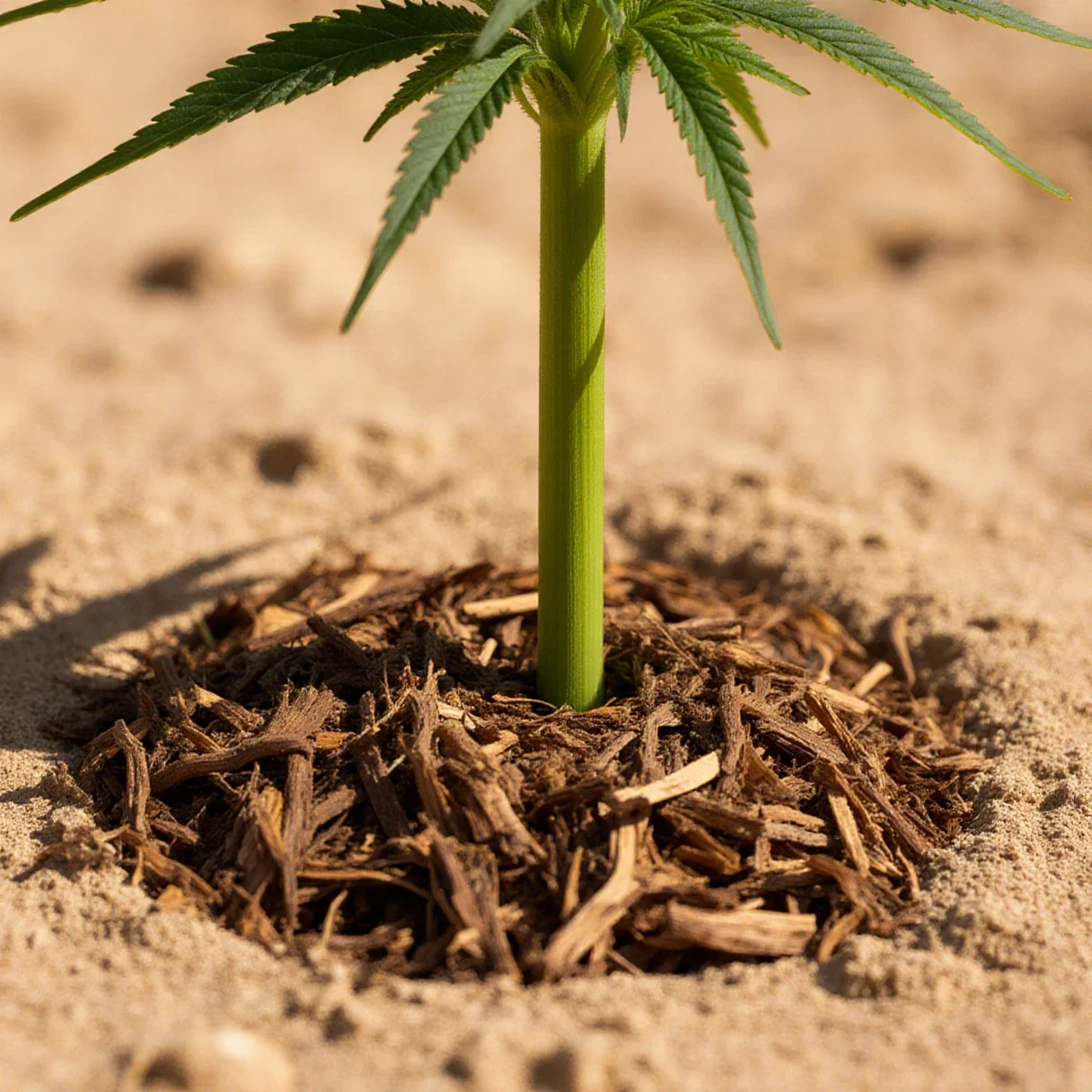
Three details from the same study are easy to miss. Decomposed granite — the rock mulch you see on every desert landscape — did not cool the soil the way wood did. The mulch surface itself hit 143–154°F (62–68°C) in the afternoon, so mulch cools the soil, not the air around your plant.
The mulch also broke down by as much as 48% in depth over two seasons, so top it up. University of Arizona Extension suggests 3–4 inches (7.5–10 cm) and keeping it away from the stem to avoid rot. This was bare landscape soil, not a cannabis crop, but the root zone doesn’t care what’s growing in it. Our living soil guide covers mulch from the soil-life side.
A black plastic pot in full sun is a solar collector wrapped around your roots. A Kansas State University thesis tested bush beans and nursery trees. In its bean study, the sun-facing side of black pots averaged a daily high of 122.5°F (50.3°C), against about 97°F (36°C) in white pots. Root mass on that hot side was 63–71% lower in the black pots. In separate peer-reviewed work on arborvitae, white containers cut maximum root-zone temperature by up to 12.6°F (7°C), and the time spent above 100°F (38°C) fell from 21% of the time to 3%.
None of that is cannabis data. The worst damage in the bean study was on the sunny side, but the black pots also ran hottest at the core and grew less root overall. And in the thesis’s heat-sensitive red maple study, white pots grew plants with up to 2.5 times the root mass and 2.3 times the top growth of black ones. For growing cannabis in heat, the direction is clear. Use light-coloured or bigger containers, which buffer heat better. Group pots so they shade each other, and shade the pot walls, not just the soil surface. The same thesis found that shading only the top of the pot didn’t stop the sides from heating.
Fabric pots are often sold as the cool option, and on the sunny side they usually are: nursery trials measured lower peak root-zone temperatures in fabric than in black plastic (a Colorado State pear trial; a 2016 shrub trial), though one Oklahoma study found monthly averages of the highs and lows similar. The catch is water. Fabric loses water through its walls, and in that shrub trial the authors think the fabric pots may have left plants mildly water-stressed in the middle and late part of the day. When growing cannabis in heat, a fabric pot needs watering more often than plastic.
Planting in the ground avoids the pot-wall problem entirely, especially under mulch. That’s our inference — we couldn’t find a desert cannabis trial comparing the two. In-ground isn’t risk-free either; Yuma’s hemp fields fought salty soil, which we’ll come to. For the temperature side, see our root zone temperature post, and for sizing, our guide to cannabis pot size.
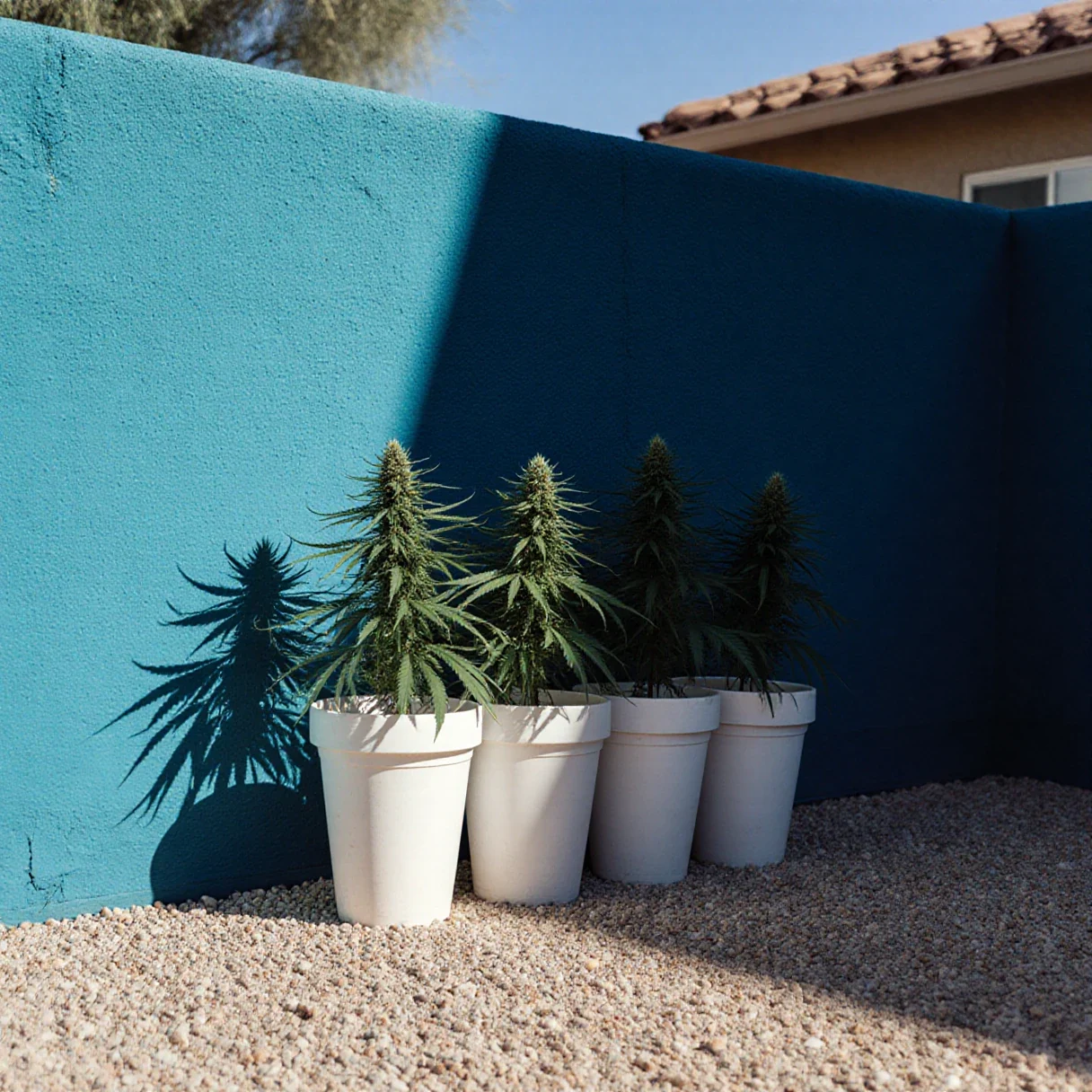
University of Arizona Extension’s watering guide — written for landscape trees and shrubs — says it plainly: “Watering in the early morning will be most efficient because of less wind and heat.” It also notes that plants use three to five times as much water in the hot, dry, windy season as in winter, so a spring schedule won’t survive July. Water deeply and less often for in-ground plants. In sandy soil, water more often but for less time.
The temptation when growing cannabis in heat is to keep the soil wet all the time. Arizona’s own hemp trial shows why that backfires. In its 2020 variety trial, a root rot called Pythium — “most active in wet, warm, soils of summer,” in the Extension’s words — caused significant losses across the state, “with 100% loss in many fields.” The advice that came out of it: let the soil dry between irrigations.
Check rather than guess when growing cannabis in heat. Arizona’s watering guide recommends pushing a smooth rod into the ground to see how deep the moisture goes; for pots, lifting them works. Our guide to watering cannabis plants covers reading pot weight and runoff. Be wary of the popular six-gallons-a-day (about 23 litres) figure. A 2025 review of hemp water use says it is much higher than what measured hemp fields use — typically about 4–5 mm (0.16–0.20 inches) of water per day across a stand. We couldn’t find a published per-plant figure for a big photoperiod plant in desert heat, so let the soil tell you.
Salt is another catch when growing cannabis in heat, because desert water and soil carry it. The Yuma trial report notes that sodium collects near the soil surface as water evaporates, and Arizona’s watering guide suggests watering three times longer than normal once or twice a year to push salts out of the root zone. If you’re deliberately drying plants down late in flower for potency, that’s a different practice — see our post on drought stress before you try it in heat.
Arizona Extension notes that sprinklers “can be inefficient because of wind and evaporation.” For growing cannabis in heat, drip puts water on the root zone and nowhere else. A cannabis study comparing drip methods found subsurface drip used 18.6% less water than surface drip, cut weed growth by 93%, and raised flower yield by 5%. That trial ran in a plastic tunnel in Germany, not a desert, so take the direction rather than the numbers. One more reason to keep water off the leaves: Arizona’s guide warns that salts in the water can damage foliage when it’s sprinkled.
This is the fix that’s easiest to overdo when growing cannabis in heat. Shade cloth lowers the heat load, but it also cuts the light, and cannabis uses an amazing amount of light. In an indoor study at comfortable temperatures, yield kept rising in a straight line all the way to the highest intensity tested — we covered it in our cannabis light intensity post. So shade has a cost. In real heat, where the light comes with a heat load, the trade-off hasn’t been measured outdoors. The one chamber study that raised light at 88°F (31°C) still got more flower from its THC cultivar, with added CO₂, but a desert afternoon is far hotter.
We couldn’t find a shade-cloth trial on growing cannabis in heat. The closest arid-US field study shaded tomatoes and chili peppers in west Texas: 50% shade held tomato yield but cost the peppers marketable fruit, 70% shade cut yield in both, and the authors, after one growing season, judged 50% shade beneficial overall for both crops but concluded that “a shading percentage below 50% may be better.” University of Arizona Extension suggests 30% shade cloth for cacti and succulents during extreme heat, and says to remove it once the heat passes so plants can get back to full sun.
Our take, inferred from those non-cannabis results: if you’re growing cannabis in heat, keep shade light, keep it on the hottest afternoons or heat waves, and take it off afterwards. Morning sun and afternoon shade from a west-side wall or fence is another way to do it, and it’s the approach Arizona Extension suggests for strawberries. And anchor any shade frame for monsoon downbursts.
The Nebraska Forest Service’s windbreak guide notes that gardens benefit from protection against “hot, dry, summer winds.”
But a solid barrier isn’t a free win. A chapter on windbreak practices in a North American agroforestry textbook notes that shelter cuts evaporation from bare soil, but also that daytime temperatures close to a medium-dense barrier can run several degrees warmer than in the open, because the air mixes less. It also notes that sheltered plants grow bigger and can end up more water-stressed in high heat, and that a very dense windbreak can raise humidity and create conditions for disease. For growing cannabis in heat, a porous screen beats a solid wall.
University of Arizona Extension’s heat guide advises avoiding or minimizing pruning during drought and excessive heat, because removing branches exposes previously shaded growth to direct sun and sunscald. It also suggests cutting back on fertilizer, which raises salinity in the root zone. That guidance was written for landscape trees and shrubs, but the logic carries over to growing cannabis in heat. Hold off on heavy defoliation until the heat wave breaks, and don’t push nutrients into a plant that’s already struggling to move water.
The research above points one way: plants differ. Chandra’s photosynthesis optimum varied by variety, and in the Wageningen study the THC cultivar held its flower weight in heat while the CBD cultivar’s tended to fall by about 30%, a drop that wasn’t statistically significant. Growing cannabis in heat starts with the seed you pick.
For growing cannabis in heat, here is how our own catalog describes each strain’s climate preference. We could not find a desert heat trial on any of these strains, from us or anyone else, so read these as listing descriptions, not test results.
Browse the full ranges in our feminized seeds and autoflower seeds categories.
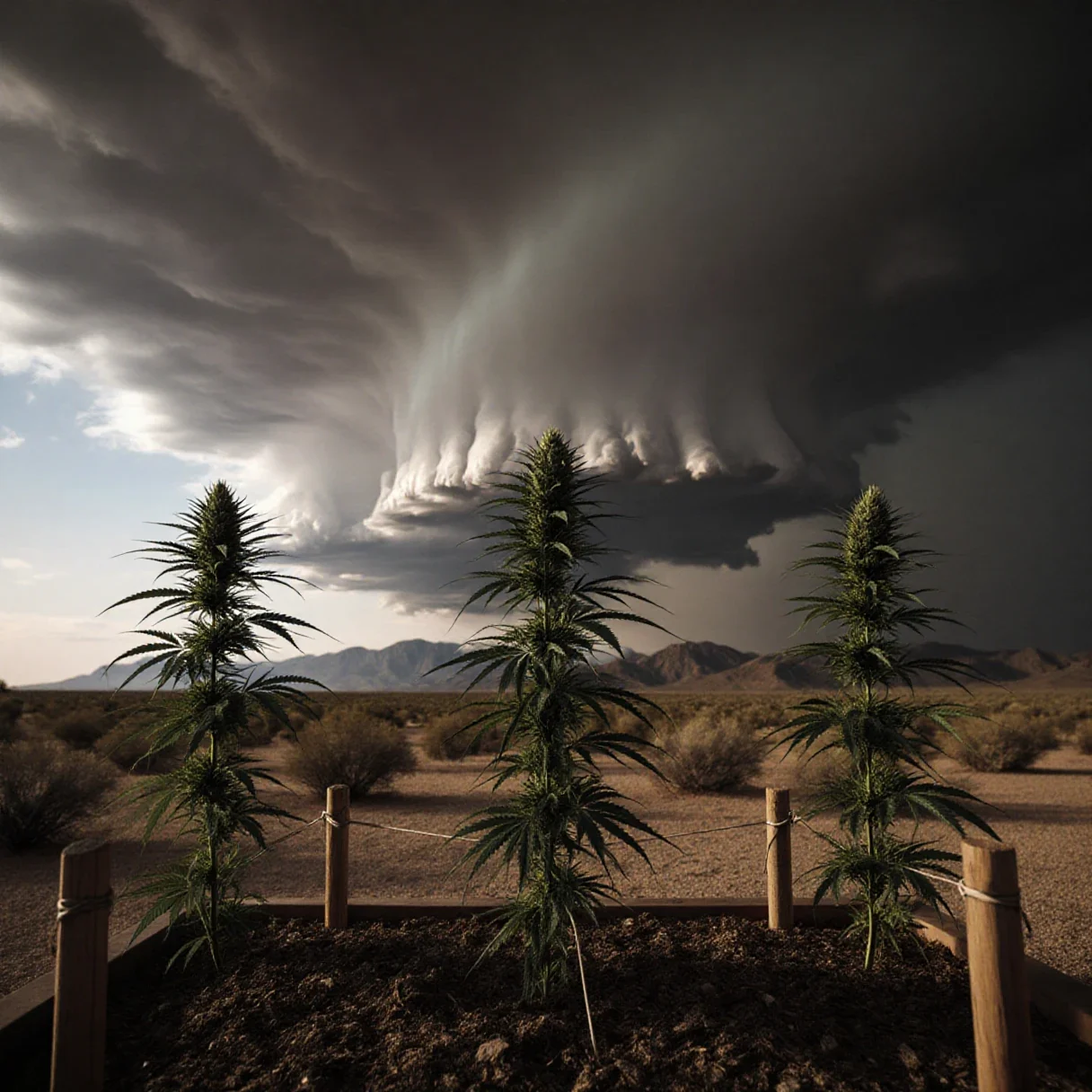
Growing cannabis in heat is as much a root-zone and timing problem as a sun problem. Cool the soil with organic mulch, keep pots out of direct sun, water early and let the soil dry between, and don’t plant into the hottest stretch of the year. Those four things cost little, and they protect the root zone without taking away any light.
When growing cannabis in heat, shade cloth is the last resort, not the first purchase. And when you pick seeds, pick genetics described for warm, dry climates — then plan for the monsoon, because the desert’s second season arrives as your buds are forming. For the rest of the season, from germination to curing, our cannabis grow guides pick up where this one stops.
Shop Cannabis Seeds | Cannabis Heat Stress | VPD for Cannabis | Growing Outdoors in the Eastern US
There’s no single cutoff for growing cannabis in heat. Leaf photosynthesis peaks around 77–86°F (25–30°C) in lab measurements and falls off above that, though one Mexican drug variety held up to 86–95°F (30–35°C). Flowering at 88°F days and 81°F nights (31/27°C) cut cannabinoid levels in a 2025 chamber study. And a week at 113–122°F (45–50°C) wilted young hemp plants within three days. The longer and hotter it runs, the more it costs.
That’s the claim you’ll see everywhere, but we couldn’t find a controlled study on cannabis that showed it. A paper often cited for it, Punja and Holmes’s 2020 study of hermaphroditism, never mentions heat; the one temperature trigger it does mention is reduced temperature. The only cannabis temperature experiment a 2026 review on the subject cites was about cold, roughly 55°F (13°C). Stress in general is linked to intersex flowers, and genetics play a big part, but we found no controlled test of heat alone.
Not in the one flowering study we found. In the Wageningen study, flowering at 88°F (31°C) days did not lower terpene levels in the finished flowers. We couldn’t find a measurement at 105–115°F (41–46°C), so the honest answer for a desert afternoon is that it’s unknown. That’s while growing cannabis in heat; drying is different, and heat in the drying room does cost terpenes (see our curing guide).
More than in spring when you’re growing cannabis in heat. Arizona Extension, writing about landscape trees and shrubs, says plants use three to five times as much water in the hot, dry, windy season as in winter. Be wary of the six-gallons-a-day (about 23 litres) figure you’ll often see quoted; a 2025 review of hemp water use says it’s much higher than measured hemp fields use, and we couldn’t find a per-plant figure for big plants in desert heat. Water when the soil or the pot tells you to, early in the day, and let it dry between.
No. When growing cannabis in heat, shade trades away light the plant could use, and the closest field trial suggests keeping it under 50%. Use light shade on the worst afternoons and heat waves, then take it off.
Keep reading
Browse all cannabis grow guides by topic, from germination to harvest.
Ready to grow? Browse premium seeds from Lighthouse Genetics:
Designed & Built by Wynne Web Design