Ask ten growers what cannabis pot size you should use and you will get ten confident answers, most of them a number of gallons with nothing behind it. Three gallons. Five. Seven if you are serious. Nobody ever says why, and almost nobody mentions the part that actually decides it — how long the plant is going to sit in that pot before it flowers.
So here is the short version before the long one. Cannabis pot size controls how big one plant can get. What it does not appear to control is how much comes off a square metre of floor. Those are two different questions, growers habitually answer the second one with the first, and the thin research that exists on cannabis yield does not back the swap.
Root volume is a real limit, and it is not subtle. The best number we have comes from a meta-analysis of 65 pot-size studies published in Functional Plant Biology, which found that on average, a doubling of the pot size increased biomass production by 43%. That is general plant science across a lot of species — it is not a cannabis trial, and we will get to the cannabis evidence in a moment — but the effect is large and consistent enough to be worth understanding before you settle on a cannabis pot size.
The interesting part is the mechanism. The same paper suggests that reduced growth in smaller pots comes mainly from a drop in photosynthesis per unit leaf area, rather than from the plant changing its shape or sending a different share of its growth to the roots. A pot-limited plant is not a plant that decided to stay small. It is a plant whose leaves are working at a lower rate, and you cannot see that by looking at it. That is the awkward thing about cannabis pot size — when you get it wrong, the plant does not tell you.
The authors also give a threshold: an appropriate pot size is one in which the plant biomass does not exceed one gram per litre. Run that against a real cannabis grow and the result is uncomfortable. A plant in a 19 L (5 US gallon) pot that gives you 150 g of dry flower is already close to 8 g per litre on the flower alone, before you count stems, fan leaves and roots. By the standard plant scientists use, essentially every cannabis plant in a home-grow container is running root-restricted.
That is not a reason to panic, and it is not a reason to buy a 100-litre pot. It is a reason to stop treating cannabis pot size as a setting you get right once and start treating it as a constraint you are always trading against something else.
Here is where it gets awkward for the gallon charts. The only peer-reviewed meta-analysis we can find that pooled cannabis yield data and included container volume as a variable is Backer and colleagues, published in Frontiers in Plant Science in 2019. It built statistical models for yield per plant, per square metre and per watt of lighting, and for THC and CBD both per plant and per square metre.
Cannabis pot size did not make it into any of the three yield models. Not yield per square metre, where the surviving variables were the duration of the flowering period, the light type and the variety. Not yield per watt. Not even yield per plant, which came down to plant density, light intensity and one variety interaction. Container volume was offered to all three and selected by none of them.
Where cannabis pot size did show up was in the two THC models — and it pointed in opposite directions. THC per plant rose with the square of the pot size (p = 0.0159). THC per square metre fell going from 5 to 11 L for the variety White Widow, with a much smaller effect on the others (p = 0.0035).
Read those two together and you have this post’s argument written in the paper’s own numbers: the bigger container produced more THC on the plant, and less THC on the floor.
Five fences on that, because this is the one piece of cannabis pot size research that gets quoted badly. The only container volumes anywhere in that paper are 5 L and 11 L — roughly 1.3 and 2.9 US gallons — so it says nothing at all about the difference between a 3-gallon and a 7-gallon pot. The grows behind it were indoor, under HPS and metal halide lamps; there is no LED anywhere in the dataset.
The next two fences are the authors’ own. They are explicit that plant density could not be statistically separated from maximum temperature or the vegetative photoperiod in those experiments. And they report that only three studies cleared the bar for inclusion, because nothing else in the published literature described its growing conditions in enough detail to model. Three studies is the entire evidence base behind every cannabis pot size result in this post.
The fifth fence is in the published data rather than the text, and it is the one that matters most. Across the modelled treatments, container volume never varies on its own — there is not one pair of treatments anywhere in that table that differs in pot size alone. Every 11-litre treatment ran one fertiliser regime, and every 5-litre treatment in the largest of the three studies ran another.
White Widow shows it cleanest, which matters because White Widow is the variety the THC result is actually about. Its 11-litre plants were all grown at 16 plants per square metre, its 5-litre plants in the same study at 20, and a third set sat in 5-litre pots at 10 plants per square metre on a different feed entirely. The pot never changed without the spacing or the feed changing with it. When that is true of the whole dataset, a model declining to pick pot size out is not the same as pot size doing nothing. It is absence of evidence.
What you should take from it is narrow and useful: per square metre of floor, the things that predicted cannabis yield in that data were light, how long you flower, and which variety you run. Cannabis pot size was not a lever this dataset could detect. That does not mean a bigger pot does nothing — Poorter’s 43% says it clearly does, for the individual plant. It means that as far as we can find, nobody has yet shown that the floor underneath cares.
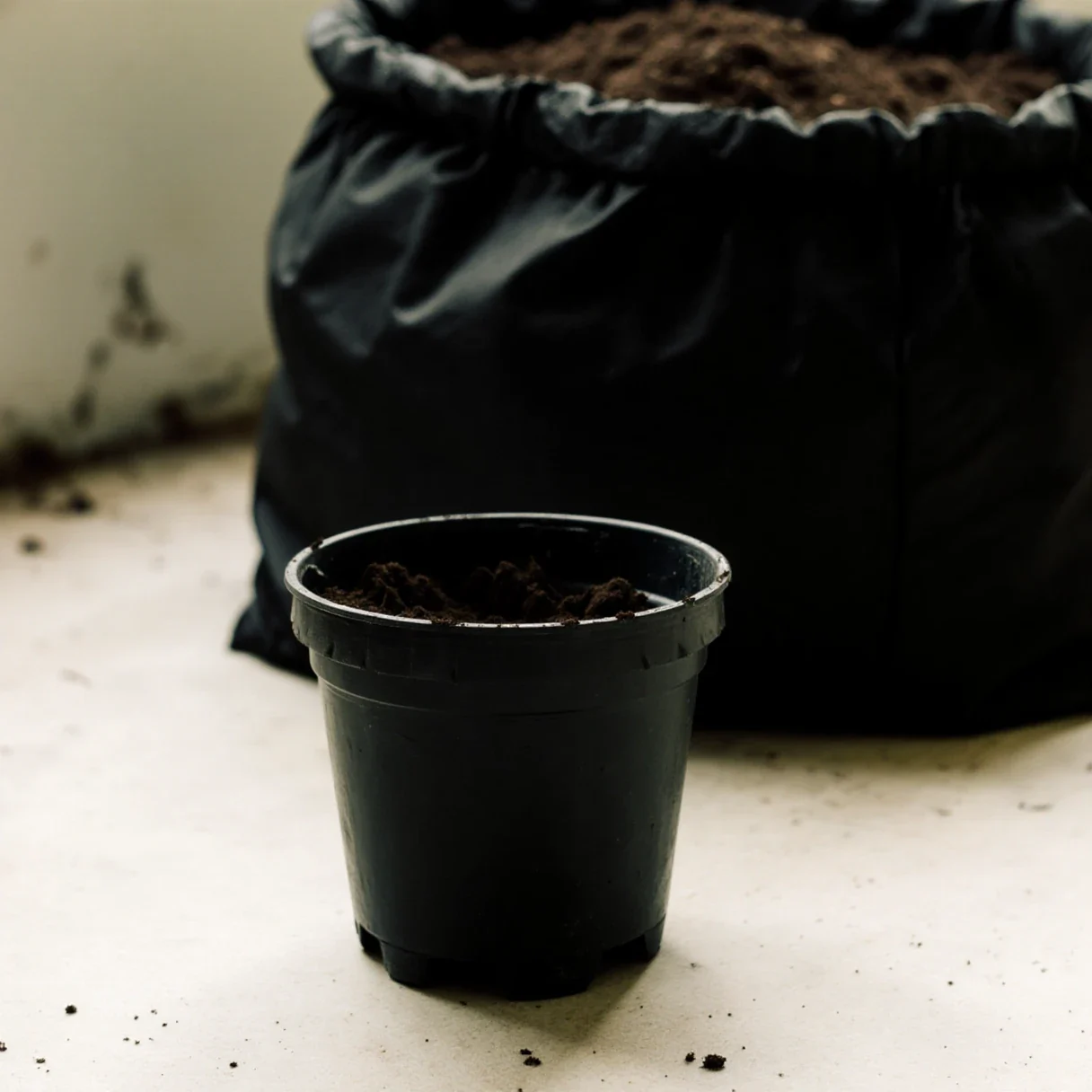
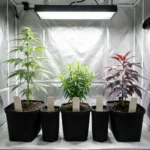
A grow tent has a fixed footprint and a fixed amount of light falling into it. Going from 11 L to 26 L (3 to 7 US gallons) per plant in a 4×4 does not add floor space or photons — it means fewer plants sharing the same light. One larger plant may well fill that space as well as three smaller ones. It will not obviously beat them, and it will take longer to get there, because a larger cannabis pot size is only worth its volume if you veg long enough to fill it with roots.
That is the trade in one sentence: pot volume buys you plant size, and plant size costs you veg time. If you are running a canopy-filling approach rather than a plant-count approach, the mechanics of that decision are in our guide to SCROG and Sea of Green — that post owns the plant-count side of this, and it is worth reading alongside this one.
The honest conclusion is that cannabis pot size is a scheduling decision dressed up as an equipment decision. Big pots, long veg, few plants. Small pots, short veg, more plants. Both routes fill the same tent.
With that framing in place, a cannabis pot size chart is finally useful — not as a yield table, but as a starting point matched to how long the plant will be growing. These are grower conventions, not measured results, and they assume a reasonably free-draining medium.
| Stage or plan | Container | Roughly | Why |
|---|---|---|---|
| Germination to first true leaves | Solo cup or small starter | 0.3–0.5 L (10–16 oz) | A tiny root system in a big wet pot is the classic overwatering trap |
| Early veg | Small pot | 4 L (1 US gal) | Roots fill it in a couple of weeks, which is the point — you want them to |
| Short veg, more plants | Final pot | 11 L (3 US gal) | Enough for a 3–4 week veg and a plant around 80–120 cm (31–47 in) |
| Standard indoor photoperiod | Final pot | 19 L (5 US gal) | The default for a reason — supports 6–8 weeks of veg without constant watering |
| Long veg, big single plants | Final pot | 26–38 L (7–10 US gal) | Only pays if you actually veg long enough to fill it |
| Outdoor season in containers | Final pot | 57 L+ (15 US gal+) | A full season of growth plus a water buffer on hot days |
Two things no cannabis pot size chart will tell you. It will not tell you which strain you are growing, and the height range on a pack matters more than any rule of thumb — Durban Poison is listed at 90 to 400 cm (35 to 157 in) and Alien Technology at 30 to 120 cm (12 to 47 in), and those two plants do not want the same container. And it will not tell you how often you can water, which for most indoor growers is the real limit on going small.
This is the other half of the cannabis pot size question — not just how big, but when. The case for potting up in stages rather than starting in the final container is simple: a small root system in a large volume of wet medium stays wet too long, and that is where beginners drown plants. Starting small and moving up keeps the wet-dry cycle tight while the plant is fragile. The first move — out of the starter and into veg — belongs to the early weeks, and we cover the timing of it in the cannabis seedling stage guide.
After that, two transplants is plenty for most indoor photoperiod grows: starter to 4 L (1 gallon), then 4 L to the final pot. Every move costs the plant a few days of stalled growth, so more transplants is not more care. It is just more interruptions.
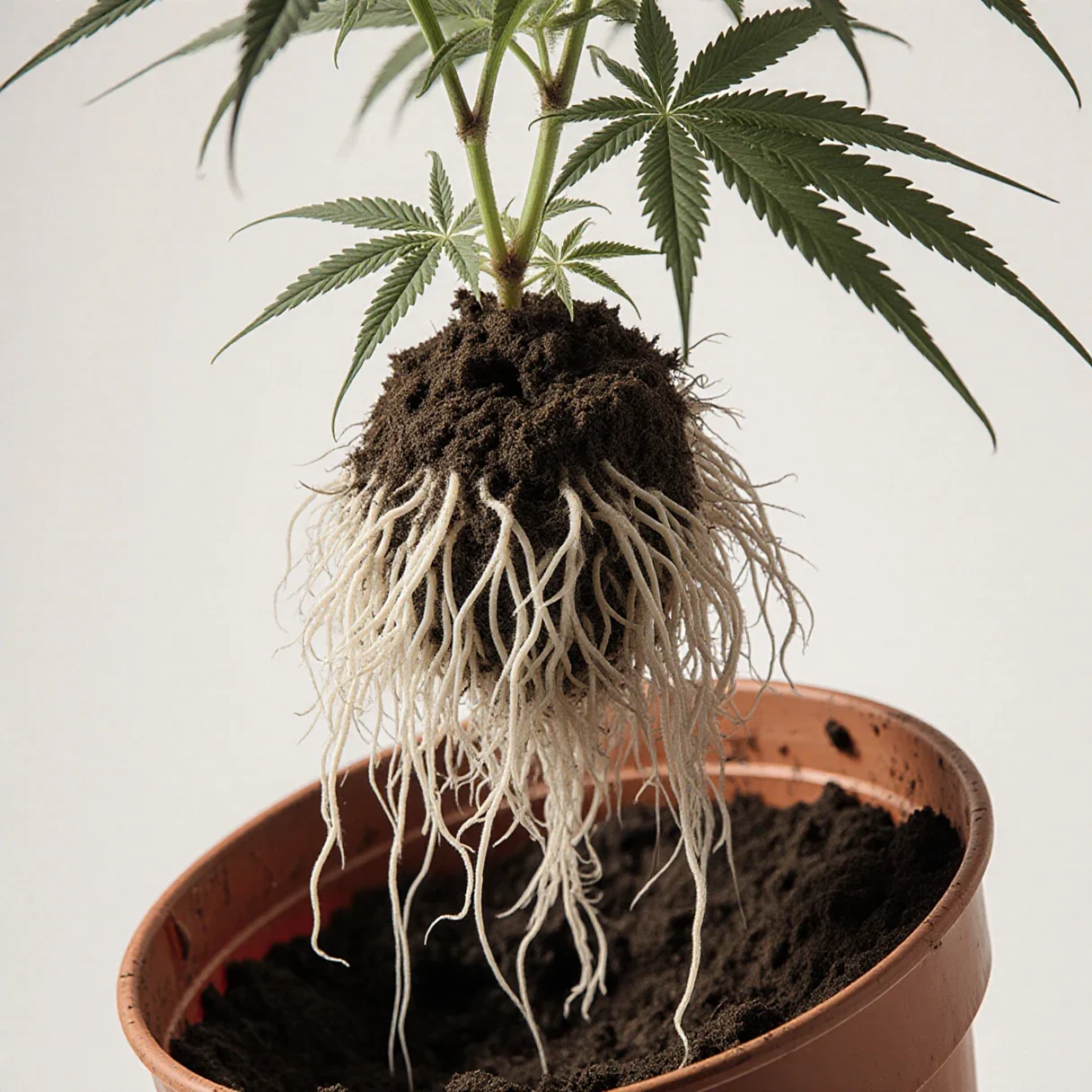
Move up when roots are visible at the drainage holes and the pot dries out noticeably faster than it did a week ago — a pot that needs water every second day when it used to go four is telling you the medium is mostly root now. Do not wait for the plant to look unhappy. By the time the leaves say something, you have already lost growth, and no change of cannabis pot size gives those days back.
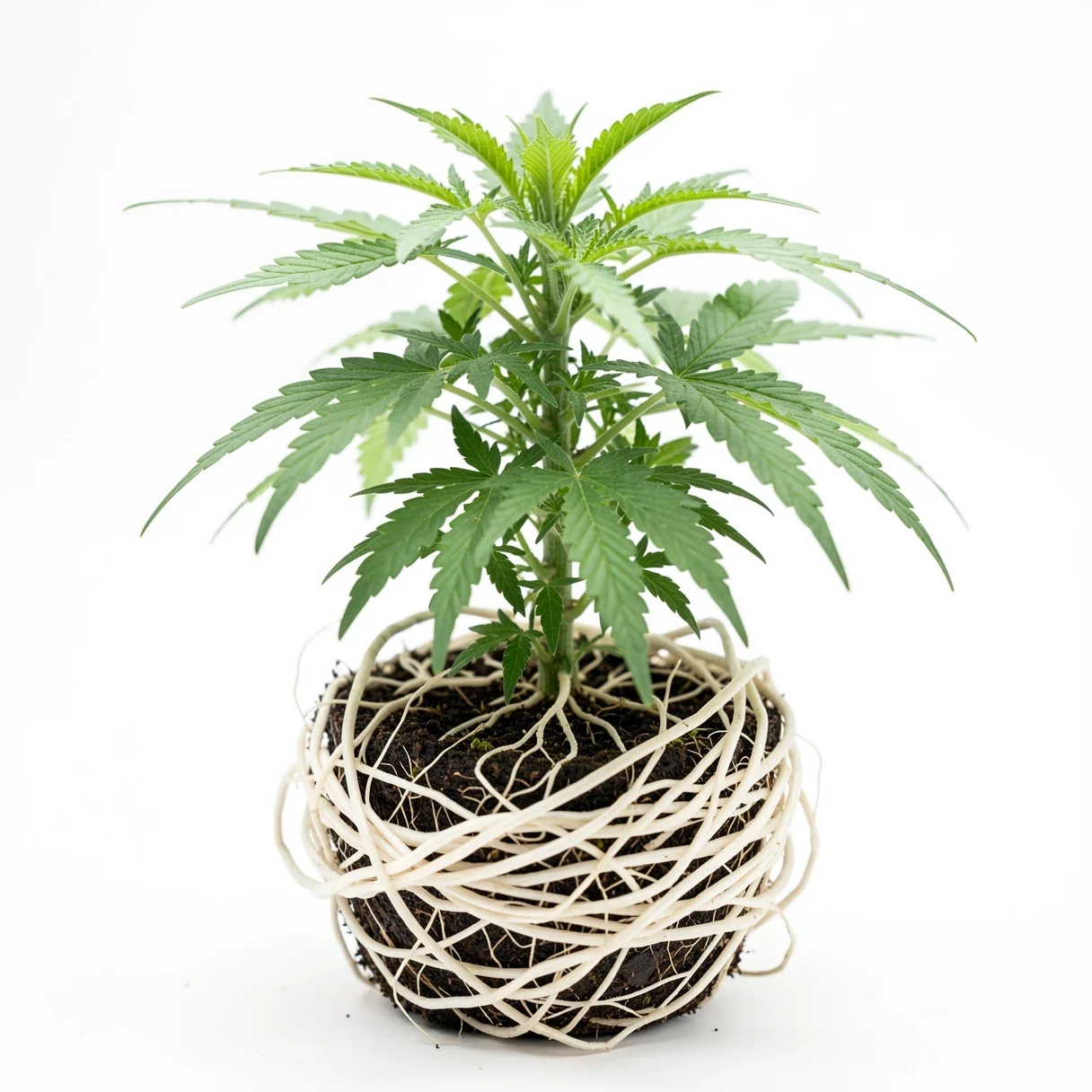
One detail from the nursery trade worth stealing. In the Acta Horticulturae container study discussed below, the authors noted that roots already touching the container wall at planting time often turned and grew inward, producing structures that could girdle the plant later. Their recommendation was to trim roots back from the wall before planting. For a cannabis grower that translates cleanly: transplant before the root ball is a solid wall of circling roots, not after.
Autoflowers are the standard exception, and the reasoning is about the clock rather than the container. An autoflower starts flowering on age, not on a light change, so it does not have an open-ended veg period to recover in. A few stalled days after a rough transplant come straight out of the only vegetative growth that plant will ever do.
The usual advice is therefore to germinate straight into the final container and leave the plant alone. Worth being honest about what that advice is: it is widely held grower practice, not something we can point to a controlled trial for. We have not found one comparing transplanted against direct-sown autoflowers under otherwise identical conditions.
Practically, the cannabis pot size that suits most autoflowers is 11 L (3 US gallons), and a 19 L (5 gallon) pot is not wasted on the larger ones. A compact runner like White Widow Autoflower at 50–80 cm (20–31 in) is happy in less; Devil XXL Autoflower at 110–160 cm (43–63 in) is not. If you want the size question answered properly before you buy the pot, that is what our autoflower plant height guide is for, and the light side of the same decision is in the autoflower light schedule post.
Cannabis pot size is only half of the container decision; what the container is made of is the other half. Fabric pots are sold on air pruning — roots hit the porous wall, dry back, and the plant branches instead of circling. That part holds up. A trial published in Acta Horticulturae compared four root-pruning containers against standard plastic on two woody nursery shrubs and found all four limited root circling and produced more fine roots, with the fabric pots showing little to no root growth along the container sides.
The part nobody quotes is the biomass. In that same trial, shoot dry weights were highest in the rigid Air-Pot and lowest in the fabric Smart Pot — for serviceberry, 494 g against 298 g. The fabric pot came last, not first.
The authors’ explanation is the useful bit, and they put it carefully: every container in the trial got the same drip irrigation each morning, the fabric pot lost more water by evaporation through its walls, and that could have left the plants in it under mild water stress through the middle of the day. On their reading the fabric pot did not lose because fabric is worse. It lost because it was watered like a plastic pot.
That is a two-page conference paper on nursery shrubs, not a cannabis trial in a tent, so do not carry the numbers across. Carry the lesson: at the same cannabis pot size, a fabric pot is a different watering job, not a drop-in swap. Plan on watering more often and check the pot by weight rather than by schedule — the how-to is in watering cannabis plants.
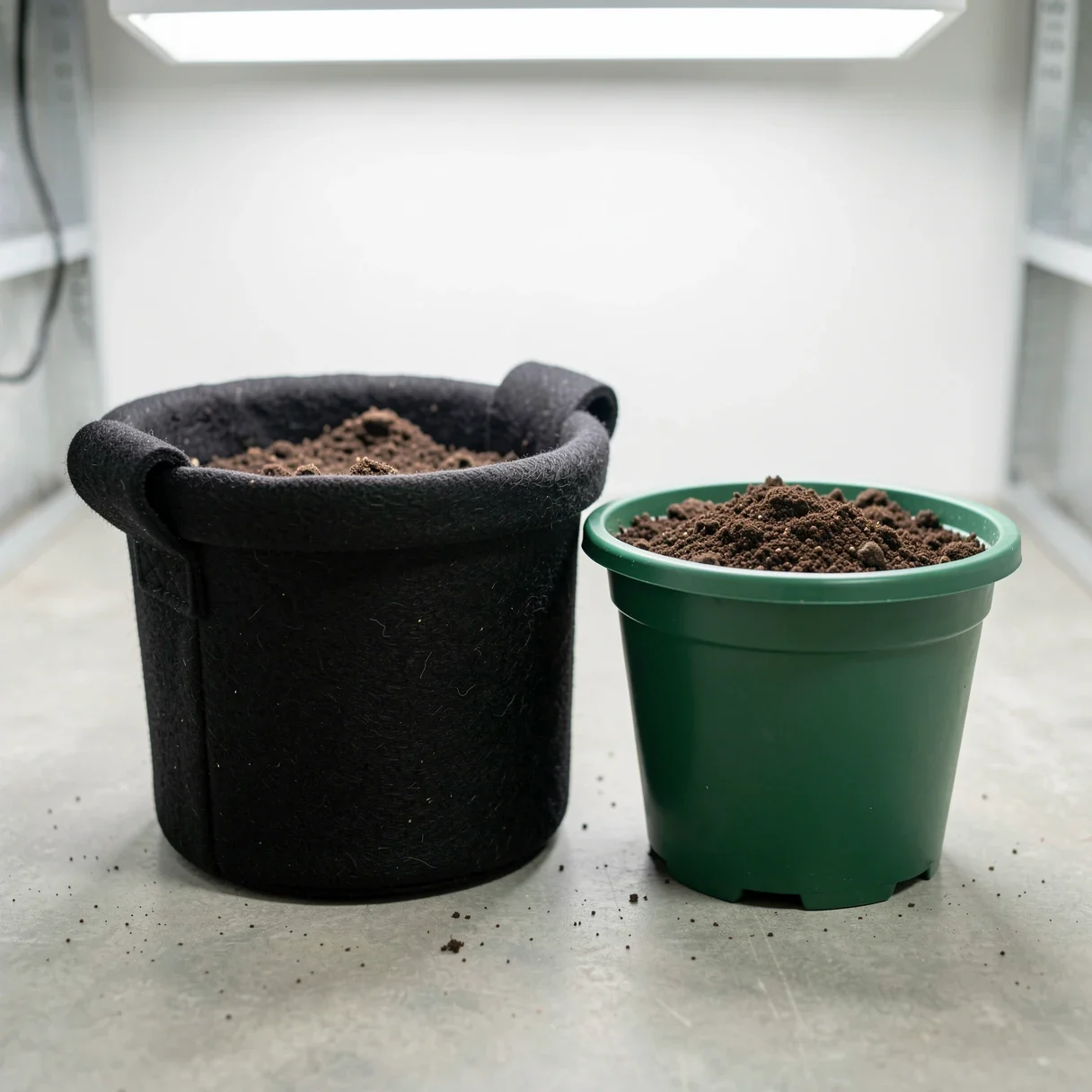
The same study measured medium temperature on the sun-exposed side and found the fabric pots ran coldest, at one point 121.4°F in plastic against 86.3°F in the fabric pot — a gap of about 35°F (roughly 19°C). Outdoors in summer that evaporative cooling is a genuine advantage, and it is the reason fabric pots turn up as a fix in our root zone temperature guide. In a cool basement in winter it is working against you.
The clearest sign your cannabis pot size is wrong is a plant that has quietly stopped growing, and a pot-limited plant rarely announces itself. The tells are a plant that dries out far faster than its neighbours, growth that flattens out while everything else is still climbing, and the sort of stubborn pale colour that does not respond to feeding. Slide the plant out and you will see it immediately: a dense mat of roots wrapped around the outside of the medium, often circling the bottom.
If you catch it in veg, pot up and the plant recovers. If you catch it in flower, you are mostly managing it — water more often and in smaller amounts, keep the feed steady, and take the lesson for next run. Pale, stalled plants are not always a container problem, so rule out the usual suspects first with our guide to cannabis nutrient deficiencies.
Worth saying plainly: the medium matters as much as the volume here. A dense, water-retentive soil in a big container behaves nothing like coco in the same pot, which is why the soil vs coco vs hydro decision comes before the cannabis pot size decision, not after it. If you are running a soil you intend to keep and re-amend, the container is part of that system too — that is covered in living soil for cannabis.
Matching genetics to cannabis pot size is the easiest part of this, because the height and yield ranges are on the product page. If you are committing to large containers and a long veg, pick something with the frame to use them. Acapulco Gold is listed at 150–250 cm (59–98 in) and 800–1500 g per plant outdoors, Big Bud at up to 225 cm (89 in), and Super Skunk Silver Haze at up to 450 cm (177 in) with yields up to 1500 g per plant. None of those are 3-gallon plants.
Going the other way — more plants, smaller containers, shorter veg — the catalogue has plenty of genuinely compact stock. Bubba Kush stays under 100 cm (39 in), Blackberry Kush runs 60–100 cm (24–39 in), and on the autoflower side Mandarin Cookies Autoflower and Grape Ape Autoflower both finish short enough for an 11 L (3 gallon) pot.
For a middle path that forgives a container mistake in either direction, the reliable ones are Northern Lights Skunk and White Widow. Mac’s own Blue Monkey Dick at 100–140 cm (39–55 in) and Grape Skunk at 80–120 cm (31–47 in) sit comfortably in a standard 19 L pot as well.
Browse the full feminized cannabis seeds and autoflower cannabis seeds ranges to check the listed height before you commit to a container.
There is no single best answer, and that is the honest one. Four plants in 19 L (5 gallon) pots and nine plants in 11 L (3 gallon) pots both fill a 4×4 canopy. The first route needs a longer veg, the second needs more seeds. Pick based on how long you are willing to veg.
Functionally, yes — not because the roots object, but because a small plant in a large volume of medium stays wet far longer than it should, and slow-drying medium is where root problems start. That is a watering problem rather than a pot problem, but it is easier to avoid than to fix.
For a single plant, the general plant-science evidence says larger rooting volume means more biomass, so a bigger cannabis pot size should give a bigger plant. Per square metre of grow space, the cannabis meta-analysis did not select container volume as a predictor of yield at all — though in that dataset pot size never changed without the feed and the spacing changing with it, so that is a weak no rather than a proven one. Both can be true at once, and usually are.
Common practice is not to — germinate into the final container so the fixed age clock is never interrupted. We could not find a controlled trial testing it, so treat that as grower convention rather than settled science.
In the only cannabis meta-analysis we can find that modelled it, it cut both ways: THC per plant rose with the square of the pot size, while THC per square metre fell for a single variety going from 5 L to 11 L. More on the plant, less on the floor. That is a narrow result from three studies under HPS and metal halide lamps, with only two container volumes in the whole dataset, so treat it as a direction rather than a rule.
More often than a plastic one of the same volume. The nursery trial above found fabric containers lost enough water through their walls to put plants under mild midday stress on an irrigation schedule that suited plastic. Go by pot weight, not by calendar.
Cannabis pot size is worth getting right, and it is not the yield dial it gets sold as. Root volume genuinely limits how large an individual plant becomes — the 43% figure from 65 studies is not nothing. But the only cannabis meta-analysis we can find that put container volume in the model did not select it as a predictor of yield in any form, and where it did turn up it split the way this whole post splits: more THC per plant, less per square metre. That is three studies and two pot sizes, so it is a direction of travel rather than a finding to bank on.
So the practical cannabis pot size answer: 19 L (5 US gallons) is a sensible default for an indoor photoperiod plant, 11 L (3 gallons) is fine for a short veg or an autoflower, and if you are going bigger, go bigger because you are vegging longer — not because you read that gallons equal grams. Then spend the attention you saved on light and flowering time, which is where that meta-analysis actually found the yield.
Cannabis pot size is one decision inside a much bigger setup. If you want the rest of that system, start with the grow tent setup guide and work through the rest of our cannabis growing guides.
Shop all cannabis seeds | The Cannabis Seedling Stage | Watering Cannabis Plants
Want to keep learning? Browse our full library of guides to growing cannabis — everything from germination to harvest, in one place.
Ready to grow? Browse premium seeds from Lighthouse Genetics:
Designed & Built by Wynne Web Design