The tops of your plant are pale, the edges are curling up like tacos, and the leaves nearest the light look scorched. Every forum will tell you the same thing: light burn, raise your light. Half the time that advice is wrong, and it costs you yield for no reason.
Cannabis heat stress and light burn look almost identical from three feet away, because they usually arrive together — but they are not the same problem and they don’t have the same fix. One is about temperature. The other is genuinely about photons, and it’s rarer than the internet thinks. Getting the diagnosis right decides whether you raise the light, fix the airflow, or leave both alone.
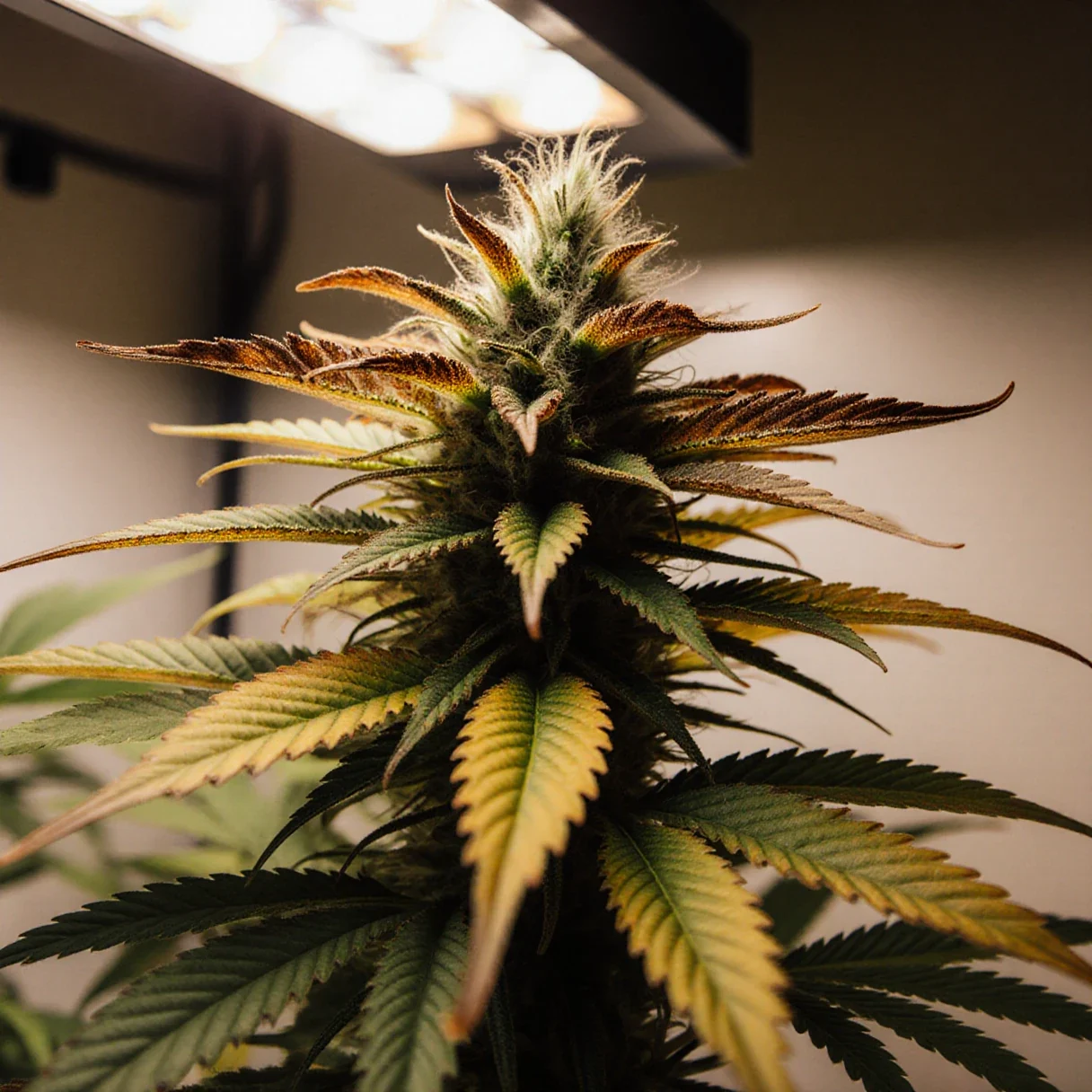
Start here, because it reframes everything else. Cannabis has an unusually high tolerance for light intensity — far higher than most growers assume when they blame the fixture.
A 2021 study in Frontiers in Plant Science grew cannabis across a wide range of light levels and found dry inflorescence yield increased linearly from 116 to 519 g·m⁻² — 4.5 times higher — as canopy light rose from 120 all the way to 1,800 µmol·m⁻²·s⁻¹. Yield never saturated inside the range they tested. There were no light-intensity effects on cannabinoid potency either. The plant just kept converting more light into more flower.
Read that against what a typical home tent actually delivers and the conclusion is awkward: plenty of home grows sit well below the 1,800 µmol·m⁻²·s⁻¹ top of that tested range — which means they are under-lit rather than over-lit. If your fixture is genuinely strong enough to injure a plant by intensity alone, it is a serious piece of equipment. So when the tops look burnt, the first suspect should be cannabis heat stress — not the diodes.
Cannabis heat stress isn’t vague discomfort — it’s a measurable collapse in how much work the leaf can do. Photosynthesis is a temperature-dependent process with a peak, and cannabis has been measured.
Work by Chandra and colleagues, published in Physiology and Molecular Biology of Plants, tested cannabis across 20, 25, 30, 35 and 40 °C. The maximum rate of photosynthesis was observed at 30 °C under 1,500 µmol·m⁻²·s⁻¹. Above 30 °C the plant went backwards: the authors reported that temperature above 30 °C had an adverse effect on stomatal conductance, and that high temperature combined with high light hurt both photosynthesis and water-use efficiency.
That last sentence is the whole story of cannabis heat stress in one line. Heat and strong light are not independent problems — the paper found them adverse in combination. A light level the plant handled comfortably in a cool room can become a problem in a hot one, which is exactly why the same fixture that ran beautifully all winter starts “burning” plants in July.
The mechanism is simple enough to picture. As leaf temperature climbs, the plant closes its stomata to stop losing water. Closed stomata mean less CO₂ coming in and less evaporative cooling going out, so the leaf gets hotter still and photosynthesis falls further. That feedback loop is what turns a warm afternoon into damage.
The signature of cannabis heat stress is always at the top, closest to the light, and it’s about margins and edges.
In flower, cannabis heat stress shows up differently and worse: airy, loose buds that never fill, and sometimes foxtailing — new spires of calyxes stacking out of the top of an otherwise finished cola. Growers widely associate that with heat at the tops, though it also has a genetic component in some lines, so treat it as a hint rather than a diagnosis.
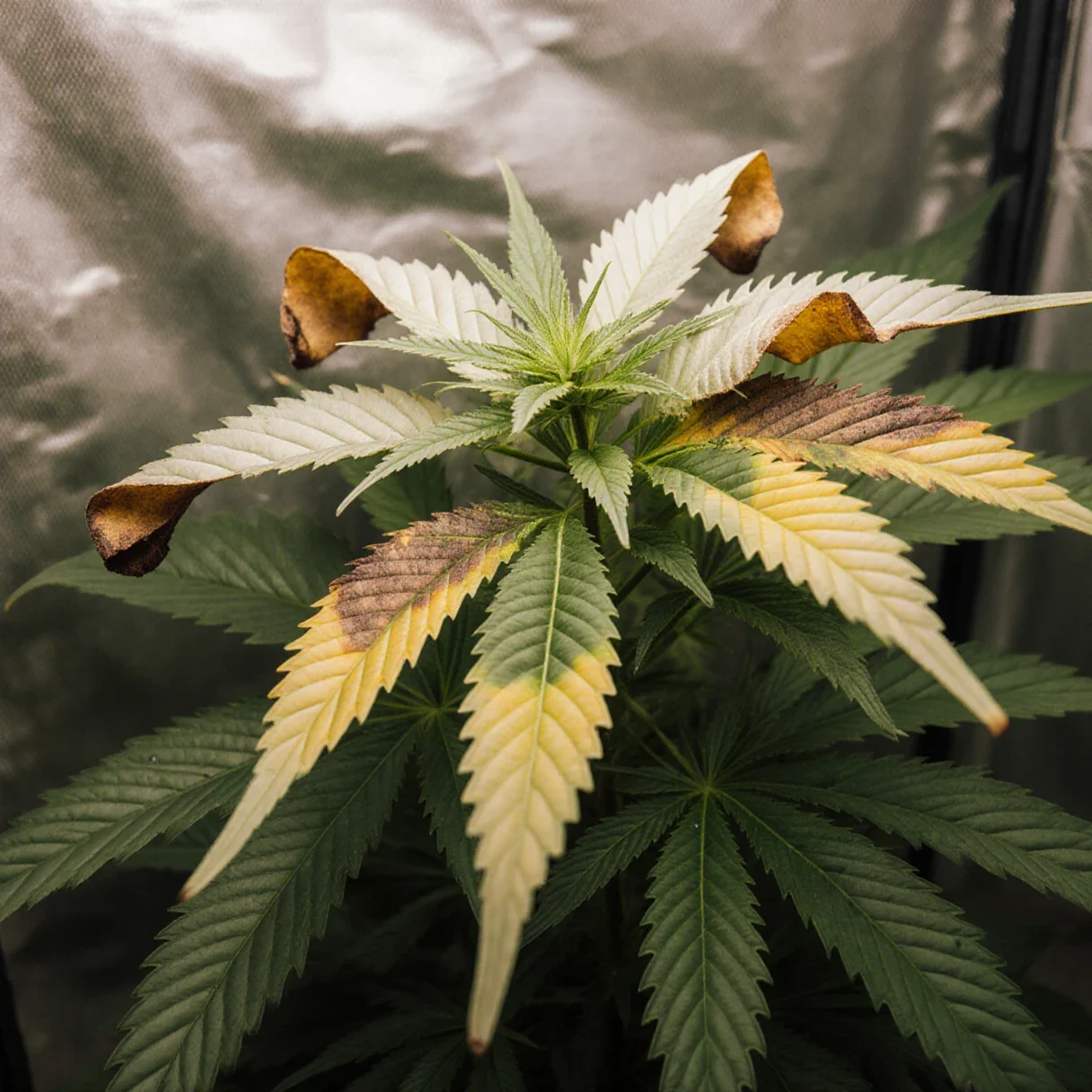
Cannabis heat stress is one of four problems that produce brown, unhappy leaves. They can be told apart in about thirty seconds if you know what you’re looking at.
| Sign | Where it appears | Most likely cause |
|---|---|---|
| Upward taco-ing, crispy margins, wilting that recovers at lights-off | Top of plant only | Cannabis heat stress |
| Uniformly pale, white or almost albino tops, veins bleached too, leaves stay flat | Directly under the fixture | Genuine light bleaching |
| Burnt brown tips pointing down, dark glossy green leaves | Whole plant, tips first | Nutrient burn / too-strong feed |
| Yellowing in a tidy pattern by leaf age, veins often still green | Old lower leaves or new growth | Deficiency or pH lockout |
The two fastest tiebreakers cost nothing. First, is it only the tops? Both cannabis heat stress and light burn are proximity problems, so they respect the vertical gradient. Nutrient problems and pH lockouts follow leaf age instead, which means they show up on plants regardless of position. Second, does it curl? True bleaching tends to leave the leaf flat and simply drained of colour. Heat curls it.
Your tent thermometer is reading air somewhere on a wall. The leaf is what actually has to do the photosynthesis, and leaf temperature is not the same number — it can sit above ambient in still air with the stomata shut, or below it on a well-ventilated canopy that is transpiring freely. Under LEDs, which put out far less radiant heat than HPS, a leaf with air moving over it often runs at or slightly below room temperature. The point is that you cannot infer it. A cheap infrared thermometer pointed at the top of the canopy tells you which situation you’re in, and it also gives you the leaf temperature that VPD calculations actually depend on.
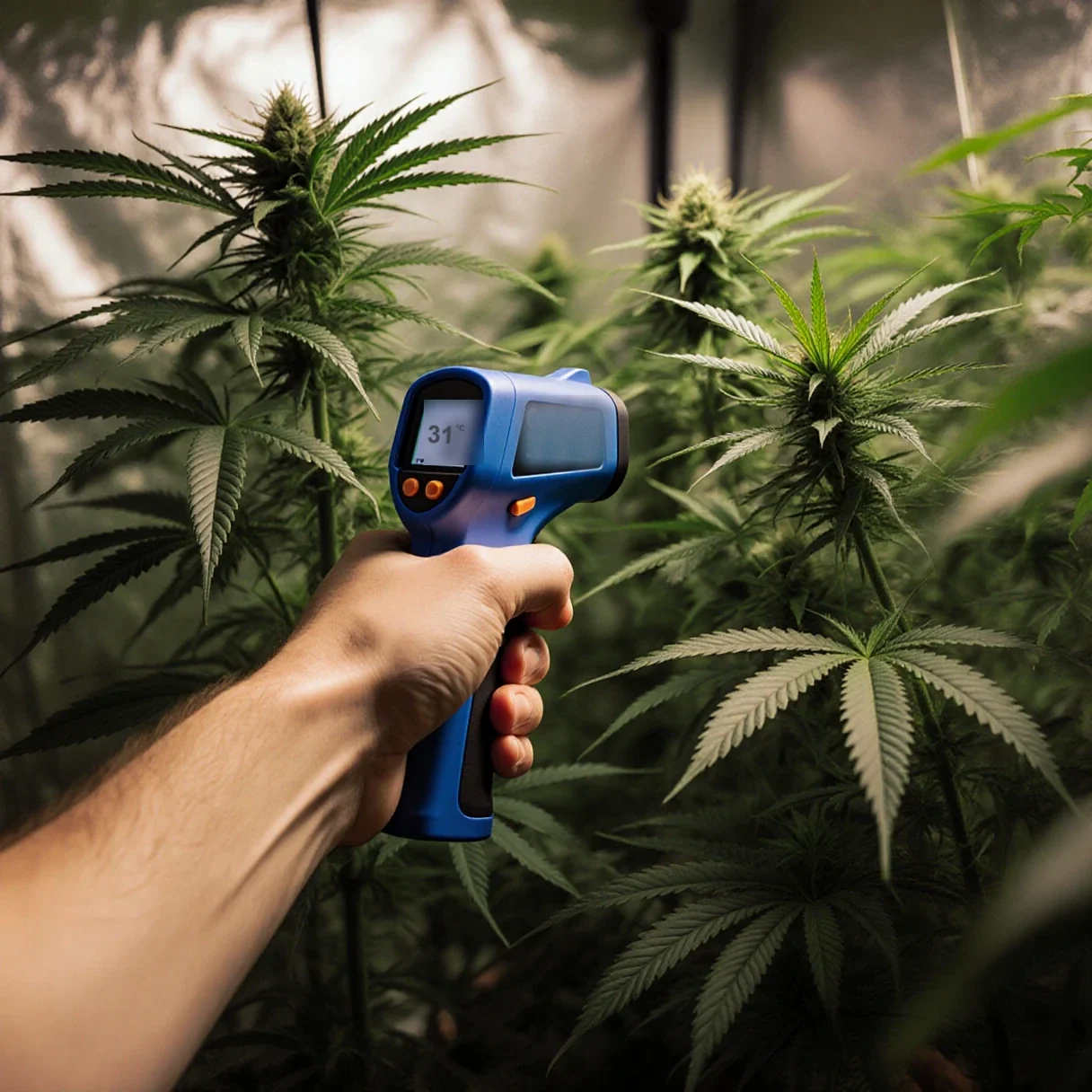
1. Move the heat, don’t just move the light. Almost every case of cannabis heat stress is an extraction problem before it’s a light problem. Raising the fixture is the reflex, and it’s the fix with the biggest yield cost — you throw away intensity that the research says the plant would have converted into flower. Extract more air first. Get hot air out of the top of the tent, pull cooler air in low, and check whether your exhaust is actually running fast enough for the wattage in the room.
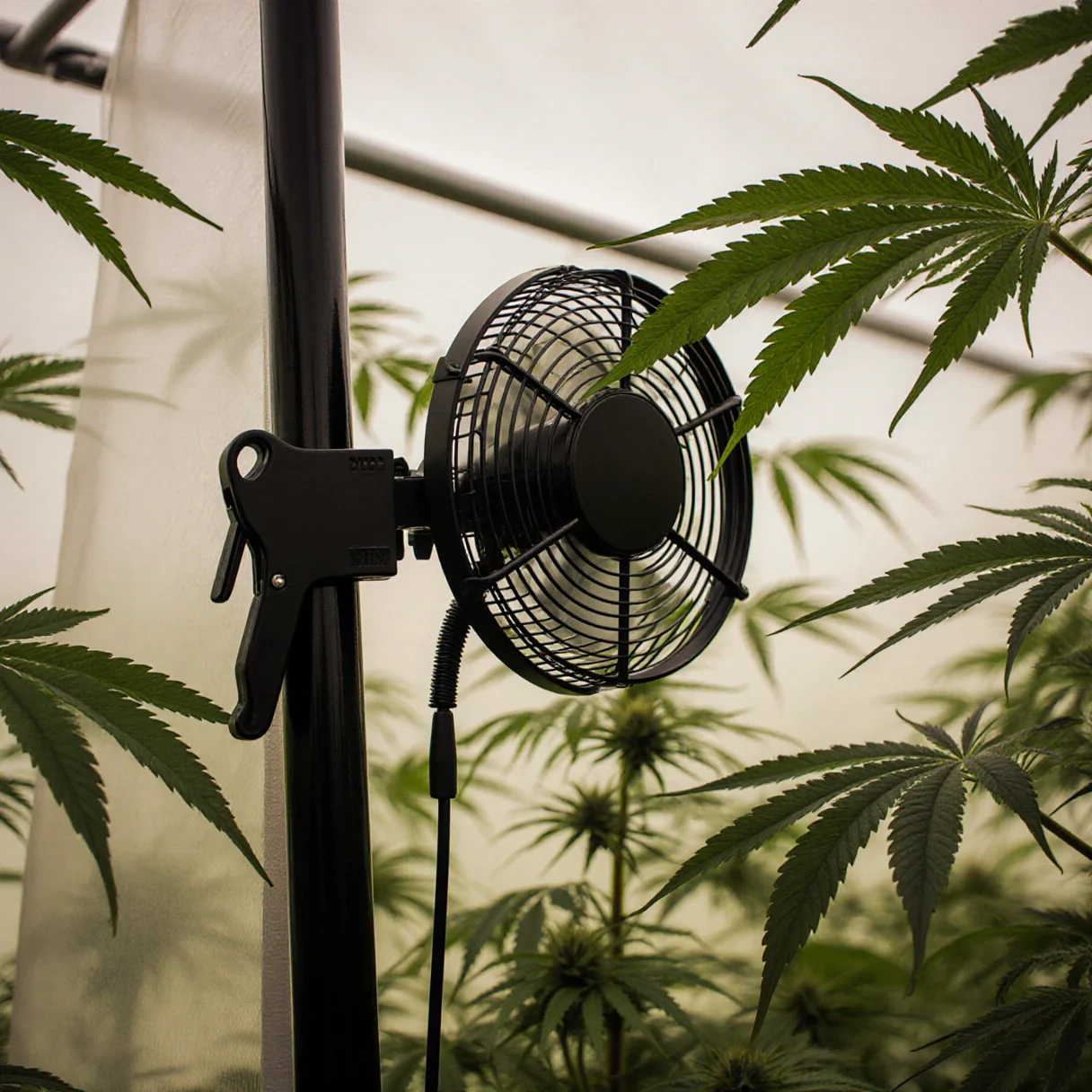
2. Move air across the canopy. Still air lets a boundary layer of hot, humid air sit against the leaf surface and stops evaporative cooling dead. An oscillating fan aimed just over the tops is often worth more than several degrees of room-temperature control. Airflow is a build question, covered in the grow tent setup guide.
3. Dim rather than raise, if the fixture allows it. Dimming cuts the fixture’s heat output as well as its intensity. Raising it only trades intensity for a wider footprint and does nothing about the temperature in the room — you still have the same watts of heat, just spread further away. If the problem is heat and you have the dial, the dial is the better tool.
4. Run the lights at night. Flipping your dark period to daytime moves the plant’s photoperiod into the coolest hours of a summer day. It’s free, it works, and it’s the single most effective summer fix for a tent in a hot room. Just keep the dark period genuinely dark and uninterrupted — a tent that leaks daylight during a daytime dark period will cause you a different problem entirely.
5. Narrow the gap between air and leaf, not between plant and light. Check humidity alongside temperature — dry air pushes the plant to transpire harder while heat is already closing its stomata, and that combination does more damage than either alone. Get the temperature and humidity relationship right rather than chasing a single number on a thermometer.
6. Don’t forget the roots. A hot pot is a slower, quieter version of the same problem — root zone temperature affects uptake independently of what’s happening at the canopy, and a black pot sitting in direct light will run far hotter than the room.
What not to do about cannabis heat stress: don’t cut back watering because the plant looks stressed, don’t strip leaves to “cool it down,” and don’t feed it more thinking it’s hungry. A heat-stressed plant is already struggling to move water; adding salt to the root zone makes it worse.
Genuine light bleaching exists, it just isn’t what most people staring at cannabis heat stress are actually looking at. It shows up as the topmost buds and their surrounding leaves going pale, yellow-white or almost albino directly under the brightest part of the fixture, while the tissue stays flat and structurally intact rather than curling and crisping.
It’s a photobleaching effect — pigment destroyed faster than the plant can replace it — and it turns up most often on the colas closest to a powerful fixture running very close to the canopy. The buds keep their shape but lose their colour and their market value. If your tops are pale but flat, raise or dim the light. If they’re curled and crispy, you have cannabis heat stress and raising the light is treating the wrong thing.
Genetics is a real lever against cannabis heat stress, and unlike pest resistance it’s actually recorded in the catalog. Every strain we carry lists a climate suitability, and the ones bred for hot, dry, sunny conditions are the ones that shrug off a rough July.
Skywalker is listed for hot, dry, sunny climates and rated Easy — about as direct a fit as the catalog offers. Durban Poison and White Whale CBD are both listed warm and sunny, both Easy. Super Skunk Silver Haze is listed for warm, dry, sunny conditions, and LA Kush Autoflower for warm, dry, Mediterranean.
Landrace-derived sativas from equatorial regions are the classic heat-tolerant lineages — long, lanky plants that evolved under exactly the conditions that flatten a compact indica. Columbian Gold is listed for warm, humid, tropical climates, though it’s rated Challenging and runs 10–12 weeks, so it’s a plant for a grower who has already solved their climate rather than one who’s trying to.
The other angle is timing. If your problem is a hot indoor summer, a shorter grow simply spends fewer weeks in it — fast flowering cannabis covers the quickest finishers, and an autoflower run in the cooler months sidesteps the season entirely. Browse the feminized range or the autoflowers and read the climate field before you buy.
Outdoor plants get cannabis heat stress too, and they get it without a fixture to blame. A heat wave in a black plastic pot on a patio is brutal — the medium bakes, the roots cook, and the plant wilts by noon every day. Shade cloth during peak afternoon hours, mulch on the surface, a larger or lighter-coloured container, and watering early rather than at midday all help more than anything you can spray.
The plants that suffer worst from cannabis heat stress outdoors are the ones in small pots, because a small volume of medium heats fast and dries faster. That’s a container decision made months before the heat wave arrives — one of the quiet advantages in the indoor versus outdoor comparison that nobody weighs up front.
The measured photosynthetic peak is around 30 °C, and performance falls off above it — so the low 30s is where you start giving up growth outright. Most growers still target the low-to-mid 20s °C in practice, for reasons the photosynthesis curve doesn’t cover: humidity control, mould risk in dense flower, and terpene retention. Either way it’s leaf temperature that matters, not the number on your wall thermometer.
Leaves already crisped by cannabis heat stress won’t heal — that tissue is gone. But the plant will resume normal growth once conditions come back, and new growth comes in clean. Fix the environment and judge the recovery by the new leaves, not the damaged ones.
Curled and crispy at the margins means cannabis heat stress. Flat, pale and bleached directly under the fixture means light. If it’s both, fix the heat first — it’s the more common cause and the cheaper fix.
Not first. Rule out cannabis heat stress as the cause before you touch the hanging height. Research found cannabis yield rising linearly with light intensity all the way up to 1,800 µmol·m⁻²·s⁻¹, so backing the light off costs real weight. Improve extraction and airflow first, dim second, raise last.
Anything that suppresses photosynthesis for weeks costs you yield, and heat does that measurably. On potency specifically, the same light-intensity study found no effect of light level on cannabinoid content — so don’t assume harder light is buying you strength, and don’t assume a stressed plant is secretly making more.
Most “light burn” is cannabis heat stress wearing the wrong name, and the fix people reach for — raising the light — throws away yield the plant would happily have used. Diagnose with the gradient and the curl: top-only plus curled and crispy is heat; top-only plus flat and pale is light.
Then fix cannabis heat stress in the right order. Extraction, airflow, the dimmer, lights-at-night — and only then the hanging height. Buy an infrared thermometer, point it at the canopy, and stop guessing what temperature your plants are actually living at.
Sources: Chandra, Lata, Khan & ElSohly, Photosynthetic response of Cannabis sativa L. to variations in photosynthetic photon flux densities, temperature and CO2 conditions, Physiology and Molecular Biology of Plants 14(4):299–306, 2008. Rodriguez-Morrison, Llewellyn & Zheng, Cannabis Yield, Potency, and Leaf Photosynthesis Respond Differently to Increasing Light Levels in an Indoor Environment, Frontiers in Plant Science 12:646020, 2021. Utah State University Extension — How to Recognize Plant Heat Stress.
Shop Cannabis Seeds | Cannabis Light Intensity | More cannabis grow guides
Want to keep learning? Browse our full library of cannabis grow guides — everything from germination to harvest, in one place.
Ready to grow? Browse premium seeds from Lighthouse Genetics:
Designed & Built by Wynne Web Design