Every bottle of nutrients ships with a feed chart, and every feed chart tells you to run your plants harder than the research says you need to. That is not a conspiracy. It is just what happens when the company printing the chart also sells the bottle.
So what is the best EC for cannabis, really? The honest answer is that there is a wide plateau where your plants do not care, a floor below which they starve, and a ceiling above which you start paying for damage. Most growers spend their first two seasons hunting for a magic number that does not exist, when the useful skill is learning to read the number you already have.
Here is what EC measures, why two meters will hand you two different readings off the same bucket, and where the peer-reviewed work lands on how hard to feed.
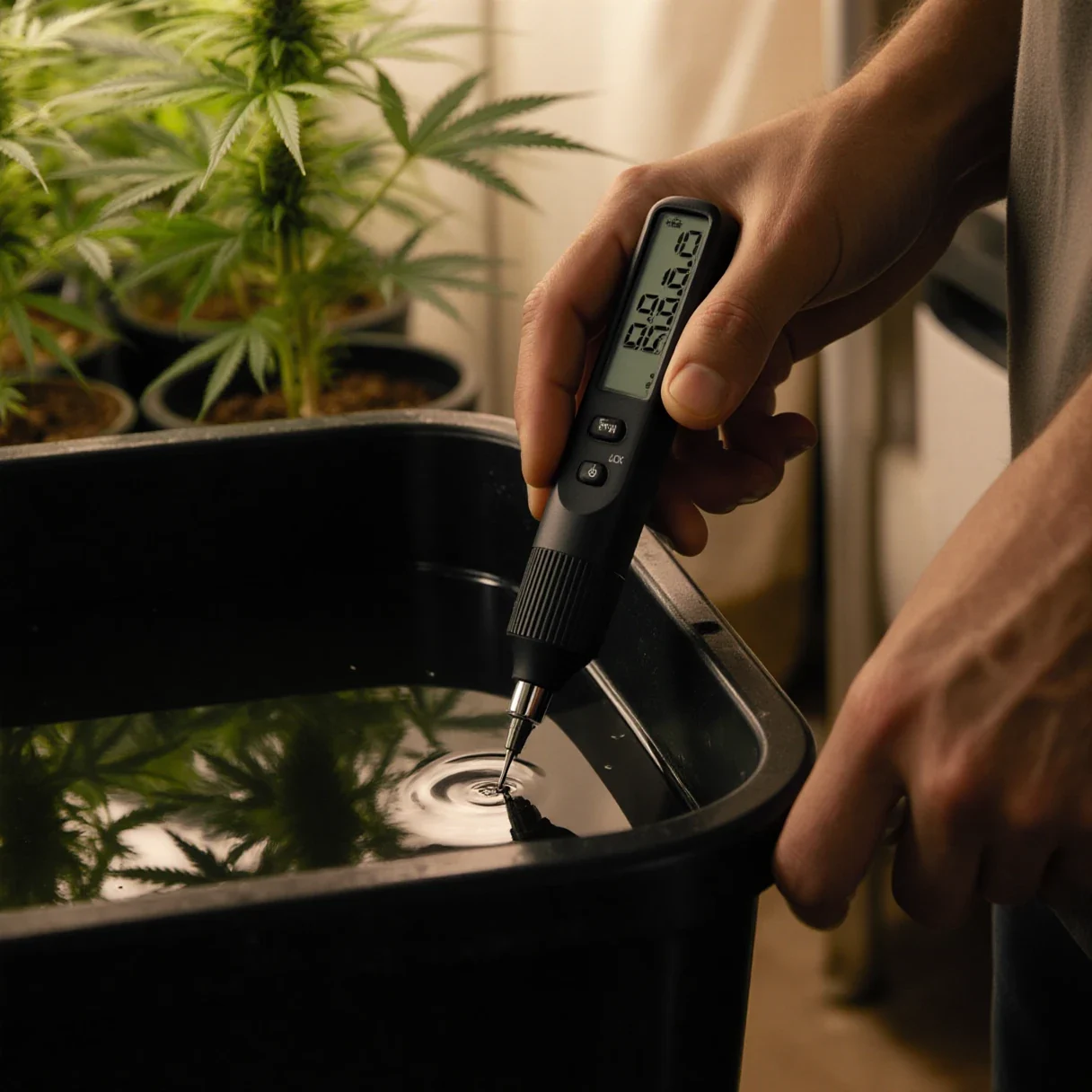
EC stands for electrical conductivity. Pure water barely conducts electricity; dissolved mineral salts conduct it well. Drop a probe in your reservoir and it measures how easily current crosses the gap, which is a direct proxy for how much dissolved salt is in there.
That is the whole mechanism behind every discussion of the best EC for cannabis. It is genuinely useful, and it has one enormous blind spot.
EC is a total. It has no idea what it is counting. A reservoir at 1.6 EC that is perfectly balanced and a reservoir at 1.6 EC that is drowning in calcium and starved of nitrogen read exactly the same on your meter. So the best EC for cannabis, read off a meter, is a single blunt total. The number cannot see ratios. It cannot see a single deficient element. It cannot tell fertiliser apart from the sodium already in your tap water.
This matters more than any target number in this article. Growers get a meter, dial in a reading they read on a forum, and then get confused when the plants show a deficiency anyway. The meter was never going to catch that — if you are seeing symptoms, the map you need is how to spot and fix cannabis nutrient deficiencies, not a conductivity reading.
The other half of the same coin: EC and pH are separate measurements answering separate questions. EC tells you how much is in the water. pH decides how much of it the roots can actually take up. Getting the best EC for cannabis exactly right while your root zone sits at pH 7.4 buys you nothing at all, because half those nutrients are chemically locked away. If you only own one meter, buy the pH pen first — the reasoning is laid out in the right pH for cannabis.
This one causes more bad advice about the best EC for cannabis than anything else in the hobby, and it is worth understanding before you accept a target number from anyone, including this post.
EC is an actual measurement, in millisiemens per centimetre (mS/cm) or the identical decisiemens per metre (dS/m). PPM is not a measurement. PPM is EC, multiplied by a conversion factor that somebody chose.
There are two factors in common use. Per Bluelab’s own documentation, the ppm 500 scale is based on the sodium chloride content of a solution and the ppm 700 scale is based on potassium chloride, giving you ppm500 = EC × 500 and ppm700 = EC × 700.
Run the arithmetic on a single bucket at 1.4 EC. On a 500-scale meter it reads 700 ppm. On a 700-scale meter, the same water reads 980 ppm.
Same bucket. Same salts. Two numbers 280 apart. Anyone quoting you the best EC for cannabis in ppm without naming a scale is quoting you nothing.
North American meters commonly ship on the 500 scale and several popular brands use 700, which means “feed at 800 ppm” is an instruction with no fixed meaning unless the person saying it also tells you their scale. They almost never do. Bluelab’s own recommendation is to skip the whole mess and use EC, the international standard — and that is the right call. Learn EC, ignore ppm, and translate other people’s ppm numbers only when you know which scale they are on.
Worth adding that even the underlying conversion is loose. Wikipedia’s summary of total dissolved solids puts the conversion factor anywhere between 0.55 and 0.8 depending on what is actually dissolved in the water. Nobody’s ppm number is as precise as it looks.
With that caveat established: the ranges below are where mainstream feed charts and long-running grower practice put the best EC for cannabis at each stage. They are conventions, not research findings — treat them as a sane starting point you adjust from, not a law.
| Stage | EC (mS/cm) | ppm 500 scale | Notes |
|---|---|---|---|
| Seedling / fresh clone | 0.4 – 0.8 | 200 – 400 | Plain or very light. Most seedling problems are overfeeding, not underfeeding. |
| Early veg | 0.8 – 1.2 | 400 – 600 | Ramp slowly as the root mass builds. |
| Late veg | 1.2 – 1.8 | 600 – 900 | Peak demand for most photoperiods. |
| Early flower / stretch | 1.4 – 2.0 | 700 – 1000 | Demand stays high while the plant is still building frame. |
| Mid–late flower | 1.2 – 1.8 | 600 – 900 | Taper down as nitrogen demand falls off. |
| Final 1–2 weeks | 0 – 0.6 | 0 – 300 | Plain water if you flush — see below. |
Two adjustments to that table matter more than the numbers in it, and both push the best EC for cannabis down rather than up.
Autoflowers want less. The best EC for cannabis grown as an autoflower sits below the photoperiod figure at every stage. They run a compressed life cycle on a smaller root system and, in most growers’ experience, sulk at photoperiod-strength feed. Starting an auto around two-thirds of the equivalent photoperiod figure and climbing only if the plant asks for it is the safer play. A compact, quick auto like White Widow Autoflower Seeds — 8–9 weeks, 50–80 cm (20–31 inches) in our catalogue — simply does not have the tissue to absorb a big charge of salt in the time available.
Same logic for Green Crack Autoflower Seeds at 7–8 weeks. There is no room in a seven-week plant to recover from a burn.
Your tap water is already on the meter. Measure it before you mix anything. If it comes out of the tap at 0.4 EC, that is 0.4 you did not choose, sitting underneath every number above — and on hard water a good chunk of it is calcium and magnesium the plant can use, while on softened water it may be sodium it can’t. Subtract your source water and dose to the difference.
The best EC for cannabis in the table above is written for coco and hydro, where the medium holds no nutrient reserve and the feed is doing all the work. Soil does not behave that way.
Living soil and pre-amended potting mixes carry their own charge, which means the best EC for cannabis in soil is partly already in the pot before you mix anything. Feeding a rich organic soil to a 1.6 EC target on top of what the mix already contains is how people burn plants while following a chart correctly. In soil, the number you care about is what comes out of the pot, not what goes in.
Coco is the opposite: it carries no nutrient reserve, so you feed a complete solution every time you water. It is not completely inert, though — coco grabs onto calcium and magnesium, which is exactly why Cal-Mag is not optional in it. What coco does not give you is a stock of food to draw down, and that is why coco growers run EC more tightly than soil growers. True hydro is tighter still, and the swings are faster. The tradeoffs across all three are worked through in soil vs coco vs hydro for cannabis.
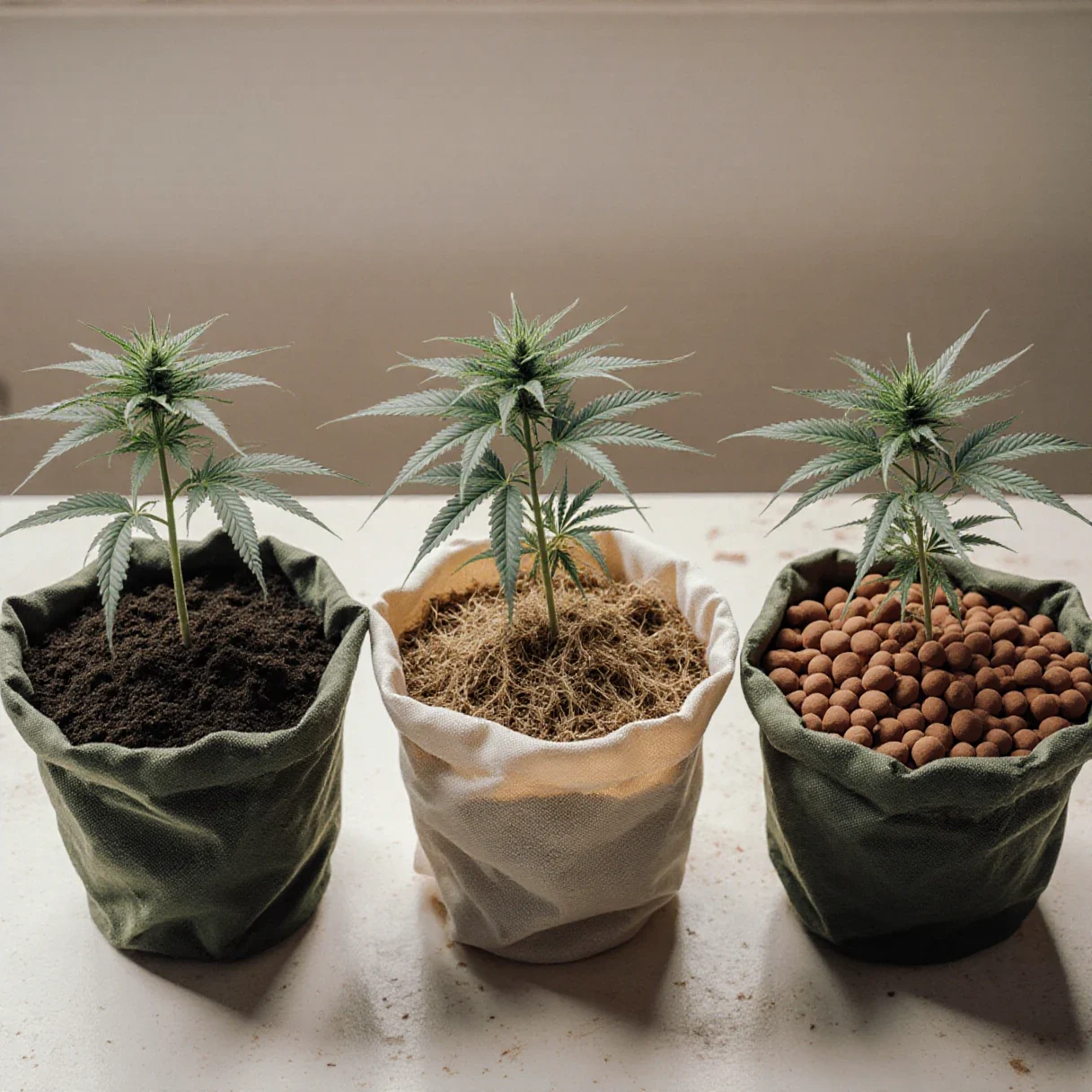
If you are new and want the widest margin for error, grow in soil. The buffer that makes soil imprecise is the same buffer that forgives a mistake, and beginners make mistakes. Northern Lights Skunk Feminized Seeds and Afghani Feminized Seeds are both rated Easy in our catalogue and both shrug off the kind of feeding wobble that would stall a fussier plant.
Here is the part that should change how you feed, and it is the most directly relevant controlled trial we have on the best EC for cannabis.
A 2025 study in Frontiers in Plant Science by Hershkowitz, Westmoreland and Bugbee grew the high-CBD medical cultivar ‘T1’ — a chemotype III plant that tested at 13.55% CBDeq and just 0.59% THCeq — in closed deep-flow hydroponics and, among other treatments, ran the nutrient solution at EC 2 against EC 4 mS/cm. Their finding, stated plainly: “Doubling the nutrient solution concentration from an EC of 2 to 4 mS per cm had no effect on flower yield or cannabinoid concentration.”
Not a small effect. No effect. And on the potency question specifically, the same paper reports “no significant effect of solution EC or P on concentrations of CBDeq, THCeq, or the ratio of CBDeq to THCeq.”
Sit with that one, because it undercuts the most popular idea about the best EC for cannabis there is. Feeding harder did not buy more flower. Be careful how far you carry the potency half of that finding, though: THCeq in this cultivar was 0.59%, so “EC did not change THCeq” is a much weaker statement about a 25% plant than it first looks.
On yield, which is what the trial was well designed to measure, the result is clean. If you have been feeding heavier for bigger harvests, you are paying for salt that ends up in your runoff. The levers that actually move THC are elsewhere — genetics first, then light and ripening, which is the ground covered in maximizing THC potency.
The same paper points at where the real ceiling sits. Citing earlier work by Baas and Wijnen (2023), Hershkowitz and colleagues report “no difference in yield between plants grown at an EC of 1.8 and 3 mS per cm but increasing EC to 12 mS per cm reduced yield by three-fold,” along with no difference in THCeq concentration across that entire 1.8–12 range. We have not read that trial directly — it reaches you here secondhand, through the paper that cites it — but the shape it describes fits everything else: a broad flat plateau, then a cliff.
Evidence from the other direction is more uncomfortable. Anderson and colleagues, publishing in PLoS ONE in 2021, fertigated five essential-oil hemp cultivars at rates from 0 to 600 ppm nitrogen, spanning EC 0.33 to 2.85 dS/m. Their optimum landed at 50 ppm N — an EC of just 0.54 — and above it “increased fertilizer rates significantly reduced plant growth, biomass accumulation, and cannabinoid concentrations.” CBD fell hardest — 16% moving from 50 to 150 ppm N, against 7 to 10% for CBG and THC.
Be careful with that one. It is CBD hemp in containers under greenhouse conditions, not drug-type plants in a tent, and 0.54 EC is far below what any indoor grower runs successfully. It is not a target. What it does establish is that the overfeeding penalty is real, measurable and lands on the exact thing you are growing for.
Put the three together and the practical conclusion is uncomfortable for anyone selling nutrients: the best EC for cannabis is very probably lower than the chart on the bottle, and there is no measured upside to running hot. The plateau is wide, so being conservative costs you almost nothing. Being aggressive has a documented cost.
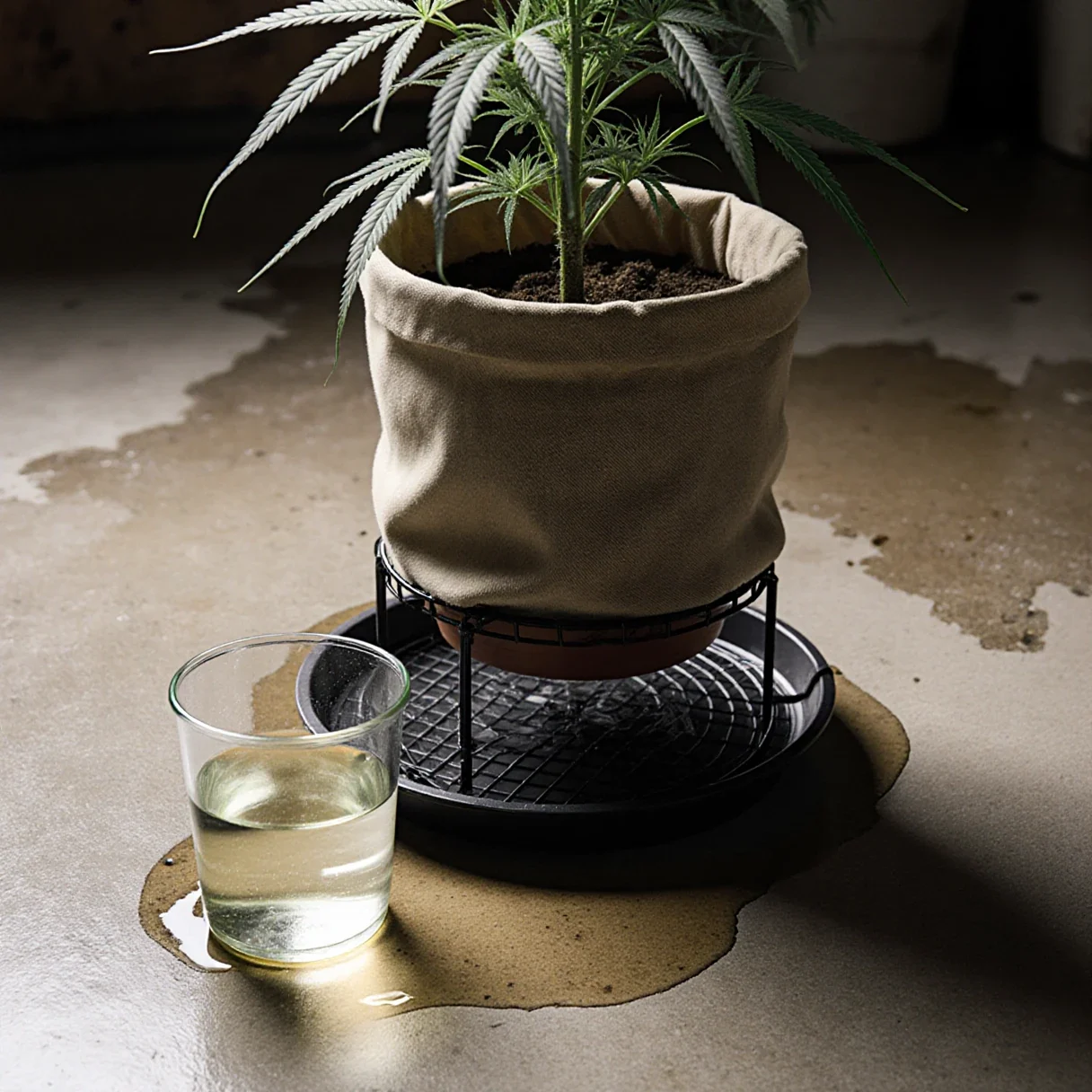
Input EC is what you intended. Runoff EC is what happened. Only one of them tells you whether you actually hit the best EC for cannabis in your room.
Water to a decent volume of runoff, catch some, and measure it. The comparison is what matters:
Rising runoff EC across a week warns you about salt buildup well before the plant does — earlier than leaf-tip burn, and much earlier than the crispy margins that mean you have already lost tissue. (An in-substrate EC probe reads the root zone earlier still, if you have one.) Catching it here means adjusting a number. Catching it later means damage control.
Two notes on technique. Runoff volume and watering rhythm change what the reading means, and that mechanical side belongs to watering cannabis plants — the wet-dry cycle drives everything you measure here. And a high runoff EC with no visible symptoms is still worth acting on. The symptoms are lagging indicators.
Some honest perspective, because obsessing over the best EC for cannabis is a classic second-season trap.
Nutrition is the third lever, not the first. Genetics set the ceiling, light decides how close you get to it, and feed keeps the plant from falling short of either. A plant under weak light cannot use a strong feed no matter how precisely you mix it — feeding harder to compensate for a dim fixture is one of the most common and most expensive mistakes in indoor growing, and the fix is on the light side, covered in cannabis light intensity.
Where the best EC for cannabis earns its place is as a diagnostic, not a target. It is cheap, instant, and it catches salt accumulation before your plants do. That is a real job, and a meter that costs less than a pack of seeds does it well.
One specific interaction worth knowing: additives land on your EC too. Silica in particular shifts both EC and pH in the reservoir, so it needs to go in first and be accounted for rather than dosed on top of a finished mix — the evidence on whether it is worth adding at all is weighed in does silica help cannabis.
Feeding is a skill you build by getting it wrong on plants that survive being got wrong. Nobody finds the best EC for cannabis in their own room on the first try.
For a first run, hardy and well-known beats trendy and temperamental. White Widow Feminized Seeds is rated Easy in our catalogue and finishes in 8–9 weeks — long-established genetics that tolerate a wobbly feeding routine. Big Bud Feminized Seeds is another Easy option, rated Moderate THC (15-20%), which suits a first grow where the goal is finishing a plant rather than chasing a number. On the autoflower side, Mazar Autoflower Seeds is rated Easy and forgiving.
Once your feeding is dialled in, heavier plants start to pay off. Gorilla Glue 4 Feminized Seeds is rated Very High THC (25-30%+) and reaches 120–200 cm (47–79 inches), and Blue Dream Feminized Seeds runs 500–650 g/m² indoors — both worth more when your EC discipline is steady, because plants that big are less pleasant to rescue. The wider set of options is in feminized cannabis seeds and autoflower cannabis seeds.
Most feed charts and growers land between 1.2 and 2.0 mS/cm through flower, peaking during the stretch and tapering as nitrogen demand falls. But the research is clear that the upper half of that band buys you nothing measurable — Hershkowitz and colleagues found no yield or cannabinoid difference between EC 2 and EC 4 in a hydroponic trial. Sitting at the lower end is the better bet.
There is no good evidence that it does, but the honest answer is that the question is under-tested in high-THC plants. The 2025 Frontiers in Plant Science trial found no significant effect of solution EC on THCeq or CBDeq — in a chemotype III cultivar carrying 0.59% THCeq. The earlier work it cites found no THCeq difference from EC 1.8 to 12, but we have not seen that trial’s chemotype either. No trial we found produced evidence that feeding harder raises potency, and the levers that clearly do move it — genetics, light, ripening — are well established.
No, and the difference matters when someone quotes you the best EC for cannabis. EC is a direct measurement; ppm is EC multiplied by a chosen conversion factor. The 500 scale gives ppm = EC × 500 and the 700 scale gives ppm = EC × 700, so one solution at 1.4 EC reads either 700 or 980 ppm depending on the meter. Use EC and the ambiguity disappears.
Dropping EC to plain water for the last week or two is standard practice, but the controlled work has not found the payoff — no measurable improvement in THC, terpenes, ash colour or taste-panel ratings. A gentle taper over the last 7 to 10 days is the sensible version. We went through the evidence in flushing cannabis before harvest.
Very little. The best EC for cannabis at the seedling stage is roughly 0.4 to 0.8 mS/cm including whatever your tap water contributes, and plain water is fine for the first week or two. Nearly every seedling problem attributed to hunger is actually overfeeding or overwatering. The first fortnight is covered in the cannabis seedling stage.
In soil, honestly, no — plenty of good growers hit the best EC for cannabis by schedule and observation alone. In coco or hydro, yes. Neither medium holds a nutrient reserve, so the meter is the only early warning you get before symptoms appear.
Start low. Read the runoff. Move in small steps, and only when the plant asks.
The best EC for cannabis is not a number you look up — it is the lowest input that keeps your runoff stable and your leaves green. For most indoor growers in coco or hydro that lands somewhere between 1.2 and 1.8 through the heart of the grow, lower for autoflowers, lower again for seedlings, and lower still than the chart on the bottle suggests.
What the evidence rules out is the idea that pushing past the best EC for cannabis is a strategy. Doubling the feed did nothing for yield in a controlled cannabis trial, and overfeeding hemp measurably cost both biomass and cannabinoids. There is no version of this where running hot wins.
Buy the pH pen first, the EC pen second, and spend the money you saved on better genetics — the ceiling you can never feed your way past. Our cannabis growing guides work through the rest of the inputs the same way: what is established, what is marketing, and what to do on Saturday.
Shop Feminized Seeds | Autoflower Seeds | The Right pH for Cannabis | Fixing Nutrient Deficiencies
Want to keep learning? Browse our full library of cannabis growing guides — everything from germination to harvest, in one place.
Ready to grow? Browse premium seeds from Lighthouse Genetics:
Designed & Built by Wynne Web Design