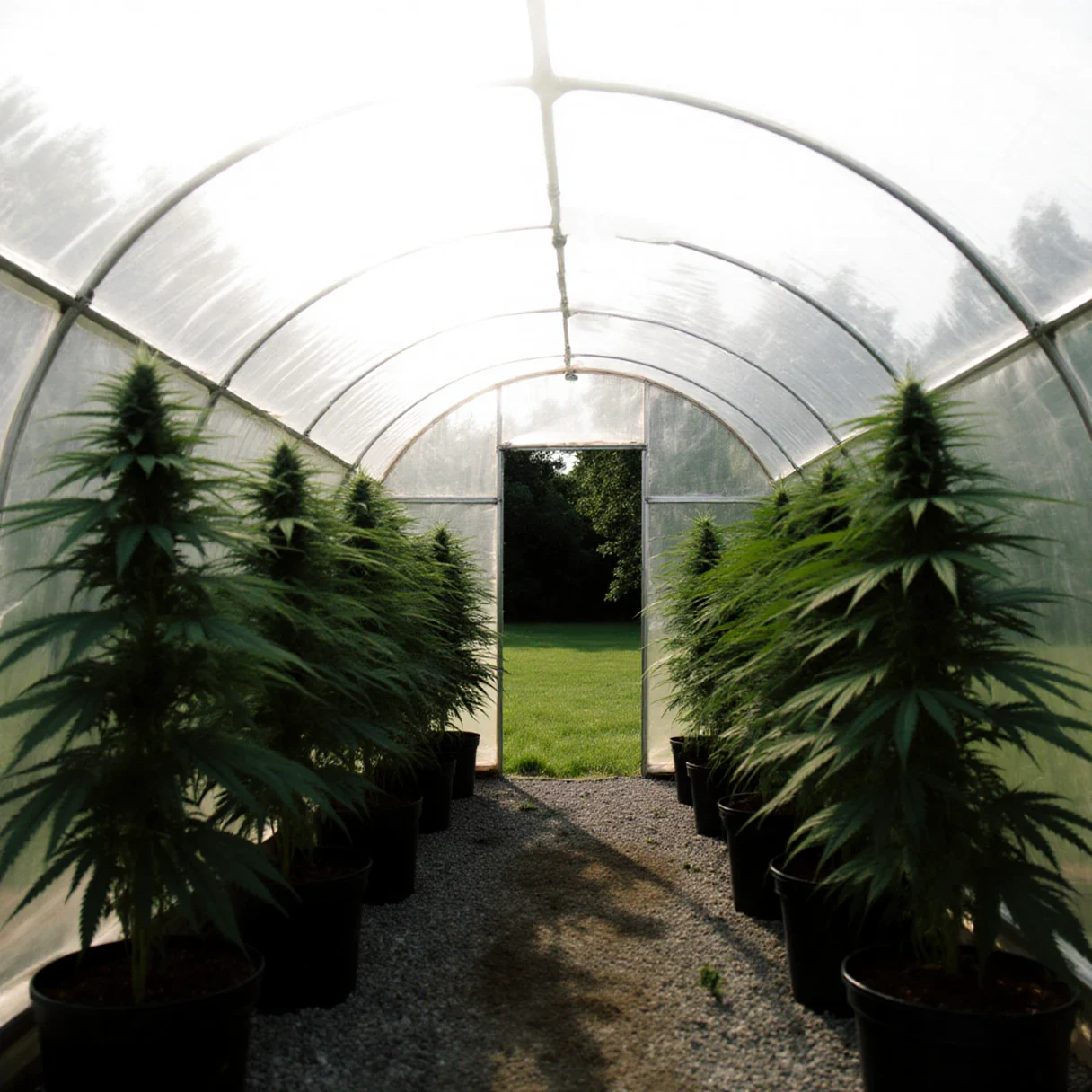
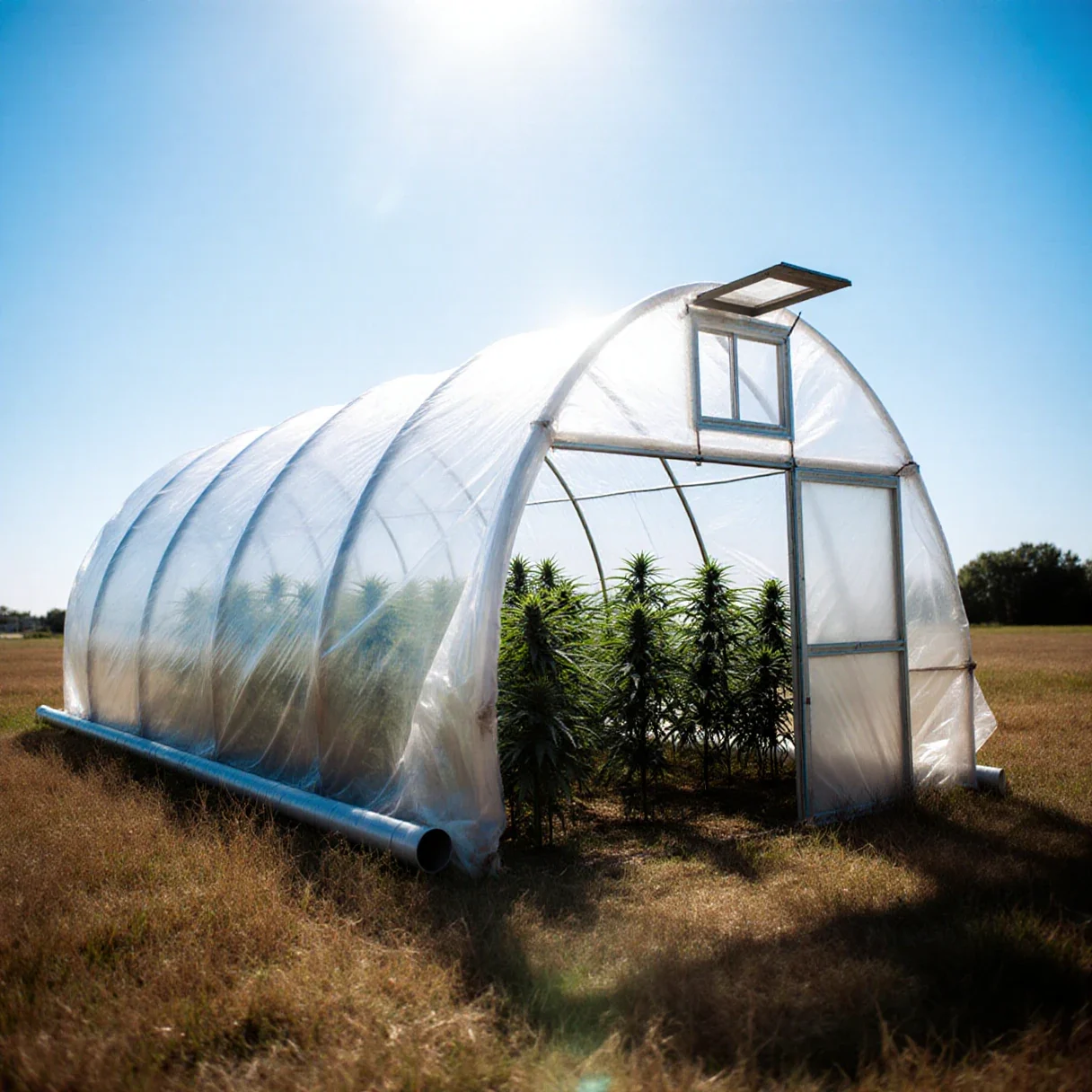
A greenhouse looks like the obvious answer to every outdoor problem. The sun is free, the roof keeps September rain off your colas, and you get to start earlier and finish later than the plants in the garden. Greenhouse cannabis really can be the best of both worlds. But a greenhouse is not “outdoors with a roof.” It is its own climate, and it brings four problems you have to manage differently than in the open garden.
It overheats. It sweats at night. It lies to your photoperiod plants about what season it is. And it is a very comfortable home for spider mites. This guide is built around those four: what each trap is, what the research says, and what to do about it.
If you are still deciding between a tent and the backyard, start with our indoor vs outdoor cannabis comparison. This post picks up where that one leaves off — the third option.
The first thing greenhouse cannabis gives up is light. People expect the opposite, because the inside of a greenhouse looks bright. But every layer of glazing reflects and absorbs some of the sun, and the frame and dust take more.
Virginia Cooperative Extension’s guide to greenhouse coverings and glazing gives the numbers for new, clean material. Single-layer glass lets through 88–94% of the light. A single layer of polyethylene film lets through 85–87%, and a double layer 74–77%. Twin-wall polycarbonate panels sit around 83%. And those are the best-case figures. In reported examples in the same guide, only 56% of the outside light reached the plant canopy in a glass greenhouse, and only 45% in a double-poly house.
That is not a reason to skip greenhouse cannabis. Summer sun is so strong that half of it is still a lot of light. It is a reason to keep the glazing clean, to replace yellowed film, and to stop assuming a greenhouse cannabis plant gets everything an outdoor plant does. The same guide notes that polyethylene film degrades and fibreglass panels yellow under UV, while polycarbonate panels resist UV and lose little light for about ten years. Many plastic glazings also cut UV; whether that costs your greenhouse cannabis anything is covered in our post on whether UV light increases THC.
What you get back for that light is control over water. Rain stays off the buds. You decide when the soil gets wet. For greenhouse cannabis ripening into a wet autumn, that alone can be the difference between a harvest and a bin of grey mould — and it is the main reason a greenhouse appeals to growers in places where autumn turns wet.
A closed greenhouse is a solar collector. The University of Georgia’s extension bulletin on greenhouse heating, ventilation and cooling says a greenhouse could, in theory, absorb as much as 300 BTU per hour for every square foot of floor (roughly 950 W/m²), and warns that this excess energy can make plants wilt on warm days. On a bright July afternoon, heat is the problem you will fight before any other in a greenhouse cannabis grow.
The fix is air, and the bulletin gives a rule you can actually size a fan with. Plan for one complete air exchange per minute in summer. That should hold the inside about 8°F (4.4°C) above the outside temperature. Half that airflow gives a rise of about 15°F (8.3°C). Two air exchanges per minute brings it down to about 5°F (2.8°C).
Here is what that rule means for a typical hobby house. An 8 by 12 foot greenhouse (about 2.4 by 3.7 m) with an average inside height of 7 feet (2.1 m) holds roughly 670 cubic feet (about 19 m³) of air. By that rule, it needs an exhaust fan moving around 670 cubic feet per minute (about 1,140 m³ per hour) to make one exchange a minute. That is our arithmetic, not the bulletin’s, but it is a far better starting point than buying whatever fan was on the shelf.
Passive venting works too, if the vents are big enough. The same bulletin says ridge vents should be about one quarter of the floor area, with side vents about the same size, so warm air rises out of the top while cooler air comes in along the sides. If your greenhouse has one small roof vent, that is nowhere near a quarter of anything.
Shading is the last lever. Roll-up shade screens, which the bulletin says “work well in hobby houses,” can cut incoming radiation by 50%. But shading cuts light as well as heat, and light is what grows flower. Use it on the hottest weeks, not as a permanent roof.
How hot is too hot? The honest answer is that we could not find a published greenhouse heat threshold for cannabis. The closest data is a lab study of leaf photosynthesis in Physiology and Molecular Biology of Plants: depending on the variety, photosynthesis peaked somewhere between 25 and 35°C (77–95°F), and at 40°C (104°F) it fell by 16–38%. That is leaf gas exchange, not yield, so treat it as a direction rather than a line. If your canopy is curling and you are not sure whether it is heat or something else, our cannabis heat stress guide has the diagnostic table.
This is the one that catches greenhouse cannabis growers out, because a greenhouse feels drier than the garden. During the day it often is. The problem starts at sunset.
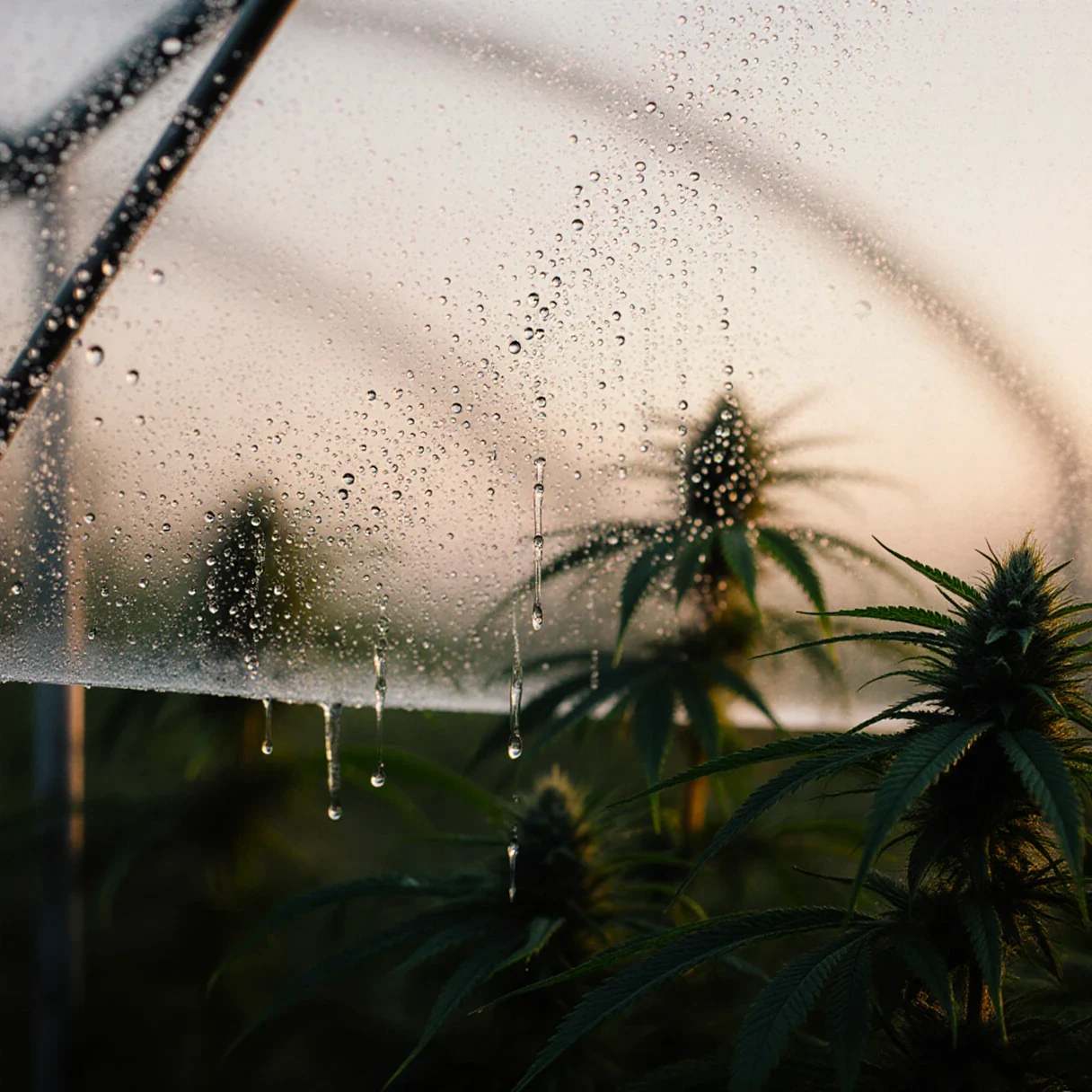
UConn Extension’s fact sheet on Botrytis blight on greenhouse crops explains it simply. Warm air holds more moisture than cool air. As the greenhouse cools in the evening, the air reaches its dew point and water condenses on every surface — the glazing, the frame, and your buds. Botrytis is the fungus behind bud rot, and the same fact sheet says its spores generally need a film of moisture for 8 to 12 hours, relative humidity of 93% or more, and temperatures between 55 and 65°F (13–18°C) to infect. That describes a closed greenhouse on a cool autumn night almost perfectly.
Greenhouse cannabis growers are not guessing about this. A 2024 review of disease management in greenhouse cannabis production by Buirs and Punja in Plants lists bud rot and powdery mildew among the most important diseases of the crop, alongside root rots. Their flowering-stage targets for commercial greenhouses are 23–28°C (73–82°F) at 50–70% relative humidity, and they say growers often have to run cooler and drier than the plant’s growth optimum when disease pressure is high.
Here is what actually works in a hobby greenhouse cannabis setup:
Strain choice matters for greenhouse cannabis too. Punja’s 2021 review of cannabis diseases in Pest Management Science lists “avoid growing strains with large dense inflorescences that retain moisture” as a bud rot management step. That is the trade-off with the fattest indica colas. For everything you can do once rot shows up, see our cannabis bud rot guide. Powdery mildew behaves differently: UC IPM notes that its spores need no external moisture to germinate, and our cannabis powdery mildew post explains why drying the air is only half of that fix. The temperature-and-humidity balance behind all of this is in our VPD for cannabis guide.
This is the trap a greenhouse makes easiest to fall into, because it lets you plant greenhouse cannabis weeks before the garden would allow — and it is the one most growers never see coming.
A photoperiod greenhouse cannabis plant does not know what month it is. It reads the length of the night. Put it in a warm greenhouse in early spring, when the nights are still long, and it will happily decide it is autumn.
How long is “long”? The closest data on drug-type cannabis comes from a University of Guelph growth-chamber study published in 2023. Ahrens, Llewellyn and Zheng grew clones of ten cultivars under day lengths from 12 to 15 hours. Flowering started in all ten under every day length up to 14 hours. At 15 hours, some cultivars started to flower but the flowers did not develop past that first stage. Work on CBD hemp at the University of Florida found the switch point varies by cultivar too, with the shortest between 13 hours 45 minutes and 14 hours, and some above 15.
Now look at a spring calendar. At 40°N — about the latitude of Philadelphia, Columbus or Denver — sunrise to sunset on April 1 is roughly 12 hours 35 minutes, and it does not pass 14 hours until early May. (That is standard astronomy you can check with any sunrise table.) Plants also count some twilight as day. Michigan State floriculture specialist Erik Runkle advises growers to assume plants perceive light from about 15–20 minutes before sunrise to 15–20 minutes after sunset. Even with that added, a greenhouse in early April is sitting inside the range where all ten of those cultivars flowered in the chamber.
What happens next is easy to see in a field trial. UF/IFAS Extension’s report on using supplemental lighting to grow hemp in Florida planted in February. Without extra light, every cultivar flowered within 27 days, the CBD types averaged around 25 cm (1 foot) tall, and the plants made 20 g (0.7 oz) of dry weight or less. With lights extending the day, plant dry weight was up to 200 times higher. That was hemp in a Florida winter, where days are shorter than a northern spring. But it shows what a photoperiod plant does when it decides it is autumn: it flowers small and fast.
Early planting does not always cost greenhouse cannabis growers, though. In a Georgia field trial published in HortTechnology, planting photoperiod hemp outdoors in early April did not lower its yield compared with later plantings. How much early planting costs you depends on your latitude, your cultivar, and how far into spring you really are.
And there is a second act. As the days lengthen, a plant that started flowering can flip back to leaf growth. A controlled study on the drug-type cultivar ‘White Russian’ by Sae-Tang and colleagues moved plants that had already started flowering from 12-hour to 18-hour days (the extra six hours were blue light), and they reverted to vegetative growth, producing leaves on top of the flowers. That was a growth chamber, not a greenhouse, and we could not find a study that measured spring re-vegging under natural light. But it matches the odd, leafy, twisted plants growers describe from an early greenhouse start.
The safe rule: if you want an early greenhouse cannabis start with photoperiods, give them the light they need to stay in veg. Do not plant them in a cold-season greenhouse and hope.
You do not need a grow light’s worth of power to hold greenhouse cannabis in veg. You only need to tell it the night is short. Runkle’s guidance for greenhouse crops is to switch on day-extension lamps around sunset and keep them on until the desired day length is reached, or to break up the night with a 4-hour interruption such as 10 p.m. to 2 a.m. He recommends at least 10 foot-candles (about 108 lux) for this lighting.
The Florida hemp trial used LEDs from 6 p.m. to midnight for the first two to three months after transplanting. For the cannabis-specific side of day length, our post on the 13 hour photoperiod covers what happens in flower.
The opposite trick works for greenhouse cannabis in summer. Pull a lightproof cover over the plants every evening and you can give a photoperiod plant 12-hour days in June. Growers call it light dep; ornamental growers use the same trick with blackcloth to flower poinsettias and chrysanthemums. A peer-reviewed hemp breeding program in Hungary did exactly this in a double-layer polytunnel, switching plants to 12/12 under a blackout system on June 18 and harvesting in early August.
Two warnings from Runkle’s guidance apply directly. Plants can perceive less than one foot-candle (about 11 lux) of light, so gaps and holes in the cover are not acceptable. And it can get very hot under the cloth if it is closed in the afternoon or early evening, which is why some growers wait until late evening to close it and open it again mid-morning.
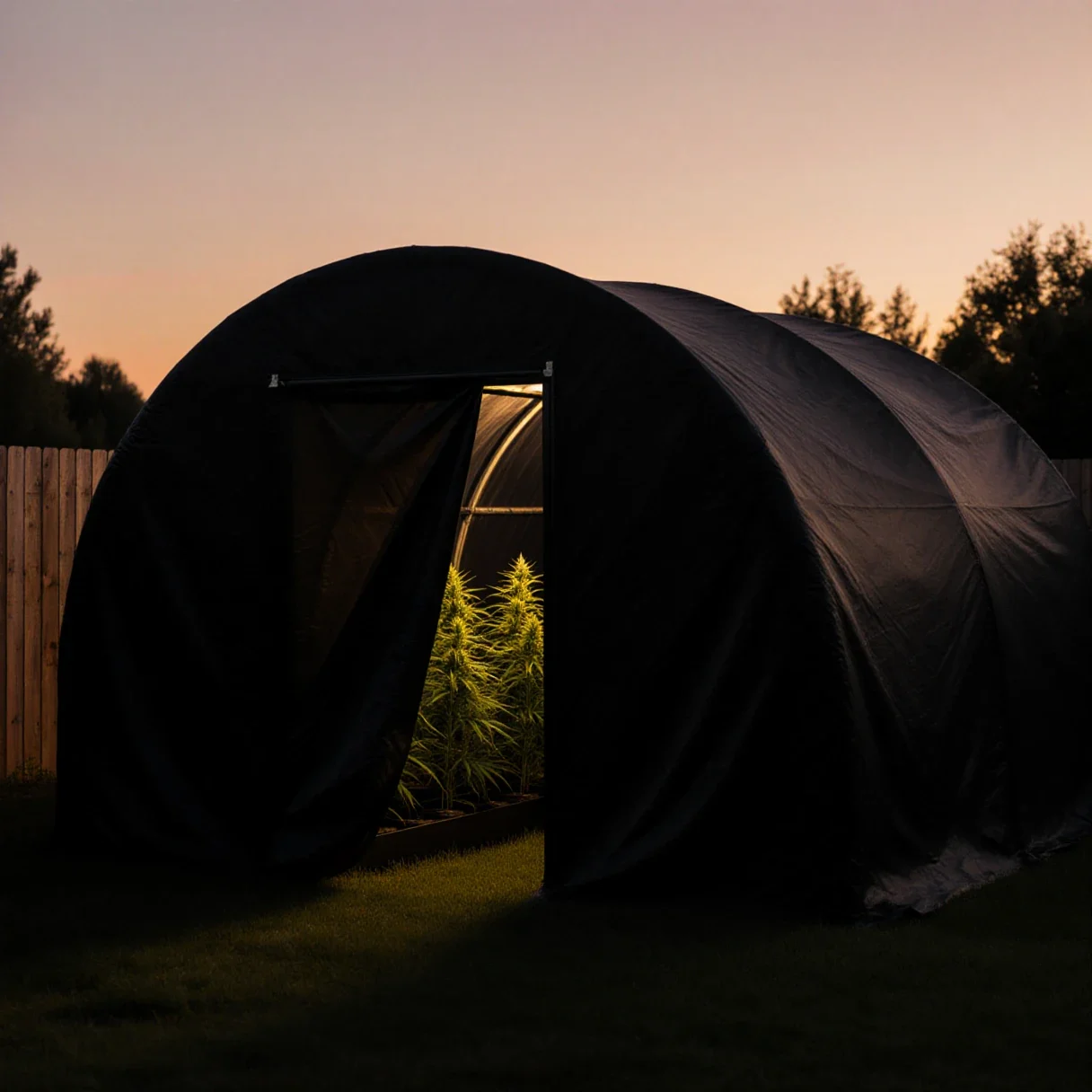
Greenhouse cannabis is very sensitive to stray light at night. The Guelph team set their own limit at 0.05 µmol/m²/s anywhere in the canopy — a tiny amount — after seeing flowering delays from stray light at 0.1 µmol/m²/s or less in one cultivar. The Florida hemp researchers reported that light as weak as about 2 µmol/m²/s disrupted flowering in one hemp cultivar in their greenhouse, and Runkle names street lights as a classic source of this kind of light pollution. A greenhouse cannabis plant sitting under a streetlight, a security floodlight or a lit window can stall in flower. If it will not finish, look around at night before you blame the genetics.
Autoflowers are the exception for greenhouse cannabis: they do not read the night at all. A Cornell study by Toth and colleagues (2022) mapped a major-effect autoflowering locus, which they named Autoflower1. It is recessive: plants carrying two copies of the autoflower version flowered under continuous light, while plants carrying only one copy did not. A 2024 study by Dowling and colleagues later found a second, independent autoflowering locus in hemp, Autoflower2, so there is more than one genetic route to an auto.
That makes autoflowers an easy fit for greenhouse cannabis. April’s short days will not flower them early, a porch light will not stall them, and you can run one batch in spring and another in summer in the same house.
The cost is size. A 2026 Cornell Cooperative Extension study of greenhouse cannabis in New York found autoflowers produced smaller plants with less total biomass than photoperiod plants. Its THC figures ran lower too, at about 10% for the two autoflower varieties against roughly 15–18% for the four photoperiod varieties with lab results. Treat that as a weak signal: the THC numbers came from company-chosen third-party labs, whose reliability the authors themselves question, and the comparison covered one farm and different strains, with the autos grown from seed and the photoperiods from clones. For lighting questions when you do add lamps, see our autoflower light schedule post.
The last trap is the slowest. Under cover, some pests can simply keep breeding.
A review of hemp pest management in the United States by Cranshaw and colleagues (2019) calls the twospotted spider mite a key pest of cannabis wherever there is an indoor or greenhouse phase of production — and notes that high spider mite populations do not appear to be sustained once plants are moved to the field. The same review says the cannabis aphid may keep reproducing year round where plants are grown under cover with enough light. A 2024 study of greenhouse hemp in Environmental Entomology named twospotted spider mites, hemp russet mites, broad mites and cannabis aphids as the most significant pests of greenhouse-grown hemp.
Spider mites like greenhouse cannabis in summer. UConn Extension says their populations increase rapidly when it is 68–86°F (20–30°C) with 30–50% relative humidity, and they can go from egg to adult in as little as 7 days above 80°F (27°C). Those are the same warm, dry days you are venting for.
What to do about it:
Our cannabis pests guide covers identification and treatment for each of these.
The best strains for greenhouse cannabis are the ones that dodge the traps above. That means two things: plants that finish early, and plants you can keep dry and airy late in flower. Autoflowers and light dep can finish greenhouse cannabis before autumn; in most of the US and Canada, even the fastest photoperiods, left to natural light, still ripen in late September or October. Here are picks for a hobby greenhouse cannabis grow, using the figures from our own catalog.
Autoflowers for spring and summer runs. White Widow Autoflower is listed at 10–12 weeks from seed and rated Easy. Fat Bastard Autoflower runs 8–10 weeks from seed to harvest and is rated for all climates. Bruce Banner Autoflower is described in our catalog as performing in greenhouse setups, though its dense, chunky buds need good airflow late in flower.
Fast photoperiods for an autumn finish. Super Skunk is listed at 6–7 weeks of flowering. California Hash Plant flowers in about 7 weeks (45 to 50 days), and its listing puts the outdoor harvest at late September to early October, so even a fast photoperiod meets some cool autumn nights. Afghani flowers in 7–8 weeks, but its own page warns that its dense buds can hold moisture, so keep humidity down late in flower.
Dense buds, with a short finish. If you want weight, pick heavy strains that finish early and manage the humidity. Sugar Black Rose flowers in 7–8 weeks with very dense flowers, and Big Bud finishes in 7–9 weeks. We found no mould-resistance test for either, so run the house at the dry end in late flower: the bud rot sources in our bud rot guide say under 50%.
One of Mac’s own. Grape Skunk, one of our house originals, is rated Easy, listed at 8–10 weeks of flowering, and suited to temperate and continental climates. Its listing puts the outdoor finish at early to mid-October, so it suits growers who can keep the house dry into October.
Browse the full range of autoflower cannabis seeds or feminized cannabis seeds to compare more options.
Greenhouse cannabis rewards growers who treat the greenhouse as its own climate. Vent harder than you think you need to. Dry the air out at sunset. Do not trust April with a photoperiod plant. And scout for mites from the first warm week. Get those four right and a greenhouse gives you something no tent can — free sunlight — with something the open garden cannot — a roof over the buds when the autumn rain arrives.
For the outdoor side of the season, see our guides to growing cannabis outdoors in the Eastern US and growing cannabis outdoors in Canada, or browse all our cannabis growing guides.
Shop all cannabis seeds | Indoor vs Outdoor Cannabis | Cannabis Bud Rot
Direct comparisons are rare. A 2026 study of three cultivars grown indoors, outdoors and in a greenhouse found greenhouse cannabis chemically closer to outdoor flower than to indoor, with relatively more sesquiterpenes and fewer monoterpenes. But the growing method explained only about 4% of the chemical variation, against about 24% for the cultivar, and the study measured chemistry, not quality or yield. As of October 2026, we found no study showing greenhouse flower is better or worse. What the research does show is that indoor and greenhouse grows share more diseases with each other than with field-grown cannabis, according to Punja’s 2021 review. Quality in greenhouse cannabis comes down to how well you manage heat, humidity and pests.
Only with heat and light. Through autumn and winter the days are under 14 hours, so photoperiod plants will flower small unless you extend the day with lamps, and an unheated house gets too cold. Autoflowers are the simpler choice for off-season greenhouse cannabis runs, but they still need warmth and enough light to grow.
No. It is an option, not a requirement. Light dep lets you harvest photoperiods in mid-summer, ahead of the wet autumn, but it means covering and uncovering the house every day with no gaps. If that sounds like too much, autoflowers give you a similar early finish without the daily routine. For greenhouse cannabis, a fast-finishing photoperiod helps less: on natural light it still ripens in late September or October, into the cool nights that bring bud rot.
Planting photoperiods in early spring without extra light. They see long nights, start to flower small, and may re-veg as the days lengthen. Wait until the days are long enough for your cultivar, light the evenings, or start with autoflowers.
Not the way you can in a tent. A carbon filter only cleans air that is pulled through it, and a greenhouse vented hard enough to stay cool pushes most of its air out through open vents, doors and big exhaust fans, not through a filter. In practice it behaves like an outdoor grow: placement, distance from neighbours, prevailing wind and an earlier finish do most of the work. Our cannabis grow smell guide explains why the smell climbs in late flower.
Keep reading
 Growing Cannabis in Heat
 Growing Cannabis Outdoors in Canada
 Growing Cannabis Outdoors in the Eastern US
Browse all guides to growing cannabis by topic, from germination to harvest.
Ready to grow? Browse premium seeds from Lighthouse Genetics:
Designed & Built by Wynne Web Design