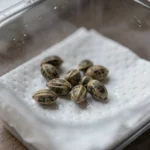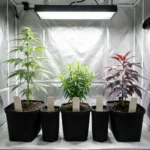
Most feeding advice treats a pot of soil as a container you pour nutrients into. Living soil cannabis growing inverts that. You feed the soil, the soil biology feeds the plant, and your job shifts from mixing a bottle every Tuesday to keeping a small ecosystem alive.
That sounds like marketing until you see a living soil cannabis bed that has been running for three cycles with nothing but water and a top dress. Then it just looks like less work.
It is also how a lot of the best gardens we know are run: a worm farm out back, castings through the mix, dry amendments on top, water. What follows is how a living soil cannabis bed actually works, where the evidence backs it and where it does not, and — the part almost nobody writes down — when we deliberately do not bother.
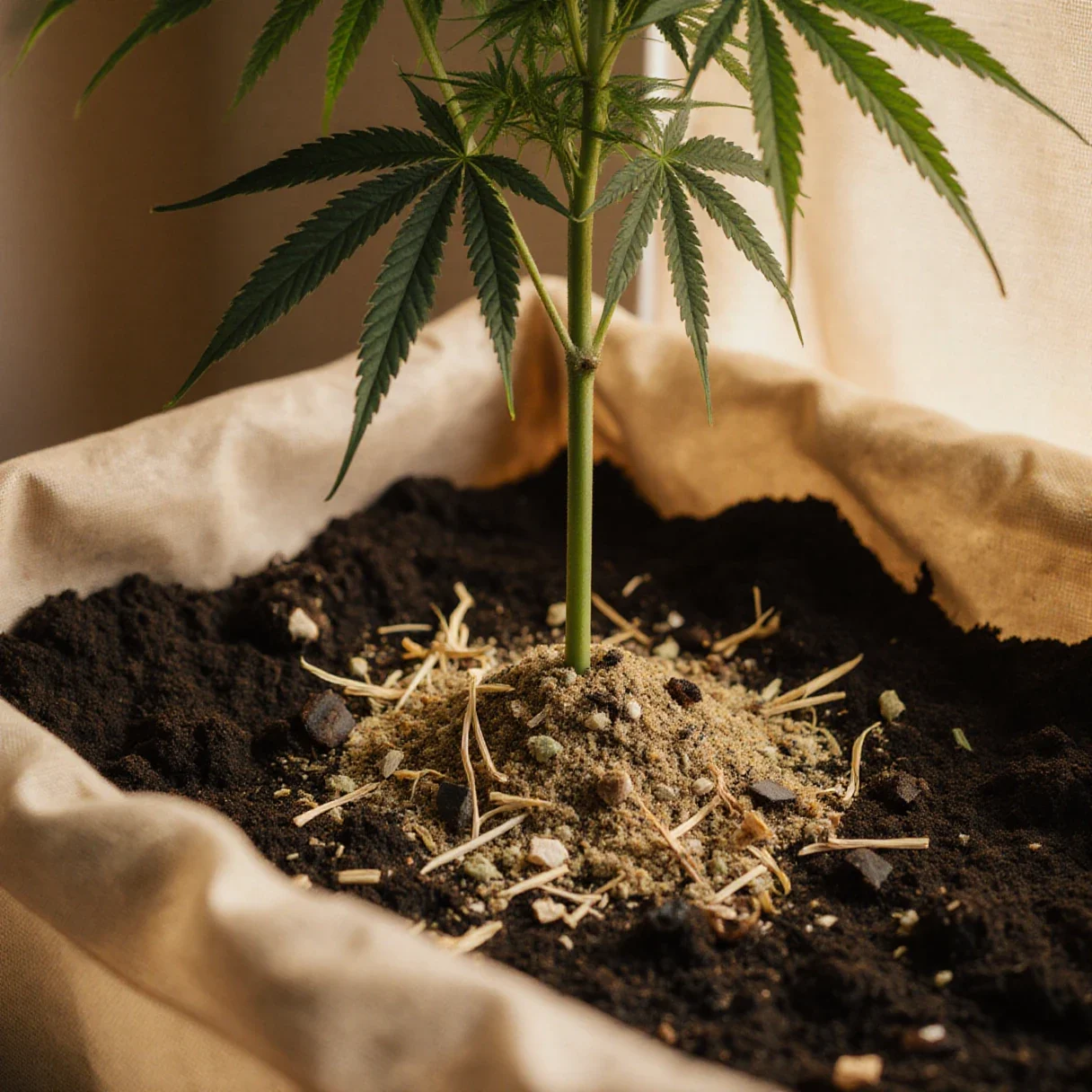
Three terms get used as synonyms in living soil cannabis discussions and they are not the same thing.
Organic growing in pots means your inputs are organic. You might still be mixing a liquid organic feed and pouring it on fresh, inert-ish medium every cycle. The bottle changed; the model didn’t.
Living soil means the medium itself is a functioning biological system — bacteria, fungi, protozoa, arthropods, worms — that mineralises organic matter into plant-available nutrients on an ongoing basis. You are managing a population, not a solution.
No-till is a further step: you never turn the bed out. Same soil, run after run, replanted into a hole you dig for the root ball. The fungal networks and worm channels survive because nothing rips them apart.
You can run living soil cannabis without running no-till, and we usually do. That distinction matters more than it sounds, and it comes back later.
The underlying trade against bottled feeding is straightforward: you give up precise, immediate control in exchange for a buffer that forgives you. If you are still weighing living soil cannabis against coco and hydro before committing, we have a whole post on choosing between soil, coco and hydro. This one assumes you have already picked soil and want to run it properly.
There is a myth that a living soil cannabis bed means throwing the pH pen away. It does not, and growers who believe it tend to find out the hard way. What soil buys you is a slower and far more forgiving system — not an exemption.
Hydro growers check pH daily because they have to. A bare nutrient solution has almost nothing in it to resist change, so a small addition moves the number a long way.
Soil is the opposite, and the mechanism is well established. Montana State University Extension’s soil fertility module puts it plainly: “A high CEC soil will also have a greater buffering capacity, increasing the soil’s ability to resist changes in pH,” and “Soils with high amounts of clay and/or organic matter will typically have higher CEC and buffering capacities than more silty or sandy soils” (McCauley, Jones and Jacobsen, Nutrient Management Module No. 8, 4449-8, 2009).
Cation exchange capacity is the soil’s ability to hold exchangeable ions on clay and organic matter surfaces. Build a soil rich in organic matter — compost, castings, humus — and you build the buffer at the same time. That is why a living soil cannabis bed absorbs a watering that would swing a reservoir badly.
That buffer is why a soil grower is not chasing a number hour to hour the way a reservoir grower is. It is not a reason to stop measuring.
And hear the limit, because the internet routinely drops it: a buffer is finite, not infinite. It is a quantity of exchange sites, and it can be overwhelmed — by genuinely hard or alkaline tap water, by a small pot with little soil mass to do the buffering, or by a young bed that has not built much organic matter yet. The forgiveness is real in a mature, well-built living soil cannabis bed with volume behind it. It is not a promise that your water can never be a problem.
So know your water. Test it once and you will know whether it is a variable in your garden or not — and if it is very hard, you want to know that before you start blaming the genetics.
The other half of this is worth saying plainly, because it is where living soil cannabis advice usually goes wrong in the opposite direction: the textbook number is a starting point, not a verdict. Published soil targets sit around 6.0 to 7.0, and growers who have run the same room for years often settle slightly off the commonly quoted figure, because that is what their water, their mix and their genetics turned out to like. That is not them being wrong — it is what dialling in looks like, and it is earned over many runs of paying close attention to the plant.
If you are new, start in the textbook range and change one thing at a time. Let your own garden tell you where its sweet spot is. The target numbers and how to measure them live in our guide to the right pH for cannabis.
Here is where most living soil cannabis content quietly stops being honest, so this section is the one to read slowly. The claim is usually that organic simply grows better weed. The controlled work does not say that, and pretending otherwise is how you lose a reader who checks.
Two studies are worth knowing before you commit, and they point in different directions.
A 2023 trial in Frontiers in Plant Science compared organic against mineral liquid fertiliser on a CBD-rich cannabis genotype at matched nitrogen rates. Mineral won. Inflorescence dry matter came in at 23.7 g per plant on mineral versus 19.6 g on organic, and the authors concluded that a higher CBD concentration “could not compensate for the lower inflorescence dry matter,” attributing the gap to “the lower acquisition and utilization efficiency for the organic fertilizer” (Frontiers in Plant Science, 2023, 14:1233232).
Read the mechanism there, because it is the bit that matters: the organic nitrogen was not becoming available fast enough. That is a criticism of liquid organic feeding in a pot — which is exactly the problem a mature living soil is built to solve, by holding a standing reserve that biology releases continuously.
Which brings in the second study, and it is worth reading the design carefully because the headline is easy to overstate. A 2025 hemp field trial in Plants tested six compost blends against a conventional NPK control. The composts went in at 16 t/ha and then received half the control’s rate of synthetic nitrogen — 50 kg/ha against 100. Of the organic treatments, two (C1 and C5) gave the best growth performance, which “reached, or even exceeded, that of NPK”, and three (C1, C2, C3) produced terpene and cannabinoid yields that also “reached, or even exceeded, those of NPK” (Plants, 2025, 14(10):1519).
Two things that study does not show, and you will see both claimed. It is not a test of compost against bottles — the paper is titled Effect of Combining Organic and Inorganic Fertilizers, and its own conclusion is that a “50% replacement of inorganic nitrogen fertilizer” works — with five of the six composts, the sixth having produced no real gain in growth or biomass. Every winning treatment still got a synthetic nitrogen side dress.
And it is not “the same result on half the input”: 16 t/ha of compost carries a great deal of nitrogen in its own right, so total N in those plots was higher than the control’s, not lower. What it shows is that you can halve the synthetic nitrogen without losing anything, if compost is doing the rest of the work.
Put the two together and a pattern shows up. Liquid organic feed, asked to supply nitrogen on demand, lost to mineral outright. Solid compost worked into the soil ahead of time held its own. The difference is not organic versus synthetic — it is a reserve in the soil versus a dose in the water, which is the actual argument for living soil cannabis growing. Read that as a pattern rather than a result, though: these were two very different experiments, indoor pots against an open field season, on two different plants.
Two caveats we are not going to bury. Both studies used CBD-type plants — the Plants trial was industrial hemp, under 0.3% THC. Neither tells you what happens to a high-THC drug-type cultivar in a living soil cannabis bed in a tent. And as far as we can find as of this writing, nobody has run a controlled trial of a no-till living soil bed against bottled feed in high-THC cannabis at all. Anyone quoting you a percentage for that comparison is making it up.
We are also not going to tell you living soil makes your weed taste better. It is the claim people most want confirmed and the evidence for it is thin. Genetics set the terpene range a plant can express, which is the actual subject of our post on why strains taste so different. Growing conditions move expression around inside that range — so a soil difference is not impossible, just unmeasured here.
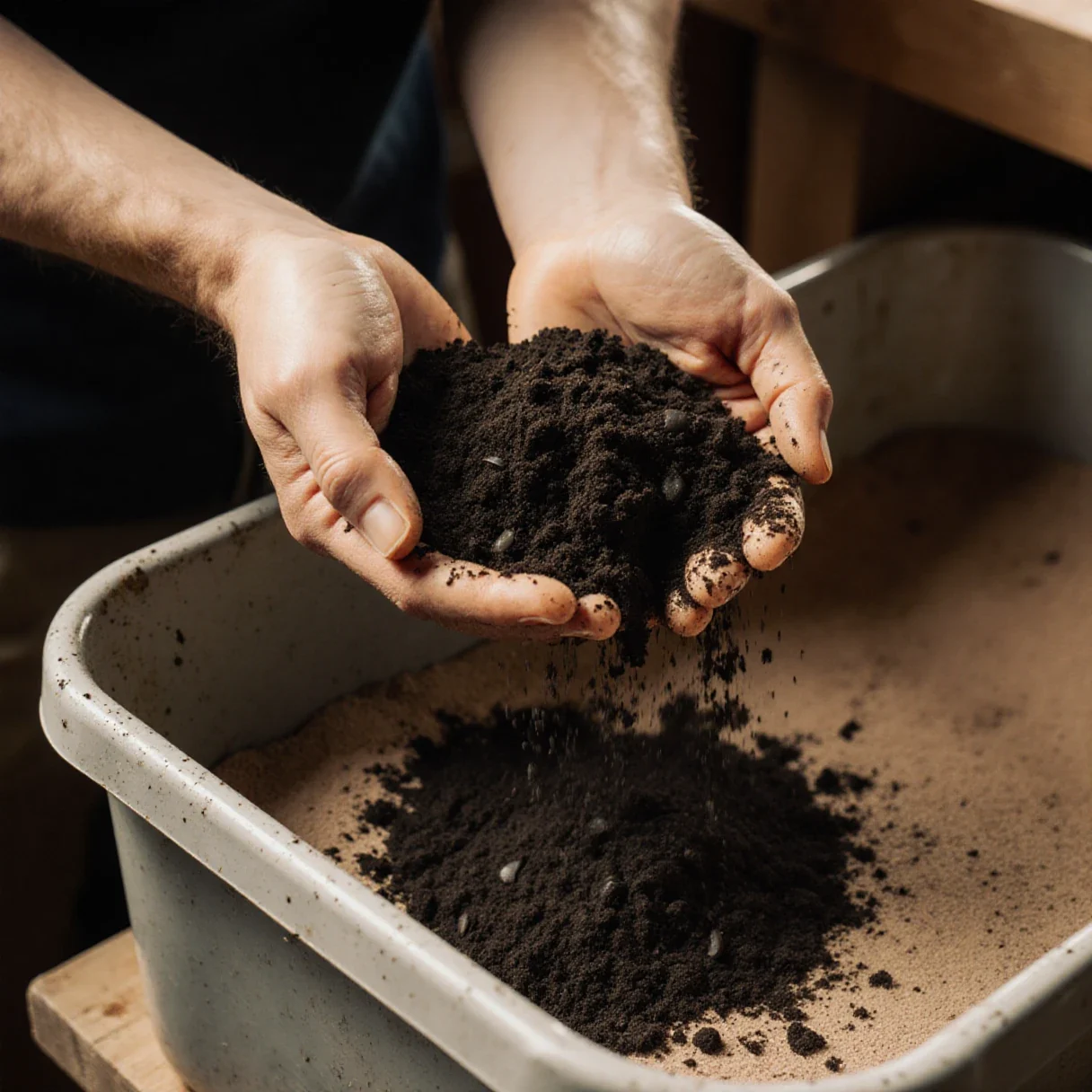
If you take one thing about living soil cannabis from this post, take this one. Castings go into the base mix when the living soil cannabis bed is built — not only sprinkled on top later, and not only brewed into a tea.
Castings do two jobs at once in the mix. They are a mild, slow nutrient source that is very hard to burn a plant with, and they are an inoculant carrying the microbial population you actually want living in the bed. They also add organic matter, which loops straight back to the buffering section above.
The research on vermicompost is better than most growers realise, and it points at something beyond simple nutrition. A 2022 greenhouse study in Plants compared vermicompost against a commercial humic acid extract and against indole-3-acetic acid, a plant growth hormone. Read that one with a caveat the paper is open about: the vermicompost was enriched — with nitrogen, sulphur and phosphorus and with bacterial inoculants — while the two comparators supply essentially no nutrition. Part of the gap is simply that one treatment fed the plant and the others did not.
Even with that discounted, the study reported “the complete superiority of VC over the CHA and IAA,” and concluded that the humic acid and IAA applications “were not found to be suitable and therefore not recommended.” The authors credit hormone-like activity, high microbial and enzymatic activity, and a rise in cation exchange capacity driven by the extra organic matter — and that last one is the same property that gives a living soil cannabis bed its pH buffer (Plants, 2022, 11(2):227).
That was rapeseed, not cannabis. Take it as support for the mechanism, not as a yield figure you can expect.
Worth being clear on the boundary here too: castings are not a mycorrhizal inoculant, and the evidence on bought mycorrhizae packets is its own messy subject — we covered it in do mycorrhizae really boost cannabis yield, including the finding that most commercial packets fail to colonise at all.
Plenty of good living soil cannabis growers run an aerator in their tea. We are still not going to tell you the science is settled, because it is not, and this is the single most oversold practice in organic growing.
The sceptical case is real and it is old. A Washington State University extension review by Dr Linda Chalker-Scott tabulated university trials of aerated compost tea across tomato, pumpkin, squash, rose, apple, wine grapes and turf — and the efficacy column reads “No” almost the whole way down. Her bottom line, and note the date on it, was that “Aerated compost tea use for disease control continues to lack scientific credentials” (The Myth of Compost Tea, Episode III, WSU, 2008). That review is from 2008, so treat it as what the university evidence looked like then, not as a statement about today.
One distinction in that same review matters here and almost nobody repeats it: the negative findings are specific to aerated tea. Chalker-Scott notes that reviews of the time reported non-aerated compost tea “can be effective in reducing some foliar pathogens in laboratory, greenhouse and field studies” — and non-aerated tea needs no special equipment. The bubbler is the part with the weakest evidence behind it.
More recent work is more encouraging but not a vindication. A two-year vineyard trial published in Journal of Fungi in 2025 found downy mildew severity “significantly lower in plants treated with compost tea compared to those managed with synthetic fungicides in 2023” — and then, in 2024’s low-pressure season, “no significant differences observed” (Journal of Fungi, 2025, 11:527). The authors flag that their result is validated for one grape variety in one Italian region. It was also a foliar programme paired with a conventional fungicide, not a soil drench on its own.
So: grapes, not cannabis. One good year, one null year. That is the honest state of it.
One finding is worth carrying forward whatever the efficacy picture turns out to be, and it is the safety one. Chalker-Scott’s review notes that a focus of published compost tea research has been “the discovery of human pathogens, such as E. coli, in some ACTs,” and calls fecal contamination of compost teas “a health issue of serious concern to the EPA and other agencies.” A brewer is a warm, aerated, nutrient-rich vessel, and it will happily grow whatever went into it. Brew clean, use it fresh, and do not drench ready-to-eat produce with it.
We use tea in our own living soil cannabis beds. We use it as a microbial top-up on a soil we already trust, not as a rescue for a bed that is struggling and not as a disease spray. If yours is going in as a fungicide substitute, the evidence is not behind you.
Between runs, and periodically during a long one, a living soil cannabis bed gets a dry amendment blend worked into the surface and watered in. Gaia Green, a Canadian organic amendment line, is what we reach for, and there is nothing magic about that specific brand — any reputable dry organic blend does the same job. The pattern matters more than the label.

The logic of top dressing is the entire living soil cannabis model in miniature. You are not dosing the plant. You are restocking the pantry that the biology draws from, then letting mineralisation set the release rate. Water carries it down, microbes break it down, roots take up what they need when they need it.
Practical notes from running it:
One genuine weakness worth naming: a living soil cannabis bed is slow to correct. If you get it badly wrong, you cannot flush and re-feed your way out in a day the way a coco grower can. That is the price of the buffer, and heavy feeders like Big Bud will show you the limit of an under-amended bed faster than a modest one will.
This is the part we have never seen written down anywhere else, and it is the most useful thing in this post.
Not every plant deserves the same soil, and running every one of them on a full living soil cannabis build is how growers burn effort they did not need to spend. Nobody running twenty plants in a pheno hunt intends to smoke twenty plants — most exist to answer a question and then get culled. Spending full living-soil effort on a plant whose entire purpose is to tell you whether it is worth keeping is spending in the wrong place.
So the practice splits by intent:
Growing for consumption, where the result is the point. Fresh living soil, built properly, with castings worked through the mix. This is the run where the bed’s condition shows up in the jar, so it gets the full living soil cannabis build. Our own genetics are what we would put in one — Blue Monkey Dick, Grape Skunk and Neptune’s Wedding are the ones we want in a properly built bed rather than a recycled cup.
Selection runs, where the plant is a question. Pheno hunting through twenty seedlings, hunting a male to breed with, or running small cups just far enough to see what is there. If the soil from the last run is still in decent shape, it gets bumped with castings and reused. No fresh build, no ceremony. The plant only has to live long enough to tell you whether it moves on, and a solo cup of recycled soil does that perfectly well.
That second mode is why we said earlier that living soil and no-till are not the same commitment. Reusing and re-amending soil between selection runs is living soil practice. It is not no-till, and calling it that would be dressing it up.
If the selection side is new to you, what phenotype hunting actually involves walks through how breeders pick keepers, and regular cannabis seeds explains why a male hunt needs regular stock rather than feminised.
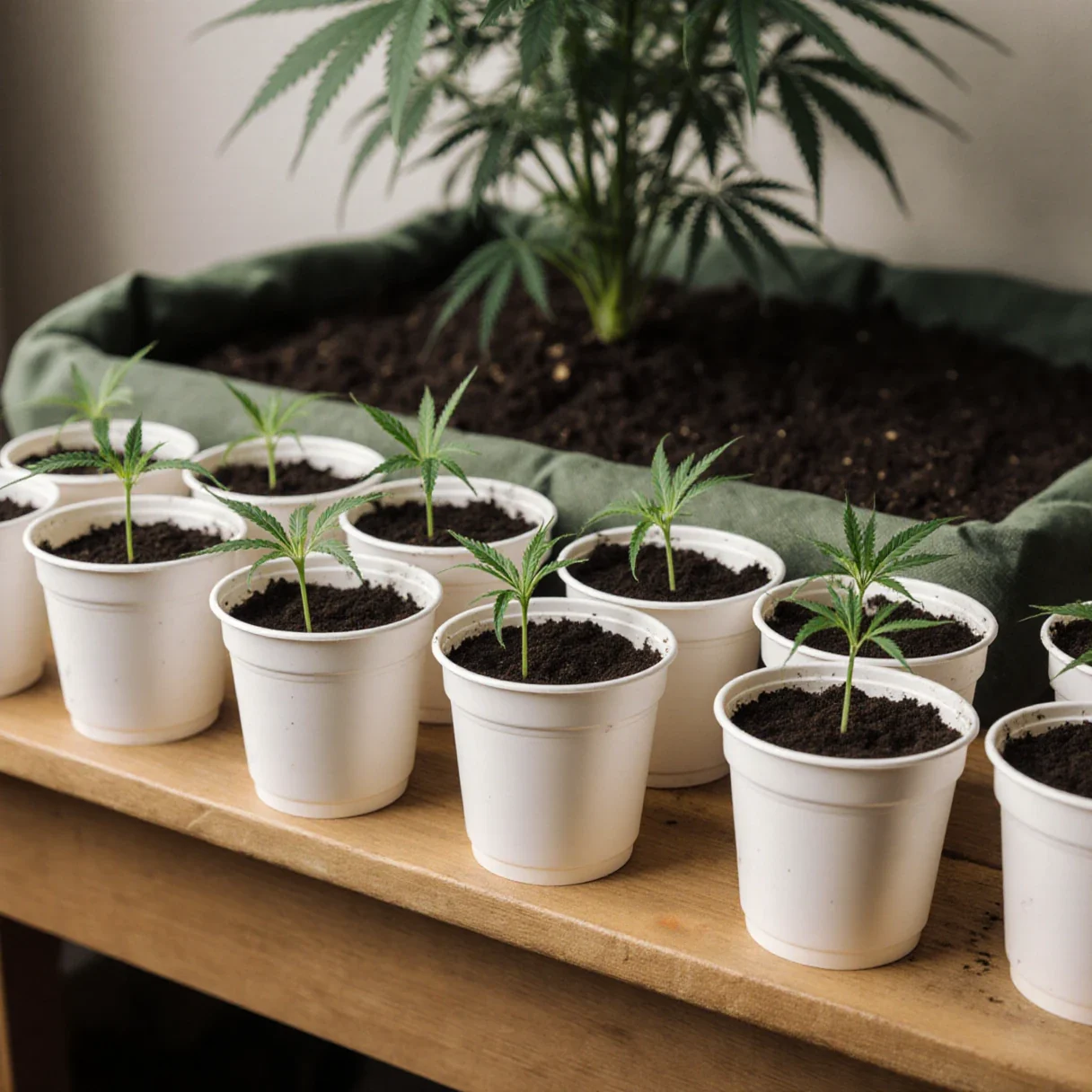
Living soil cannabis rewards a plant that can take a slightly variable nutrient supply without sulking. Vigorous, forgiving genetics suit it; highly strung cultivars that want precise feeding are happier in coco.
Reliable picks from our catalogue for a first organic bed: Northern Lights Skunk, White Widow and Afghani are all rated Easy and none of them are fussy eaters. Blue Dream is a step up in size and appetite but handles an organic bed well. For something with a bit more history behind it, Acapulco Gold Skunk is one of our own crosses, rated Moderate rather than Easy.
Autoflowers are the honest caveat in any living soil cannabis plan. An auto runs on a fixed clock and cannot wait for slow mineralisation to catch up, so a bed that is still cycling can cost you real yield in a plant whose whole life is a couple of months. If you want to run autos organically, amend the soil well before they go in and let it sit — do not build the bed and plant the same day. Mazar, Moby Dick and Mandarin Cookies are sturdy enough to make it work. Browse the full range of feminized cannabis seeds if you want to compare difficulty ratings across the catalogue.
Less often and less anxiously than a hydro grower does — the soil’s cation exchange capacity buffers incoming water, so the number moves slowly. That is not the same as never. Test your water, know whether it is hard, and watch it more closely in small pots and brand-new beds, which have less buffer and less margin.
Yes, and that is largely the point. Amend it between cycles and it improves rather than degrades. We reuse aggressively for selection runs and build fresh for the grows that matter most.
Over several runs, usually — you buy soil components and amendments once and keep the soil. The first build costs more than a bottle of nutrients does, so it is not a saving on your first grow; the return comes from reusing the soil rather than rebuying it.
It is not immune, though soil grows see far less of it than recirculating hydro does. Overwatering is still overwatering. Our guide to cannabis root rot covers the causes and fixes across mediums.
Far less than a hydro grower does, because you are not managing a solution. If you are curious about what the numbers mean, our post on EC targets explains it — but runoff EC in organic soil is a much noisier signal than it is in coco.
Living soil cannabis growing is a legitimate method, not a lifestyle choice, and the case for it is better than the case usually made for it. Build the soil properly, get real organic matter and castings in the mix, top dress ahead of demand, and you get a bed that buffers your mistakes and gets better every cycle instead of worse.
What it is not is a guaranteed upgrade in yield or flavour. The controlled organic-versus-mineral work we could find is thin and was done on CBD-type plants, and one trial found liquid organic feeding losing outright to mineral on biomass. Compost worked into the soil did much better — which is an argument for building a reserve, not for switching which bottle you buy.
And match the effort to the job. Full build for the grows you are going to smoke, recycled and bumped for the plants that are only there to answer a question. Running every plant like it is precious is the most common way growers make living soil more work than it needs to be.
Start with forgiving genetics, be patient through the first cycle, and judge your living soil cannabis bed on run three. That is when a living soil cannabis bed starts showing you what it is for.
Shop Cannabis Seeds | Soil vs Coco vs Hydro | More cannabis growing guides
Want to keep learning? Browse our full library of our cannabis growing guides — everything from germination to harvest, in one place.
Ready to grow? Browse premium seeds from Lighthouse Genetics:
Designed & Built by Wynne Web Design