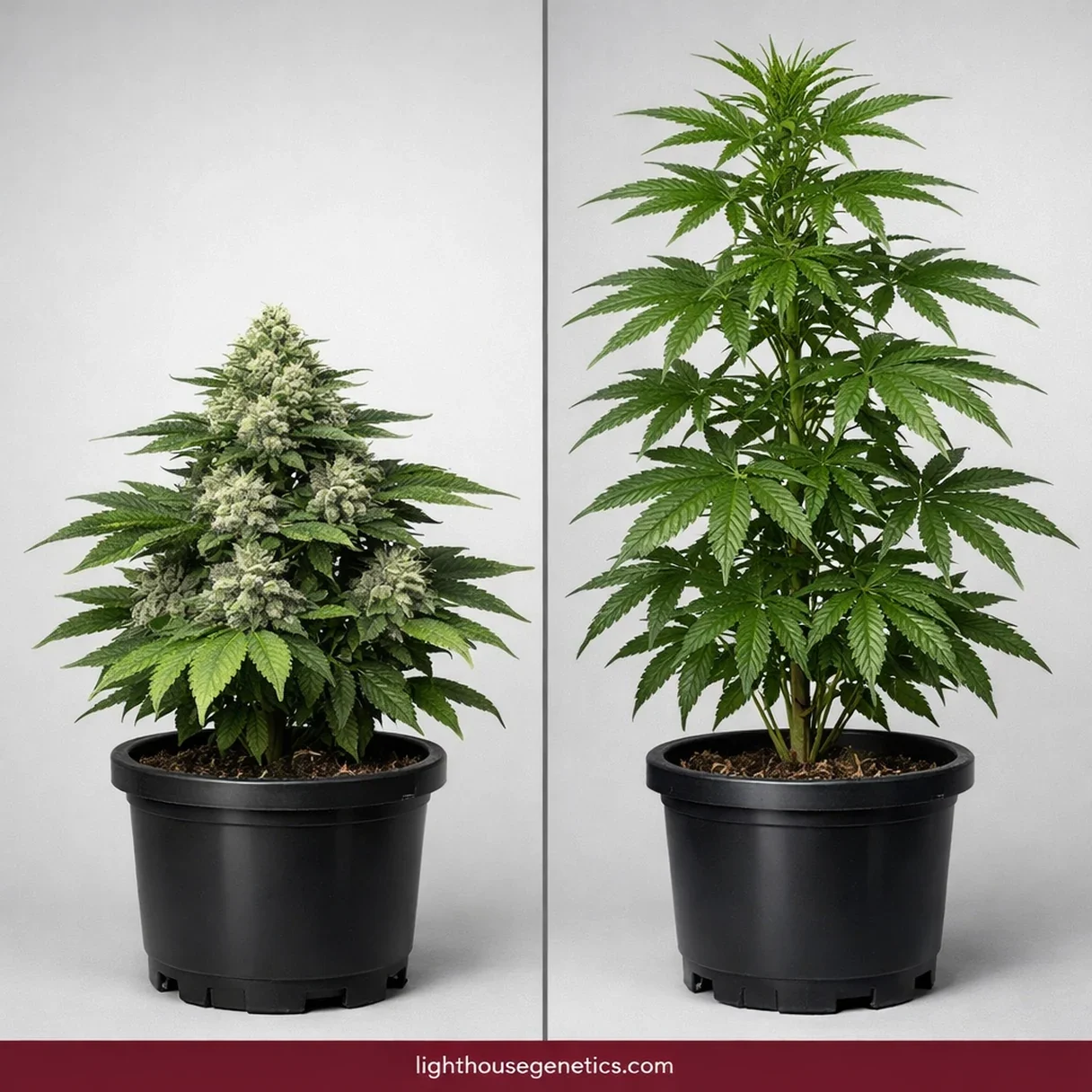
Autoflower vs feminized seeds sounds like a choice between two kinds of seed. It isn’t quite. The two words answer different questions. “Feminized” is about sex: the seed is bred to grow into a female plant, the kind that makes buds. “Autoflower” is about timing: the plant starts flowering when it reaches a certain age, not when the days get shorter.
So a seed can be both. Many autoflowers are sold feminized too, though not all. Every autoflower we sell at Lighthouse Genetics is feminized; anywhere else, check the listing. The real choice behind autoflower vs feminized seeds is this: do you want a plant that flowers on its own schedule (an autoflower), or one that waits for you, or the season, to tell it when (a feminized photoperiod)? We went through the university trials and plant genetics research to answer it properly, with extra time on growing outdoors, where the choice matters most.
Cannabis plants are normally male or female, and only females make the buds growers want. Plant a pack of regular seed and roughly half come up male. In a Cornell University hemp trial, regular seed lots came up anywhere from 34% to 59% female. That’s a lot of plants to grow, sex and pull, and it’s the problem feminized seed exists to solve.
Feminized seed fixes that at the breeding stage. A breeder sprays a female plant with silver thiosulfate, or sometimes colloidal silver. The silver blocks ethylene, the plant hormone that keeps female flowers female, so the plant grows pollen sacs. Because that pollen comes from a female, it carries only female genetics, and the seeds it makes grow into females. University of Connecticut researchers showed the spray reliably turns female hemp flowers male, and researchers at the University of Ljubljana used the same method on high-CBD drug-type cannabis.
How close to 100% female do feminized seeds get? It matters on both sides of autoflower vs feminized seeds, since many autos are sold feminized too. We couldn’t find a large published grow-out of commercial feminized seed, so treat any exact figure you see online with suspicion. In a University of Arizona field trial of 17 commercial hemp seed lots, 14 produced no males at all; the other three had between 4% and 14%. Bad lots happen.
No seed is hermie-proof. Stress gets blamed for intersex plants, though controlled studies haven’t confirmed it. Where the research points anywhere, it points at genetics: a 2026 review calls sex expression in cannabis “highly genotype dependent”, though no study has yet confirmed a particular strain as hermie-prone. That’s true of feminized seed and autoflowers alike.
A feminized seed on its own is a photoperiod plant. It grows leaves and stems for as long as the days are long, and switches to flowering when the nights get long enough. Indoors, you control that with a timer: most growers drop the lights to 12 hours on, 12 off to start flowering. Outdoors, the sun does it, and it does it later in the summer the further north you live. That one fact drives most of the autoflower vs feminized seeds decision outdoors (more on that below).
An autoflower ignores day length. It grows for a few weeks, then flowers because it’s old enough, whatever the light is doing. Scientists call this day-neutral or photoperiod-insensitive flowering. That trait is the real dividing line in autoflower vs feminized seeds.
It’s genetic, and it’s now mapped. A 2022 Cornell University study pinned one autoflowering gene, which the team named Autoflower1, to chromosome 1 and showed it’s recessive: a plant needs two copies, one from each parent, to autoflower. Plants with only one copy didn’t flower under constant light, just like photoperiods. Since then, researchers have found a second autoflowering gene in hemp, Autoflower2, and a 2026 study proposed a third, based on flowering-time data from landrace plants. So there’s more than one genetic route to an auto. With Autoflower1, the gene Cornell found in commercial autos, that recessive pattern is why breeding takes work: cross an auto with a photoperiod and the first-generation plants don’t autoflower.
You’ll often read that the trait came from Cannabis ruderalis, a wild plant from Russia and Central Asia. That’s the traditional story, but the same Cornell paper calls it “gray literature”, and the most detailed genomic studies don’t support ruderalis as a separate group. Where it really came from is still an open question.
The Cornell team found something else worth knowing: several commercial hemp seed lines sold as one type were genetically mixed, so some plants autoflowered and some didn’t. If an “auto” in your tent is still growing leaves at week eight, that may be why.
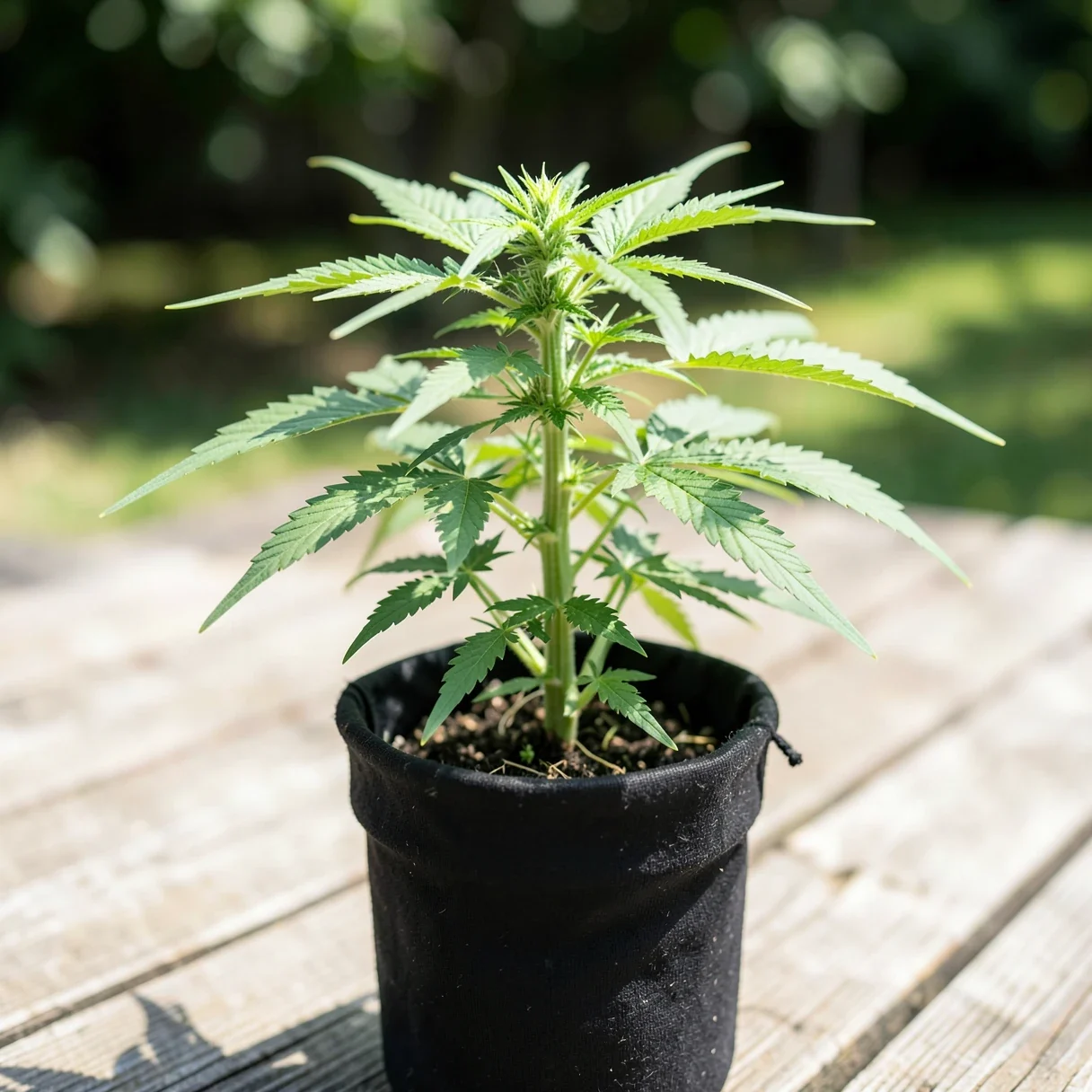
Here’s what the measured evidence supports when you put autoflower vs feminized seeds next to each other. Most of it comes from hemp trials, so it shows direction and size, not exact numbers for every drug strain.
| Feminized photoperiod | Autoflower | |
|---|---|---|
| What starts flowering | Long nights (indoors: you switch to 12/12) | The plant’s age, a few weeks after sprouting |
| Seed to harvest, outdoors (university trials) | About 5½ months in a spring-sown Arizona trial | About 9½ to 10½ weeks in the same field |
| Plant size | You control it with veg time; tall plants outdoors | Small; about 40 to 80 cm (16 to 31 in) in an outdoor Vermont hemp trial |
| Flower per plant | Much more | Much less, but a larger share of the plant is flower |
| Clones and mother plants | Yes | Not practical: a cutting is still an auto |
| Harvests per outdoor season | One, in fall | One per run; more than one is possible where the season allows, but untested |
| Labor | More (support and trimming) | Less |
This is where a lot of autoflower vs feminized seeds articles quote numbers with no source behind them. Here’s what has actually been measured.
Per plant, photoperiods win clearly in every autoflower vs feminized seeds trial we found. In the only published side-by-side of high-THC plants we found, a commercial New York greenhouse studied by Cornell Cooperative Extension, the autoflowers produced about 21 g (0.75 oz) of usable flower per plant against about 89 g (3.1 oz) for the photoperiods. That’s roughly a quarter, from one farm and two auto strains. University of Vermont and Arizona outdoor hemp trials point the same way.
Per square foot, the picture is mixed. Autos are small, so you can plant them closer together. In the University of Vermont trial, two autoflower varieties planted 60 cm (2 ft) apart out-yielded the full-season average per acre, though that figure was worked out from the spacing rather than tested statistically, and the researchers noted that seed costs and disease risk rise when you pack plants that tight. In the New York greenhouse, where the autos were planted only a little closer than the photoperiods (about 450 to a bay against 350), a bay of photoperiods was still estimated to produce about three times as much usable flower per crop as a bay of autos.
You’ll read that the potency gap between autos and photoperiods has closed. We couldn’t find evidence for that. In the New York greenhouse, the two autoflower varieties tested about 10% total THC, while the photoperiods tested between about 15% and 18%. That’s one farm and two auto strains, so it doesn’t settle the question for every strain. But it’s the only measured comparison we found, and it points the other way.
Time is the autoflower’s real advantage in autoflower vs feminized seeds. In a University of Arizona trial, autos sown in spring were harvested 66 to 73 days later. Photoperiods sown in the same field the same week took about 166 days. In the New York greenhouse, autos spent about 60 days in the greenhouse to the photoperiods’ 80 (the photoperiods went in as rooted clones, not seed).
Does speed make up for yield? That’s the core trade in autoflower vs feminized seeds. Not in the one study that did the maths. The New York greenhouse could fit five autoflower crops a year to four photoperiod crops, and the photoperiods still earned more per square foot. The authors’ conclusion is a fair summary of autoflower vs feminized seeds as a whole: autos suit growers short on space, money or time; photoperiods suit growers chasing the biggest harvest.
Outdoors, autoflower vs feminized seeds comes down to your season, because you don’t choose when a photoperiod plant flowers. The sun does. Cannabis is a short-day plant: it starts flowering once daylight drops below a threshold that varies by strain. University of Georgia Extension puts it at roughly 13 to 14 hours for most hemp cultivars. Other sources quote different numbers for different strains, so treat any single “flip date” with suspicion.
That threshold arrives later the further north you are. As a rough guide, worked out from NOAA’s sunrise and sunset equations, daylight falls below 14 hours around:
| Latitude | Roughly where | Days drop below 14 hours |
|---|---|---|
| 35°N | Charlotte, NC; Albuquerque, NM | About late July |
| 40°N | Philadelphia, PA; Denver, CO | About August 10 |
| 45°N | Minneapolis, MN; Ottawa and Montreal | About mid-August |
| 50°N | Winnipeg, MB | About late August |
Once a photoperiod starts flowering, it keeps going for weeks. Georgia’s extension guide gives 45 to more than 100 days for hemp, depending on the cultivar. That’s the whole problem in the north. A plant that starts flowering in mid-August still has a long way to go, and it’s racing your first fall frost and the cool, wet weather that brings bud rot. Botrytis likes cool, humid, rainy conditions, and once it’s in the buds it can’t be cured.
Look up your first fall frost before you settle autoflower vs feminized seeds for your garden. US growers can get local freeze dates and growing-season length from NOAA’s climate normals. Canadian growers can check the first-fall-frost map at ClimateData.ca. Plan around an early frost year, not the average one. North Carolina State Extension points cautious growers to the conservative date, and for good reason: an average date is one that frost beats in about half of all years.
Autos don’t care about day length, so they can go in later and still finish before fall. In a University of Wisconsin trial at about 43°N, autoflowering hemp sown directly in the ground as late as late June was still harvested in mid to late September (some photoperiod hemp in that trial, started indoors in May, finished on the same dates). In Vermont, near the Quebec border, autos planted in mid-June were done around the start of September, a month or more before the photoperiods beside them (late September into October).
That makes autos the safer bet where fall comes early: northern states, high elevations, much of the prairies, or anywhere your frost arrives in September. (Check your local rules first; Manitoba, for one, only allows growing indoors, and Newfoundland and Labrador bars open-yard growing.) A plant that finishes in late summer is out of the garden before the coldest, wettest weeks. That part is common sense rather than a measured result, but it’s sound.
If autos win your autoflower vs feminized seeds call, two rules from the trials apply. First, don’t waste the long days. In a two-year University of Georgia hemp field trial, autoflower yields fell as planting moved later, across four spring planting dates from early April to late May. Late-sown autos can still finish (see Wisconsin above). Second, don’t stress them young. Georgia’s extension guide warns that autos are very sensitive to early stress, and even a little root restriction in a transplant tray can start them flowering early. Sow them directly or move them out young.
Can you fit two auto crops in one summer? On paper, in a long southern season, yes: one run takes roughly 10 to 12 weeks. Georgia’s guide calls multiple crops a year a “promise”. But no trial we found actually grew back-to-back outdoor auto crops and measured them, so treat it as a plan, not a promise.
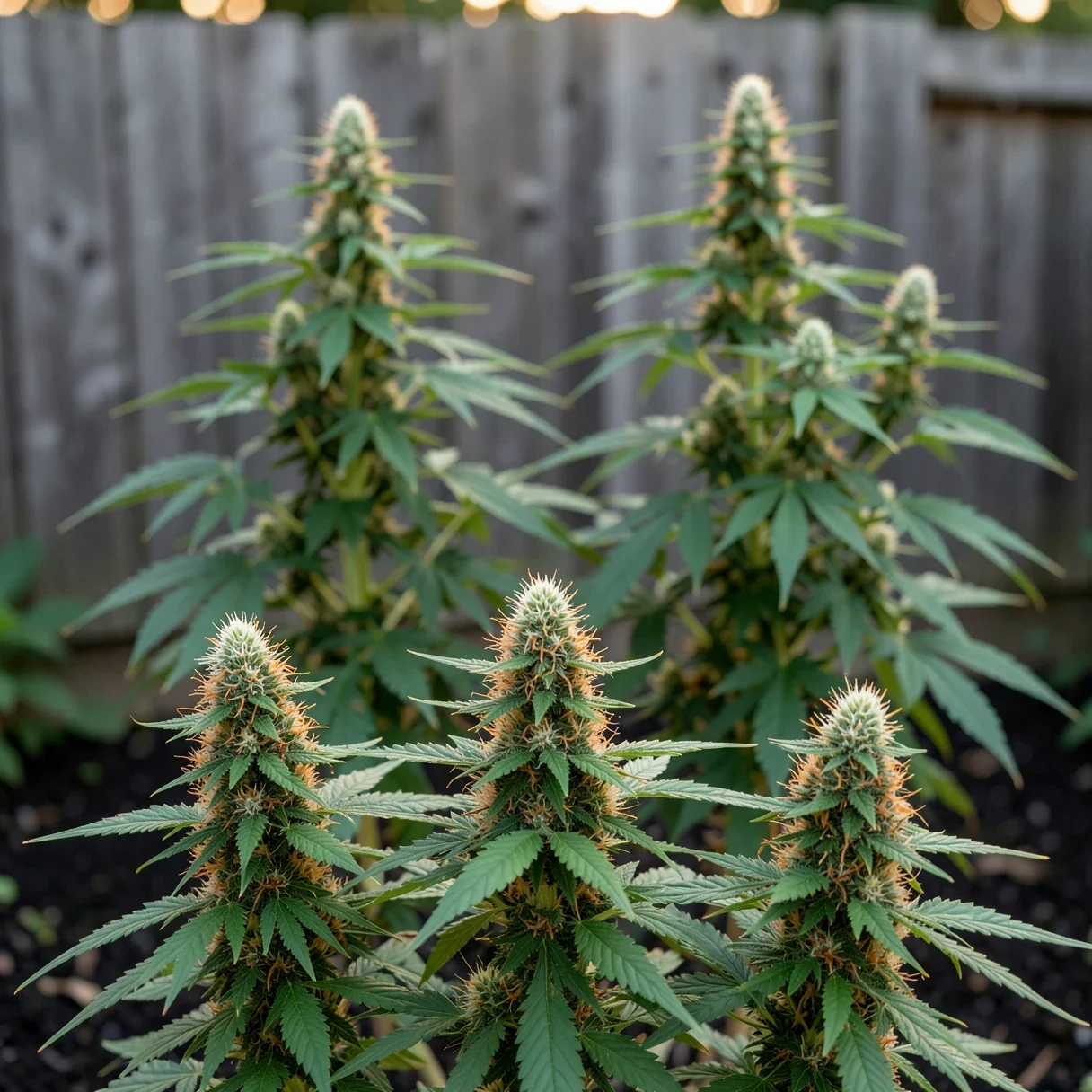
Where the season is long enough, the autoflower vs feminized seeds math flips: a photoperiod makes far more per plant, and that matters when the law caps your plant count. In the same Georgia trial, the photoperiods out-yielded the autos in both years.
In Canada, the Cannabis Act allows four plants per household, but provinces add their own rules. Quebec bans home growing, Manitoba allows it indoors only, and Newfoundland and Labrador only inside a home or an enclosed structure, not in the open yard. US states set their own limits, so check yours. With only four plants, one big photoperiod is worth several small autos. Our Canadian outdoor guide covers the limits and frost timing province by province, and our Northeast and Midwest guide does the same for the eastern US.
Photoperiods also have a trap of their own. Plant too early in the far south, or too late anywhere, and they can start flowering before they’ve grown much. In Georgia’s trials, some crops planted in mid-July flowered at the same time as June plantings, with very little growth. Give them the long days of early summer to get big.
And there’s no rule against mixing. Under a four-plant cap, a couple of autos for a late-summer harvest and a couple of photoperiods for the big fall one spreads your risk across two different finish dates.
Here’s how we’d decide between autoflower vs feminized seeds. Find your situation in one of these two lists.
A few parts of autoflower vs feminized seeds the trials don’t settle, so we’ll keep these short and point you to the guides that cover them. Autos run on a long light schedule from seed to harvest; our autoflower light schedule guide covers the options. For size, see how tall autoflowers grow. We couldn’t find a trial that tested training autos, and with Georgia’s extension guide warning that autos are very sensitive to early stress, keep training gentle; if you top one at all, do it once and early (see topping vs fimming). And if you’re torn on timing, our guide to how long cannabis takes to grow walks through each stage for both types.
Whichever side of autoflower vs feminized seeds you land on, these are good places to start. All of them are listed as Easy to grow in our catalog. The figures below are the specs listed in our catalog, not trial results.
White Widow Autoflower is listed at 70 to 80 cm (28 to 31 in) tall and 60 to 80 g (about 2 to 3 oz) per plant outdoors, a compact pick for a short season or a small space. Super Skunk Widow Autoflower is listed at 100 to 200 g (3.5 to 7 oz) per plant outdoors. Green Crack Autoflower and Mandarin Cookies Autoflower are listed at 9 to 10 and about 8 to 9 weeks from seed, and Bruce Banner Autoflower at 65 to 70 days from seed. For a shortlist built for first-time growers, see our best autoflower strains for beginners.
Mac’s own Blue Monkey Dick and Grape Skunk are both listed at 400 g (14 oz) per plant or more outdoors. Afghani is listed at a 7 to 8 week flowering time, short for a photoperiod and handy where fall comes early, though its listing warns its dense buds can hold moisture, so keep an eye on bud rot in a wet fall. For a bigger harvest in a long season, Train Wreck is listed at 600 to 700 g (21 to 25 oz) per plant outdoors.
Browse the full ranges: autoflower cannabis seeds and feminized cannabis seeds.
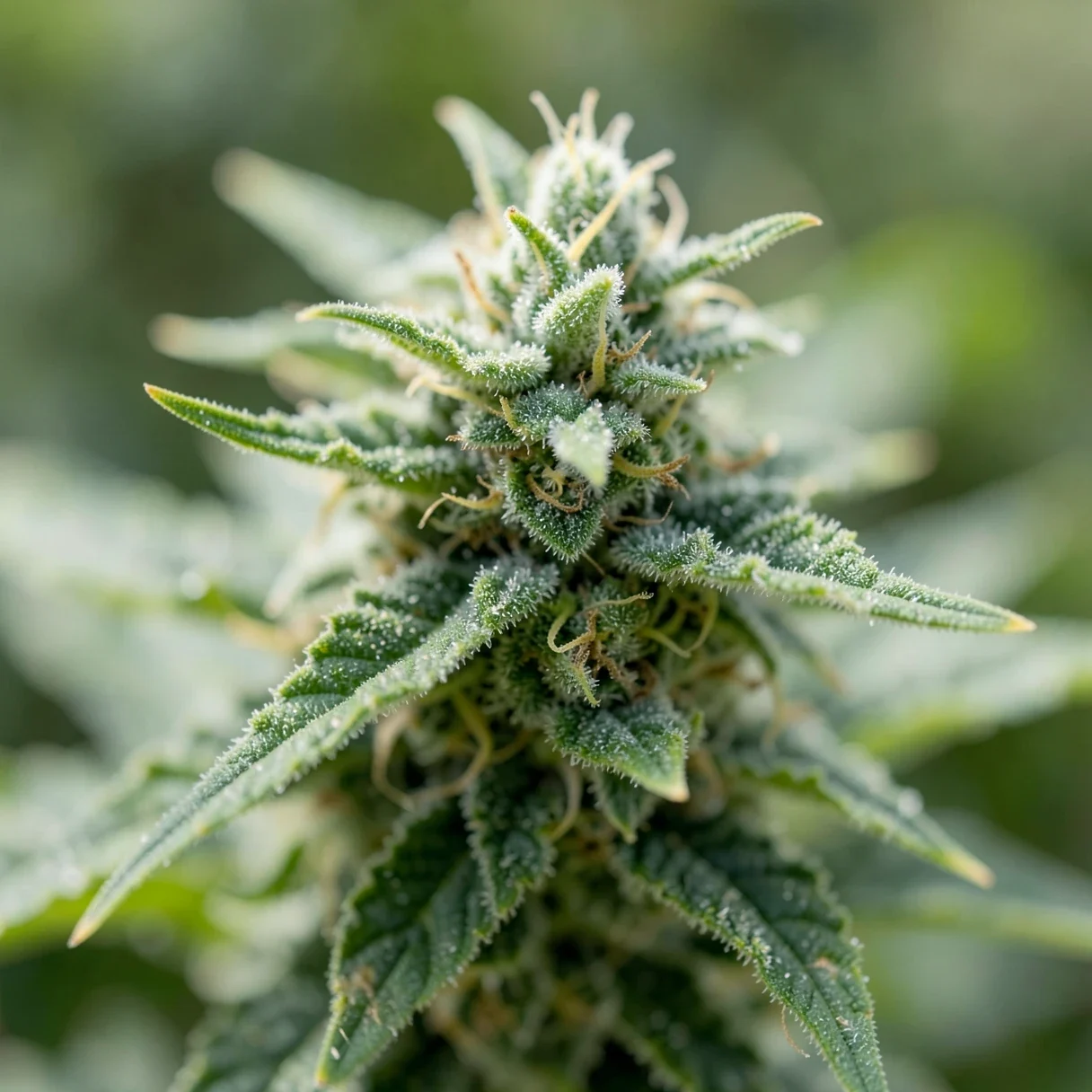
Autoflower vs feminized seeds is really a choice between a plant that flowers on a clock and one that flowers on the calendar. Autos are faster, smaller and simpler, and they’re usually the safer bet in short or wet seasons because they finish earlier. Feminized photoperiods take longer and need more care, but they give you more per plant and more control. If you want the most from a few plants and you have the season for it, grow photoperiods. If you want a quick, forgiving harvest or your fall comes early, grow autos. Either way, match autoflower vs feminized seeds to your season first, then pick the strain.
Shop cannabis seeds | Regular cannabis seeds explained | Our cannabis growing guides
Often, but not always. “Autoflower” describes when a plant flowers and “feminized” describes its sex, so a seed can be one, the other or both. Many autos are sold feminized, but regular autoflower seed exists too. Every autoflower we sell is feminized; elsewhere, check the listing before you buy; it’s the first thing to confirm in any autoflower vs feminized seeds comparison.
Per plant, yes, by a lot. In a New York greenhouse study, autos produced about a quarter of the usable flower per plant, and the photoperiods came out well ahead on returns. Planting autos closer together can help on paper: in a Vermont hemp trial, two densely planted auto varieties out-yielded the full-season average per acre when worked out from their spacing, but in the New York greenhouse a bay of photoperiods was still estimated to produce about three times as much per crop. Yield is the biggest practical gap in autoflower vs feminized seeds.
In the only measured high-THC comparison we found, yes: the autos tested about 10% THC against roughly 15% to 18% for the photoperiods. That’s two auto strains on one farm, so other autos may do better. But there’s no evidence the gap has closed across the board.
Outdoors, autoflower vs feminized seeds depends on your season. Where the first fall frost or the fall rains come early, autos are usually the safer bet, because they can finish in late summer before the coldest, wettest weeks. Where the season is long and plants are capped by law, feminized photoperiods give you far more per plant. You can also plant some of each.
You can take a cutting, but it’s still an autoflower, so it won’t wait in a leafy stage for you. That’s why growers don’t keep auto mother plants. We couldn’t find any published study on how auto cuttings perform.
Keep reading
 How to Choose Cannabis Seeds for Your Setup
 What Are Regular Cannabis Seeds?
 How to Read Cannabis Seed Descriptions
Browse all our cannabis growing guides by topic, from germination to harvest.
Ready to grow? Browse premium seeds from Lighthouse Genetics:
Designed & Built by Wynne Web Design