Nobody notices cannabis pests early. That’s the whole problem. By the time you can see something moving on a leaf, the population has been doubling quietly for a couple of weeks on the undersides where you never look. What starts as a few pale speckles on one fan leaf ends as a webbed, bronzed plant three weeks later — and in flower, there is very little you can safely do about it.
This is a field guide to the cannabis pests you’ll actually run into indoors, what each one does to a plant, and the order of operations when you find them. It is not a spray list. The growers who never lose a crop to bugs aren’t the ones with the best chemicals — they’re the ones who look under the leaves every week.
Half of what gets blamed on cannabis pests is a feeding or pH problem wearing a costume. Both produce yellowing. Both produce spots. They don’t produce the same pattern.
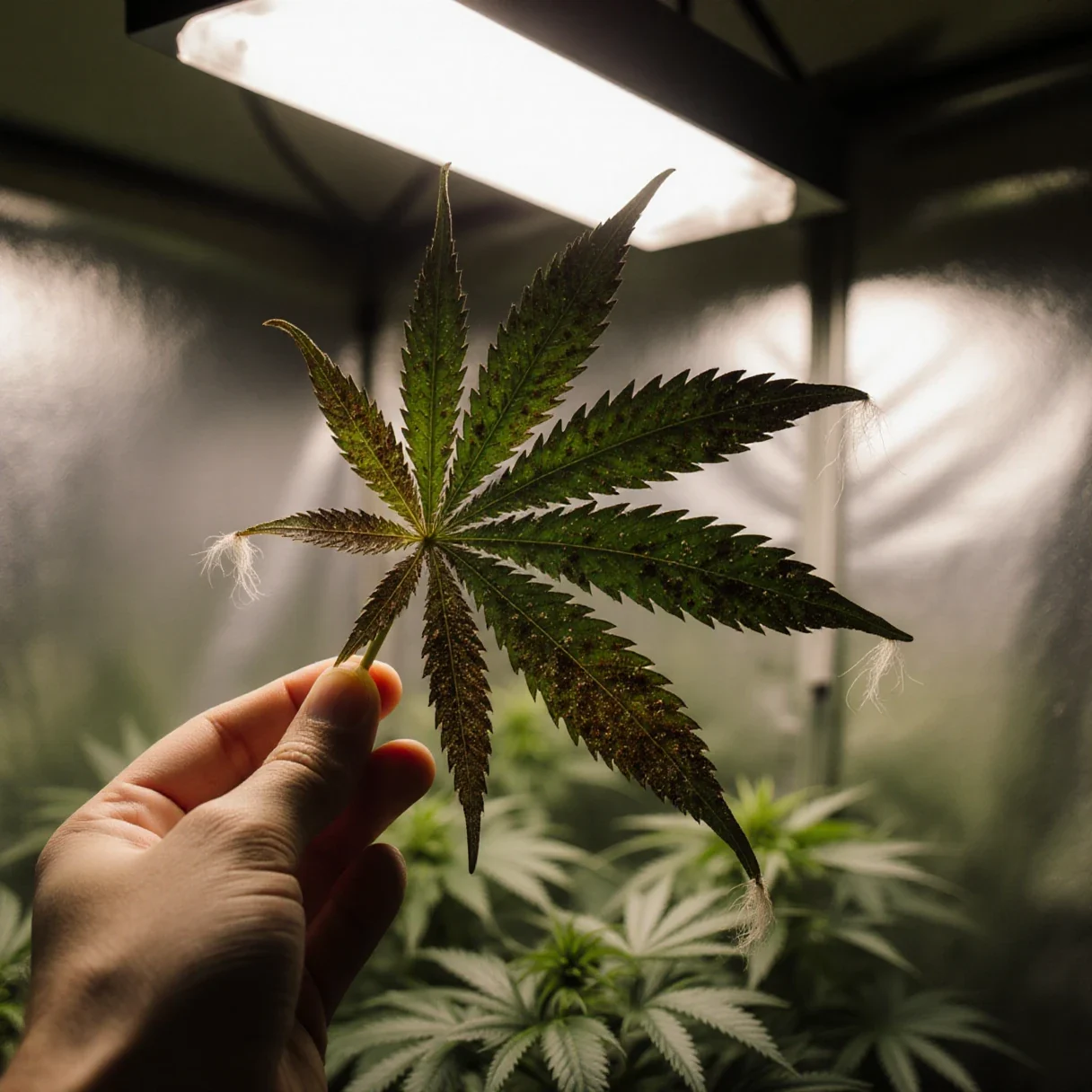
Pest damage is usually asymmetric and localised — a few leaves worse than their neighbours, damage concentrated on one side of the plant or one plant in the row, and something physically present when you flip the leaf. Nutrient problems follow the plant’s plumbing instead: mobile nutrients drain out of the old lower leaves first, immobile ones show up in new top growth, and the pattern is broadly even across plants fed the same way. If the yellowing is tidy and symmetrical, start with nutrient deficiencies and pH, not bugs.
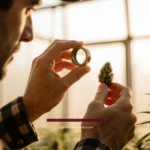
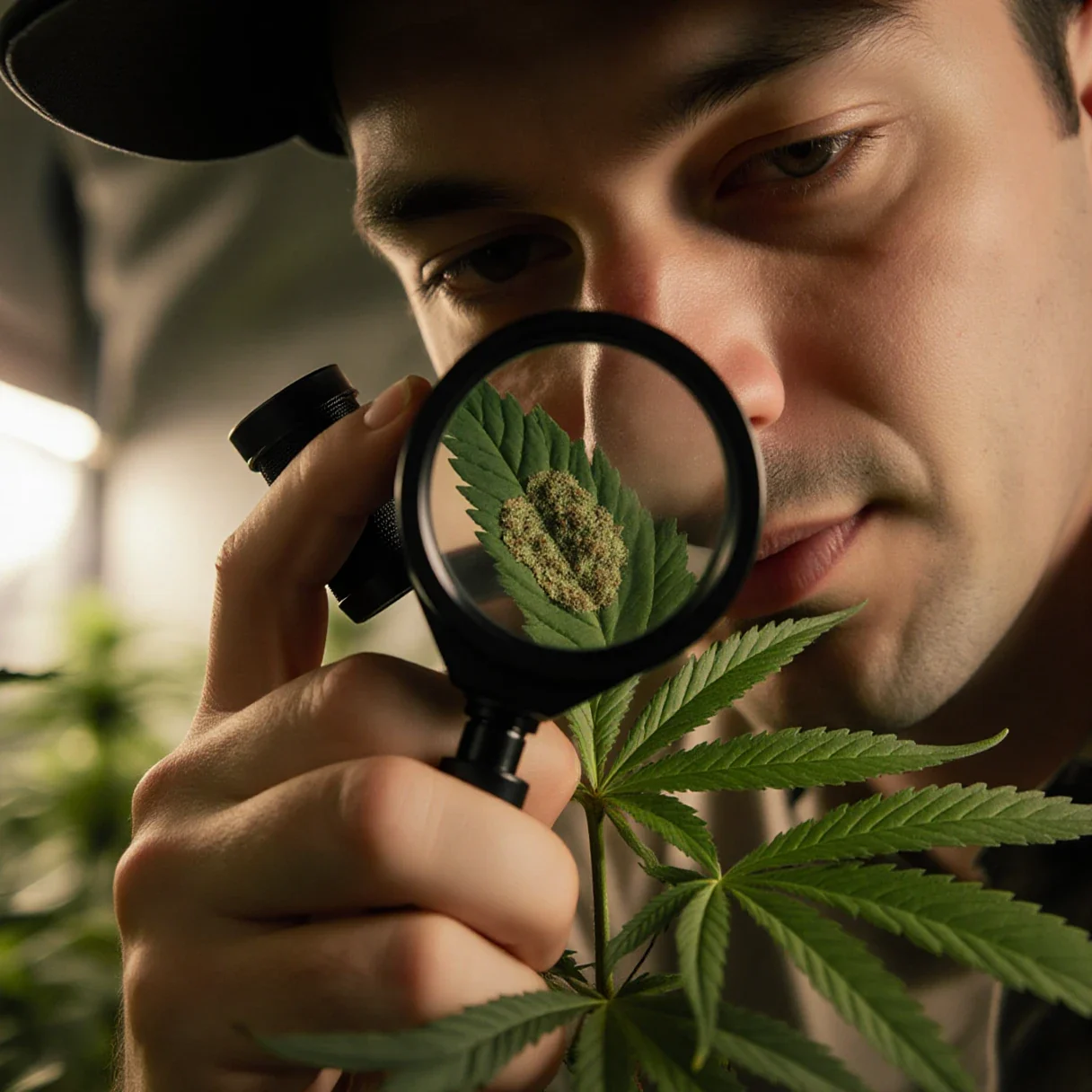
The tiebreaker for nearly all cannabis pests is a hand lens. A 30x jeweller’s loupe costs a few dollars and settles the question in ten seconds. No loupe, no diagnosis — you cannot see a russet mite with your eyes, and you will misidentify it every time.
The usual assumption is that a light infestation is a cosmetic problem. The research says otherwise, and it’s worth knowing before you decide to ride one out.
A 2023 study in Environmental Entomology ran controlled infestations on greenhouse hemp and measured what came out the other end. In the 2020 run, high spider mite densities produced significantly reduced THC and CBD accumulation compared to uninfested controls. The 2021 repeat did not replicate: neither the THC nor the overall CBD effect reached statistical significance that year. What did survive was narrower — low-density mite pressure reduced CBD accumulation at the 14-day mark, and regression across the trial put mite numbers negatively correlated with both cannabinoids. The authors also noted plainly that mite and aphid injury leads to leaf drop, and that aphid injury reduces flower and resin production.
So the honest read: the effect isn’t perfectly consistent year to year, but it points one direction, and none of it is good. Cannabis pests take potency, not just leaves. That’s the argument for acting on the first one you find rather than the tenth.
Not all cannabis pests are equally likely, and not all of them are equally dangerous. A 2024 review in the Journal of Integrated Pest Management catalogued the major arthropod pests of indoor hemp production in Florida and landed on eight species — a mix of generalists that will eat anything and two specialists that have made cannabis their job. Add broad mites and fungus gnats — both common in home grows without making that particular list — and you have nearly everything you’ll ever meet.
The one everyone means when they say cannabis pests, and the one you are most likely to meet. Tiny, yellowish-clear bodies with a dark spot on each side of the back. Utah State University Extension notes that all life stages occur most often on the undersides of leaves — which is exactly why people miss them. Damage starts as stippling, small yellow speckles on the upper leaf surface, then progresses to generalised bronzing or reddish discolouration on leaves and stems, brown leaf margins, and premature leaf drop. Webbing means you’re late. USU records eight or more generations a year. A warm, dry tent removes most of the seasonal brakes that slow them down.
A cannabis specialist, and the nastiest of the cannabis pests precisely because it’s invisible. Far too small to see unaided — you need magnification or you’re guessing. It works upward from the lower plant, and the first sign is usually a plant that looks vaguely sick and stunted with no obvious cause: dull, taco-ing, brittle leaves and stalled growth. Growers routinely spend two weeks chasing an imaginary deficiency before someone puts a loupe on it.
Same invisibility problem, different signature. Unlike most cannabis pests, broad mites attack new growth, so the damage shows at the top of the plant: twisted, glossy, blistered-looking young leaves with margins curling downward and an almost varnished sheen. If your tops look deformed and burnt while the rest of the plant is fine, it’s not light burn and it’s not a nutrient issue.
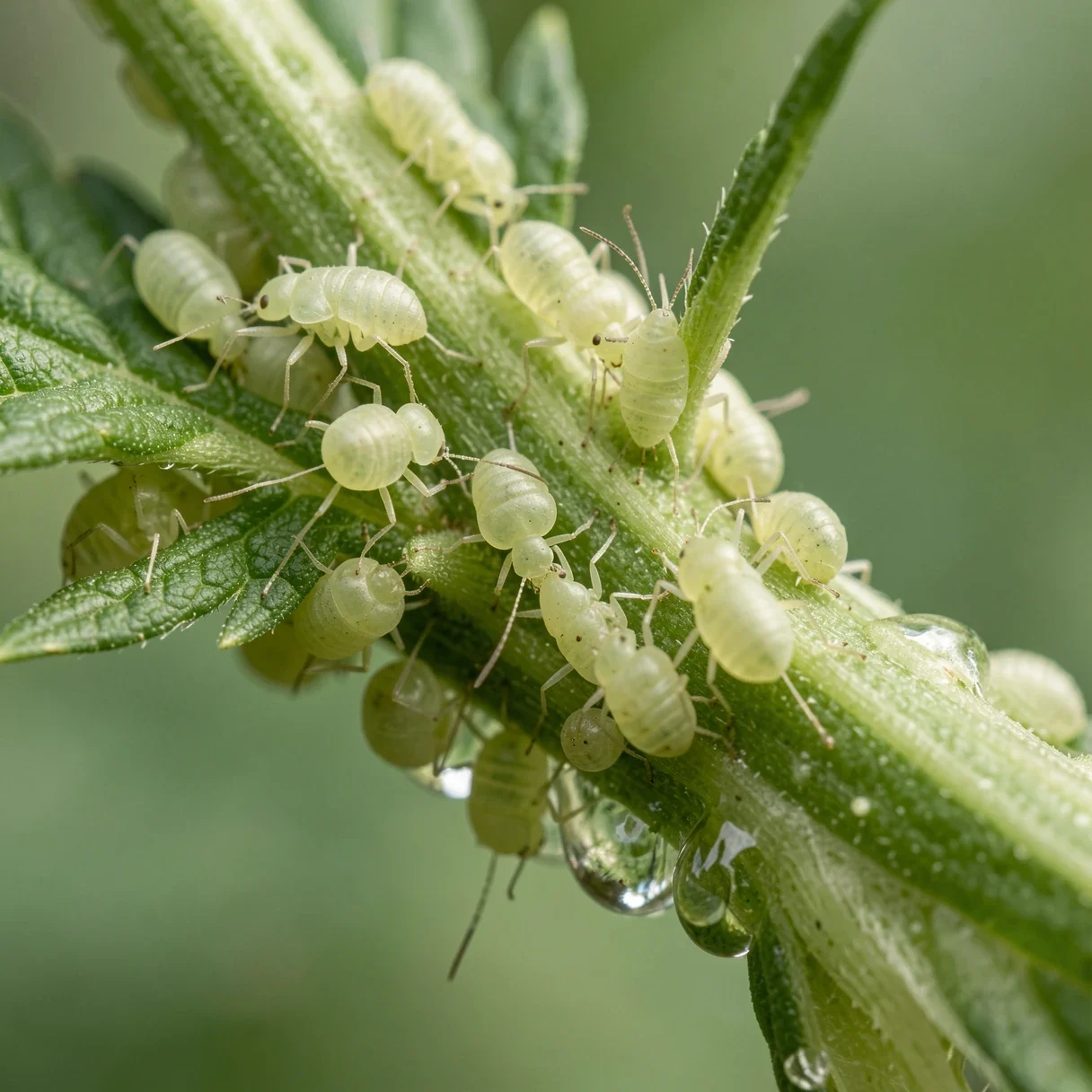
The other specialist. Aphids are phloem feeders — they tap the plant’s sugar plumbing rather than chewing cells — and they’re big enough to see, which makes them the friendliest of the cannabis pests to diagnose. Look for sticky honeydew on lower leaves, sooty mould growing on that honeydew, and shed white skins. They cluster on stems and leaf undersides.
Thrips are the sneakiest of the common cannabis pests: slim, fast, and hard to catch in the act. They rasp the leaf surface and drink what leaks out, leaving silvery or bronze scarring with tiny black specks of frass in it. That black-dot detail is the giveaway that separates thrips from mite stippling. Most thrips species drop into the growing medium to pupate, which is why foliar-only treatment often fails to finish the job — though not all do. Echinothrips americanus, the thrips most often recorded on indoor hemp, completes every stage on the leaves.
Both the sweetpotato whitefly and the greenhouse whitefly turn up on indoor cannabis. Disturb the plant and a small cloud lifts off the undersides. Like aphids, they’re phloem feeders that leave honeydew behind, and their eggs and nymphs sit on the leaf undersides where sprays aimed at the top of the canopy never reach.
The least frightening entry on the list: little black flies drifting around the medium. The adults are harmless and annoying; the larvae live in wet soil and chew root hairs, which hits seedlings and fresh clones hardest. Fungus gnats are the one entry on this list that is almost entirely a watering problem — they need persistently wet topsoil to breed, and they’re the least dangerous of these cannabis pests to an established plant.
Every serious grower catches cannabis pests the same way — on a schedule, not by accident.
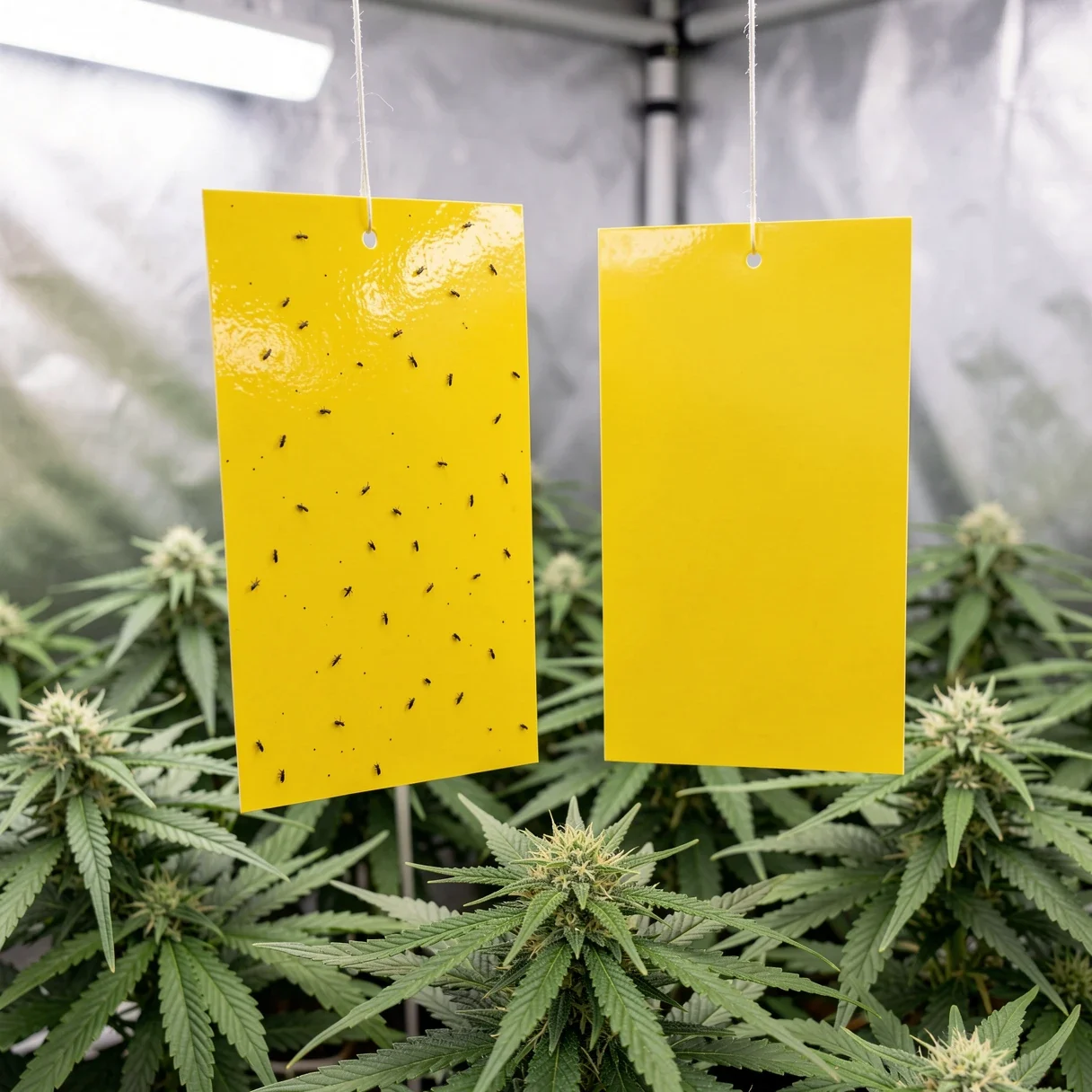
Pick a day. Once a week, hunt for cannabis pests properly — flip leaves on the lower and middle canopy of every plant and look with magnification, because that’s where nearly all of these start. Check the growing tips separately for the twisted, glossy new growth that means broad mites. Hang a few yellow sticky cards just above the canopy — they catch adult fungus gnats, thrips and whiteflies days before you’d notice them, and the card is a running record rather than a snapshot.
Then close the front door. Most indoor infestations arrive on something you carried in: a clone from someone else’s room, a plant brought inside from the garden, or your own sleeves after an afternoon outdoors. If you’re bringing in genetics you didn’t grow, quarantine them away from the tent for two weeks. Starting from seed sidesteps the single most common entry route entirely, which is one of the underrated arguments for it over taking cuttings from unknown stock.
Order of operations matters more than product choice. Nearly everyone who loses a plant to cannabis pests got this sequence wrong, not the spray.
On products: this is where local rules govern, so read the label and check what’s permitted where you live before anything touches a plant you intend to consume. The general principle worth holding is that anything oily or soapy applied to open flowers is a bad idea — it traps moisture in dense buds and invites bud rot, which is a worse problem than the one you started with. In practice you get a narrow window: treat aggressively in veg and early flower, and after that your options collapse to physical removal and hoping.
Almost everything that keeps cannabis pests out of a room is unglamorous. None of this is exotic. It’s just consistent.
Keep the room clean — most cannabis pests arrive on something, and a tidy room gives them fewer places to arrive into.
No dead leaves on the floor, no random houseplants sharing the space, no old medium sitting around. Wash up and change clothes after being in the garden before you go near the tent. Run good air movement so there are no dead, still pockets in the canopy, which is a build-and-airflow question covered in our grow tent setup guide. Filter your intake if you can. Quarantine anything living that comes in from outside.
And don’t overcrowd. A jungle you can’t see into is a jungle you can’t scout, and cannabis pests are found by looking. That’s the real cost of a canopy so dense you can’t get a hand into the middle of it.
Not as much as the internet suggests. No cannabis seed is pest-proof, and any strain will get eaten given the chance — so treat this as a small edge, not a solution.
What genetics genuinely buys you is time. Every extra week in the tent is more generations of whatever is breeding in there, so a shorter grow is simply less exposure. Super Skunk is listed at 6–7 weeks of flower and rated Easy — one of the shortest bloom windows in our catalog. Mandarin Cookies Autoflower (7–8 weeks, Easy), Kush XL Autoflower (7–8 weeks) and Green Crack Autoflower (7–8 weeks) do the same job on an autoflower clock. Our roundup of fast flowering cannabis has the full list sorted by speed.
The other edge is vigour. Hardy, forgiving genetics recover from a knock and a rinse far better than a temperamental plant does — Afghani, Northern Lights Skunk, White Widow and Durban Poison are all rated Easy in our catalog for exactly that reason. Browse the whole feminized seed range or the autoflowers and check the difficulty and flowering-time fields before you buy.
Outdoors you’ll meet a wider cast of cannabis pests — caterpillars, beetles, slugs, grasshoppers — but you also get rain, wind and a working population of predators keeping numbers down for free. Damage tends to be visible and chewed rather than microscopic.
Indoors the list is shorter and the odds are worse. A sealed tent has no predators, no weather, and a stable warm climate that lets a population go from invisible to catastrophic without a single setback. That’s the trade nobody mentions in the indoor versus outdoor debate: total control also means total responsibility.
Spider mites first, by a distance, then aphids, thrips, whiteflies and fungus gnats. Russet and broad mites are less common but do the most damage per bug because they’re invisible without magnification and get diagnosed late.
Treat this as a last resort and read the label and your local rules first. Anything oily or soapy on open buds traps moisture and invites bud rot. Deal with cannabis pests in veg and early flower — that’s the window where you have real options.
Flip the leaf and use a loupe. Mite stippling is fine, irregular and worst where the bugs are; deficiencies follow a tidy pattern by leaf age and hit plants evenly. If there’s nothing under the leaf, read the pattern instead.
The evidence points that way without being airtight. In one greenhouse study, high mite densities significantly reduced both THC and CBD accumulation in the first season — but the second season didn’t replicate, with neither cannabinoid reaching significance overall. Mite numbers still correlated negatively with both. Treat it as a real risk rather than a proven number.
You. Clones, plants brought in from outside, unfiltered intake air, and clothing after time in the garden are the four routes that account for nearly everything.
Cannabis pests are a scouting problem before they’re a spraying problem. Buy a loupe, pick a day of the week, and flip leaves on the lower canopy every single week — that habit catches all seven of these while they’re still a nuisance instead of a crop loss.
And be honest about the timing — cannabis pests get harder to beat every week. Your ability to fix an infestation drops off a cliff once buds form, so the work is front-loaded: quarantine what comes in, keep the room clean, keep the air moving, and don’t grow a canopy so thick you can’t see into it. Anything you find in week two of flower, you’re managing rather than solving.
Sources: Ahmed, McKenzie & Osborne, Arthropod and mollusk pests of hemp, Cannabis sativa, and their indoor management plan in Florida, Journal of Integrated Pest Management 15(1), 2024. Pulkoski & Burrack, Assessing the impact of piercing-sucking pests on greenhouse-grown industrial hemp, Environmental Entomology 53(1), 2023. Utah State University Extension — Two-Spotted Spider Mite.
Shop Cannabis Seeds | Cannabis Bud Rot | More guides to growing cannabis
Want to keep learning? Browse our full library of cannabis growing guides — everything from germination to harvest, in one place.
Ready to grow? Browse premium seeds from Lighthouse Genetics:
Designed & Built by Wynne Web Design