Nobody notices the smell in week three. The plants are green, the tent is quiet, and the whole thing feels like a houseplant hobby. Then somewhere around week six of flower you open the tent to water, and the entire floor of your house knows about it within ninety seconds.
That gap is what catches people out. Cannabis grow smell is not a constant you can plan around once — it ramps, hard, at the exact point in the grow when you have the most to lose. And most of the advice about it is built on a piece of chemistry that turned out to be wrong.
Here is what actually produces a cannabis grow smell, when it peaks, and the one mechanical principle that does more for odour control than every product you can buy.
For decades the standard explanation was “skunky terpenes.” It was repeated in grow forums and in the scientific literature alike. It was also wrong.
Two independent research groups landed on the answer in 2021. The skunk character comes from a family of volatile sulfur compounds — thiols, chemically closer to what a real skunk sprays than to anything in the terpene family. The Oswald team’s 2021 paper in ACS Omega identified 3-methyl-2-butene-1-thiol as the primary odorant, part of a previously undescribed group of prenylated sulfur compounds. A 2022 viewpoint reviewing both teams’ work put it bluntly: the cause had been “historically misassigned to unspecified ‘skunky terpenes’.”
This is not trivia. Terpenes are what you smell in the jar as lemon, pine, or fuel — that side of the plant is covered in our guide to cannabis terpenes and flavour. But the skunk character that travels down a hallway and out to a shared driveway is sulfur. Thiols are among the most detectable odour compounds there are — it is the same chemical family utilities add to natural gas precisely so a trace leak is obvious across a room. That is why a cannabis grow smell carries so much further than the strength of the smell inside the tent would suggest.
Practically, it means one thing: you are not trying to mask an aroma. You are trying to physically capture a gas before it leaves the room. Every method that genuinely works on cannabis grow smell follows from that, and every method that fails ignores it.
The same research tracked these compounds across a full indoor grow. Sulfur compound levels climbed sharply in the last weeks of flowering, and the paper notes the rise was “concomitant with an intense rise in the pungency of the skunk-like aroma of the flowers.”
Which matches what growers see. Seedlings and veg plants smell faintly green and grassy. The real cannabis grow smell arrives late, and it arrives fast.
The part almost nobody expects is what came next in that study. Concentrations did not peak at harvest. The main sulfur compounds kept climbing while the flower hung, hitting their maximum at the end of an eleven-day dry and cure — and when the same flower was measured again ten days later, they had fallen off substantially. In other words, peak cannabis grow smell happens after the grow is over.
Read that again if you are planning your odour control around the tent. Your loudest days are not the ones where the plants are in the tent. They are the days the plants are out of it, hanging in a spare room with no carbon filter anywhere near them.
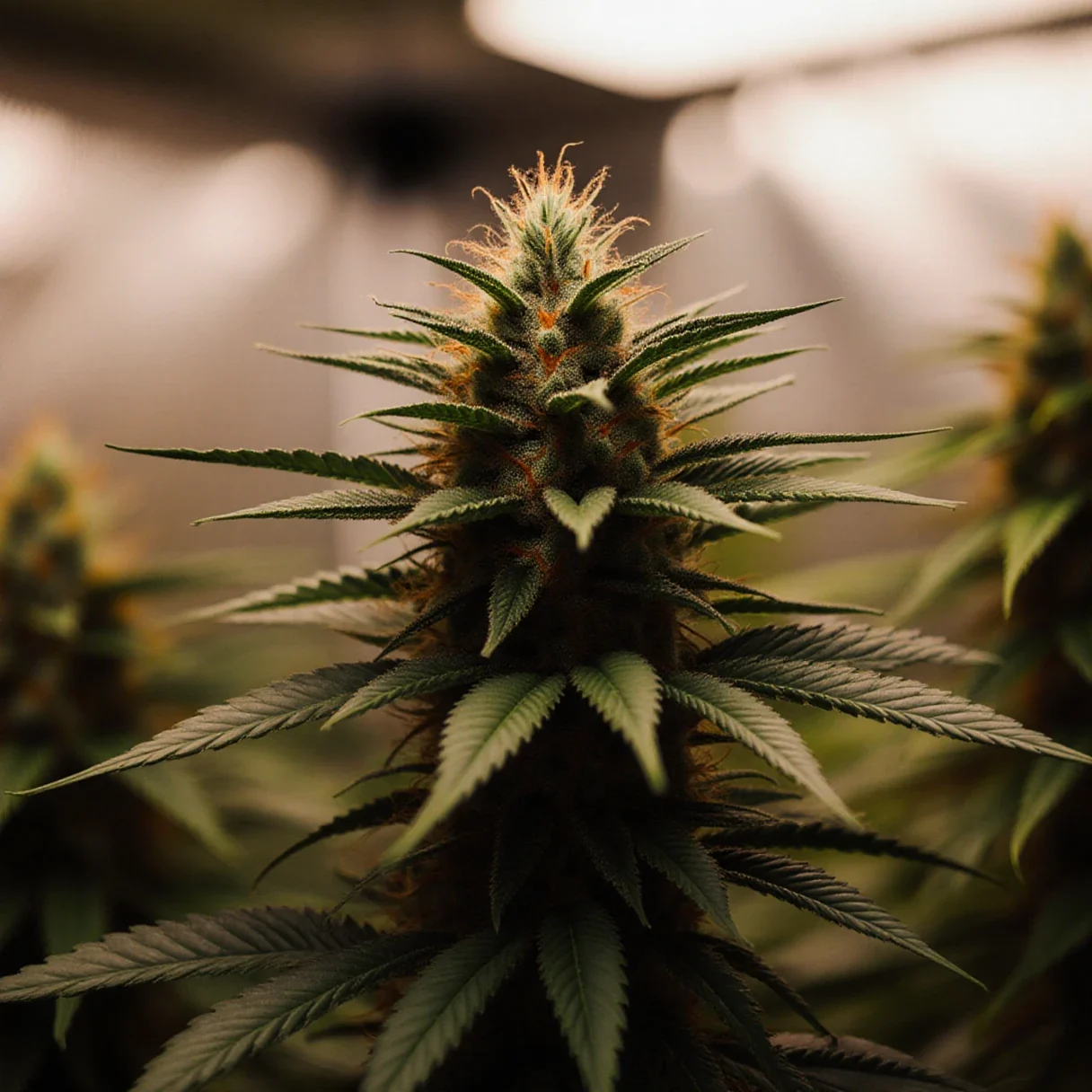
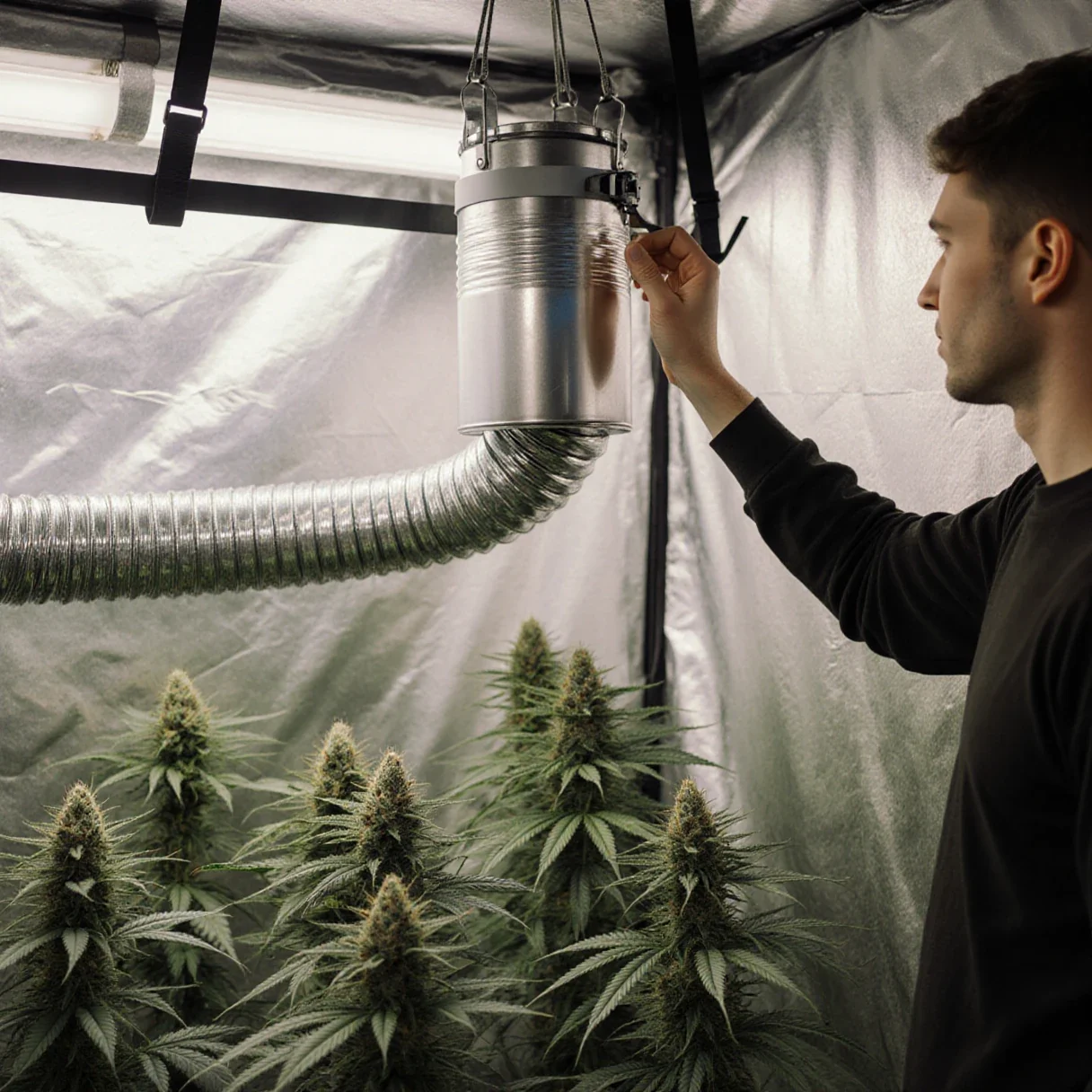
Here is the principle that matters more than any product: your tent must be at slightly lower pressure than the room around it.
An inline fan pulling air out through a carbon filter creates that. When it works, air can only move into the tent through your intake, and every molecule that leaves does so through carbon. That is the entire basis of cannabis grow smell control, and you can see it working — the tent walls suck visibly inward, and the seams pull taut.
When it fails, the tent bulges. Air is finding its way out through zips, cable ports, and the passive intake flap, carrying odour with it and completely bypassing your filter. A bulging tent with an expensive filter on it is a bulging tent, and it will smell. It is why a grower with all the “right” gear can still have a cannabis grow smell problem.
Three things break negative pressure, and all three are cheap to fix. A filter that is too restrictive for the fan. Ducting with too many sharp bends. And unsealed cable pass-throughs — the little velcro sleeves where your light and fan cords enter. Tape them. The basic exhaust and intake layout is covered step by step in our grow tent setup guide; this post is about what happens when that layout leaks.
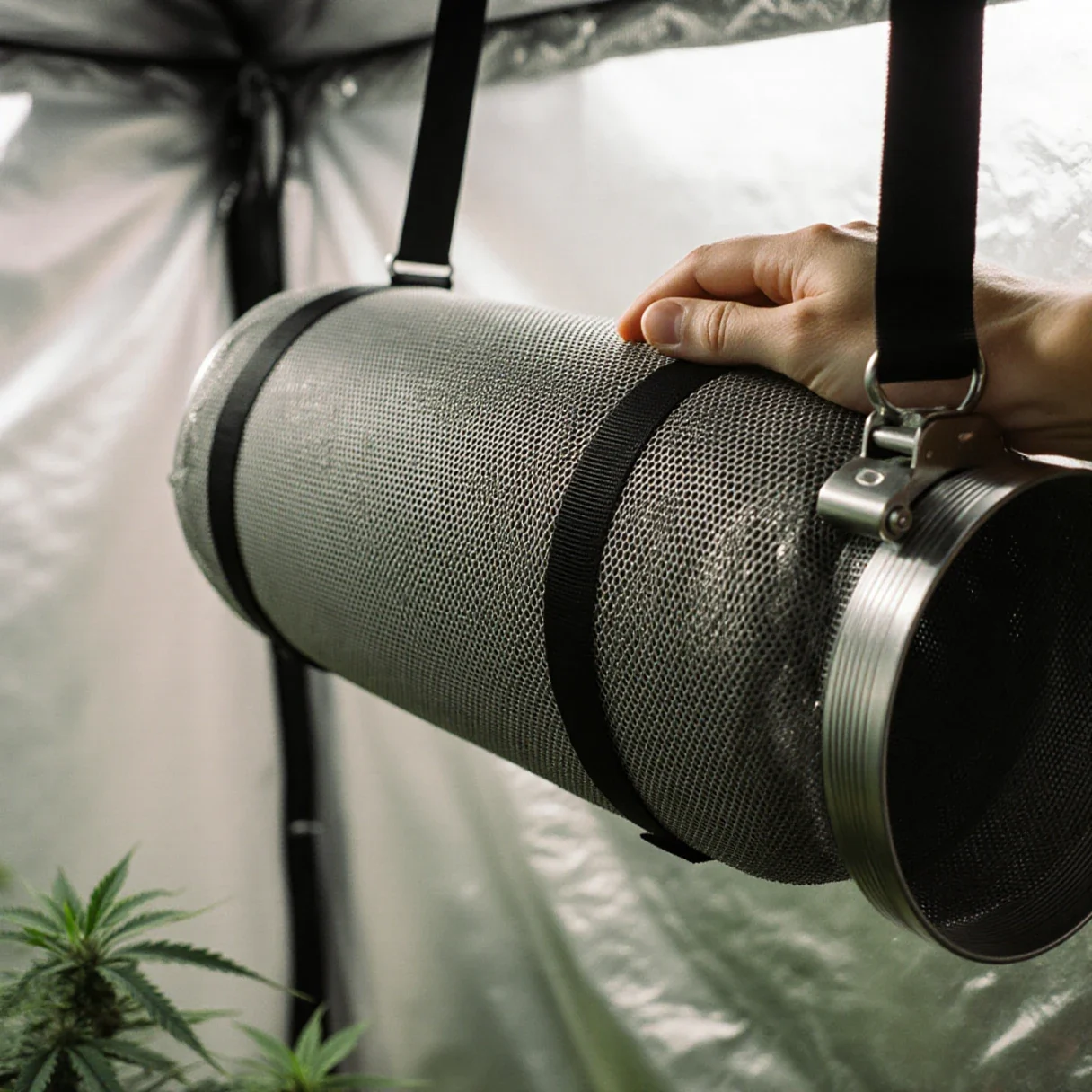
The rule of thumb most growers work to is exchanging the tent’s full air volume every one to three minutes. Multiply length by width by height in feet to get cubic feet, then pick a fan rated to move at least that many cubic feet per minute.
Then ignore that number, because it is a lie of convenience. Fan ratings are measured on an open port with nothing attached. Bolt a carbon filter to one end and run several feet of flexible ducting off the other, and real airflow drops well below the sticker — every bend, every foot of duct, and the resistance of the carbon itself takes a cut.
So size up. A fan that is somewhat oversized and run at reduced speed on a controller is the right answer nearly every time: you get the headroom for when cannabis grow smell peaks in late flower, quieter running the rest of the time, and the ability to turn it up rather than replace it. Undersizing is the mistake that is expensive to undo.
Match the filter to the fan, not the other way around. A filter rated well below your fan’s airflow chokes the system and costs you the negative pressure you just paid for.
Activated carbon works by adsorption — odour molecules stick to an enormous internal pore surface as air passes through. It is a finite resource. Every molecule captured occupies a site that is then unavailable, and eventually the carbon is loaded and air passes through essentially untreated. Filters do not fail loudly. They fade — which is why a cannabis grow smell often returns gradually enough that growers blame the strain rather than the filter.
Humidity accelerates that badly, and the mechanism is well established in the adsorption literature. Water vapour competes for the same sites the odour molecules need. One 2024 study in ACS Omega found that water adheres quickly to the carbon surface and “occupies a majority of the adsorption sites” — with working capacity for the test compound falling by roughly half once the carbon was loaded with water. That work used acetone rather than a cannabis thiol, so treat it as the mechanism rather than a measurement of your tent. The practical lesson stands: a filter running in a swampy tent is being consumed by water instead of odour.
Which ties odour control directly to your climate control. Keeping flowering humidity sensible protects the filter and protects the crop — the same discipline that keeps bud rot out of dense colas. If you are not already managing this by the numbers, our VPD guide is the place to start.
Expect somewhere in the range of a year to eighteen months of useful life from a filter in a flowering tent, less if you run it wet. The honest test is your nose, not the calendar: go outside to wherever your exhaust vents and smell the discharge. If there is a cannabis grow smell at the outlet, the carbon is done. Nothing else diagnoses it as reliably.
Odour-neutralising gels and sprays mask rather than remove. They add a second smell on top of the first, and the combination — pine gel plus late-flower sulfur — is more conspicuous than the original, not less. Anyone who has smelled it knows the signature instantly.
Ozone generators are the one to genuinely avoid. They are marketed hard to growers and they do destroy odour molecules, but the US EPA’s assessment is unambiguous: no federal agency has approved ozone generators for use in occupied spaces, ozone damages lung tissue, and at concentrations that stay within public health standards it is not effective anyway. It also reacts with other chemicals indoors to form new irritants. Running one in a house you live in trades an odour problem for a health problem.
The boring answer is the correct one. There is no shortcut around a cannabis grow smell: carbon, sized properly, in a tent held at negative pressure, replaced when it is spent.
Remember where that sulfur peak lands: while the flower is hanging, before it ever reaches a jar. So the drying room deserves the same planning as the tent — and it almost never gets it.
The usual failure is treating an empty closet or spare bedroom as a dry space because it is dark and cool. It is also unfiltered. Wet flower hanging in an open room for a week or more, right at the point in its life when it is producing the most odour it will ever produce, will generate more cannabis grow smell than the tent ever did.
Fix it the same way: dry inside a space you can put under negative pressure, with a filter on the exhaust. A second small tent works. So does an empty grow tent, if your run is staggered. Just do not let the filter fight the drying conditions — you want slow drying at 60–68°F with humidity held in the 55–65% band, which our guide to drying temperature and terpene retention covers properly, so use gentle extraction rather than a gale.
Once the flower is in sealed jars, the problem largely ends. It is the window between chopping and the jars going on the shelf that gets people caught, and that whole window is covered in our curing guide.
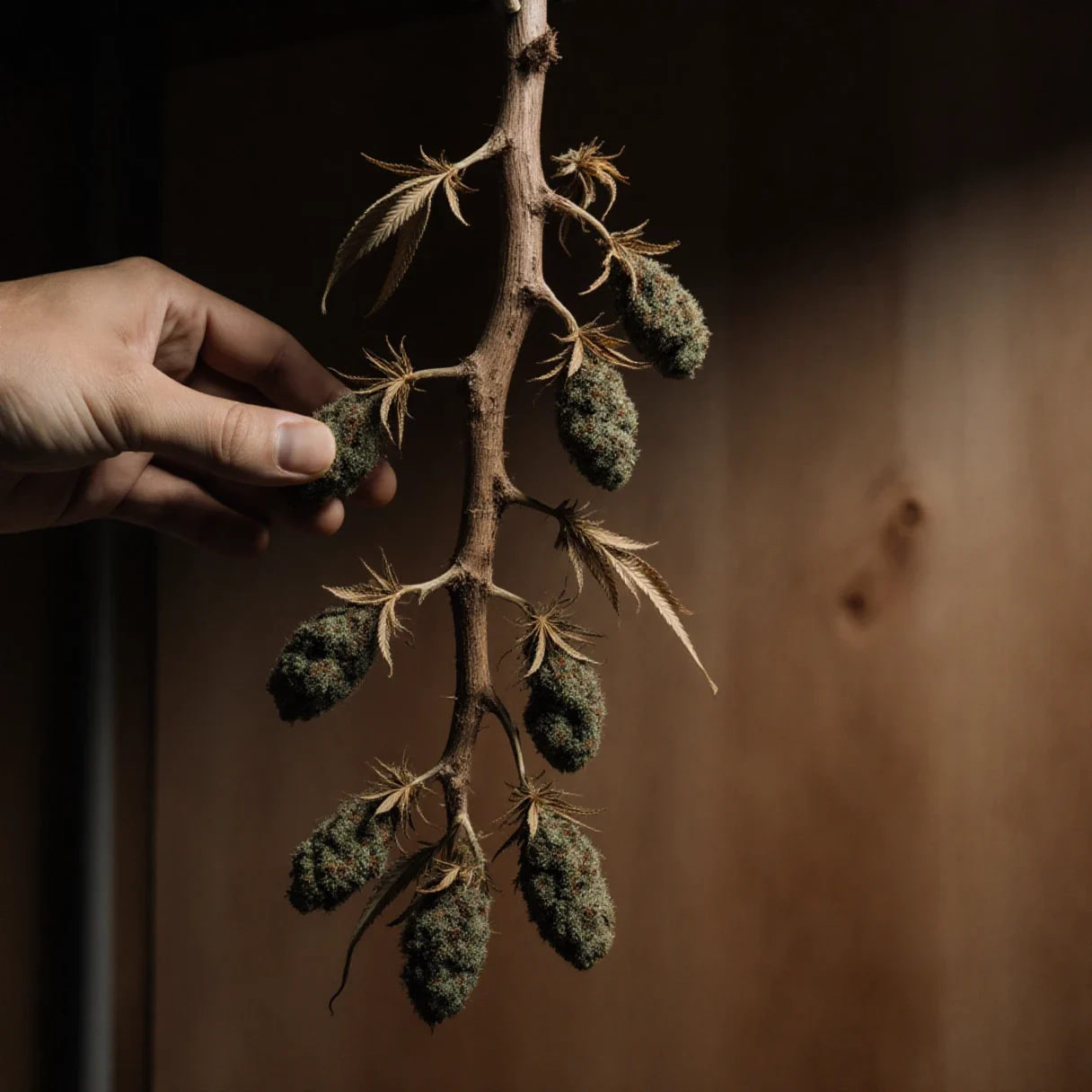
Genetics set the ceiling on how much cannabis grow smell you have to deal with, and the difference between cultivars is not subtle.
If discretion matters, know what you are signing up for. Chemdawg carries what our catalogue calls one of the most recognisable scents in all of cannabis — an unmistakable diesel-fuel aroma, and it does not stay in the tent politely. NYC Sour Diesel Autoflower is described as loud and fuel-soaked for good reason. Gorilla Glue 4 brings pungent earth, sharp pine and strong diesel. Super Skunk Kush is exactly what the name promises, and AK-47 has pungent skunk notes that fill a room the moment a jar opens.
Mac’s own crosses run loud too. Grape Skunk pairs grape candy sweetness with pungent Skunk funk, and Blue Monkey Dick announces itself in flower with berry and tropical fruit. Mandarin Cookies Autoflower carries one of the loudest citrus profiles in modern breeding — gorgeous, and about as subtle as a fruit stand.
None of that is a reason to avoid them. It is a reason to have the filter sorted before you germinate. Browse the full feminized seed collection or the autoflower range if you are matching a strain to a discreet setup.
Everything above assumes a sealed box. Outdoors there is no box, no exhaust, and no filter — a mature plant in September is simply a large odour source in open air, and there is no equipment that changes that.
What you have instead is placement and timing. Distance from property lines and prevailing wind direction do most of the work. Tall companion planting breaks up sightlines, though it does little for smell. And finishing earlier keeps the loudest weeks out of the window when neighbours have their windows open — one of several arguments for faster-finishing genetics. The broader trade-offs are laid out in our indoor vs outdoor comparison.
If odour is a genuine constraint where you live, that is an argument for growing indoors, where a cannabis grow smell is a solvable engineering problem rather than a weather report.
A HEPA purifier will not — HEPA captures particles, and odour is a gas. A purifier with a substantial activated carbon stage takes the edge off a cannabis grow smell in the room outside the tent, but it is not a substitute for extraction. Filter the air on its way out of the tent, not after it has already spread.
Barely. Veg plants have a mild green scent noticeable at close range. The sulfur compounds responsible for the real cannabis grow smell rise sharply in the final weeks of flower, so a tent that seems fine in week two of flower can change dramatically by week seven. Set up your odour control before you need it.
Smell the exhaust where it discharges. If a cannabis grow smell is coming out of the outlet, the carbon is saturated. Filters degrade gradually rather than failing outright, so a calendar reminder around the twelve-month mark plus that sniff test is more reliable than either alone.
You can, and with a healthy filter it works fine — the air is scrubbed before it re-enters. It does mean your filter is your only line of defence, so there is no margin if it is spent. Venting outside is more forgiving, but check where the discharge actually lands before you commit.
Odour control is not a product you buy, it is a pressure difference you maintain. Get the tent sealed and pulling inward, put a correctly sized carbon filter ahead of an oversized fan, keep humidity off the carbon, and replace it when your nose says so — that handles the cannabis grow smell that a tent produces.
Then extend the same thinking to the drying room, because that is where the research says cannabis grow smell actually peaks, and it is the step almost everyone leaves unfiltered.
Skip the ozone. Skip the gels. Buy the filter before you buy the seeds.
Shop Feminized Seeds | Grow Tent Setup Guide | More cannabis grow guides
Want to keep learning? Browse our full library of cannabis grow guides — everything from germination to harvest, in one place.
Ready to grow? Browse premium seeds from Lighthouse Genetics:
Designed & Built by Wynne Web Design