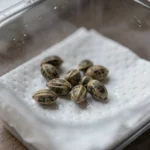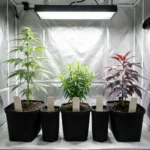
A seed listing is a spec sheet for a plant that does not exist yet. That is the whole problem. Every number on the page — potency, flowering time, yield, height — describes what somebody else got, from a different phenotype, in a room you have never seen. Cannabis seed descriptions are honest documents when they are written well, but they are predictions, not promises, and most growers read them as if they were promises.
Learning to read cannabis seed descriptions properly is the cheapest skill in growing. It costs nothing, it takes about ten minutes, and it stops you buying a 450 cm sativa for a 1.2 metre tent.
Here is what each field in our cannabis seed descriptions actually measures, where the numbers come from, and which ones deserve your trust.
Our cannabis seed descriptions give THC as a band — Mandarin Cookies Autoflower reads High (18-25%) rather than a single figure. Growers ask us about this fairly often, usually some version of “why won’t you just tell me the number?”
Because the number does not exist. Not for a seed.
THC content is set by three things working together: the genetics in the seed, the phenotype that particular seed expresses, and how you grow and cure it. A seed carries the genetic ceiling. Everything under that ceiling is you. Two seeds from the same pack, grown side by side by the same person, will not test identically — that variation is the entire reason breeders hunt phenotypes in the first place.
Then there is the measurement problem, which is worse than most people realise. Jikomes and Zoorob analysed 175,136 flower measurements from Washington State’s legal market and found that the median total THC reported for the same class of flower ranged from 17.7% to 23.2% depending on which accredited lab did the testing. Same product category. Same regulated market. Five and a half percentage points of spread, and the labs that read high on THC read high on CBD too — a systematic tilt, not random noise.
It gets less flattering. A follow-up analysis found that reported THC concentrations bunch up just above the 20% mark — the frequency of results landing immediately above 20% jumped about 43% in Nevada and 17% in Washington. At the two Washington labs whose licences were later suspended, the jump was 47%. At the state’s largest lab, it was 1%.
So when a competitor’s cannabis seed descriptions quote “27.4% THC” on a seed, they are quoting a number that came from one plant, at one lab, with a thumb somewhere near the scale. A band is the honest unit. Read the band, assume you will land in the middle of it, and treat anything above the top of it as a good year. That is the only sane way to read the potency line in cannabis seed descriptions.
The CBD Level field in our cannabis seed descriptions works the same way, though the ratio matters more than the absolute figure — we break that down in the CBD cannabis seeds guide.
This one causes more disappointment than any other field in cannabis seed descriptions, and it is almost always a measurement-start problem rather than a bad number.
For a photoperiod plant, flowering time is counted from the day you flip the lights to 12/12 — not from germination. Blue Dream at 9–10 weeks means nine to ten weeks after the flip, on top of however long you vegged. Four weeks of veg plus a ten-week bloom is a fourteen-week grow, and the listing only ever showed you ten of them. Cannabis seed descriptions rarely spell that out.
For an autoflower, it depends on the strain, and you have to look at the number itself to tell. Compare two autos in our own catalogue: AK-59 Autoflower lists 5–7 weeks, and Moby Dick Autoflower lists 10–11 weeks (75 days from seed).
Those are not the same measurement. No autoflower on earth goes from seed to jar in five weeks, so AK-59’s figure is the bloom window — the plant still needs its three or four weeks of early growth first. Moby Dick’s spells out the start point in brackets, which is what all cannabis seed descriptions should do.
The rule: if an autoflower’s flowering time is under about eight weeks, it is describing the flower phase. If it is ten weeks or more, it is probably seed-to-harvest. When cannabis seed descriptions do not say, add three to four weeks to any autoflower figure and plan against that.
Add two to three weeks to whatever you calculate, too. Drying and curing appear in nobody’s cannabis seed descriptions, and a plant that finishes on schedule is still that far from being smokable. If a hard finish date is what you are shopping for, our roundup of fast flowering cannabis sorts the catalogue by exactly that.
Two different units live in this field of most cannabis seed descriptions, and mixing them up produces some wildly optimistic expectations.
Indoor yield is g/m² — grams per square metre of canopy, not per plant. Northern Lights Skunk at 500–650 g/m² does not mean one plant gives you 600 grams. It means a fully filled square metre does, whether that square metre holds one big trained plant or four small ones.
Outdoor yield is grams per plant, because outdoors nobody is filling a defined canopy area. Big Bud shows both: 500–600 g/m² indoors, 800–1200 g per plant outdoors. Those figures are not in conflict — they are answering different questions.
The second trap is the phrase “up to”. Super Skunk Silver Haze lists up to 1500 g per plant outdoors, and Green Crack up to 800 g. Those are ceilings from a full season in the right climate, in the ground, with a plant that was never restricted. “Up to” is the best case anyone recorded. It is not the expected case, and cannabis seed descriptions that lead with the ceiling are selling, not informing.
What the yield figure in cannabis seed descriptions genuinely tells you is the strain’s relative productivity. Mandarin Cookies Autoflower at 300–400 g/m² against Northern Lights Skunk at 500–650 g/m² is a real difference in the same units under comparable conditions, and that comparison holds even though neither number will be exactly what you get. Use the field to rank strains against each other. Do not use it to forecast your harvest.
Height ranges in cannabis seed descriptions look sloppy until you understand what the width is telling you. The range is the answer, not a dodge.
Big Bud lists 50–225 cm. That is not vagueness — it is the difference between a topped, trained indoor plant in a restricted pot and the same genetics left alone in the ground outdoors. Durban Poison runs 90–400 cm for the same reason, and Super Skunk Silver Haze simply says “up to 450 cm”.
A wide range means the strain responds hard to its container and training. A narrow one means it does what it wants regardless. That is real information, and it is the part of cannabis seed descriptions most readers skim straight past. White Widow Autoflower at 50–80 cm is a genuinely small plant, and no amount of pot volume changes that much — autoflowers run on a clock, so they cannot be held in veg while you fix a space problem.
Plan against the top of the range, minus whatever your training will realistically take off. Then subtract your light’s hanging height. A 1.5 metre tent gives you about a metre of usable plant once the fixture and pot are in, which rules out most of the tall sativas and makes something like Gorilla Glue 4 at 120–200 cm a training commitment rather than a drop-in choice.
Every one of our cannabis seed descriptions carries one — 85% Indica / 15% Sativa on Big Bud, 0% Indica / 100% Sativa on Durban Poison. It is the field readers trust most and the one that deserves it least.
The ratio describes reported lineage, not a lab result. Nobody assays a plant and derives a percentage. It is inherited from what the breeder recorded, passed down through crosses, and rounded on the way. When Sawler and colleagues genotyped 81 marijuana samples at 14,031 SNPs, they found only a moderate correlation between genetic structure and reported indica/sativa ancestry — an r² of 0.36. Reported ancestry explains roughly a third of what the genome actually shows.
Use the ratio as a rough shape hint and nothing more. High indica percentages generally mean shorter, faster, broader-leafed plants; high sativa percentages generally mean taller, slower, lankier ones. That structural read is reasonably reliable. The effect read is not — which is why we sort by effect rather than by indica versus sativa, and why the Effects field on each listing is worth more of your attention than the ratio above it.
The Strain Type field (Hybrid, Indica-Dominant, Pure Sativa) is the same information rounded harder, and it turns up in cannabis seed descriptions everywhere for the same historical reasons. And for what the name implies — the Kush, Haze and Cookies families, plus the Auto and Fem suffixes — we have a full strain name decoder.
If I could keep only two fields, I would drop every number before I dropped these. Between them they carry more signal than the rest of the cannabis seed descriptions put together.
The Genetics field gives the cross. Blue Monkey Dick reads Blue Dream x Chunky Monkey x Moby Dick — that tells you where the structure, the vigour and the terpenes are coming from, and it lets you check the parents against strains you have already grown. Frosted Grape Shoes reads Grape Skunk x Cement Shoes. Cannabis seed descriptions that will not name the cross are telling you something by omission.
The Breeder field tells you who did the work and, indirectly, how stable the line is. Both of those examples are Mac’s own Lighthouse Genetics work, which is why we can talk about their selection history at all. Where a line sits in its generations — F1, F2, F4 — changes how much variation to expect across your pack, and we cover that in the seed generations explainer.
The Seed Type field is the other one that changes your whole plan rather than a detail of it — photoperiod or autoflower. Whether a strain is a CBD line shows up in the CBD Level field instead, not in this one. If you are still deciding between those two, that comparison has its own post.
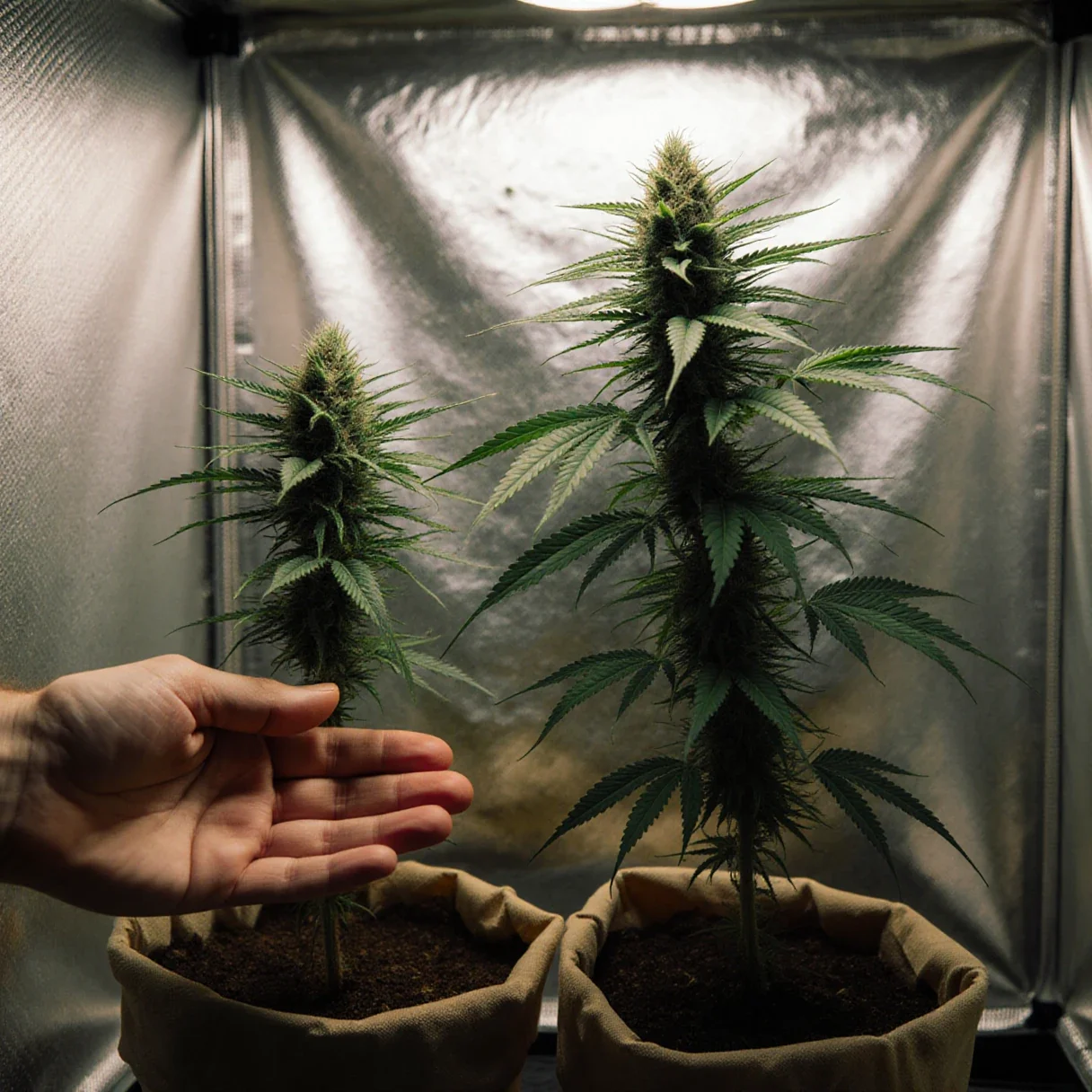
Grow Difficulty is a relative rating in cannabis seed descriptions, not an absolute one, and it quietly assumes you can supply what the strain wants.
Durban Poison is rated Easy. It is also 90–400 cm tall, pure sativa, and its Climate field says “Warm, Sunny”. Easy in a Mediterranean summer. Considerably less easy in a short northern season with September rain, where its size and its finish date both work against you. The rating and the climate line have to be read together — that is why they sit next to each other.
Frosted Grape Shoes is rated Moderate and Super Skunk Silver Haze is Moderate as well, for different reasons: one wants attention through a longer bloom, the other gets enormous. Neither is difficult in the sense of being fragile. They just punish a hands-off approach.
Read Grow Difficulty as “how much does this strain forgive?” A first grow should stay on Easy. After that, the field matters less than whether your space suits the plant.
Three things are absent from cannabis seed descriptions everywhere, ours included, and knowing what is missing is part of reading them well.
Which phenotype you will get. A pack is siblings, not clones. Unless a line has been worked for many generations, expect real variation in height, finish time and aroma across the same pack — that variation is the raw material breeders select from, and it is why serious growers buy larger packs. Our pack size guide works through that maths.
How it performs in your conditions. Every number in cannabis seed descriptions came from someone else’s environment. Your light intensity, root temperature, pot volume and watering discipline will move yield further than the difference between two strains on paper.
What it will taste like to you. The Aroma and Flavour lines in cannabis seed descriptions are shorthand written by people who grew the plant. They are useful for narrowing a shortlist and useless as a guarantee.
None of that makes cannabis seed descriptions worthless. It makes them a starting position. Browse the feminized seeds or autoflower seeds catalogue with those caveats loaded and you will shortlist far better than someone chasing the biggest THC figure on the page.
Because a seed carries a genetic ceiling, not a fixed potency. The phenotype you get and how you grow, dry and cure it decide where you land under that ceiling. Lab testing adds its own spread on top — accredited labs testing the same class of legal flower have reported median THC anywhere from 17.7% to 23.2%. A band is the honest way for cannabis seed descriptions to state it.
For photoperiod strains, no — it starts at the 12/12 flip, so add your veg time. For autoflowers it depends on the listing: figures under about eight weeks describe the bloom phase, while ten weeks or more usually means seed-to-harvest. Moby Dick Autoflower states it outright at 10–11 weeks (75 days from seed). Add two to three weeks for drying and curing either way.
Probably not exactly, and that is normal. Indoor figures are grams per square metre of filled canopy, outdoor figures are grams per plant, and anything phrased as “up to” is a best case from ideal conditions. Use the yield numbers in cannabis seed descriptions to compare strains against each other rather than to predict your own harvest.
In cannabis seed descriptions it reflects reported lineage rather than a measurement. Genetic work has found only a moderate correlation between reported indica/sativa ancestry and what the genome actually shows. Treat the ratio as a hint about plant structure and finish time, not as a description of effect.
Plant height, against your actual space. It is the one spec that can make a grow impossible rather than merely disappointing, and it is the field readers most often skip in cannabis seed descriptions in favour of the THC band.
Read cannabis seed descriptions in this order: height first, because your space is fixed. Then flowering time, because your season or your patience is fixed. Then genetics and breeder, because that is where the honest signal lives. Potency last — it is the field with the loosest measurement behind it and the heaviest marketing pressure on it.
Every good set of cannabis seed descriptions is a well-informed estimate from someone who grew the plant. Treat cannabis seed descriptions that way and they will steer you well. Treat them as a specification you are owed, and the plant will disagree with you around week six.
If you want the other half of this — matching a shortlist to your particular setup rather than decoding the fields — start with how to choose cannabis seeds for your setup, or work through the rest of our cannabis growing guides.
Shop All Seeds | How to Choose Cannabis Seeds | How Many Seeds to Buy | Growing Guides
Want to keep learning? Browse our full library of our cannabis growing guides — everything from germination to harvest, in one place.
Ready to grow? Browse premium seeds from Lighthouse Genetics:
Designed & Built by Wynne Web Design