Buy the LED. That is the honest one-line answer to LED vs HPS in 2026, and if you stop reading here you will not have made a mistake.
But the reasoning most people give for it is wrong, and the wrong reasoning leads to bad buying decisions — a cheap panel with an invented wattage number, a fixture hung too high, a grower convinced his lamp “runs cool.” So here is the LED vs HPS question worked through properly: what the measured numbers actually say, where high pressure sodium still holds its own, where ceramic metal halide fits, and what any of it is worth in a 4×4 tent in somebody’s basement.
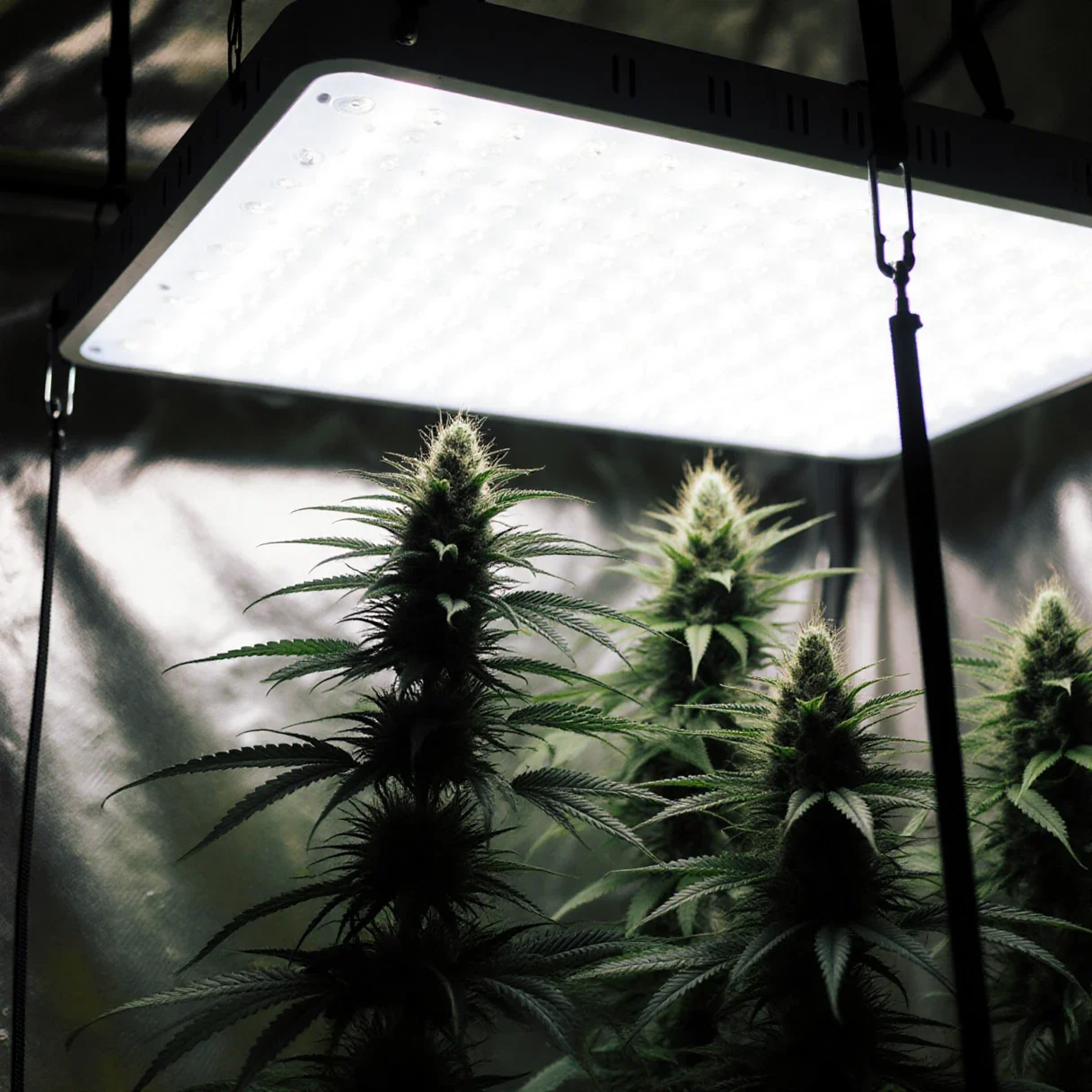
Forget watts. Watts tell you what the wall pays, not what the plant gets, and almost every bad LED vs HPS argument starts with someone comparing them.
The number that matters is photosynthetic photon efficacy — micromoles of usable light per joule of electricity, written µmol/J. It is a fixture’s fuel economy, and it is the one spec that makes LED vs HPS an answerable question rather than an argument. Two lamps pulling identical power can put wildly different amounts of light on your canopy, and efficacy is the only spec that exposes it.
Jacob Nelson and Bruce Bugbee at Utah State measured a pile of horticultural fixtures for a 2014 economic analysis in PLOS ONE. Their results are the baseline every LED vs HPS argument since has been built on:
| Fixture type (2014 testing) | Best measured efficacy |
|---|---|
| Double-ended HPS | 1.66–1.70 µmol/J |
| LED (best two models of that era) | 1.66–1.70 µmol/J |
| Ceramic metal halide | 1.46 µmol/J |
| Mogul-base (single-ended) HPS | 1.02 µmol/J |
| Fluorescent | 0.95 µmol/J |
Read that table again, because it is the part everyone skips. In 2014 the best LED on the bench tied double-ended HPS. It did not beat it. Anyone telling you LED has always been the efficient choice is selling something.
What flipped LED vs HPS is that one side kept improving and the other did not. By the time Bugbee’s lab ran a cannabis-specific trial in 2021, the best white-plus-red LED fixture measured 2.51 µmol/J against 1.7 for HPS. The plain white LEDs in that same trial sat right around 2 — 2.05 for warm white, 1.98 for cool white. That is roughly a 50% advantage, and it appeared in about seven years.
There is now an easy way to check a fixture without trusting the box. The DesignLights Consortium sets a minimum efficacy for a lamp to make its horticultural list, and that floor keeps moving. Version 3.0 put it at 2.30 µmol/J in 2023. Version 4.0 raised it to 2.5 µmol/J, in force for applications since April 2025, and the products that only ever met the old 3.0 threshold were delisted on January 5, 2026.
So the current bar is 2.5, not 2.3 — and that matters, because plenty of listings and reviews still quote the old number. If a light is not on the DLC list and the seller will not give you a µmol/J figure, treat the LED vs HPS comparison as unanswerable for that fixture and walk.
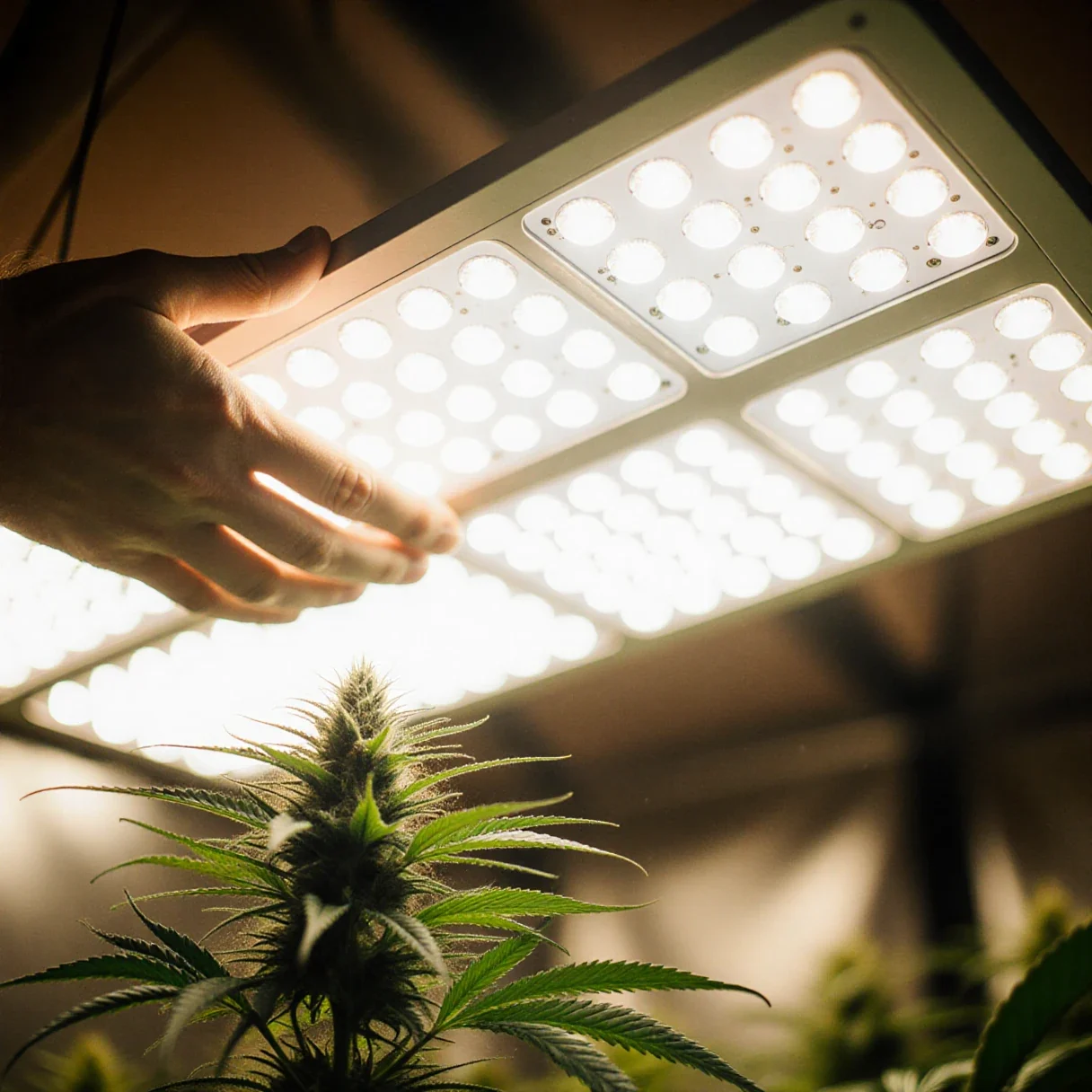
CMH gets left out of the LED vs HPS conversation, usually unfairly and occasionally for good reason.
The best ceramic metal halide fixture in that 2014 testing came in at 1.46 µmol/J — behind double-ended HPS, well behind anything modern. Newer 315W CMH units claim better than that, and I have not seen independent bench numbers that put them at LED level. Growers who love CMH usually love it for the light quality: a broad, sun-like output that makes the plants easy to read and the room pleasant to work in.
That is a real benefit and it is not a yield benefit. If you already own one, run it. If you are buying today, the efficacy gap is the whole story, CMH loses it, and the decision collapses back to LED vs HPS.
Here is where the internet gets it backwards.
Westmoreland, Kusuma and Bugbee published a cannabis lighting trial in PLOS ONE in 2021, running the hemp cultivar ‘Trump’ (T1) through three trials in five separate one-square-metre chambers, holding everything constant except spectrum. HPS was in the mix, with the lowest blue photon fraction of any treatment at 4%. The LEDs ran from 9.8% blue up to 20%.
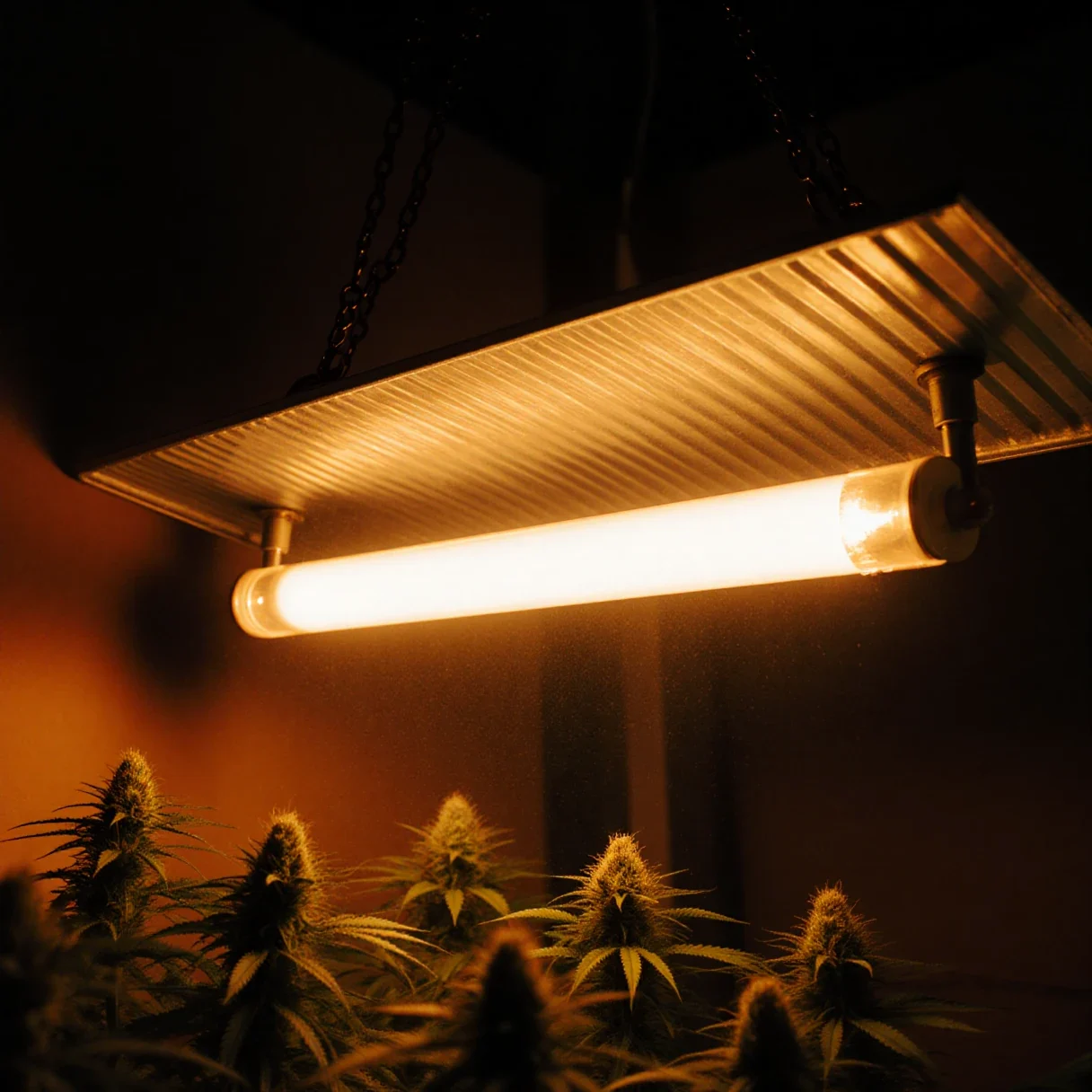
The finding: as blue climbed from 4% to 20%, flower yield fell 12.3% — about 0.77% of yield lost per 1% of blue added. The low-blue fixture grew more flower per square metre. That fixture was the HPS.
So the old-timers defending their sodium lamps were not imagining things. Their side of LED vs HPS was measuring something real.
The catch is that grams per square metre is not the number you pay your bill in. Take the head-to-head the authors actually report: the best white-plus-red LED, running 10.4% blue at 2.51 µmol/J, yielded 4.6% less than the HPS per square metre — and 27% more per dollar of electricity. It made slightly less flower under the light and considerably more flower per dollar, at the same time. Both are true and there is no contradiction. One is a spectrum effect and the other is an efficiency effect, and the efficiency effect is far bigger.
Worth being precise here, because this is where the LED vs HPS argument usually goes wrong: that 12.3% figure is the slope across the whole blue range, and the fixture at the far end of it was a different LED running 20% blue. The one that won on cost gave up 4.6%, not 12%.
The authors’ own conclusion is the sentence to remember: efficacy has a larger effect than spectrum on the economics of indoor cannabis growing.
One more result worth having, with a caveat attached: across those spectral treatments there were no statistically significant differences in cannabinoid concentration. The caveat is that ‘Trump’ is a CBD-dominant cultivar running roughly 24:1 CBD to THC, so that null is weaker evidence about THC than it looks. It also is not the last word.
An earlier trial by Magagnini and colleagues, run at 450 µmol/m²/s, reported 9.5% THC under HPS against 15.4% under one of its LED spectra. So fixture choice is mostly a yield and cost decision — but nobody should tell you the potency question is closed. Our post on whether UV light really increases THC covers the related myth, and the deeper spectrum picture is the job of our post on the best light spectrum for cannabis.
Ask ten growers how they resolved LED vs HPS and nine will say “LEDs run cooler.” That is half right in a way that causes problems.
An LED does not magically avoid making heat. Nearly all the power it draws still ends up as heat in your room. What changes is how much power it needs to hit your target intensity, and how that heat leaves the fixture.
Nelson and Bugbee looked at exactly this in a 2015 PLOS ONE paper on leaf temperature. LED fixtures emit almost no near-infrared radiation in the 700–3000 nm band; HPS emits a lot of it. The practical size of that effect is smaller than the forums suggest — they put it at roughly 1.3 °C cooler leaves under LED than under HPS in typical indoor conditions, and found that in plants that are not water stressed, leaves sit within about 2 °C of air temperature under every source they tested.
Where it gets dramatic is at the edges. Modelling a bad-case scenario of water-stressed plants with little air movement, leaf temperature ran 8 °C above air under LED and 12 °C above air under HPS. A stressed plant under a sodium lamp with no airflow is in a different situation than the same plant under a panel.
Two things follow from this that change how you grow, whichever side of LED vs HPS you land on. First, a cooler canopy under LED means your leaf-to-air difference shifts, which quietly moves your VPD targets — most LED growers should be running warmer air than the old HPS-era numbers. Second, the symptoms of a canopy pushed too hard look the same regardless of fixture, and are worth knowing on sight: see heat stress and light burn.
The strongest historical argument in LED vs HPS was never about light. It was about price.
That 2014 analysis found the five-year electricity-plus-fixture cost per mole of photons was 2.3 times higher for LED than for HID, because LED fixtures cost five to ten times more per photon of capital. The efficiency savings could not dig out of the purchase price.
That was twelve years ago, and it is the single most out-of-date fact in the whole LED vs HPS debate. LED capital cost per photon has fallen hard while efficacy climbed from 1.7 to over 2.5 µmol/J. I would not run those 2014 economics on a fixture you can buy this week — but the shape of the argument still holds, and it is why a cheap unbranded panel is a genuinely bad deal: you pay LED capital cost for HPS efficacy.
Here is what the LED vs HPS electricity difference actually looks like at home. Take a 600W HPS at 1.7 µmol/J, putting out about 1020 µmol/s. To make the same photons at 2.5 µmol/J, an LED draws about 408W. That is roughly 190W saved, running 12 hours a day — about 70 kWh a month, or somewhere near ten to twelve dollars a month at typical Ontario residential rates.
Ten dollars. That is the honest number for one tent, and it is arithmetic from the efficacy figures above, not a study result.
The LED vs HPS case at home is not really built on that ten dollars. It is built on the heat you do not have to exhaust, the ceiling height you get back, and a fixture that will still be near full output in five years rather than needing a bulb every season. Run a hundred lights and the ten dollars becomes the whole argument.
| Your setup | Buy this | Why |
|---|---|---|
| 2×2 or 2×4 tent, low ceiling | LED, no argument | Heat and headroom decide it before efficacy does |
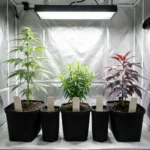
| 4×4 tent, one light | DLC-listed LED at 2.5 µmol/J or better | Best cost per gram, and the list is a verifiable spec |
| Cold garage or basement in winter | HPS is defensible | The waste heat is doing a job you’d otherwise pay for |
| Buying used on a tight budget | Used double-ended HPS with a fresh bulb | A known 1.7 beats an unverifiable cheap blurple panel |
| Greenhouse supplemental light | Either, depending on winter heating | Sunlight is doing the work; the lamp is filling gaps |
That fourth row is where LED vs HPS gets argued hardest, so let me be blunt about it. A used double-ended HPS with a new bulb is a known 1.7 µmol/J. A $120 “1000W” blurple panel is an unknown that is almost certainly under 1.5, with no way to verify. In LED vs HPS at the bottom of the market, HPS wins on the only thing that counts — you know what you are getting. Buy the cheap HPS now and a real LED later.
And whatever you hang, hang it at the manufacturer’s stated distance and get a par meter or a decent phone app on the canopy. A 2.5 µmol/J fixture mounted too high delivers less usable light than a 1.7 µmol/J fixture mounted right. Our guide to cannabis light intensity has the PPFD and DLI targets by stage, and the grow tent setup guide covers the exhaust side of the heat problem.
However you land on LED vs HPS, a strong fixture only earns its money if the plant under it can use the light. Some strains genuinely convert high intensity into flower, and some just get tall and disappointing.
If you are putting a proper LED over a 4×4 and want the yield back, the heavy indoor producers are the place to spend the photons. Big Bud is rated 500–600 g/m² indoors and finishes in 7–9 weeks. Gorilla Glue #4 sits in the same 500–600 g/m² band. Green Crack is listed at 500+ g/m², and Northern Lights Skunk at 500–650 g/m². Those are the plants worth pointing a good light at.
Short tent with the fixture close overhead? Height is your real constraint and the compact autos solve it. White Widow Autoflower stays 50–80 cm and wraps in 8–9 weeks. Gelato Autoflower runs 70–100 cm. AK-59 Autoflower has a 5–7 week flowering window, which is about as forgiving as it gets when your light is 40 cm off the canopy.
The strains to think twice about under a hot fixture in a short tent are the stretchers. Durban Poison is listed at 90–400 cm, Super Skunk Silver Haze up to 450 cm, and White Amnesia Haze at 100–200 cm over a 9–11 week flower. Give them room, or give them an LED you can raise. Blue Dream at 150–180 cm and Bruce Banner at 100–150 cm are the sensible middle if you want sativa character without the ceiling fight, and Moby Dick Autoflower gives you a 400–500 g/m² auto at 70–150 cm.
Browse the full range of feminized cannabis seeds or the autoflower cannabis seeds if you are building around a fixture you already own.
There is no good evidence that it does, and some evidence pointing the other way. The 2021 trial found no significant cannabinoid differences across spectra, though on a CBD-dominant cultivar. Magagnini’s earlier work found higher THC under LED than under HPS. No study I have found shows LED costing you potency, and on the LED vs HPS evidence we have, genetics and intensity are still doing most of the work.
You can, and some growers run LED vs HPS side by side on purpose — the HPS fills in the low-blue end that the 2021 data associated with higher yield, while the LED carries the efficiency. It also doubles your heat load in a small tent, which is usually the thing that kills the idea. In a big room it is reasonable.
A modern LED at close range absolutely can bleach a canopy — running one too close is one of the most common ways new growers damage plants. It is an intensity problem rather than anything to do with LED vs HPS, and it looks distinct from nutrient issues once you know the signs.
Almost never. Marketing wattage on cheap panels refers to some theoretical maximum the diodes are not driven at. Look for actual power draw at the wall plus a µmol/J figure, or a DLC listing. If neither is offered, that silence is the answer, and the LED vs HPS comparison cannot be made honestly.
Output falls off well before the bulb dies, so most growers replace on a schedule rather than waiting for failure. That recurring bulb cost belongs in any honest LED vs HPS budget — it is a real line item that LED does not have.
LED vs HPS is settled on efficacy, and it was not settled by forum opinion — it was settled by a bench that measured 2.51 µmol/J against 1.7. Buy a DLC-listed LED meeting the current 2.5 µmol/J bar, hang it at the stated height, and spend the difference on genetics that can use the light.
Just do not walk away believing the folklore that came with the win. HPS still grew more flower per square metre in that 2021 trial, LEDs are not cool-running, and a used sodium lamp beats a cheap blurple panel every day of the week. Strip the marketing away and LED vs HPS is one question: the lamp is a tool for putting photons on a canopy at a price. Everything else about LED vs HPS is marketing, and our cannabis growing guides will get you further than a new fixture will.
Shop Cannabis Seeds | Cannabis Light Intensity | Best Light Spectrum for Cannabis | Grow Tent Setup Guide
Want to keep learning? Browse our full library of our cannabis growing guides — everything from germination to harvest, in one place.
Ready to grow? Browse premium seeds from Lighthouse Genetics:
Designed & Built by Wynne Web Design