The first cut is the hardest. You’ve spent weeks babying a seedling — perfect water, perfect light, talking to it when nobody’s watching — and now every guide on the internet is telling you to chop its head off. On purpose. Topping cannabis feels like vandalism the first time you do it, which is exactly why so many growers put it off until the plant is too far along for it to matter.
Here’s the case for doing it anyway: one snip turns a plant with one dominant cola into a plant with two, four, or eight main tops sharing the light. FIMming promises the same result with a sloppier cut and less stress. This guide covers what each technique actually does, what the research on topping cannabis really shows — including a controlled study that put topping head-to-head against untouched plants — and which one deserves a spot in your grow.
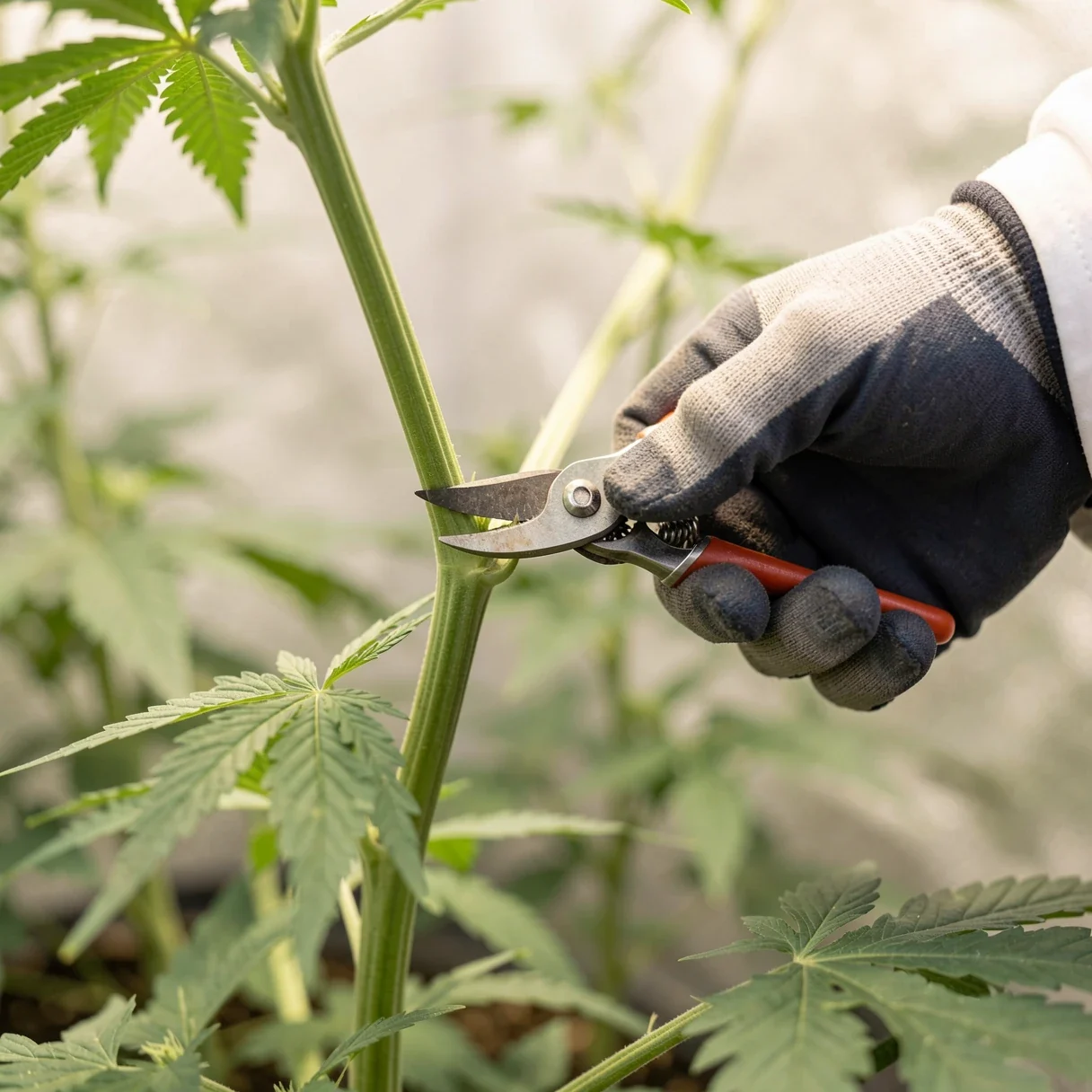
A cannabis plant left alone grows like a Christmas tree: one tall main stem, one big cola at the top, and side branches that get smaller and weaker the further down you go. That shape isn’t an accident. The main growing tip chemically suppresses the side shoots below it — a hormone-driven pecking order called apical dominance. As long as the top tip is intact, the plant pours its energy into going up, not out. That’s the problem topping cannabis exists to solve.
Topping cannabis removes that tip with one clean cut through the main stem, just above a node. With the boss gone, the hormone balance shifts and the side shoots wake up. The two branches at the node directly below the cut take over as twin main stems, and the branches further down stretch upward to fill the space. One Christmas tree becomes a candelabra.
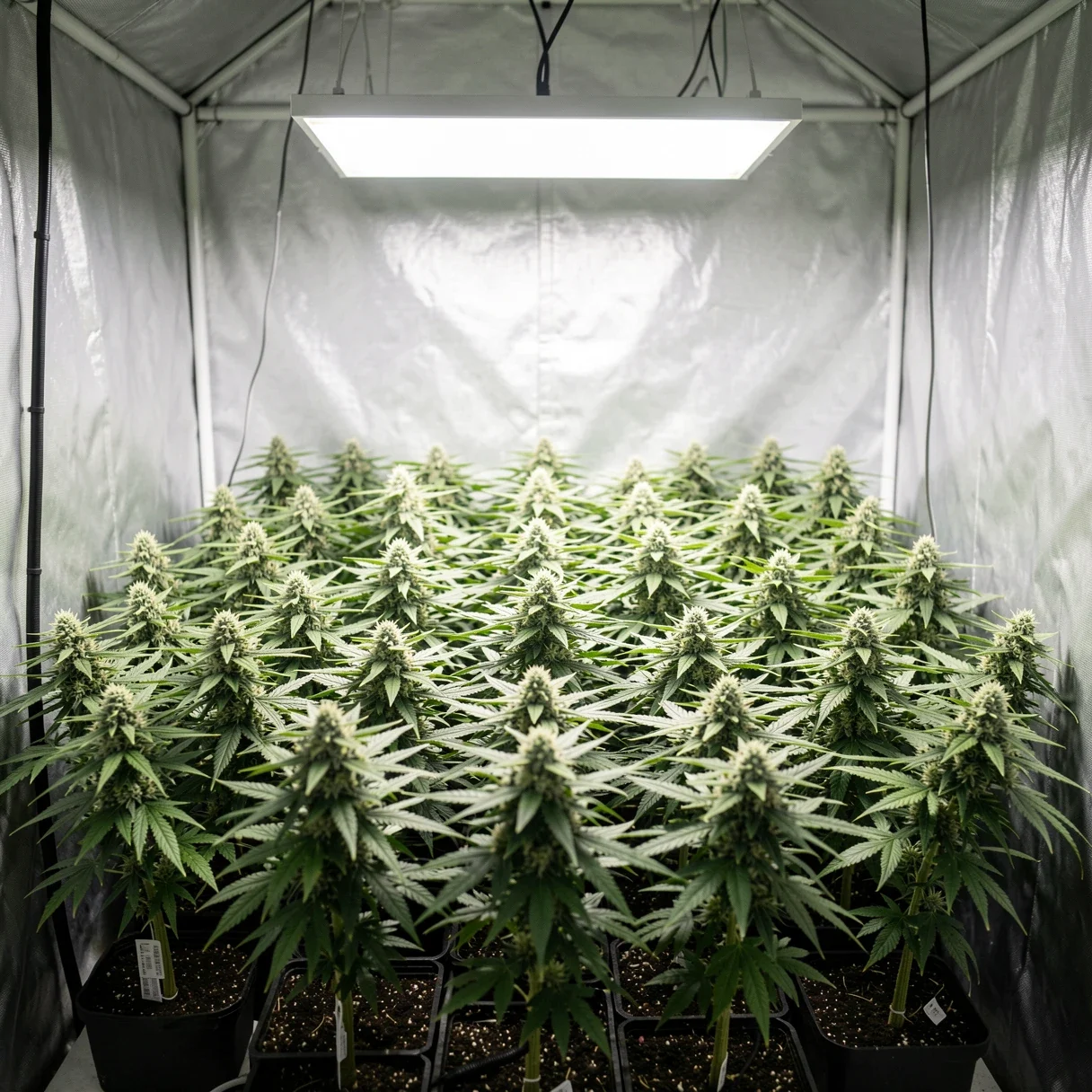
The practical wins of topping cannabis stack up fast. The plant gets shorter and wider, which matters enormously if you’re working with the fixed ceiling of a grow tent. The canopy gets flatter, so light lands evenly on many tops instead of blasting one cola while the rest sit in shade — and as we covered in our guide to cannabis light intensity, light that doesn’t reach bud sites is yield you paid for and didn’t get. And it’s repeatable: top the two new mains again and you’ve got four. Some growers go to eight.
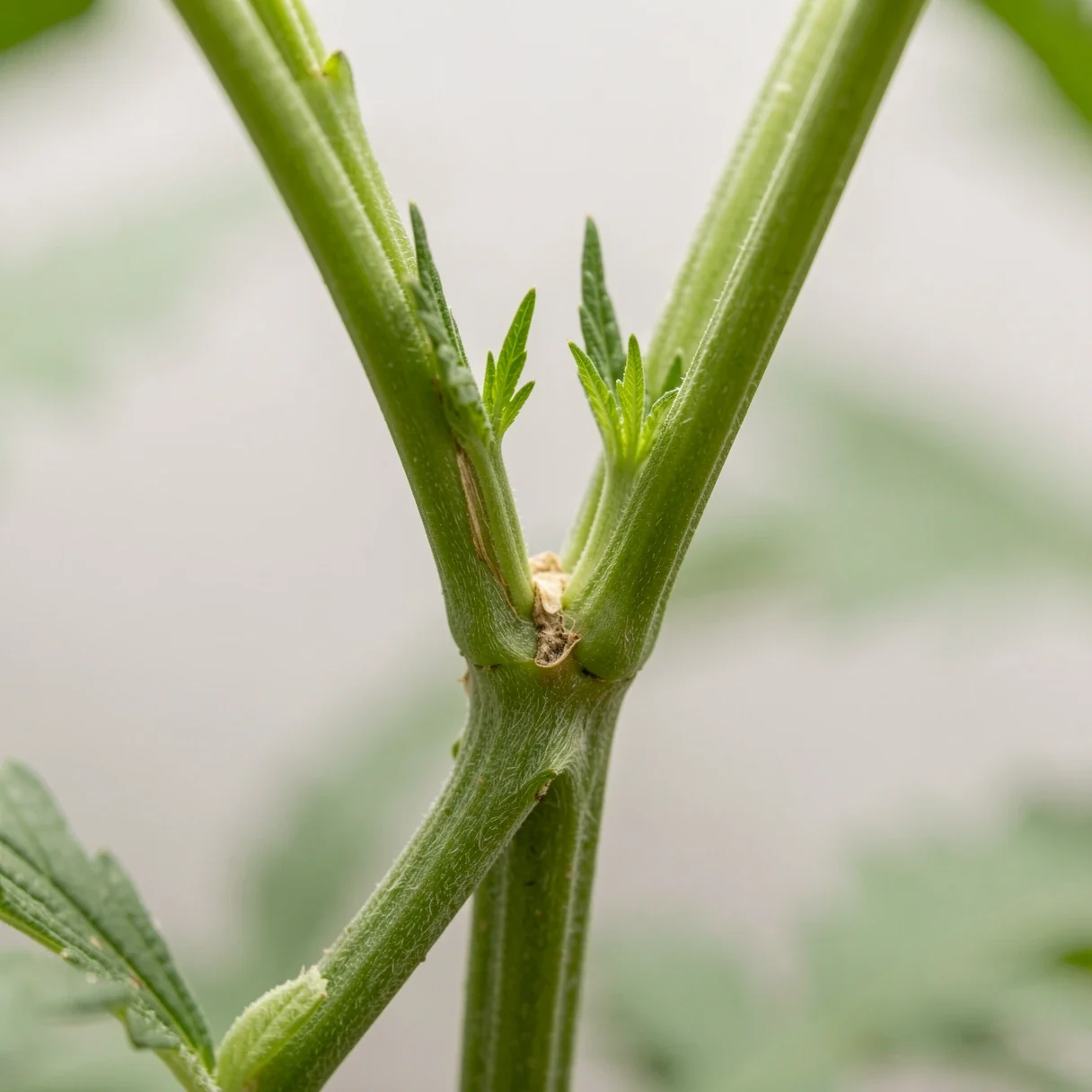
FIM stands for “F*ck, I Missed.” The story goes that a grower botched a topping cut, took off only part of the tip, and the plant responded by throwing three or four new main shoots instead of two. The mistake became a method.
Instead of cutting cleanly through the stem, you pinch or snip off roughly the top three-quarters of the new growth tip — leaving a ragged little stump of immature leaf tissue behind. Because the cut tears through several developing growth points at once, the plant often pushes out three, four, sometimes five new mains where topping cannabis reliably gives two. Growers also report it stresses the plant less, since you’re removing a smaller amount of tissue and never fully severing the stem.
The catch is consistency. A topping cut produces two new mains nearly every time — it’s plumbing, not luck. A FIM is a judgment call on a piece of tissue the size of a fingernail, and the results range from four beautiful new tops to one slightly mangled top to a plant that just… keeps growing like nothing happened. Anyone comparing topping cannabis to FIMming honestly has to lead with that: one is predictable, the other is a good bet that sometimes doesn’t pay out.
| Topping | FIMming | |
|---|---|---|
| The cut | Clean snip through the main stem above a node | Pinch off ~75% of the growth tip, leave a stump |
| New main shoots | 2, very reliably | 3–5, sometimes 0–1 |
| Stress & recovery | More stress; typically a few days to a week | Less tissue removed; usually faster bounce-back |
| Height control | Strong — breaks vertical dominance completely | Weak — main stem often keeps some dominance |
| Consistency | Predictable, beginner-proof | Hit-or-miss, technique-sensitive |
| Best for | Tents, height limits, structured canopies | Quick top-count boost when height isn’t a problem |
Our take: topping cannabis wins for most growers, and it isn’t close. The whole point of training is control — a flat, even canopy you can plan around. Topping gives you that on a schedule. FIMming can produce more tops per cut, but you don’t know what you’re getting until a week later, and it does far less to keep a stretchy plant short. If you’re FIMming for height control in a tent, you’re using the wrong tool.
Where FIMming earns its keep is outdoors or in tall spaces, where height doesn’t matter and you just want maximum bud sites with minimum recovery time. Pinch, walk away, and if it only half-works, the plant lost almost nothing.
Grower forums have argued about topping cannabis for decades. The peer-reviewed record is thinner than you’d expect, but it exists — and it’s worth reading honestly, because it doesn’t say exactly what the forums say.
A controlled greenhouse study published in the Journal of Cannabis Research took two industrial hemp cultivars and topped them above the 4th, 5th, or 6th node, against untouched controls. The results read like a checklist of everything growers claim: topping above the 4th node cut plant height by roughly 17–21%, and the side branches exploded — in one cultivar, secondary shoot length went from about 21 cm in control plants to around 144 cm in plants topped at the 4th node.
Fresh and dry biomass came out highest in plants topped at the 4th and 5th nodes, and the 4th-node plants also showed higher photosynthetic rates. The authors’ recommendation: top at the 4th or 5th node to maximize yield and quality.
One honest caveat before you tattoo that on your arm: this was industrial hemp grown for CBD-type cannabinoids, not the drug-type plants most people topping cannabis at home are growing. The architecture response — shorter, bushier, more productive side growth — is the same machinery your plant runs on, but exact percentages won’t transfer one-to-one.
The other data point cuts the hype down a notch. Researchers studying plant architecture in drug-type medical cannabis — the same Danziger and Bernstein work we covered in our defoliation deep-dive — found that a single pruning didn’t significantly change inflorescence yield versus untouched control plants. Pruning twice did produce a higher yield than the control, and the architecture treatments made cannabinoid levels more uniform across the plant, pulling the weaker lower buds closer to the quality of the top colas.
Put the two studies together and you get the grown-up version of the topping story. Topping cannabis isn’t a magic yield multiplier — one cut on one plant in a sea of light may change little. What it does is restructure the plant so that light, space, and bud quality are distributed evenly — and in real grows with real walls and real lamp footprints, that structure is usually where the extra yield comes from. We put topping in context with the other techniques in our guide to maximizing yield in cannabis.
Topping cannabis takes longer to read about than to do.
Want four tops? Once both new mains have put out a few nodes of their own, top each of them the same way. Just remember every round of topping cannabis adds recovery time to your veg, which stretches the calendar we laid out in how long it takes to grow cannabis. Two rounds is plenty for most home grows.
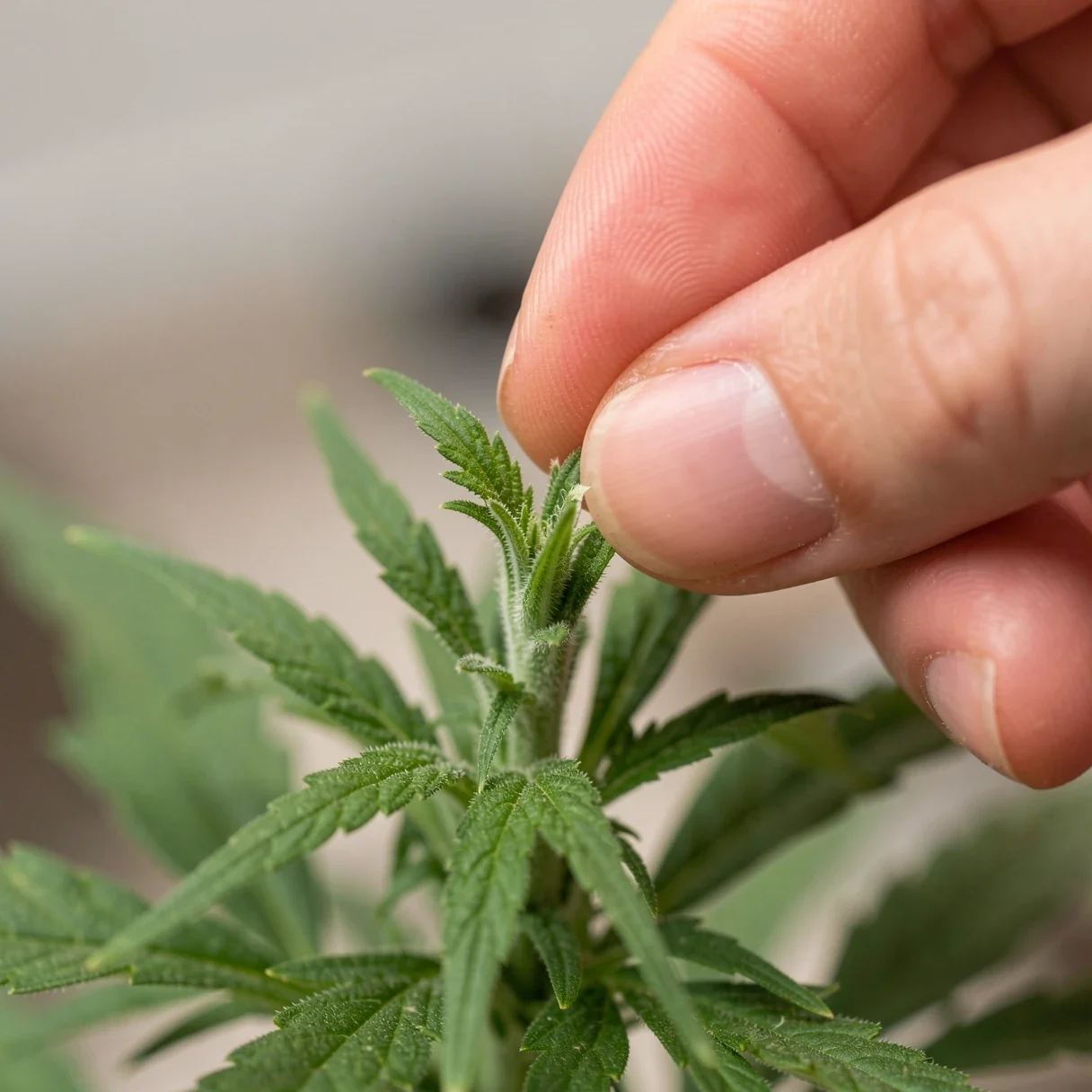
Same timing, same hygiene rules, different cut. Find the newest growth tip at the top of the plant — the tight little cluster of immature leaves. Instead of cutting the stem below it, pinch or snip off about three-quarters of the tip itself, leaving a quarter of it sitting there looking ragged and wrong. That’s the move. It will look like you ruined the plant. You didn’t.
Within a week or two you’ll know what you got: ideally three to five new shoots developing from the torn tissue, occasionally just one or two. If the FIM doesn’t take, nothing is lost — let the survivor grow a node or two and either re-FIM or fall back to topping cannabis the conventional way. That low cost of failure is the technique’s best feature.
Carefully, and only the right ones. A photoperiod plant waits for you — it stays in veg as long as you keep the lights long, so it has unlimited time to recover from training. An autoflower is on a fixed clock. It flowers when its age says so, recovered or not, and every day spent healing is a day not spent building structure — which makes topping cannabis on an auto’s clock a much tighter bet. Top an auto late or top a slow one, and you can shrink your harvest instead of growing it.
The working rule most experienced growers use: only top vigorous, fast-growing autos, do it early — around the 4th node, while the plant is still weeks from flowering — and do it once. A big, resilient auto like Bruce Banner Autoflower or the famously forgiving White Widow Autoflower can take an early topping and run with it. A small or sluggish auto is better left whole and bent over with low-stress training instead — all the canopy spread, none of the recovery tax. If you’re picking your first autos, our roundup of the best autoflower strains for beginners flags the forgiving ones.
Genetics decide how hard you can push. Vigorous, strong-branching photoperiod plants treat topping cannabis as a suggestion they’re happy to take; slow or brittle plants sulk. A few from our catalog that respond beautifully to a structured topping plan:
Browse the full lineup of feminized cannabis seeds for photoperiod plants with unlimited training runway, or stick to autoflower seeds and keep the training gentle.
Once flowering starts, the window is shut. Topping cannabis in flower removes bud sites and triggers a stress response with nothing to show for it — the plant no longer builds new structure, it builds flowers. Get your last cut in at least a week or two before you flip to 12/12 (or before an auto begins to flower), so the new mains are established when the stretch hits.
There’s no honest universal number. The controlled hemp study found topped plants produced the highest biomass when cut at the 4th–5th node, while the medical cannabis architecture research found a single pruning didn’t significantly raise yield on its own — though pruning twice did. The real answer depends on your light, your space, and your strain: the more your setup rewards a wide, flat canopy, the more topping cannabis pays. In a tent, it usually pays well.
No — learn topping first. It’s more predictable, it teaches you how your plant responds to training, and its height control actually solves the problem most beginners have (a plant outgrowing its tent). Add FIMming later as a low-risk experiment once topping cannabis feels routine and you have a plant you can afford to gamble with.
Not at the same time. Stacking stresses slows recovery on both fronts. Top first, let the plant bounce back fully, and treat leaf removal as its own decision — one with more nuance than the forums admit, as the research in our defoliation guide shows.
Topping cannabis is the single highest-value cut a home grower makes: predictable, repeatable, backed by real research showing shorter plants, dramatically longer side branches, and more biomass when you cut above the 4th or 5th node. FIMming is a worthwhile sidearm — more tops per cut, less stress, less certainty — best used where height doesn’t matter and failure costs nothing. Learn topping properly, add FIMming when you’re curious, and give either one a healthy, vigorous plant to work with. The genetics half of that equation is the part you get to choose before a single seed hits water.
Shop Feminized Seeds | Maximizing Yield in Cannabis | Does Defoliation Increase Yield? | Grow Tent Setup Guide
Want to keep learning? Browse our full library of cannabis grow guides — everything from germination to harvest, in one place.
Ready to grow? Browse premium seeds from Lighthouse Genetics:
Designed & Built by Wynne Web Design