Ask ten growers how much light their plants need and you’ll get ten answers, most of them about spectrum — blue for veg, red for flower, full-spectrum white, the whole catalogue. But spectrum is the wrong thing to obsess over. The single biggest lever on your yield is cannabis light intensity: how many photons actually land on the canopy every second. And on that question, the peer-reviewed science is unusually blunt — most home growers are running their plants in the dark.
This post walks through what a landmark 2021 study actually measured, what PPFD and DLI mean in plain terms, and the real cannabis light intensity targets to hit at each stage. No LED marketing, no guesswork — just the numbers.
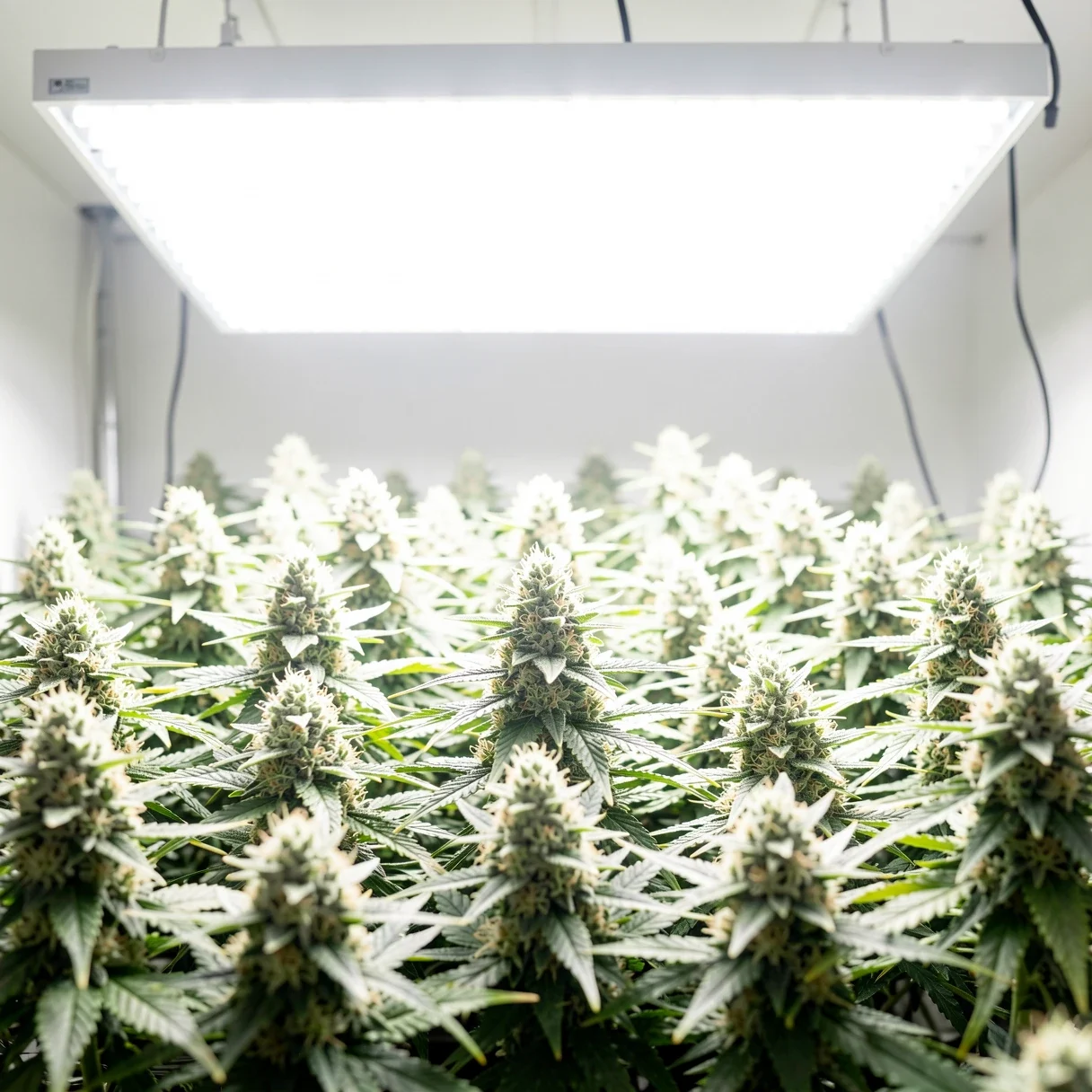
Forget watts. A grow light’s wattage tells you what it costs to run, not what reaches your plants. The two measurements that describe cannabis light intensity properly are PPFD and DLI.
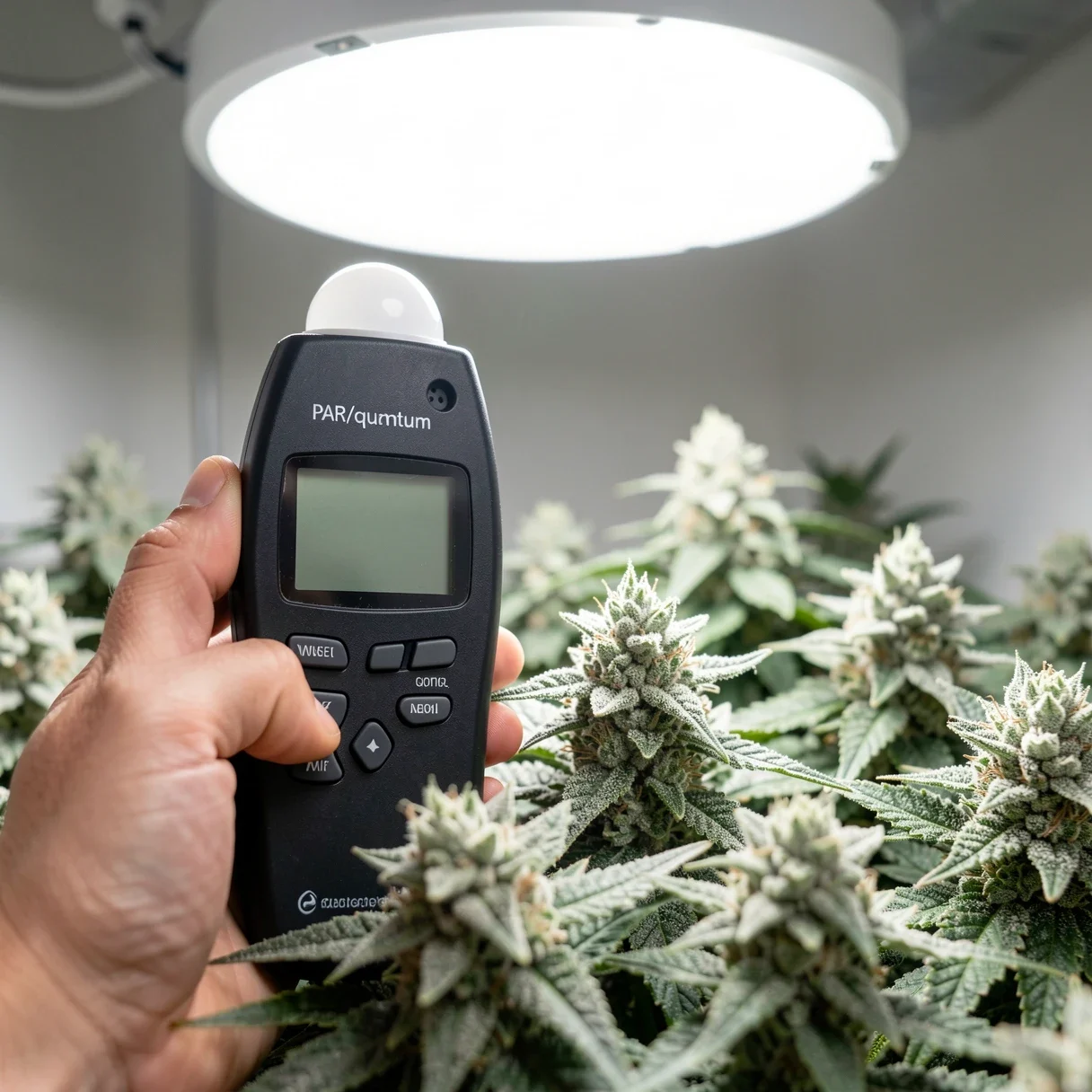
PPFD (photosynthetic photon flux density) counts the photons in the 400–700 nm range hitting a square metre of canopy every second, measured in µmol/m²/s. It’s the instantaneous brightness your plants actually feel. A cheap phone lux meter won’t capture it — you need a PAR or quantum meter, because lux is weighted for the human eye, not for photosynthesis.
DLI (daily light integral) is the total dose: how many moles of light land on that square metre across the whole day. You get it by multiplying PPFD by your photoperiod. The formula is simple:
DLI = PPFD × (hours of light × 3,600) ÷ 1,000,000
So a flowering canopy at 800 PPFD on a 12-hour day receives a DLI of about 34.6 mol/m²/day (800 × 43,200 ÷ 1,000,000). Push that to 1,000 PPFD and the DLI climbs to 43.2. PPFD is the speed; DLI is the distance travelled by the end of the day. Both describe cannabis light intensity, and both matter — a high PPFD on a short photoperiod can deliver the same dose as a gentler PPFD over more hours.
In 2021, Victoria Rodriguez-Morrison, David Llewellyn, and Youbin Zheng at the University of Guelph published a study in Frontiers in Plant Science titled Cannabis Yield, Potency, and Leaf Photosynthesis Respond Differently to Increasing Light Levels in an Indoor Environment. It’s the same Guelph lab that debunked the UV-boosts-THC myth, and it remains the cleanest answer we have on how much light cannabis can use.
They grew a single genotype in flower under a spread of light levels running from roughly 120 all the way up to about 1,800 µmol/m²/s — far brighter than most home tents ever see — at ambient CO₂. Then they measured what changed. The result reframed how serious growers think about cannabis light intensity.
The headline finding: inflorescence (bud) dry weight increased almost perfectly linearly with light intensity across the entire range. There was no saturation point, no plateau where adding more light stopped paying off — yield kept climbing right up to 1,800 µmol/m²/s. The plants’ individual leaves saturated photosynthetically much earlier, but the canopy as a whole kept converting extra photons into extra flower. More light, more bud, almost in a straight line.
The second finding is the one that surprises people: cannabinoid concentration didn’t budge. THC percentage stayed essentially flat across the whole intensity range. Brighter light grew bigger buds, not more potent ones. You harvested far more total THC per square metre because there was more flower — but the per-gram potency was set by genetics, not by how hard you ran the lights.
Here’s the uncomfortable part. The study found yield still climbing at 1,800 PPFD, yet a typical hobby grow runs its flowering canopy somewhere between 300 and 600 PPFD — a third of what the plants could use. That gap is the most common reason a healthy-looking grow produces disappointing weight. The plant isn’t the problem and the nutrients usually aren’t either. The cannabis light intensity is simply too low.
It happens for predictable reasons. Cheap LED panels are sold by inflated “equivalent wattage” numbers and rarely deliver the PPFD they imply at real hanging distances. Growers hang lights too high out of bleaching fear. And without a PAR meter, nobody actually knows their number — they’re guessing. Correcting cannabis light intensity is often the single highest-return change a frustrated grower can make, ahead of new nutrients, new genetics, or new gadgets.
There’s a real-world ceiling the study doesn’t capture, though. Guelph ran a controlled research environment; a home tent is not that. In practice, pushing intensity past roughly 1,000 PPFD without supplemental CO₂ tends to invite light stress — bleached top colas, taco’d leaf edges, foxtailing — because heat, airflow, and nutrient uptake become the new bottleneck. The honest takeaway: most growers should be chasing intensity upward toward 800–1,000, not worrying they’ve gone too far.
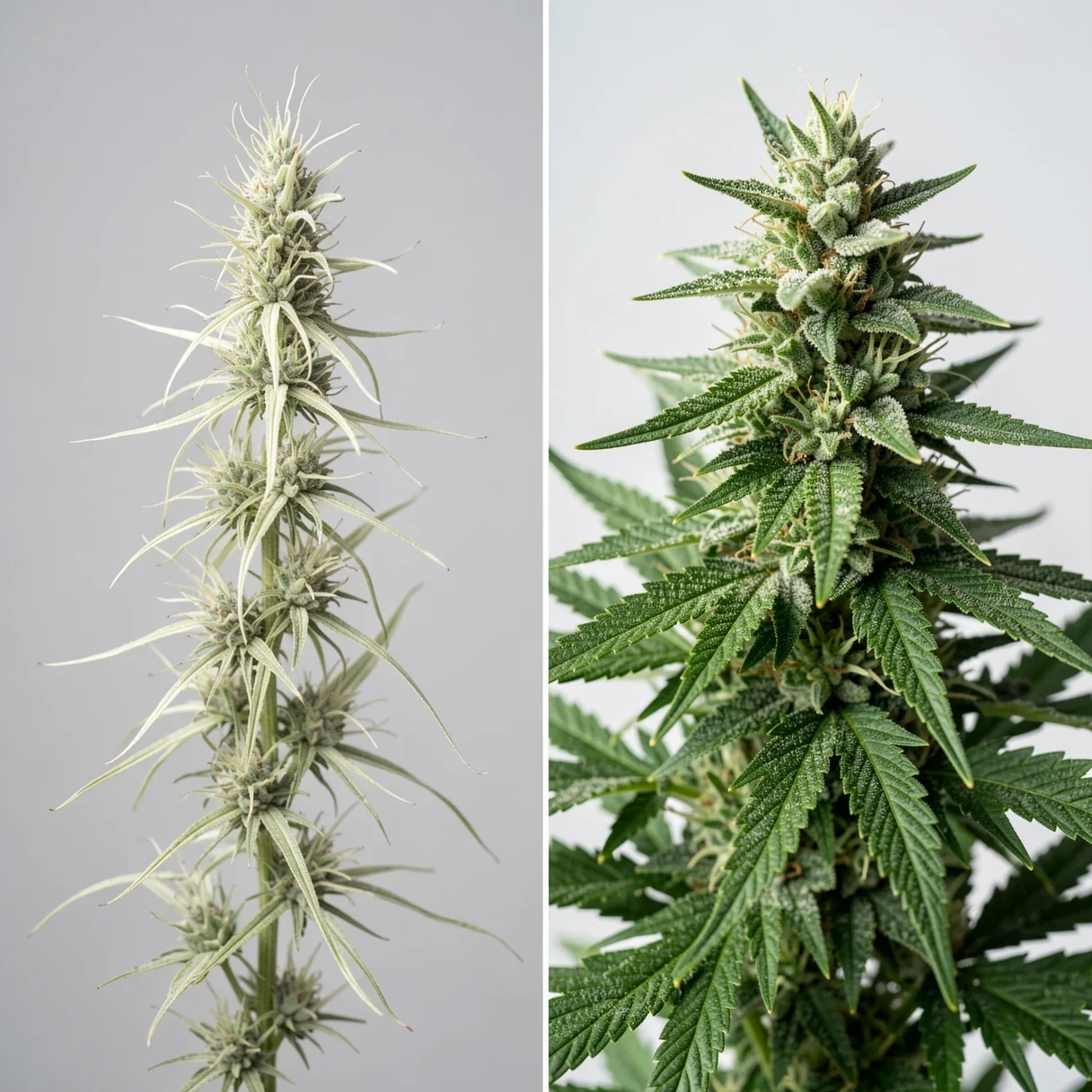
Plants don’t want the same cannabis light intensity their whole life — a seedling drowns under what a flowering canopy thrives on. Here are practical, research-aligned targets. PPFD is measured at canopy height; DLI assumes the typical photoperiod for that stage.
| Stage | Photoperiod | PPFD (µmol/m²/s) | DLI (mol/m²/day) |
|---|---|---|---|
| Seedling | 18 h | 150–300 | ~10–19 |
| Vegetative | 18 h | 400–600 | ~26–39 |
| Early flower | 12 h | 600–800 | ~26–35 |
| Peak flower | 12 h | 800–1,000 | ~35–43 |
| Flower + CO₂ | 12 h | 1,000–1,400+ | ~43–60+ |
Seedlings burn easily — start them gentle and raise the light or lower it gradually. Veg is where you build the frame, so 400–600 PPFD of cannabis light intensity keeps internodes tight and growth fast. Flower is where it earns its keep: every extra usable photon from week one of bloom onward is going toward bud. If you’re running a longer photoperiod in flower, note that the daily dose changes too — we cover that trade-off in our breakdown of the 13-hour flowering photoperiod.
One caveat worth repeating: only go past 1,000 PPFD if you’re also adding CO₂ and have your temperature and humidity dialled. More light without the supporting environment just shifts the bottleneck and stresses the plant.
Getting cannabis light intensity right doesn’t make spectrum, feeding, and genetics irrelevant. It makes them matter. A canopy soaking up 900 PPFD has a much higher ceiling for what good nutrition and strong genetics can deliver than one starved at 400. Light is the engine; everything else is tuning.
Spectrum is the obvious companion question, and we went deep on it separately — if you want the full picture, pair this with our guide to the best light spectrum for cannabis. The short version: a quality full-spectrum white LED at the right intensity beats any “cannabis-tuned” purple panel run dimmer. Feeding matters too, especially in bloom — bright light drives heavier feeding demand, which is why nitrogen levels in flower need managing once your intensity is high. And no amount of light fixes weak weight if the plant can’t use it; our notes on maximizing yield tie the levers together.
Not every plant turns extra photons into extra weight equally. High-yielding, vigorous photoperiod strains show the biggest absolute gains when you raise cannabis light intensity — they have the structure and the bud sites to use it. A heavy producer like Big Bud or Gorilla Glue #4 at 900 PPFD will out-yield the same genetics at 500 by a wide margin. The same goes for dense, resin-heavy hybrids like Cement Shoes, sativa-leaning workhorses like Green Crack and White Amnesia Haze, and balanced classics like Blue Dream.
Autoflowers respond to strong light too, though their fixed, shorter life cycle caps the total gain — there’s simply less time to bank the extra growth. Even so, autos like Bruce Banner Auto and Gorilla Glue Auto visibly stack denser under 700–800 PPFD than under a budget light. Browse the full feminized seed and autoflower seed lineups, or the whole catalog, for strains built to cash in on a bright tent. If you’re unsure what fits your space, our guide to choosing cannabis seeds helps narrow it down.
For most strains without supplemental CO₂, aim for 800–1,000 µmol/m²/s at the canopy during peak flower. The 2021 Guelph study found yield still rising past that, but 800–1,000 is the practical sweet spot where a home tent gets near-maximum bud without tipping into light stress. Below ~600 PPFD you’re leaving real weight on the table.
Roughly 35–43 mol/m²/day in flower (that’s 800–1,000 PPFD over a 12-hour day), and about 26–39 in veg. DLI is the figure commercial growers track because it captures the full daily dose of cannabis light intensity, not just the instantaneous brightness. Hit the DLI and the plant doesn’t much care whether it came from higher PPFD or more hours.
In a controlled lab with CO₂, the research found no yield penalty up to 1,800 PPFD. In a normal tent, yes — past about 1,000 PPFD at ambient CO₂ you’ll often see bleaching, foxtailing, and taco’d leaves as heat and uptake become limiting. Too much light is a real-world problem, but it’s far rarer than the under-lighting most growers actually suffer from.
No. The 2021 study was clear: brighter light grows more flower but doesn’t raise THC concentration — potency stayed flat across the whole intensity range. You harvest more total THC because there’s more bud, but per-gram potency is set by genetics, not by cranking the cannabis light intensity. Chase weight with light; chase potency with genetics.
A dedicated PAR/quantum meter is the accurate tool, but they’re pricey. Budget options: some smartphone PAR apps give a rough ballpark, and manufacturers publish PPFD maps for their panels at set heights — find your light’s chart and match your hanging distance. It’s not lab-grade, but it beats guessing, and knowing your number is the first step to fixing cannabis light intensity.
Keep them gentle — 150–300 PPFD. Seedlings and fresh clones have small root systems and bleach or stall under flowering-strength light. Raise intensity gradually as they establish. Pushing young plants too hard, too early is one of the most common cannabis light intensity mistakes.
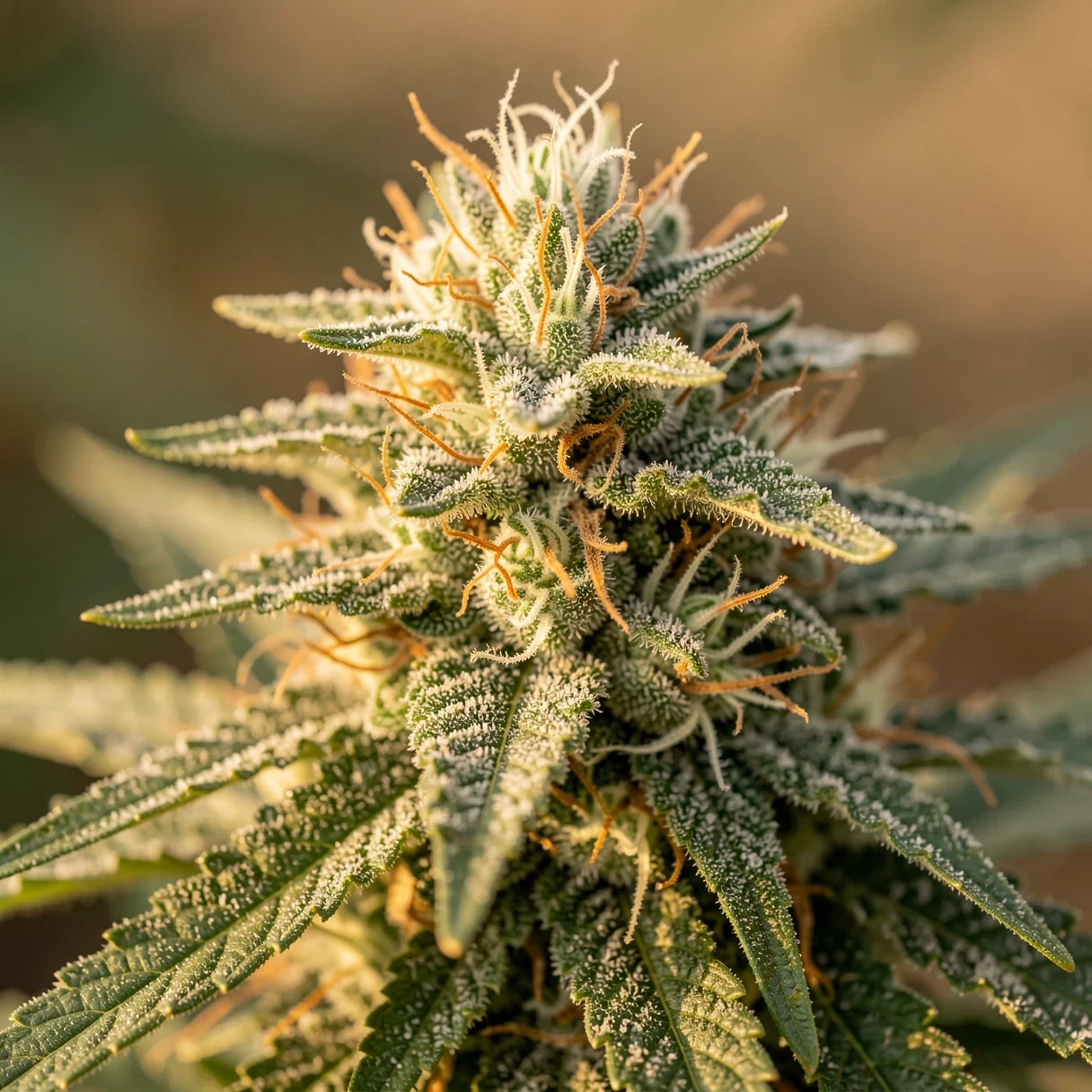
If you take one thing from the research, make it this: cannabis light intensity, not spectrum, is the master dial on your yield. The 2021 Guelph study showed bud weight climbing in a near-straight line all the way to 1,800 PPFD, while potency held flat — so brighter light buys you more flower, and the genetics decide how strong it is. Most home grows sit far below the plant’s ceiling. Get a PAR reading, aim for 800–1,000 PPFD in flower, and feed the canopy what it can actually use.
Then put that light to work on genetics that can spend it. Browse our full seed catalog, start with our germination guide, and keep your unused beans viable with our seed storage guide. Dial the intensity first; everything else follows.
Want to keep learning? Browse our full library of cannabis growing guides — everything from germination to harvest, in one place.
Ready to grow? Browse premium seeds from Lighthouse Genetics:
Designed & Built by Wynne Web Design