Germinating cannabis seeds is the one stage of a grow where doing less usually works better. A seed needs water, warmth and air. That’s the whole list. The trouble starts when you give it more than that: too much water, too much heat, too much handling, or a trick from a forum that the seed never needed.
Here’s the short version. Keep seeds damp but not wet, at about 21–26°C (70–79°F), and fresh seeds often show a root within one to three days. We checked every number in this guide against seed-testing standards and published germination studies, so you know which advice is backed by evidence and which is just habit. One caveat runs through all of it: nearly all of the lab studies on germinating cannabis seeds were done on industrial hemp. It’s the same species, but the studies didn’t test the strains in your seed pack.
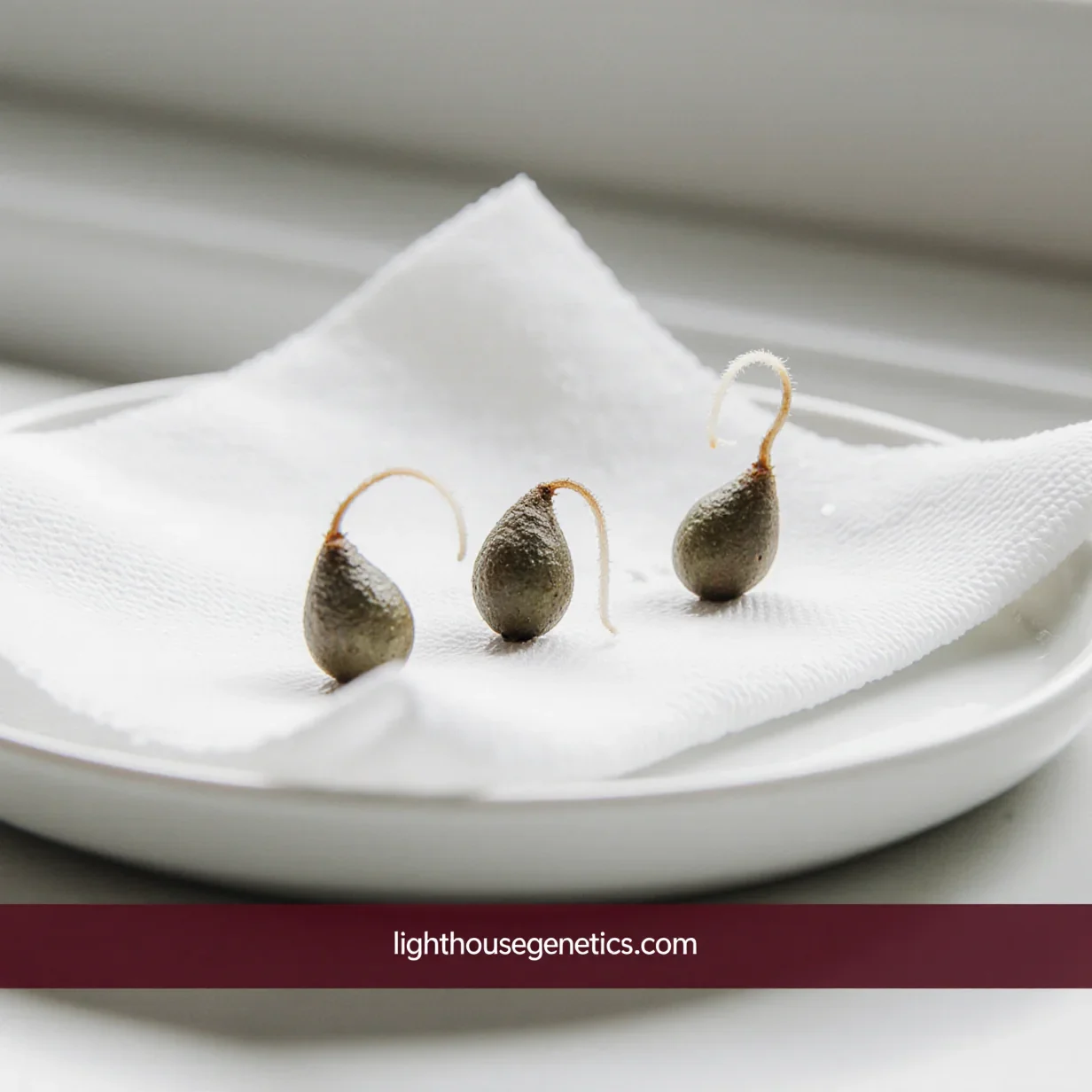
A dry seed is alive but idle. When it takes up water, the shell swells and softens and the embryo inside switches back on. Botanists call that first step imbibition. Penn State Extension’s guide to seed biology describes it plainly: “The seed rapidly takes up water and the seed coat swells and softens.” The first thing to break out is the radicle, the embryonic root. That white tail is what growers call the taproot.
Seeds also breathe. They take in oxygen and give off carbon dioxide, and in a waterlogged medium they can suffocate. That’s why “damp, not soaked” is the rule for germinating cannabis seeds, whatever method you use.
What about darkness? Lots of guides insist on it, but we couldn’t find a study that tests light against dark for cannabis seed. Canada’s official seed-testing method lists no light requirement for hemp, and the same rules note that most species “will germinate either in light or in darkness.” Lab studies have germinated cannabis seeds in the dark without trouble. So when germinating cannabis seeds, darkness is optional. A towel under an upturned plate or a buried seed is in the dark anyway.
Search for the best way of germinating cannabis seeds and you’ll find strong opinions. What you won’t find is a controlled study comparing the home methods head to head. We looked and couldn’t find one for cannabis. So here are the honest trade-offs.
| Method | How it works | Upside | Downside |
|---|---|---|---|
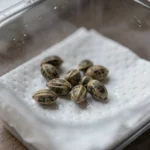
| Paper towel | Seeds between damp paper towels on a plate or in a container until a root shows | You can see which seeds sprouted. Labs use damp paper too. | You have to move a seed with a fragile root into soil |
| Direct sow | Seed goes straight into moist soil or a starter plug | The root is never handled. Simplest of all. | You can’t see what’s happening, so you’re guessing for the first week |
| Soak first | Seeds sit in a glass of water, then go into a towel or soil | May give a small head start in a dish | In studies it hasn’t raised the number that sprout, and the seed still needs air |
| Starter plugs | Seed goes into a peat or rockwool plug that later drops into a pot | Easy to move without disturbing the root | Plugs can stay too wet if you overwater them |
Our take on germinating cannabis seeds: if you’re new, or your seeds were expensive, use the paper towel. Seeing a root removes all the guesswork, and you won’t plant a dud into a big pot and wait two weeks for nothing. If your seed is fresh and you’re comfortable, sowing directly into the final medium is a fine alternative, and it means you never have to move a seed with a fragile root.
The paper towel isn’t a hack, either. The Canadian Food Inspection Agency’s seed-testing rules tell labs to germinate hemp seed between moist paper or in rolled paper towels. When the professionals measure germination, they use damp paper too.
This is the method to start with if you’re germinating cannabis seeds for the first time.
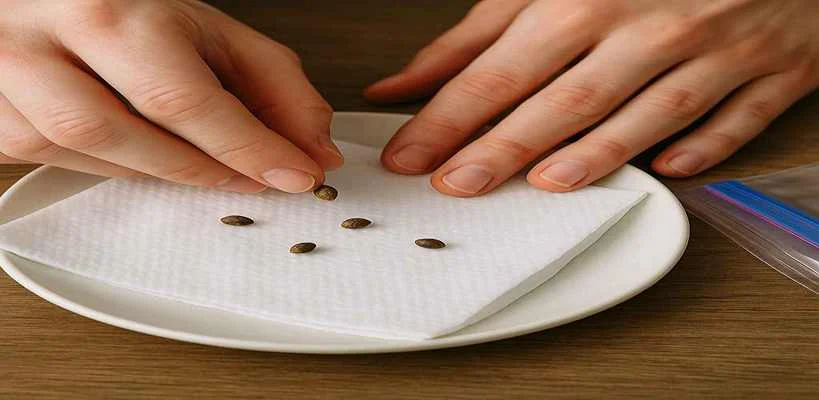
A big mistake when germinating cannabis seeds this way is too much water. In one hemp study, seeds from a weak, shelled batch were started in a dish wetted with water, and nearly 80% of them never became normal seedlings. The same seeds did better started in rolled towels. The study didn’t test why, but a likely reason is air: damp paper gives the seed water and air at the same time, while a puddle can cut the air off.
Fill a small pot, plug or your final container with a light, moist seed-starting mix. Press a hole about 1–1.5 cm (½ inch) deep, drop the seed in, cover it loosely and mist the surface. Keep the mix evenly moist and warm, but never soggy. Give it at least a week before you dig around to check on it. Most of the advice in this guide on germinating cannabis seeds applies the same way. The only difference is that the root starts out already where it needs to be.
Temperature has a big effect on how fast germinating cannabis seeds goes. In a 2022 study on hemp seed published in the journal Crops, germination was fastest and most complete between about 19 and 30°C (66–86°F). The researchers calculated lower and upper limits of about 3°C (38°F) and 43°C (109°F), with germination slow or patchy near either end. A Virginia Tech thesis on eight hemp cultivars found the share of seeds sprouting began to slip somewhere between 25 and 30°C (77–86°F) for most varieties. Below 10°C (50°F), seeds were still germinating more than 20 days into the test.
That’s why 21–26°C (70–79°F) is the target we give. It sits inside the 19–30°C (66–86°F) band where hemp germinated best, and at the low edge of the 25–30°C (77–86°F) zone where most varieties in the Virginia Tech thesis started to slip. If a batch sits there doing nothing, check the temperature first: a cold basement or windowsill slows germination right down.
How long should you wait? Fresh seeds at a good temperature often crack in one to three days. In one lab protocol, nearly half of a drug-type strain’s seeds sprouted on day one in plain water. But Canada’s official lab test for hemp runs for a full 7 days. A Slovenian study of hemp seed found the standard count days of 3 and 7 came too early, and suggested counting on day 6 and day 12 instead. Oregon State University’s seed lab gives hemp seed 7 to 14 days in the warm germinator.
So don’t give up before a week, and give older seed up to two weeks. If nothing has happened by then, work through our fixes for cannabis seeds not germinating.
This is the delicate part of germinating cannabis seeds with the towel method. Handle the seed by the shell, never the root. A pair of clean tweezers helps, or tip it from the towel straight into the hole.
Plant shallow, about 1–1.5 cm (½ inch) deep. For comparison, Manitoba’s agriculture department recommends sowing field hemp ½–1 inch (1.3–2.5 cm) deep. It also warns that deep seeding in cold, wet soil has cost growers whole stands.
Which way up? Root down if you can see it. If you can’t tell, lay the seed on its side. Roots grow downward on their own, so a sideways seed sorts itself out. We couldn’t find any study showing that orientation makes a difference for cannabis, so don’t waste time agonizing over it.
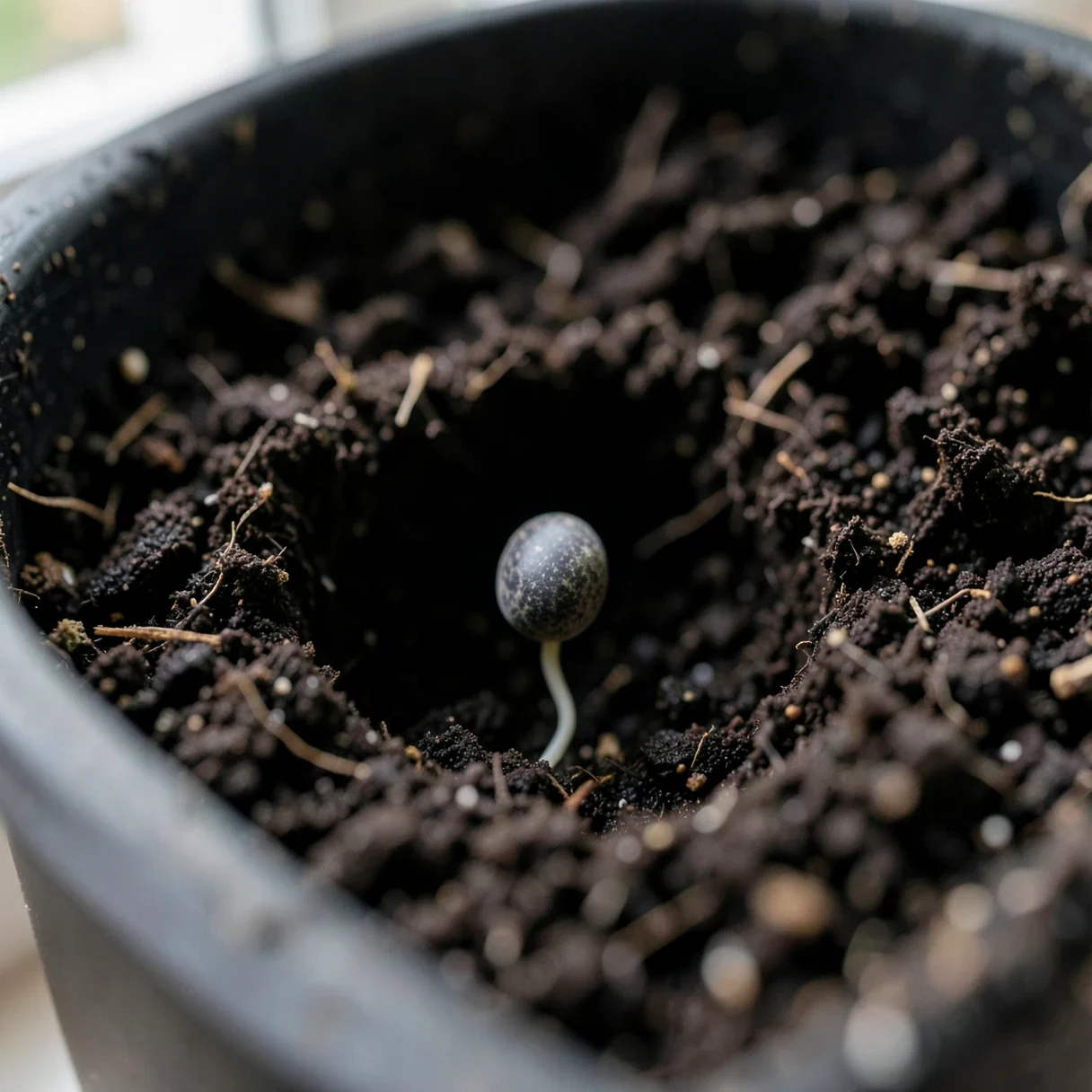
Autoflowers are worth a special mention. Many growers sow them straight into the pot they’ll finish in, because an auto flowers on age rather than day length, so any setback eats into time it never gets back. We couldn’t find a controlled study on this for drug-type autos. It’s sensible practice, not proven science. An auto like White Widow Autoflower, Bruce Banner Autoflower or Gorilla Glue Autoflower is a good candidate for sowing straight into its final pot. If you’re unsure how big that pot should be, our guide to cannabis pot size goes through the options.
When germinating cannabis seeds that are fresh and healthy, you don’t need a pre-treatment. Here’s what the studies say about the popular ones.
Soaking in water. In hemp studies, priming (a controlled soak, often followed by drying the seed back) made seeds germinate faster. It didn’t raise the share that sprouted.
We couldn’t find a study that sets a safe soaking limit for cannabis. One lab kept seeds fully underwater for four days and they still sprouted. But seeds need oxygen, and in some other crops a long soak damages them. In a 2025 hemp trial, a 24-hour water soak sped up the first sprouts while fewer seeds sprouted in three of four hemp varieties (Latif et al., 2025). The samples were small (30 seeds per treatment), and the authors still recommend the soak, so treat it as a caution, not a rule.
Move seeds out of the water after a few hours to a day, or as soon as they sink or crack.
Hydrogen peroxide. In a published cannabis germination protocol, seeds kept in a weak 1% solution in the dark had 82.5% sprouting by day one, against 47.5% in plain water. It also helped seed more than five years old. But 3% peroxide, the strength sold in drugstores, cut day-one germination to 22.5%, worse than water. If you try it, dilute drugstore peroxide about one part to two parts water first.
Scuffing the shell. In a sterile University of Guelph lab trial, cutting off the seed tip with a scalpel gave 100% germination within a week for a hemp variety, and over 90% for ten drug-type strains. We couldn’t find a study testing sandpaper scarification. In a 2025 trial, soaking seeds in sulfuric acid (a lab treatment, not a home one) helped one hemp cultivar out of three. The authors concluded that acid and cold treatments don’t significantly improve germination, though they may help with stubborn seed. The only gibberellic acid study we found tested hemp under drought stress. Save the tricks for old or stubborn seed, and start with temperature and water.
When germinating cannabis seeds, expect most of them to sprout, not all. For comparison, certified hemp seed in Canada has to germinate at least 85% to make the top grades under the federal Seeds Regulations. The EU minimum is 75%, and Florida’s standard is 80%. Even lab-tested seed sold under government rules isn’t expected to hit 100%.
Age and storage make a big difference. In a Slovenian study of hemp seed, germination fell from about 96% in fresh certified seed to 65% after three years in a fridge, and to 46% after three years at room temperature. If you’re holding seeds for later, our guide to storing cannabis seeds covers how to keep them viable.
Maturity matters too. In a 2025 hemp study, fully mature seed (brown, hard-shelled and full-sized) gave the best germination and emergence, while green, soft, immature seed did poorly. So a pale green, soft seed is a warning sign. Among seeds that already look mature, though, we couldn’t find a study showing that a darker shade or stripes predicts which ones will sprout. The only real test of germinating cannabis seeds is doing it.
If a seed from us genuinely won’t germinate, our 30-day germination guarantee is there for it. Germinate with a proven method within 30 days of delivery, send photos, and we review each claim and send replacement seeds if it’s approved (you cover the shipping on those). That goes for Mac’s own feminized lines too, like Blue Monkey Dick, Neptune’s Wedding, Grape Skunk and Freaky Queen.
Once the seedling breaks the surface, germinating cannabis seeds is done and a different stage begins. Seedlings need light right away, gentle watering and no fertilizer for the first while. Our guide to the cannabis seedling stage walks through the first two to three weeks. For the full timeline from here to harvest, see how long it takes to grow cannabis.
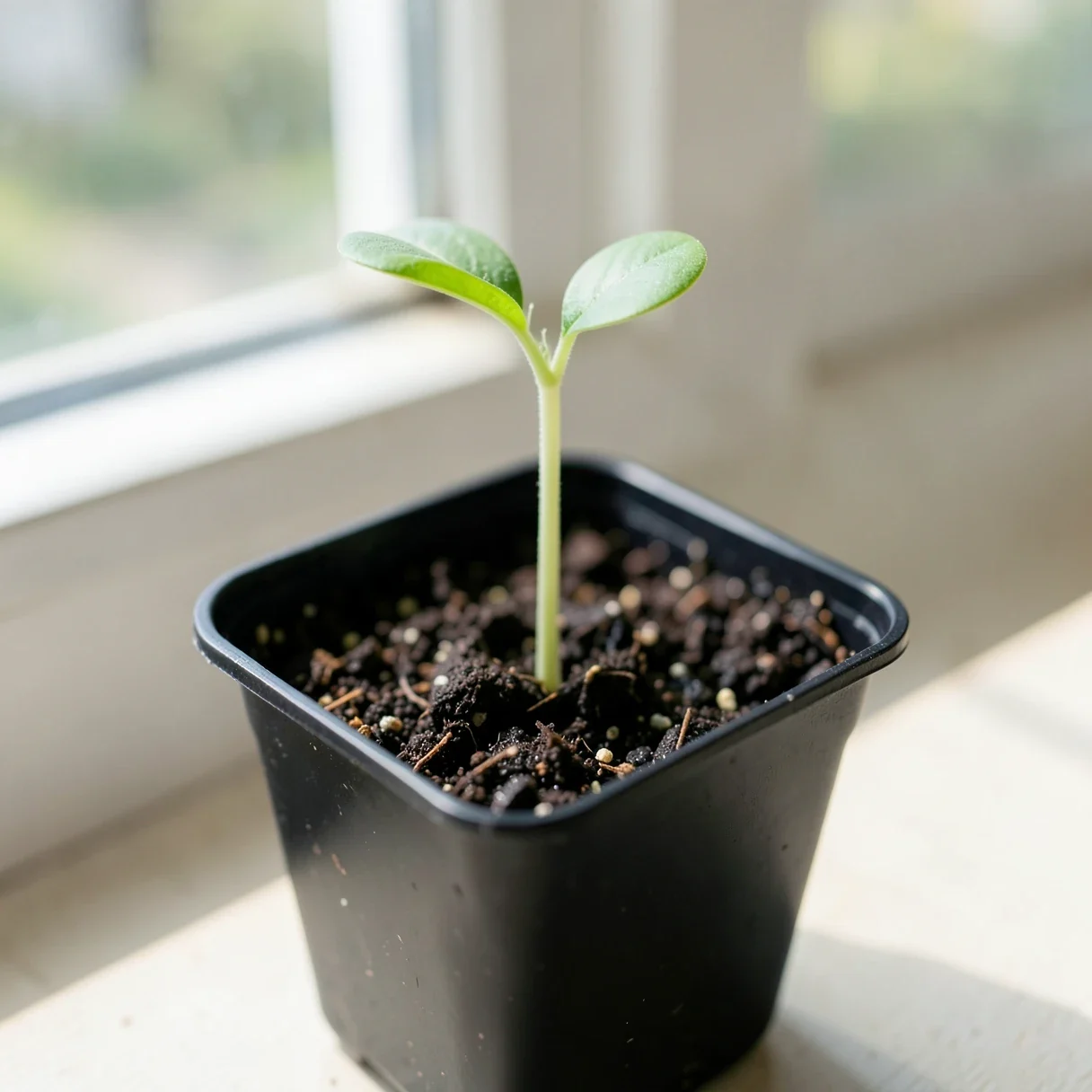
Germinating cannabis seeds comes down to three things: steady warmth around 21–26°C (70–79°F), damp but never soggy, and enough patience to wait a full week. Use a paper towel if you want to see what’s happening, and sow straight into soil if you’d rather not touch the root. Skip the tricks unless the seed is old. Get the basics right, and germinating cannabis seeds is the easiest stage of the whole grow. For the rest of the grow, our cannabis growing guides pick up from here.
Shop cannabis seeds | Browse autoflower seeds | Seeds not germinating? 7 fixes
Fresh seeds at 21–26°C (70–79°F) often show a root in one to three days. Canada’s official lab test for hemp seed runs 7 days, and some seed labs allow up to two weeks, so give them at least a week before you worry.
We couldn’t find a study that compares the home methods head to head. The paper towel is the safest choice for beginners because you can see which seeds sprouted. Sowing directly into moist soil is a fine alternative, and the root never gets handled.
After germinating cannabis seeds in a towel, plant them with the root pointing down, about 1–1.5 cm (½ inch) deep. If you can’t tell which end is which, lay the seed on its side. The root will turn downward on its own.
You don’t have to. In hemp studies, priming (a controlled soak) made seed sprout faster but didn’t increase how many sprouted. If you do soak them, take them out after a few hours to a day, or once they sink or crack.
No. Canada’s official seed-testing method lists no light requirement for hemp, and we couldn’t find a study showing that cannabis seed needs darkness. When germinating cannabis seeds, keep them covered mainly so they don’t dry out.
Want to keep learning? Browse our full library of our cannabis growing guides — everything from germination to harvest, in one place.
Ready to grow? Browse premium seeds from Lighthouse Genetics:
Designed & Built by Wynne Web Design