Most growers manage their grow room with two numbers: temperature and humidity. They aim for “around 75 and 55%” and call it good. The problem is that those two numbers don’t act on the plant separately — the plant feels them together, as one combined pressure that decides how fast it breathes. That combined number is VPD, and once you start steering it instead of chasing temperature and humidity in isolation, a lot of stubborn problems get easier to solve.
VPD for cannabis is the single most useful climate metric a home grower can learn, and it’s badly under-taught. It explains why your plants droop in a hot, dry tent even though the temperature looks fine, why your humid veg room invites mold, and why two grows at “the same” temp and humidity can transpire completely differently. This is what VPD actually is, the targets that work at each grow stage, and how to dial it in without buying a lab’s worth of gear.
VPD stands for vapor pressure deficit. It’s the difference between how much moisture the air is currently holding and the maximum it could hold at that temperature, measured in kilopascals (kPa). When the air is cool and damp, it’s already near saturation, so the deficit is small — a low VPD. When the air is warm and dry, it’s far from saturated and “pulls” moisture hard — a high VPD.
Why does that matter to a plant? Because a leaf is essentially a wet surface exposed to that air. The bigger the deficit, the harder the air tugs water out of the leaf through its stomata — the tiny pores on the underside. That pull is what drives transpiration, and transpiration is the engine that hauls water and dissolved nutrients up from the roots. So VPD for cannabis isn’t an abstract weather stat; it’s a direct dial on how fast your plants drink and feed.
One important wrinkle: VPD is really about leaf temperature, not air temperature. A transpiring leaf cools itself, so its surface usually runs a couple of degrees below the surrounding air — commonly around 1–3°C (2–5°F) cooler. That’s why proper VPD for cannabis charts ask you to account for a leaf-temperature offset rather than just plugging in the air reading. Most growers simply assume the leaf is about 2°F cooler than the air and move on; it’s close enough to be useful.
Get VPD for cannabis wrong in either direction and the plant tells you, but the symptoms are easy to misread.
When VPD is too low — cool, humid air near saturation — transpiration slows to a crawl. The plant can’t move water, so it can’t move calcium and other nutrients that ride along with the flow. You get sluggish growth, soft droopy leaves that look overwatered, and the perfect conditions for powdery mildew and bud rot to take hold. Low VPD for cannabis is the silent killer of humid veg tents and dense late-flower canopies.
When VPD is too high — hot, dry air — the opposite happens. The air pulls water out faster than the roots can replace it. To protect itself, the plant slams its stomata shut, which stops transpiration and stops the CO2 intake it needs for photosynthesis. Growth stalls, leaves curl and taco, and you’ll often see clawing or nutrient burn as the plant concentrates salts it can no longer dilute. High VPD for cannabis looks like a watering or feeding problem, but the real culprit is the air.
That’s the whole case for learning VPD for cannabis: temperature alone and humidity alone each tell you half the story. A 78°F tent at 70% humidity and a 78°F tent at 40% humidity are wildly different environments for the plant, even though the thermometer reads the same. VPD collapses both into the one figure that predicts how the plant will behave.
A plant’s ideal VPD shifts as it matures. Young plants with small root systems can’t replace water quickly, so they want gentle, humid air — a low VPD. As the plant builds roots and leaf mass, it can handle (and benefits from) a stronger pull. These are the commonly recommended VPD for cannabis ranges by stage:
| Stage | Target VPD (kPa) | Roughly translates to |
|---|---|---|
| Seedlings & clones | 0.4 – 0.8 | Warm and humid — high RH, gentle pull |
| Vegetative | 0.8 – 1.2 | Moderate — the plant is building a frame |
| Early flower | 1.2 – 1.4 | Stronger pull to drive bud development |
| Late flower | 1.4 – 1.6 | Drier air to protect dense buds from rot |
Treat these as zones, not setpoints. The right VPD for cannabis in your room depends on your genetics, your light intensity, and whether you’re running CO2 — higher light and added CO2 let a plant comfortably handle a slightly higher VPD because it’s photosynthesizing and transpiring faster. If you only remember one thing: start young plants humid and low, and let VPD climb gradually as they grow.
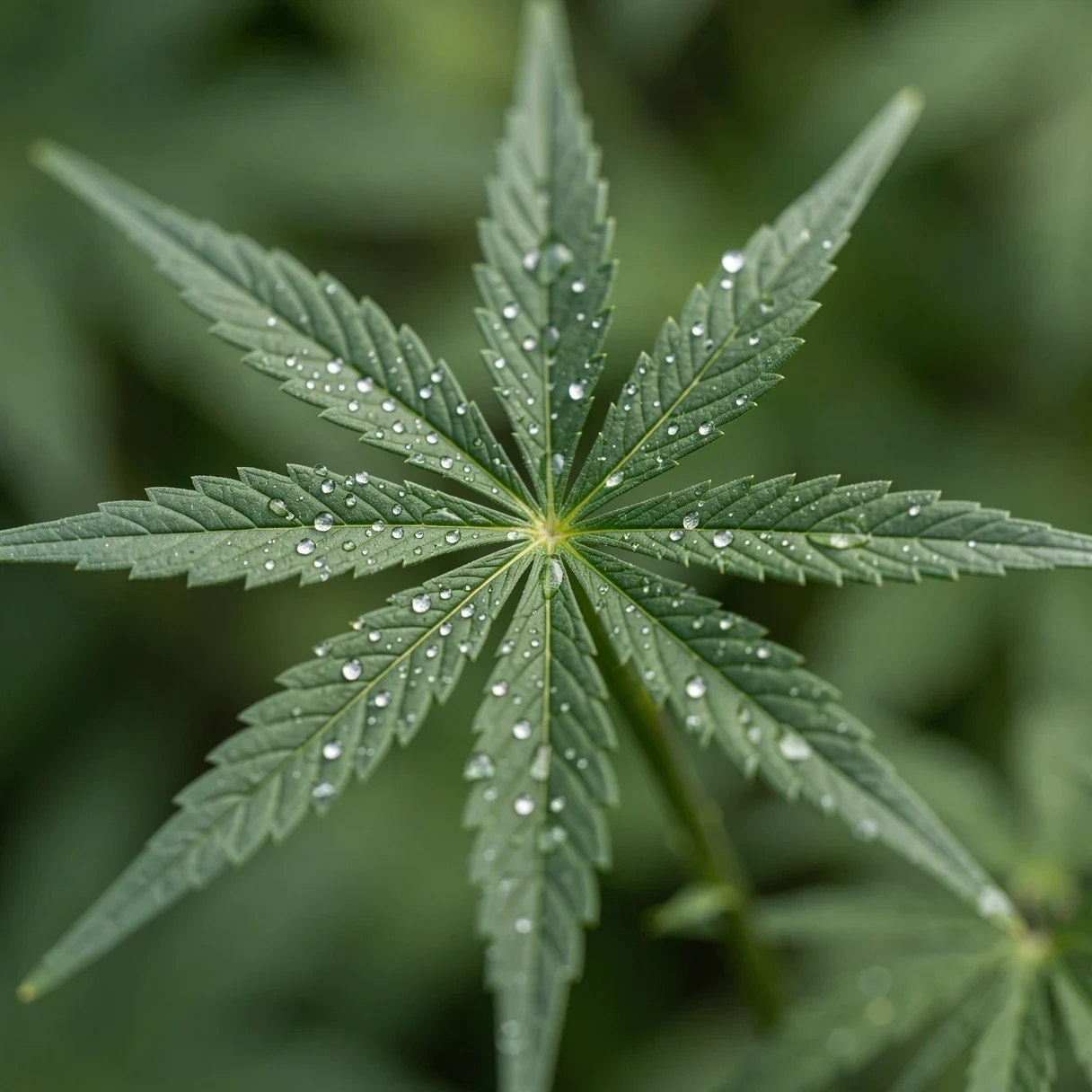
A VPD chart is the fastest way to manage VPD for cannabis at a glance. It’s just a grid: air temperature down one side, relative humidity across the top, and the resulting VPD value in each cell, usually color-coded into “too low / just right / too high” zones. To use one, find your air temperature, slide across to your humidity, and read the kPa value where they meet. If it lands in the zone for your current stage, you’re dialed in.
The one extra step that separates good VPD for cannabis management from sloppy guessing is the leaf-temperature offset. Because the leaf is cooler than the air, most charts let you subtract a degree or two before you look up the value. If you have an infrared thermometer, point it at a fan leaf and use that real leaf temperature — it’s the most accurate way to run VPD for cannabis. If you don’t, assume the leaf is about 2°F below your air reading and you’ll be close enough for a home grow.
You change VPD by changing temperature, humidity, or both. Here’s the practical playbook.
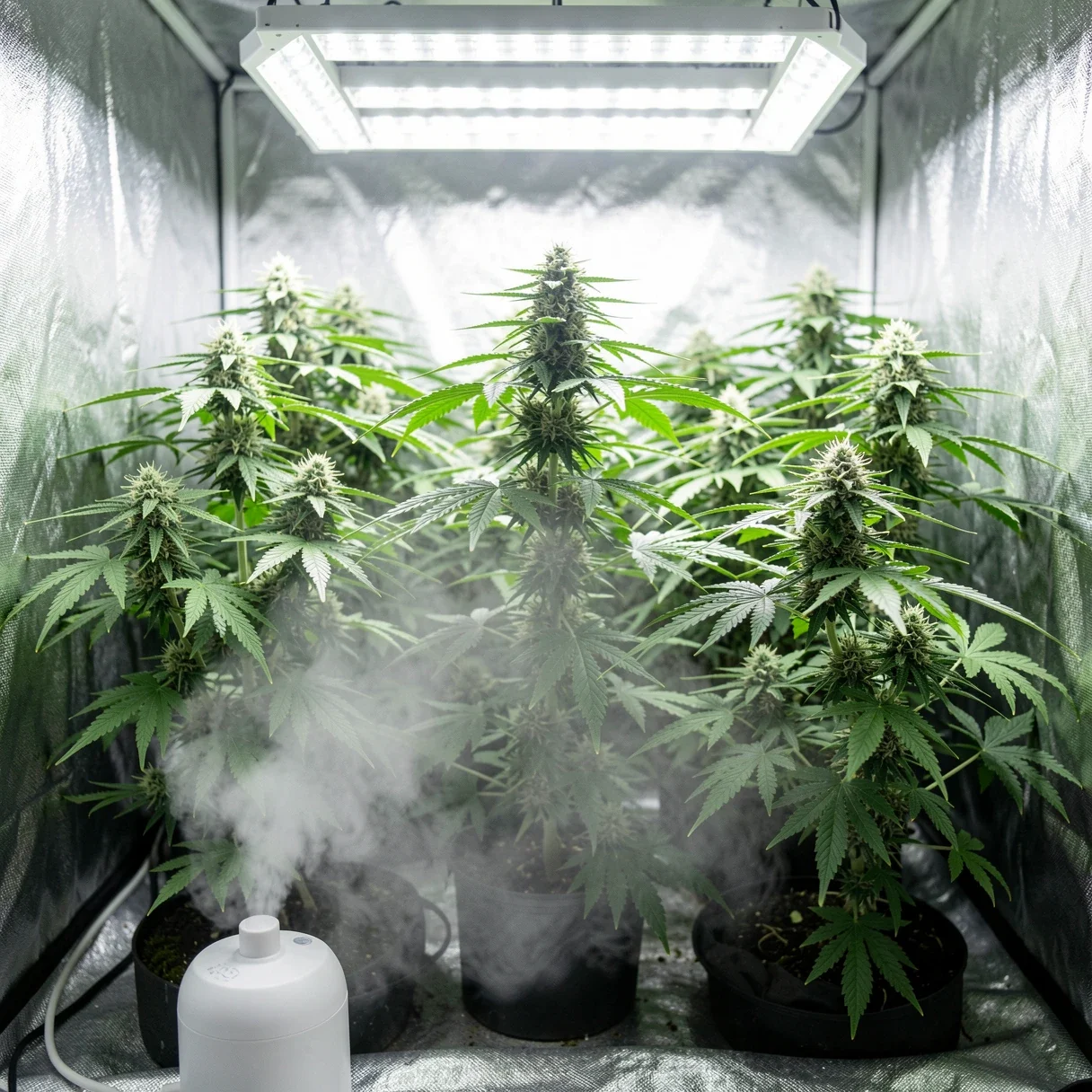
The hardware doesn’t need to be fancy. A decent thermo-hygrometer, a small humidifier, a dehumidifier sized to your space, and good circulation will let you hold a stable VPD for cannabis through the whole grow. Climate control like this is also a core part of any solid cannabis grow tent setup — VPD is the reason those temperature and humidity steps exist.
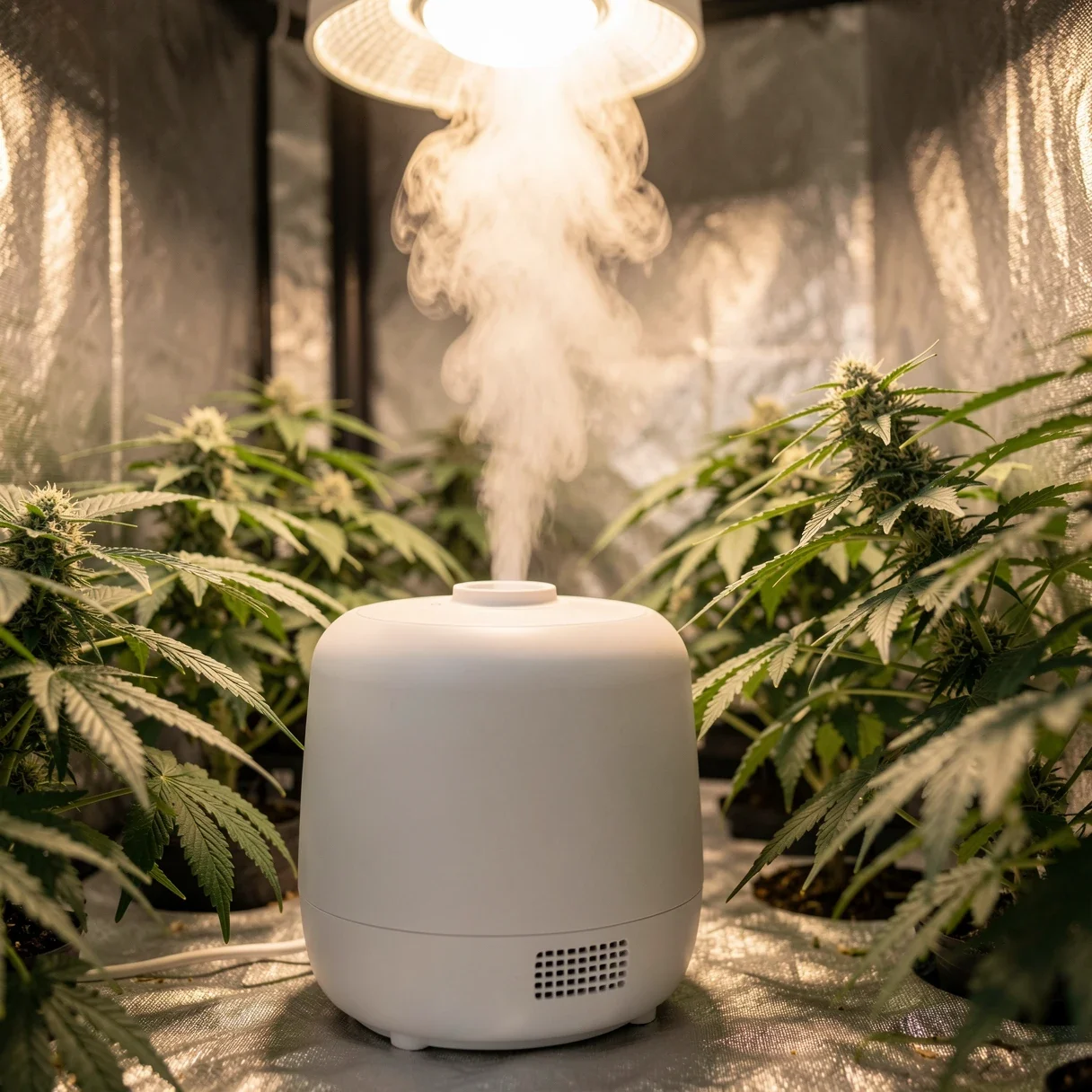
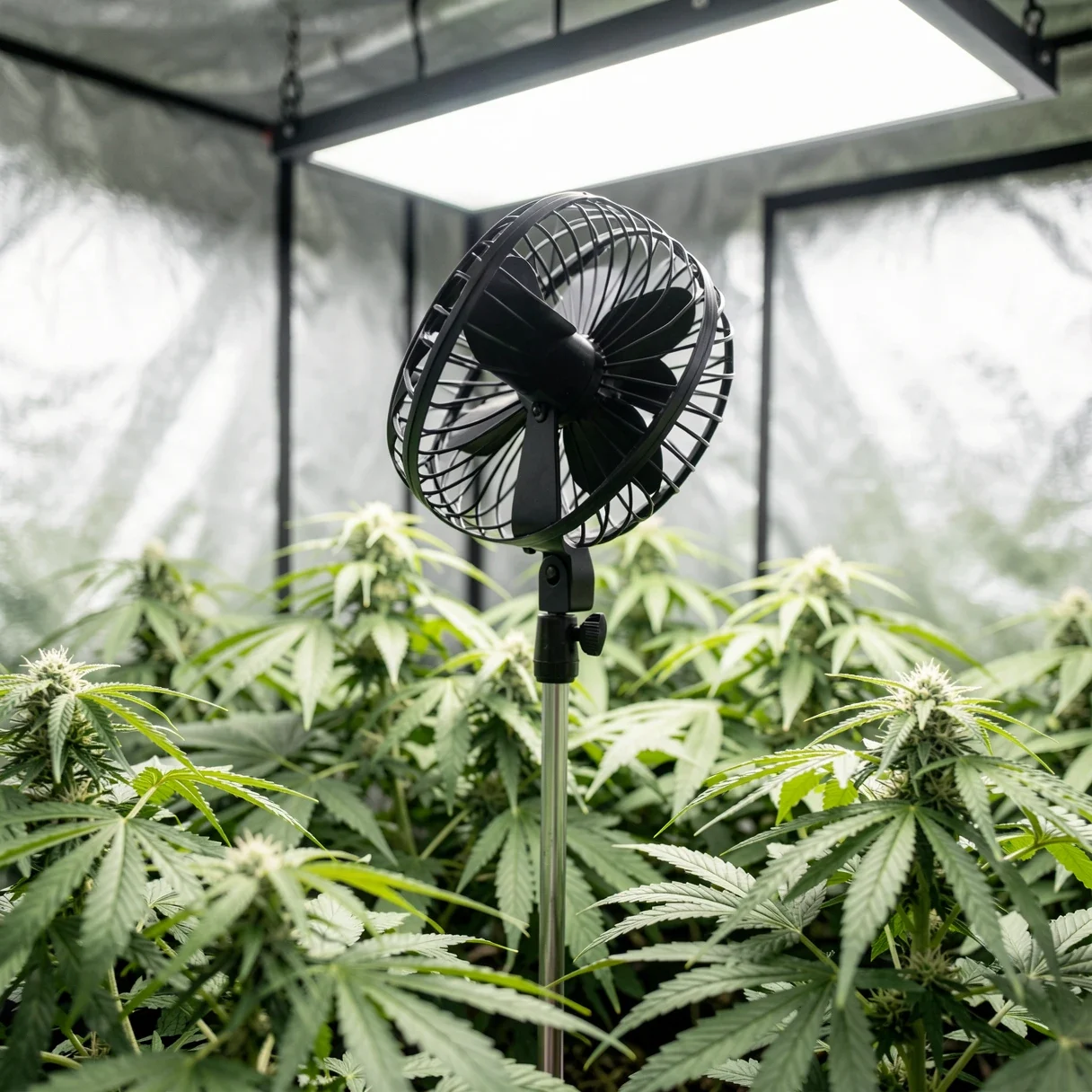
VPD is an air metric — it lives above the soil line, in the climate around the leaves. It’s easy to conflate with other temperature levers, but they’re separate dials. Your root zone temperature — the temperature of the medium your roots sit in — is a different variable entirely, and a plant can have perfect VPD for cannabis up top while cold, soggy roots quietly stall it below. Dial both.
VPD also interacts with light. Under intense lighting a plant transpires harder, so the same VPD pulls more water — which is why cannabis light intensity and climate have to be balanced together. And if you’re experimenting with a controlled late-flower dry-down for potency, understand that’s a deliberate water-stress tactic, not a VPD setting — we cover the evidence in our piece on drought stress and THC. Confusing those two is a fast way to crash a plant.
Holding a textbook VPD for cannabis is easier said than done in a closet or a basement that swings with the seasons. If your environment is hard to control, genetics buy you margin. Hardy, mold-resistant strains shrug off the humidity swings that would rot a finicky plant.
Resilient classics like White Widow and Afghani are famously tough, and an airy-structured sativa such as Durban Poison resists bud rot better than dense indicas when humidity creeps up. Northern Lights Skunk is another forgiving, beginner-friendly option. If you’re growing in a small or unstable space, autoflowers spend less time in the tent and give problems less time to develop — Gorilla Glue Autoflower and White Widow Autoflower are sturdy picks. Browse the full autoflower seed collection or our feminized seeds if you’re starting fresh.
It depends on the stage. Seedlings and clones want a low 0.4–0.8 kPa, vegetative plants 0.8–1.2 kPa, and flowering plants 1.2–1.6 kPa. Start young plants in the humid, low range and let VPD rise gradually as they mature.
For best accuracy, yes — VPD for cannabis is driven by leaf temperature, which runs a couple of degrees below air temperature. If you don’t own an infrared thermometer, assume the leaf is about 2°F cooler than your air reading and you’ll be close enough for a home grow.
Hot, dry air pulls water from the leaves faster than the roots can replace it, so the plant closes its stomata, photosynthesis stalls, and you’ll see curling, clawing, and sometimes nutrient burn. Lower the temperature or add humidity to bring VPD for cannabis back into range.
Yes — the same targets apply. Autoflowers just move through the stages faster, so adjust your VPD for cannabis to match whatever stage the plant is in rather than the calendar.
VPD for cannabis is the metric that finally makes temperature and humidity make sense together. It tells you how hard the air is pulling water through your plants, and that pull drives everything downstream — nutrient uptake, growth speed, and mold risk. Keep young plants humid and low, let VPD climb into the 1.2–1.6 range by flower, account for the cooler leaf surface, and steer with a humidifier, a dehumidifier, and good airflow. Stable beats perfect.
You don’t need expensive gear to manage VPD for cannabis — a hygrometer at canopy height and a cheap humidifier will get you most of the way. For more environment and yield techniques that build on this, dig into our guide to nutrient problems and the rest of our cannabis growing guides.
Shop Feminized Seeds | Root Zone Temperature | Grow Tent Setup | All Growing Guides
Sources: Grossiord et al. 2020, New Phytologist — plant responses to rising vapor pressure deficit; Vapour-pressure deficit — definition and greenhouse use.
Want to keep learning? Browse our full library of cannabis growing guides — everything from germination to harvest, in one place.
Ready to grow? Browse premium seeds from Lighthouse Genetics:
Designed & Built by Wynne Web Design