Walk into any grow forum and ask whether you should flush cannabis before harvest, and you will get fifty answers in five minutes. Whether to flush cannabis before harvest is one of the longest-running fights in home cultivation. Two weeks of plain water. Ten days. Seven. None at all. Some growers swear flushing makes the smoke smoother. Others say it crashes yield and tastes the same. The argument has been going on for as long as people have grown cannabis indoors. The strange thing is, almost nobody arguing has actually read the two controlled studies that tested it.
So we did. The short version: when you flush cannabis before harvest in a controlled trial, the buds do not test better, smoke smoother, taste cleaner, or burn whiter. Two independent studies — one industry trial in 2019, one peer-reviewed paper in 2024 — looked at five different cultivars between them, and neither found a meaningful quality benefit. If anything, the un-flushed plants slightly out-performed on taste-test panels. This post walks through what the studies actually did, what they actually found, and where the flushing myth came from in the first place.
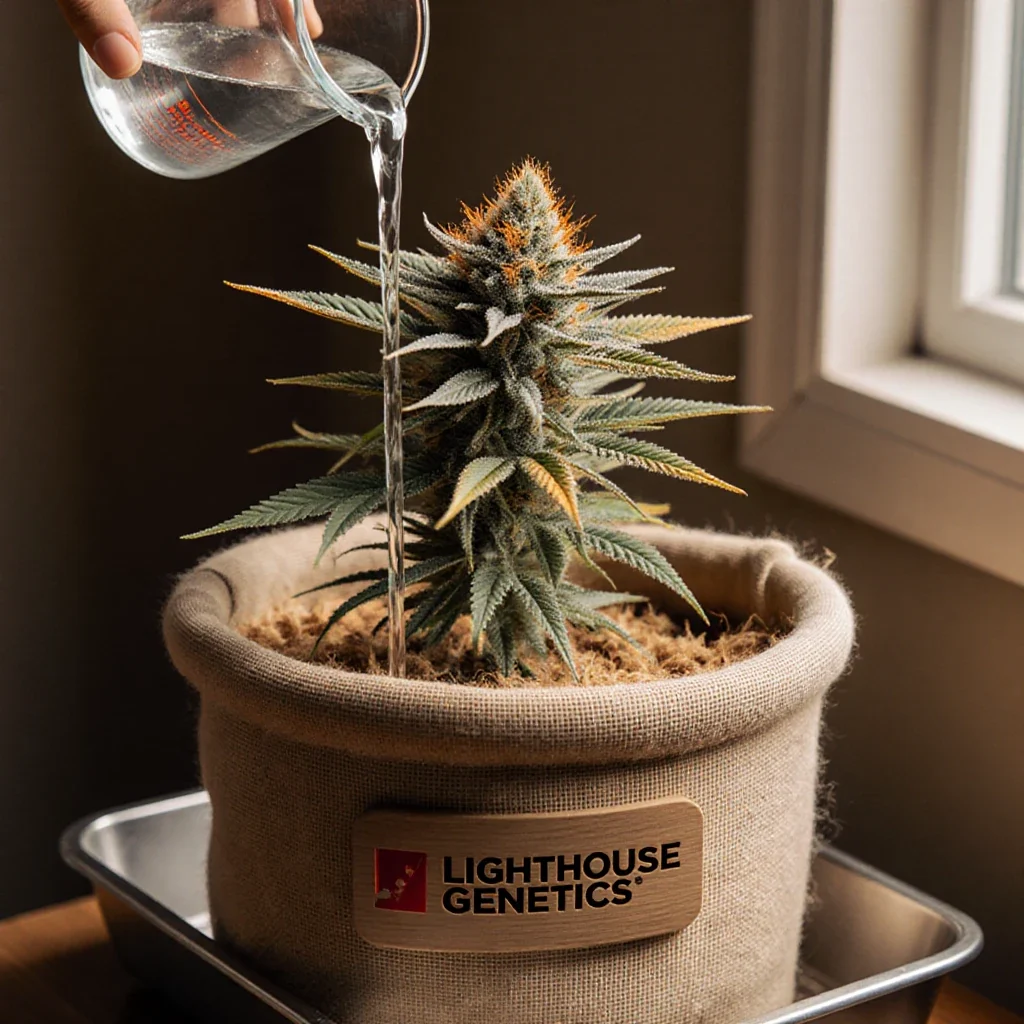
Across two controlled studies on five cultivars, when growers flush cannabis before harvest the result is no measurable improvement in THC, terpenes, ash color, smoke smoothness, or taste-panel ratings versus continuing to feed normally to the day of chop. The Rx Green Technologies 2019 trial actually saw taste-test panelists slightly prefer the un-flushed (zero-day flush) buds. The Saloner, Sade and Bernstein 2024 paper in Industrial Crops and Products tested five medical cannabis cultivars and found no improvement in cannabinoid or terpenoid content from flushing. The fan leaves yellow, the plant looks “ready,” and growers feel productive — but the buds do not change.
The decision to flush cannabis before harvest is therefore mostly aesthetic. If you like the look of yellowed fan leaves at chop, flush. If you do not, don’t. Quality-wise, both routes finish at the same place. The data on whether to flush cannabis before harvest is, at this point, settled.
The flushing myth comes from hydroponic vegetable growing, where the logic is real: if you over-fertilize tomatoes or lettuce in the last week, residual mineral salts in the substrate can leave a sharp or metallic taste. Switching to plain water for several days lowers the EC of the root zone and lets the plant pull from internal reserves. Cannabis growers picked up the practice in the 1990s, applied the same logic, and the ritual stuck. “Flush for two weeks before chop” became one of those things everyone repeats and almost nobody questions.
The problem with the analogy is that cannabis flowers are not lettuce leaves. The smokeable part of the plant is a dense cluster of glandular trichomes filled with cannabinoids and terpenes. The minerals that growers worry about — nitrogen, phosphorus, potassium, calcium — are not stored in the trichome heads. They sit in the leaves and stems. When you flush cannabis before harvest, you are pulling minerals out of the leaves, which is why fan leaves yellow. The actual bud chemistry barely changes. That is exactly what both studies found.
In 2019 Rx Green Technologies ran the first formal cannabis flushing trial. They grew Cherry Diesel in coco, divided the plants into four groups, and flushed for 0, 7, 10, or 14 days before harvest. Same room, same lighting, same nutrient line up to the flush date. Then plain water for the assigned period.
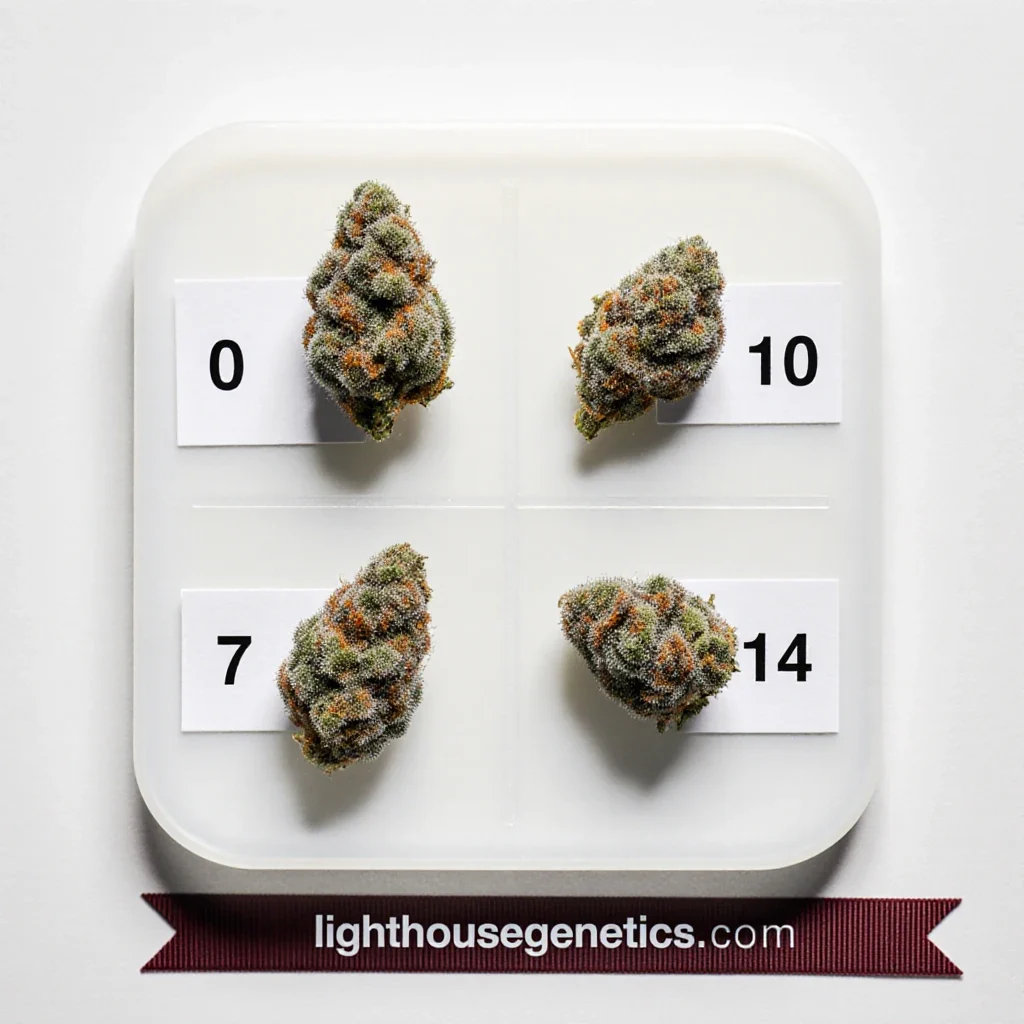
This is the cleanest controlled test we have on whether to flush cannabis before harvest. The numbers from that trial:
Rx Green’s own published conclusion: “There is no benefit to flushing Cannabis flower for improved taste or consumer experience.” That is the company that sells the nutrients telling growers to keep buying their nutrients all the way to chop. They had every commercial reason to find a small benefit if one existed. They did not.
Five years later, Saloner, Sade and Bernstein published “To Flush or Not to Flush: Does Flushing the Growing Media Affect Cannabinoid and Terpenoid Production in Cannabis?” in Industrial Crops and Products volume 220, article 119157. Peer-reviewed, full-text published, no industry sponsorship coloring the result. This is the second hard test of whether to flush cannabis before harvest, and it landed in the same place as the first.
They tested five different medical cannabis cultivars in a controlled environment. At the last phase of reproductive development, plants were split into two groups: one continued to receive full mineral nutrients until harvest, the other received distilled water (a true flush) until harvest. The flushed plants did exactly what flushing is supposed to do: leaves yellowed, chlorophyll dropped, the plants visibly aged. But when the buds were tested:
The authors did note one upside that has nothing to do with smoke quality: flushing reduces input cost and the risk of over-fertilization at the end. If you are a commercial grower running thousands of plants, skipping the last week of fertilizer saves money and reduces wastewater nutrient load. Both genuine wins. Neither related to whether the buds taste better.
The deeper reason these studies came out the way they did is that the chemistry never made sense. The compounds responsible for harshness, throat-burn, and grassy taste in poorly grown weed are mostly not residual fertilizer salts. They are chlorophyll, leftover sugars, lipids, and incompletely senesced plant tissue. These are removed by drying and curing, not by flushing.
Cannabinoids and terpenes form inside the trichome heads from a separate biosynthetic pathway. The plant builds them from CO₂, water and a small set of precursors. Once a trichome head is mature and full, no amount of root-zone manipulation in the last 14 days can pull cannabinoids back out of it or push more in. So when you flush cannabis before harvest, you are operating on the wrong tissue. The biochemistry of why flushing cannabis before harvest does not change THC or terpene levels comes down to where those molecules live and when they are made.
The “ash color” argument — that flushed weed burns to white ash and unflushed weed burns to black — also fails the controlled-test sniff. Ash color is dominated by drying and curing technique, moisture content at chop, and combustion temperature, not by whether the plant got plain water for 10 days.
None of this means you should keep dumping nutrients at full strength right up to harvest day. There are real reasons to taper or stop feeding in the last week or two — they just are not the reasons most people repeat:
Tapering at the end is fine. Flushing two weeks of plain water through your medium is not earning you better buds. The studies are clear: when growers flush cannabis before harvest at the home or commercial scale, the bud chemistry does not change.
If flushing is a non-factor, what actually controls smoothness, taste and ash color? The honest answer is the things growers tend to under-invest in:
None of these are mysterious. None of them require the ritual of flushing two weeks before chop. They require reading the plant and respecting the dry and cure.
Two controlled studies say no. The Rx Green 2019 taste panel actually slightly preferred un-flushed buds. The 2024 peer-reviewed paper found no taste or terpene improvement from flushing across five cultivars. If anything, taste tracks much harder with drying and curing than with flushing.
No. Both studies that tested whether to flush cannabis before harvest showed no significant difference in THC content between flushed and un-flushed plants. The cannabinoid biosynthesis happens inside the trichome heads and is largely complete by the time you would start a flush.
Because flushing is doing what it physically can do — pulling minerals (mainly nitrogen) out of the leaves. The plant translocates nutrients from older tissue to support late flower. This visible “fade” is what makes growers think flushing is working on the buds. It is not. The leaves are yellowing; the buds are unchanged.
Ash color is dominated by moisture content at burn and how well the bud was dried and cured. Black ash usually means the bud is still slightly damp or under-cured. Controlled tests have not shown that the choice to flush cannabis before harvest reliably changes ash color when drying and curing are held constant.
A modest taper makes sense — it saves money and reduces the chance of nutrient burn during the most vulnerable final stretch. That is different from a hard 14-day plain-water flush. Reduce EC, do not crash it.
Same conclusion. Autos like Bruce Banner Auto, Gorilla Glue Auto and Moby Dick Auto finish so fast that any aggressive late-flower flush risks crashing the plant during peak resin production. A gentle taper in the last 7-10 days is plenty.
The 2024 paper tested in a controlled hydro-style setup. The Rx Green trial used coco. Neither saw a quality benefit. In long-amended organic soil the question is moot — you stop adding liquid feed and let the soil finish on its own. In coco and hydro, flushing remains optional and the data does not support a quality reason to do it.
If you suspect nutrient burn (clawing leaves, brown leaf tips, dark over-fed coloring) in late flower, a single light flush to reset EC can rescue the plant. That is troubleshooting, not a routine quality step. Outside of that, the studies argue against making flushing part of every grow.
The decision to flush cannabis before harvest is one of the most repeated rituals in cannabis cultivation, and one of the least supported by data. Two studies. Five cultivars. Multiple flush durations. No improvement in THC, terpenes, taste, or ash color. The yellowing fan leaves are real — the better buds are not. If you have been religiously flushing for two weeks every single grow, you can stop, and your weed will not get worse. If you like the look of a faded plant at chop, flush. Either way, the buds finish where genetics, drying and curing put them, not where the last 14 days of plain water put them.
What actually moves the needle: pick the right strain for your setup, feed appropriately right through to a gentle taper, then dry slow and cure long. That is where smoke quality comes from. Browse the full seed catalog for terpene-forward strains, or start with our guides on drying temperature, nitrogen feeding, and whether defoliation actually helps — three steps that genuinely matter.
Want to keep learning? Browse our full library of cannabis growing guides — everything from germination to harvest, in one place.
Ready to grow? Browse premium seeds from Lighthouse Genetics:
Designed & Built by Wynne Web Design