Twelve hours on, twelve hours off. That has been the default flowering schedule for indoor photoperiod cannabis since at least the 1970s. It is in every grow guide, every nutrient calendar, every grow tent manual. The number is so universal that almost nobody questions it. But a small group of cannabis researchers has been quietly testing whether 12/12 is actually the right number, and a 2024 paper out of the University of Guelph just delivered the cleanest answer yet: a 13 hour photoperiod produces 35 to 50 percent more bud per plant with no loss in THC.
This post breaks down what the study actually did, why a 13 hour photoperiod gives so much more yield than the extra hour of light alone would predict, and how a home grower might cautiously test it without blowing up their entire flowering tent. Two earlier peer-reviewed papers from the same group already pointed in this direction; the 2024 paper closed the loop on two of the most popular high-THC cultivars on the planet.
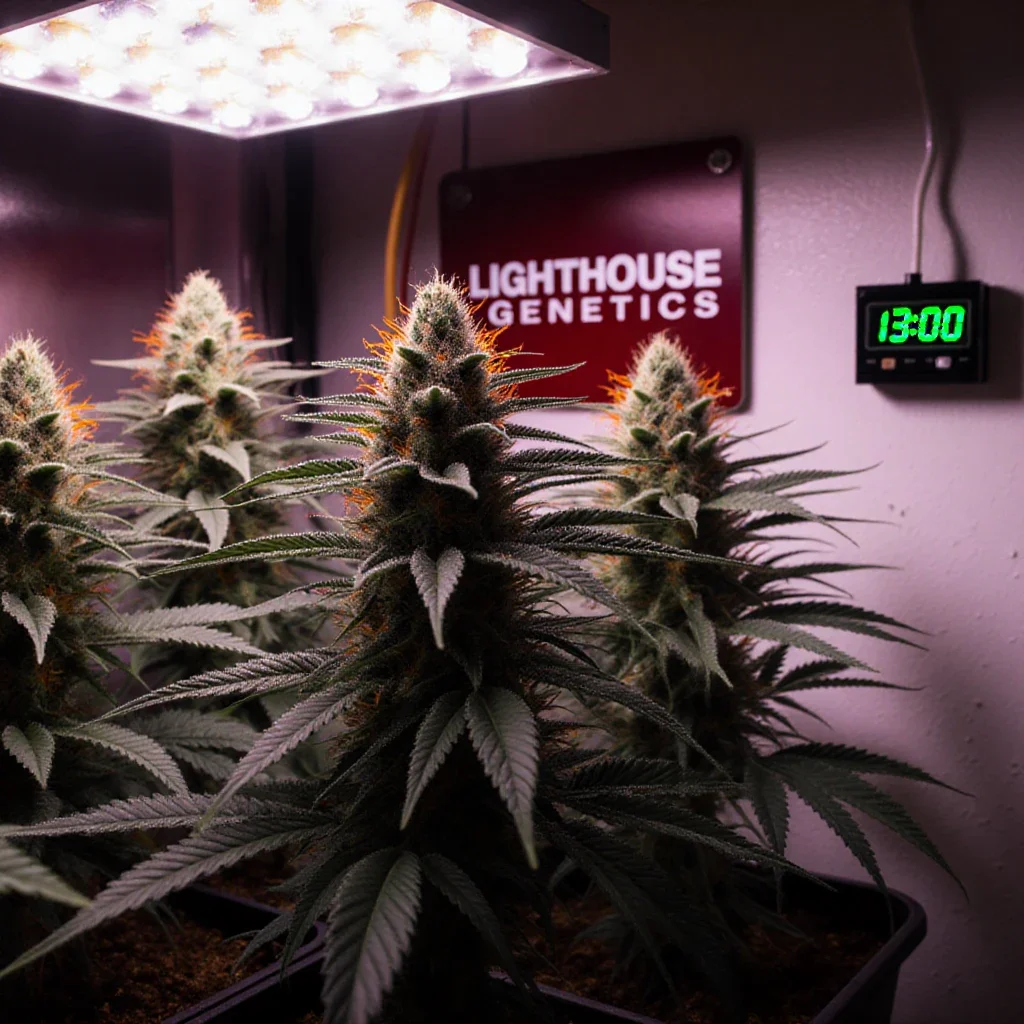
In a 2024 controlled trial published in the journal Plants, two THC-dominant cannabis cultivars (Incredible Milk and Gorilla Glue) were grown to commercial maturity under either a 12 hour or a 13 hour photoperiod. The 13 hour photoperiod produced 1.35 times the inflorescence yield in Incredible Milk and 1.50 times the inflorescence yield in Gorilla Glue. THC concentrations either held steady or improved. The grow rooms were identical in every other way — same room, same nutrients, same light intensity per hour. Only the day length changed.
That is a substantial result. A single hour of extra light per day raised total daily light integral by only about eight percent, but yield rose 35 to 50 percent. The disproportion is the interesting part. If you simply got eight percent more bud you could write it off as more photons in equals more flower out. Forty-plus percent gain off an eight percent light bump suggests a 13 hour photoperiod is doing something to the plant beyond just feeding it more light.
The 12/12 rule is a holdover from how indoor cannabis growing was first reverse-engineered. Cannabis is a “short-day” plant — it flowers when nights become long enough to trigger a hormonal shift. Indoor growers in the 1970s wanted to force flowering on demand, so they picked 12 hours of darkness as a safe number that would reliably trigger the response in any cultivar. It worked. It became orthodoxy.
What got lost is that 12/12 is the minimum photoperiod that triggers flowering, not the optimum one for maximizing yield. The plant flowers fine at 13 hours of light. It also flowers fine at 13.5 in some cultivars. But because every grower assumed 12/12 was the answer, almost no one was running side-by-side trials with longer days. The University of Guelph group changed that.
Ahrens, Llewellyn and Zheng published “Longer Photoperiod Substantially Increases Indoor-Grown Cannabis’ Yield and Quality” in Plants, volume 13, article 433. Two cultivars: Incredible Milk (a high-THC photoperiod strain) and Gorilla Glue (one of the most widely grown high-THC cultivars in North America). Both grown to commercial harvest maturity. Two treatments: 12 hours of light vs 13 hours of light per day, run side by side in matched rooms.
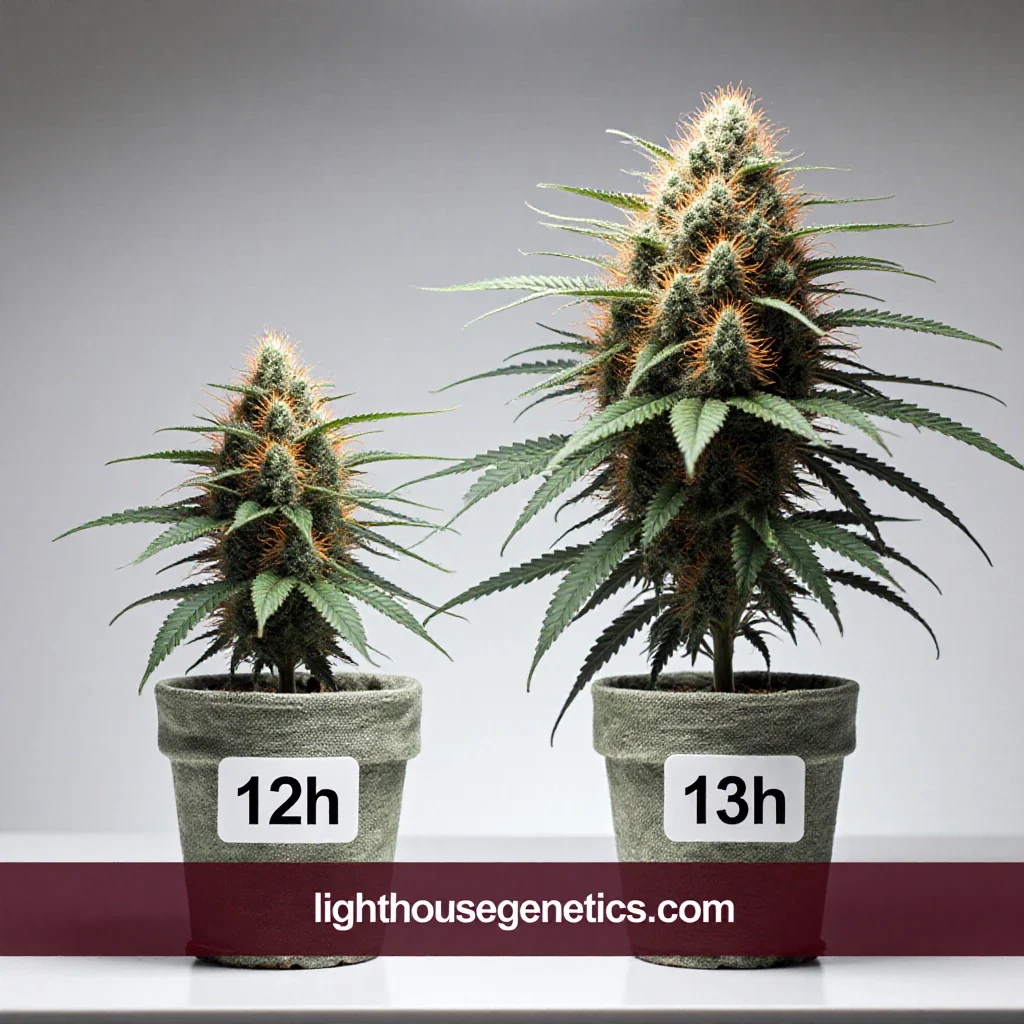
The headline numbers from the 13 hour photoperiod treatment:
The paper builds on two earlier studies from the same lab. Moher and colleagues in 2022 (Plants 12:1061) tested a range of shorter and longer photoperiods on a CBD-dominant cultivar and found 12/12 was nowhere near optimal. Peterswald and colleagues in 2023 (Plants 12:2605) asked directly “Is twelve hours really the optimum?” and answered no for several cultivars. The 2024 13 hour photoperiod paper is the cleanest two-cultivar test in the series.
The eight percent more DLI does not explain the 35 to 50 percent more bud. Something else has to be going on. The authors and the broader photoperiod literature point to a few likely contributors when you run a 13 hour photoperiod in cannabis flower:
The honest answer is that we do not yet know exactly what mechanism is doing most of the work. The phenotypic result is clear; the underlying physiology is still being pulled apart. What growers can take to the bank is the result: when you run a 13 hour photoperiod on photoperiod cannabis, you tend to get more bud without losing potency.
The Ahrens paper is careful to flag what the result does and does not mean. A grower planning to test a 13 hour photoperiod should sit with these caveats first:
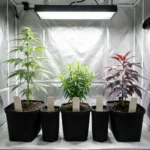
If you want to try a 13 hour photoperiod without risking your whole flower run, the conservative way to do it is one strain at a time, side by side if possible. A practical home protocol:
Pair this with the rest of the late-flower playbook — appropriate nitrogen feeding, no need to flush before harvest, the right drying temperature — and the gain you pick up from the 13 hour photoperiod compounds with the rest of the grow.
The 2024 paper did not test autoflowers. Autoflowers do not depend on photoperiod to begin flowering, so the underlying mechanism is different. Most auto growers run 18/6 or even 20/4 from start to finish for max DLI. If you grow autos like Bruce Banner Auto or Moby Dick Auto, ignore the 13 hour photoperiod conversation — your light schedule question is a different one.
Probably not. The two cultivars in the Ahrens 2024 paper both responded well, but the magnitude differed (1.35× vs 1.50×). The earlier Peterswald 2023 paper found cultivar-specific effects across a wider panel. Some strains will likely respond strongly, others weakly. Test on one strain at a time before rolling out a 13 hour photoperiod across your whole flower room.
Not necessarily. Pushing past 13 hours starts to weaken flowering signal in many cultivars. The Moher 2022 paper tested several long photoperiods and found a sweet spot rather than a linear “longer is always better” curve. 13 hours appears to capture most of the benefit while still being safely within the flowering window.
The 2024 study found that THC was either unchanged or slightly higher under the 13 hour photoperiod. The earlier related papers in the same series have generally found cannabinoid concentration holds up under longer photoperiods, with biomass scaling up. So the gain is real bud, not watered-down bud.
Not without testing. Run one strain side-by-side with a 12/12 control first. If the 13 hour photoperiod works on your specific cultivar in your specific room, then expand. The downside risk is real for sensitive strains — wasted electricity, weak flowering, or hermie pressure if the strain is borderline. The upside risk is, well, 35 to 50 percent more bud.
Outdoor photoperiods are set by latitude and the calendar — you cannot dial them in. But it does inform timing: in regions where natural day length lingers above 13 hours longer into late summer, photoperiod cannabis will keep filling out before committing fully to flower. Strains like Blue Dream and Jack Herer can take advantage of those slightly longer late-summer days.
The 2024 paper did not report hermaphroditism in either cultivar tested. That said, light-stress hermies are most common in already-borderline strains, and pushing photoperiod is technically a stressor. Stable feminized seed from a careful breeder is the best insurance. Borderline genetics will break down under any number of stresses, not just light schedule.
The 12/12 default has been the orthodoxy of indoor cannabis flowering for fifty years. The 2024 Ahrens, Llewellyn and Zheng paper, on top of two earlier studies from the same lab, makes a strong case that a 13 hour photoperiod is a better default for many photoperiod cultivars — at least at the per-plant level, with no measured cost to potency. The mechanism is not fully understood, but the result is consistent across multiple papers and multiple cultivars.
This is one of the cheapest experiments a home grower can run. It costs an hour of electricity per day and one strain swap. If it works on your cultivar, you walk away with 35 to 50 percent more dried bud at harvest. If it doesn’t, you go back to 12/12 next round. Browse the full feminized seed catalog to pick a strain to test, or read our guides on light spectrum, nitrogen feeding, and drying temperature to dial in everything else around it.
Want to keep learning? Browse our full library of guides to growing cannabis — everything from germination to harvest, in one place.
Ready to grow? Browse premium seeds from Lighthouse Genetics:
Designed & Built by Wynne Web Design