Every grow light manufacturer claims their spectrum is “optimized for cannabis.” The marketing is relentless — blurple diodes, full spectrum, enhanced red, IR booster bars, UV supplements. Cut through it all and a grower just wants to know: what is the best light spectrum for cannabis, and how much of this stuff actually matters? We went to the peer-reviewed science. Not LED-company white papers, not YouTube reviews — actual published plant-science research. What it says is clearer than the marketing pretends.
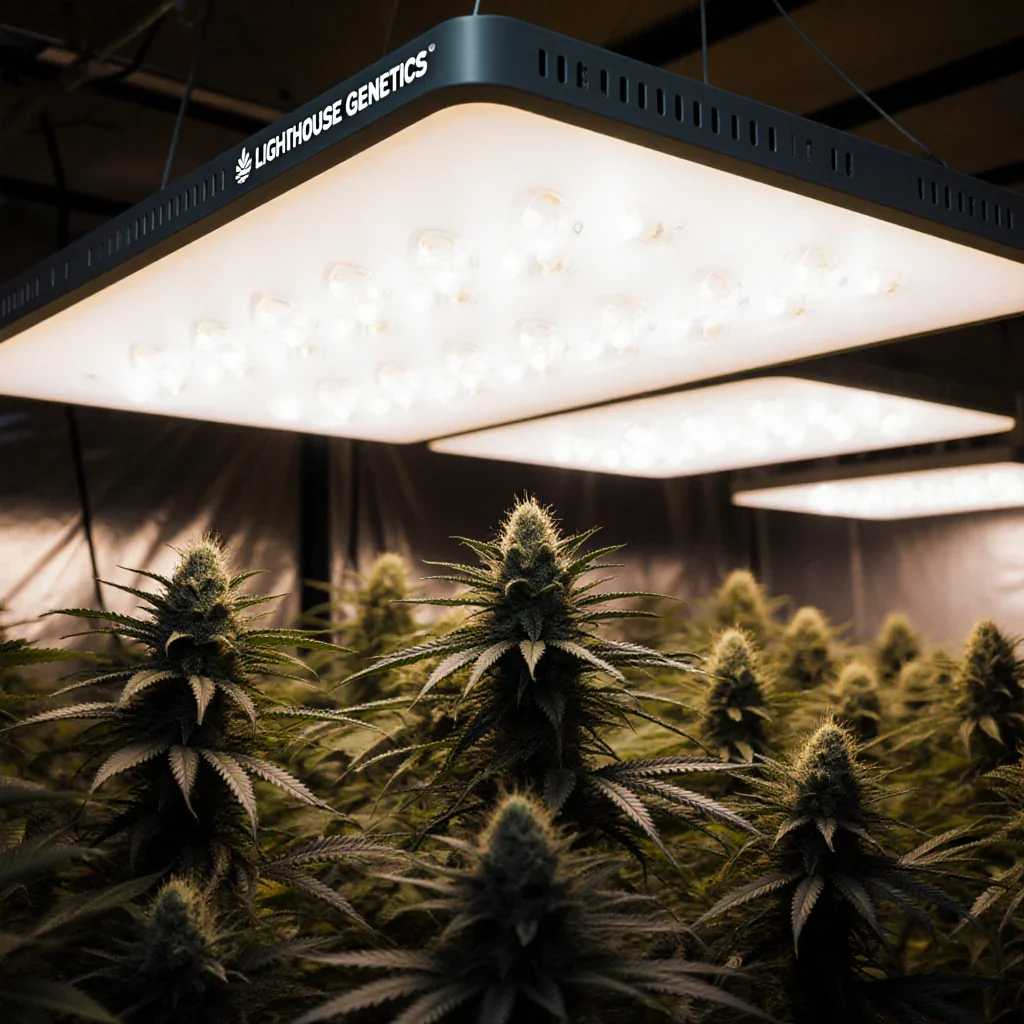
Based on the best available research, the best light spectrum for cannabis is a broad-spectrum white light centered on the photosynthetically active range (400-700 nm), with a modest blue component during early flower and balanced red for the full bloom cycle. Total light intensity (PAR) matters more than any specific spectrum tweak. A high-quality full-spectrum LED running 800-1000 μmol/m²/s at canopy will beat any specialty “purple” or “cannabis-tuned” spectrum — and costs less to run. The complicated answer to “what is the best light spectrum for cannabis” is that spectrum matters, but not nearly as much as the marketing suggests.
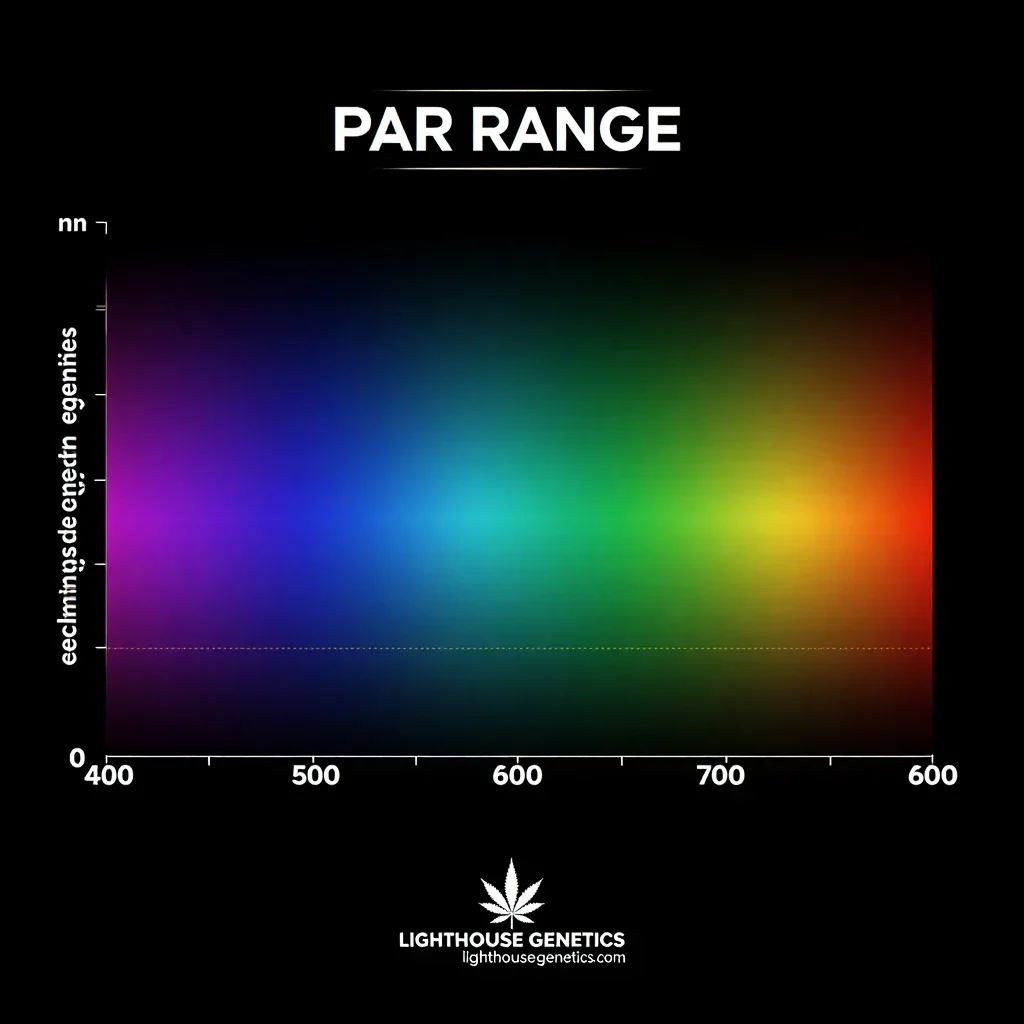
Any honest conversation about the best light spectrum for cannabis has to start with a paper from 1972. Keith McCree, then at Texas A&M, published a study in Agricultural Meteorology called “The action spectrum, absorptance and quantum yield of photosynthesis in crop plants.” He exposed 22 crop species to single wavelengths of light, measured the photosynthetic response to each, and produced what is now called the McCree curve. The finding: plants photosynthesize across the entire 400-700 nm range (what we now call PAR — photosynthetically active radiation), with a broad peak in red around 630 nm, a smaller peak in blue around 440 nm, and a real but reduced response in green wavelengths in the middle.
The McCree curve quietly demolished decades of assumptions about the best light spectrum for cannabis. Plants do NOT only use red and blue light. They do NOT reject green. The “blurple” LED panels that dominated early indoor cannabis growing were built on a misreading of plant absorption spectra — they provided the wavelengths chlorophyll absorbs most efficiently in a test tube, not the spectrum that drives real photosynthesis in a whole leaf. The whole leaf, it turns out, uses everything in the PAR range, including green, which penetrates the canopy deeper than blue or red. This was foundational plant science in 1972 and it is still the baseline for serious grow light research.
Magagnini, Grassi, and Kotiranta published the first rigorous cannabis-specific light spectrum study in 2018 in Medical Cannabis and Cannabinoids (1:19-27). They grew cannabis clones of a single genotype (“G-170”) under three different light sources: high-pressure sodium (HPS — the old industry standard), a warm-spectrum LED called AP673L, and a cooler-spectrum LED called NS1 with significantly more blue content. Same strain, same environment, same nutrients — only the light source varied.
The results were interesting. The blue-rich NS1 LED produced the highest THC concentration — about 15.4% in the first experiment compared to roughly 9.5% under HPS, approximately 38% higher in that trial (the second trial showed a ~26% advantage). The warm-spectrum AP673L LED produced THC values statistically similar to NS1; the clear loser on potency was HPS. Plants under HPS grew taller and leggier than under either LED. The study was the first published evidence that on cannabis specifically, spectrum choice affects both plant architecture and cannabinoid production — with both LED spectra outperforming HPS on THC content.
But — and this is important — the LED-vs-LED comparison was much smaller than the LED-vs-HPS gap. NS1 and the warm-spectrum AP673L were statistically similar to each other on THC content; the meaningful jump came from moving off HPS to either modern LED. For any grower thinking about the best light spectrum for cannabis, this study says upgrading from HPS to a quality LED matters a lot — but fine-tuning between two good LEDs matters much less than genetics and overall light intensity.
A 2021 Frontiers in Plant Science study by Rodriguez-Morrison, Llewellyn, and Zheng (same Guelph lab that debunked the UV-boosts-THC myth) looked at how cannabis yield and potency respond to different light intensities in an indoor environment. Their finding: cannabis inflorescence yield scaled nearly linearly with canopy photosynthetic photon flux density (PPFD) from about 120 up to 1800 μmol/m²/s — well past what most home growers ever reach. More photons in the PAR range = more yield. Interestingly, the study also found that cannabinoid potency (% THC) did NOT scale with light intensity — potency stayed roughly flat across the whole PPFD range tested. Intensity grows bigger buds, it does not make them more potent.
What this means practically: the difference between running your LED at 500 μmol/m²/s and 900 μmol/m²/s is bigger than the difference between a “cannabis-tuned” spectrum and a generic white spectrum at the same intensity. When people ask about the best light spectrum for cannabis, they are often asking the wrong question. The better question is: how much PAR is hitting my canopy? Get that right first, then worry about spectrum.
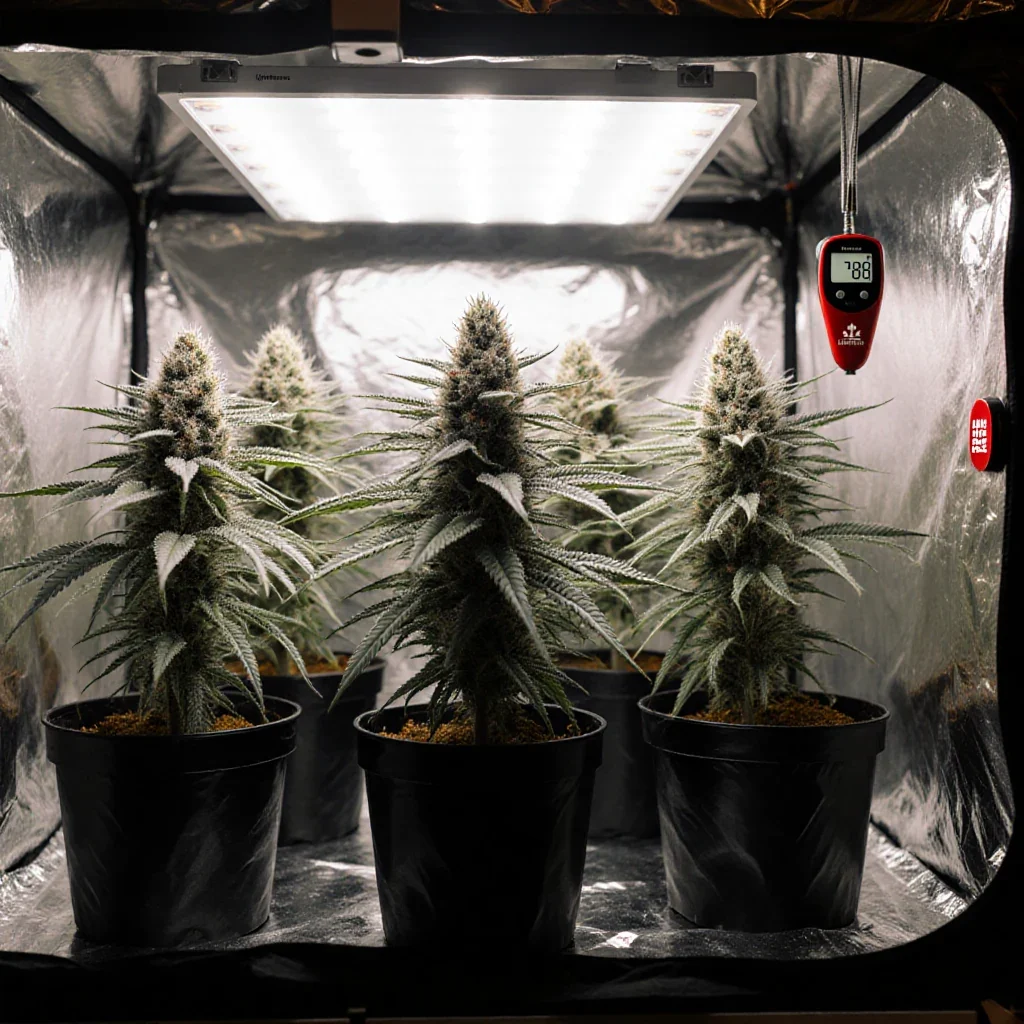
Pulling it all together, here is what the research suggests is the best light spectrum for cannabis across the grow cycle:
For most home growers asking about the best light spectrum for cannabis, the honest answer is: any quality full-spectrum LED from a reputable brand (HLG, Mars Hydro TS or FC series, Spider Farmer, ViparSpectra premium lines, etc.) will perform within a few percentage points of any other quality LED if driven at the same canopy PPFD. Spend your time and money optimizing intensity and environment, not chasing exotic spectra.
High-yielding strains reward high-intensity proper-spectrum light with the biggest absolute yield gains. A strain like Gorilla Glue #4 at 1000 PPFD produces dramatically more than the same strain at 500 PPFD. The same is true for Cement Shoes, Train Wreck, and most modern hybrids. Autoflowers respond too, though their shorter life cycle means the total gain is smaller — strains like Bruce Banner Auto and Gorilla Glue Auto produce notably better under 700-800 PPFD than budget lights can deliver.
If you are still choosing which genetics to run under your lights, our guide to choosing cannabis seeds walks through picking strains that actually fit your grow space and experience level.
A few claims about the best light spectrum for cannabis keep circulating online that the peer-reviewed research does not support:
A warm full-spectrum white LED (3000-3500K) at 800-1000 μmol/m²/s canopy PPFD is the current best-practice answer on the best light spectrum for cannabis. Blue content should still be present — the 2018 Magagnini study showed blue contributes to cannabinoid production even during flower — but the overall color temperature skews warmer than during veg.
Not bad — just suboptimal. A blurple panel with only deep-blue and deep-red diodes misses out on the green and yellow wavelengths that penetrate the canopy and drive photosynthesis in lower leaves. Modern white-light LEDs consistently outperform blurple panels at the same watts drawn.
Rough targets: seedlings 200-300 μmol/m²/s, veg 400-600, flower 800-1000 for most strains, 1200+ only with CO2 supplementation. Going higher than 1000 without CO2 usually causes light stress — pale leaves, taco’d edges, bleaching — without a yield gain.
It is a useful proxy but imperfect. 3000K is warm (red-heavy), 6500K is cool (blue-heavy), 4000-5000K is balanced. A quality LED with a good PAR spectrum at any K value will outperform a cheap LED at the “right” K value. Kelvin is a color temperature number, not a plant-quality number.
Far-red (700-750 nm) may have a small benefit for flower initiation but is not transformative. UV-B specifically does not increase THC in modern genetics. Skip the UV supplement bars. If your all-in-one LED includes some far-red, fine — do not pay extra for it as a separate unit.
Technically yes, poorly. Household LEDs are engineered for human eye response, not plant photosynthesis. The spectrum is thin in the wavelengths plants use most. Plants will grow but yield will be a fraction of what a proper horticultural LED produces per watt.
The best light spectrum for cannabis is not a secret magic wavelength. It is a broad full-spectrum white light in the PAR range (400-700 nm), with blue present throughout the cycle and a warmer tilt during flower, driven at enough intensity to matter (800+ μmol/m²/s canopy PPFD for most strains in bloom). McCree’s 1972 work established the foundation. Magagnini’s 2018 study confirmed blue contributes to cannabinoid production. Rodriguez-Morrison’s 2021 intensity research showed yield scales with PAR almost linearly. None of them found a magic spectrum.
If you are still shopping for the best light spectrum for cannabis, skip the “cannabis-specific” marketing and buy the best-built full-spectrum LED you can afford in the PPFD range you need. Then pair it with genetics that can actually use all that light. Browse our full catalog for high-yield strains, and if you are just starting, our germination guide and seed storage guide will get your grow started right. Science first, marketing second.
Want to keep learning? Browse our full library of cannabis grow guides — everything from germination to harvest, in one place.
Ready to grow? Browse premium seeds from Lighthouse Genetics:
Designed & Built by Wynne Web Design