CO2 for cannabis has a reputation as the secret weapon of big indoor grows. Part of that is earned. Plants build bud out of carbon dioxide, light and water, and raising the CO2 in a sealed room really can put more weight on the scale. The other part is marketing. Most home growers who buy a tank or a CO2 bag are feeding their exhaust fan, not their plants.
Here’s the short version. Outdoor air holds about 427 ppm of CO2. Raising a sealed room to around 1,000–1,200 ppm while the lights are on can add yield, but only once your light is already strong, your climate is dialled in and nothing is venting the gas outside. We checked the claims in this guide against the cannabis studies, greenhouse extension guides and workplace safety limits. Some popular ones held up. Several didn’t.
About half the weight of dry flower is carbon, and all of that carbon comes out of the air. Leaves pull CO2 in through tiny pores called stomata and use light to turn it into sugars. When CO2 is the limiting ingredient, adding more speeds that process up.
Cannabis responds strongly. In two University of Mississippi studies, leaf photosynthesis rose about 50% when CO2 went from ambient to 750 ppm (Chandra et al. 2008), and 38–48% at 700 ppm across four high-THC varieties (Chandra et al. 2011). At 545 ppm, the change was mostly too small to count. Those were single leaves measured for minutes, though, not whole plants over a harvest. More photosynthesis in a leaf chamber is not the same as more bud in the jar.
Using CO2 for cannabis also partly closes the stomata. The plant loses less water for each unit of sugar it makes, which is why water-use efficiency doubled or more in those leaf studies. It’s one reason humidity and transpiration shift in an enriched room, so check your VPD settings after you start dosing.
This is the rule that decides whether CO2 for cannabis pays off. Extra CO2 only helps when light isn’t already the bottleneck. Ontario’s greenhouse factsheet puts it simply: as light rises, “the optimal CO2 concentration becomes higher,” and at low light the economics may not justify enriching to 1,000 ppm (OMAFRA).
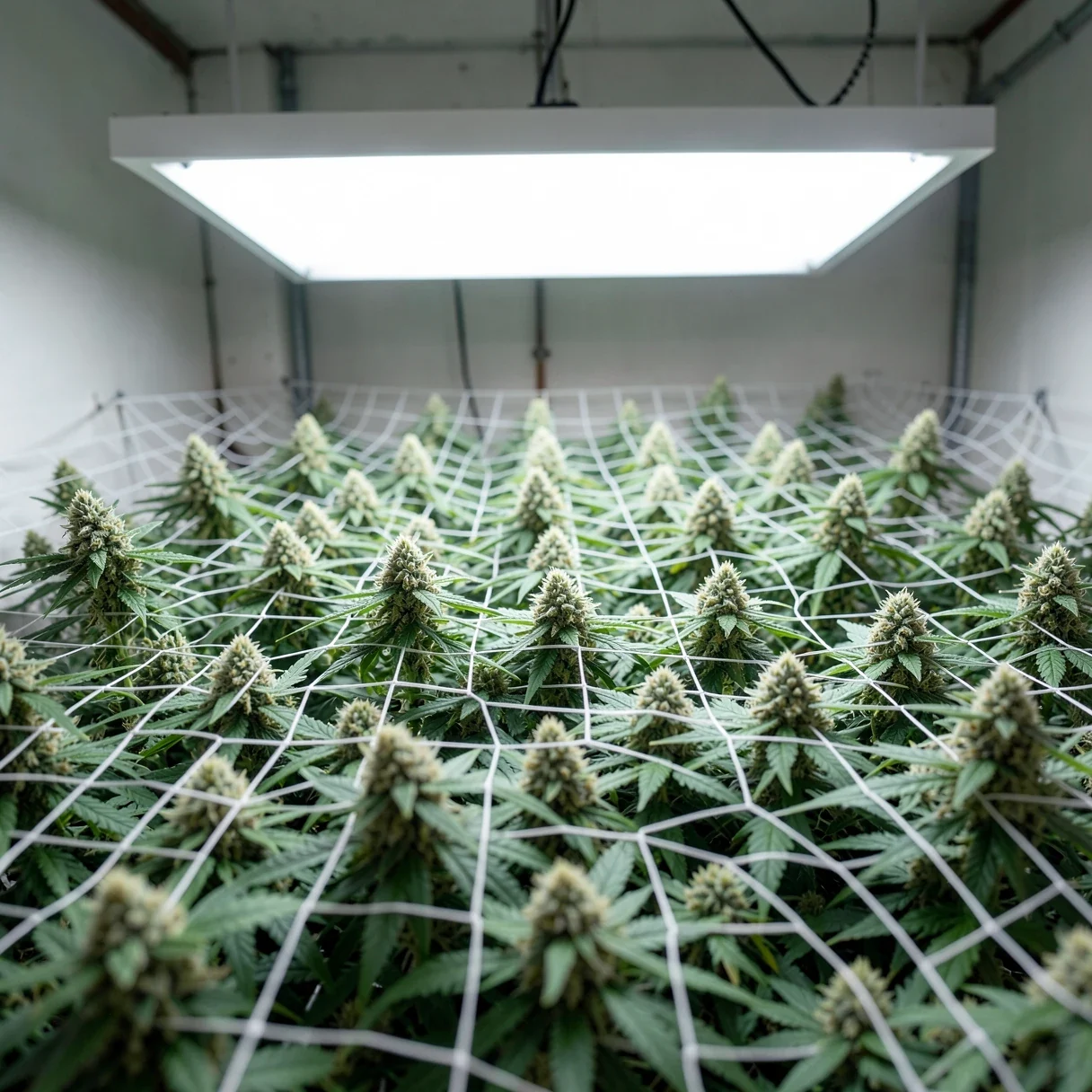
For CO2 for cannabis to work, light has to be maxed out first, and cannabis can use a lot of light. A University of Guelph study found yield still climbing at about 1,800 µmol/m²/s of light, in a room running ordinary ambient CO2. Our cannabis light intensity guide covers those numbers. In practice, most tents should reach 800–1,000 PPFD in flower before anyone spends money on gas. Pushing past about 1,000 is where added CO2 starts to earn its place.
If your light is weak, buy light. It’s the cheaper fix.
Here’s what surprised us. There’s far less research on CO2 for cannabis than the confident forum posts suggest. A 2019 meta-analysis of cannabis yield studies had to drop CO2 as a factor because too few papers reported it.
The one whole-plant yield result we could find comes from Bruce Bugbee’s lab at Utah State University, in a 2024 PhD dissertation. Its summary reports that “elevating CO2 to 1200 ppm increased yield by about 40%” (Westmoreland 2024). Two caveats travel with that number. The plants were high-CBD medical cannabis, not high-THC strains. And the author notes that the short-term photosynthesis boost was bigger than the long-term gain in yield. We could only read the summary, so we can’t give you the light level or the starting CO2 behind that 40%.
What we couldn’t find matters just as much:
So set your expectations accordingly. CO2 for cannabis means more bud, not stronger bud, and only under the right conditions. That’s why it shows up as a yield lever rather than a potency lever in our guide to maximizing THC potency.
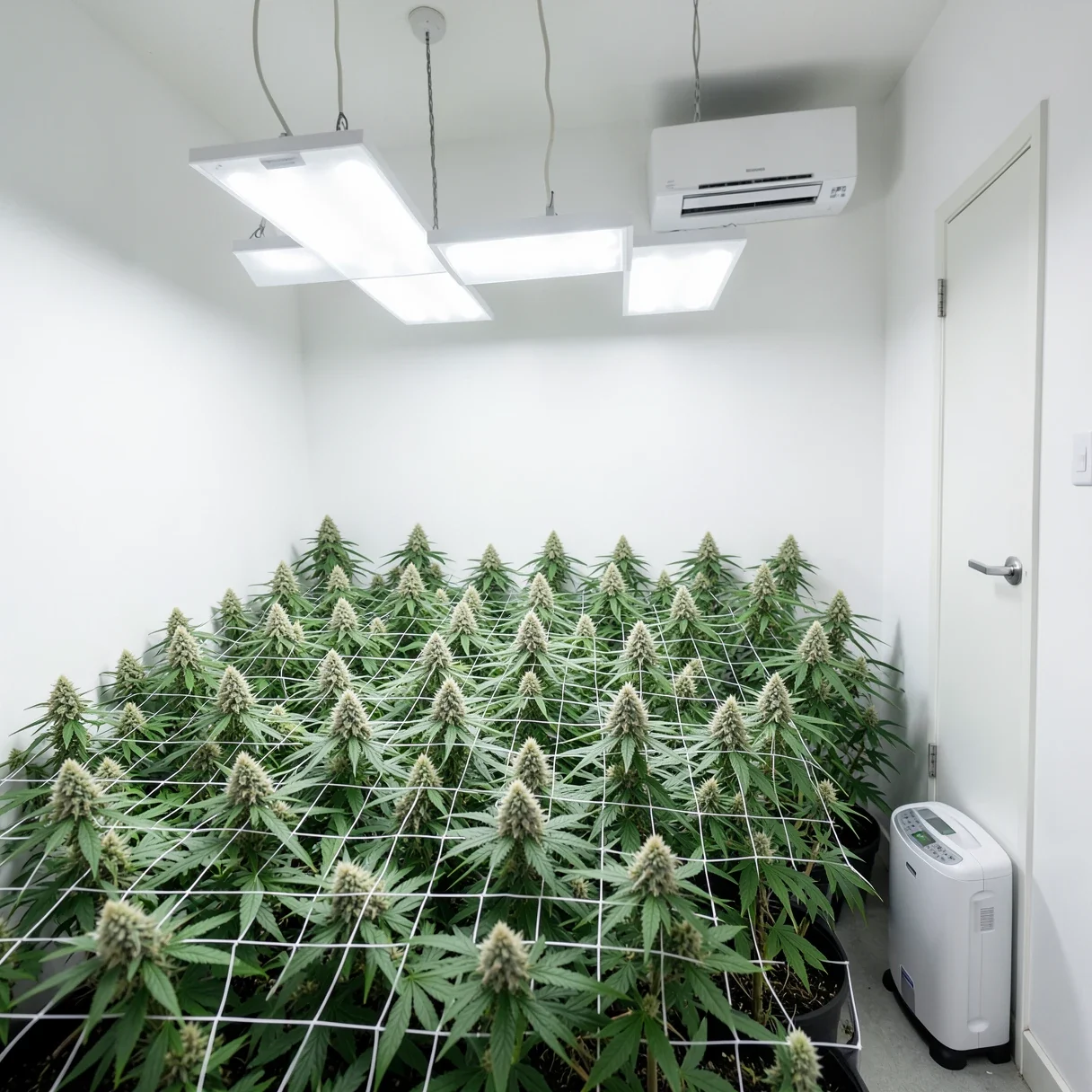
No study of CO2 for cannabis sets stage-by-stage targets, so these come from greenhouse guidance plus the one level tested on cannabis. For most crops, photosynthesis saturates around 1,000–1,300 ppm “under ideal circumstances,” and the standard greenhouse target is about 1,000 ppm with the vents closed (OMAFRA).
| Stage | CO2 (ppm) | Light to pair it with | Where the number comes from |
|---|---|---|---|
| Seedlings / clones | Ambient (about 427) up to 800–1,000 | Low light, so the light usually limits growth first | OMAFRA seedling guidance (general crops) |
| Vegetative growth | 800–1,000 | 400–600+ PPFD | General greenhouse guidance (about 1,000 is the standard target) |
| Flower, strong light | 1,000–1,200 | 1,000–1,400+ PPFD | 1,200 ppm = the level that raised yield ~40% (high-CBD plants) |
| Lights off | Off | None | No photosynthesis in the dark |
| Avoid | Above about 2,000 | — | General sources warn of plant damage |
Plenty of growers run up to 1,500 ppm in flower. We couldn’t find a cannabis source that shows a benefit above 1,200, so we’d stop there.
Run CO2 for cannabis only while the lights are on. Ontario’s factsheet is blunt: CO2 “is not required at night as no photosynthesis occurs,” and the level builds up naturally overnight as plants respire.
This is where most home setups fall down. Enrichment only works in a closed space. Greenhouse guidance says to shut the CO2 off, or drop it to ambient, once vents are open past about 10% or the exhaust fans are running. In a grow tent, your exhaust fan is that open vent.
Here’s our own rough estimate, not a study. A 4 × 4 ft tent that’s 6.5 ft tall holds about 104 cubic feet (2.9 m³) of air. Raising it from ambient to 1,200 ppm takes only about 2.3 litres (0.08 ft³) of CO2. But if your fan swaps that air about once a minute, holding 1,200 ppm through a 12-hour light period would take roughly 2.9 kg (6.4 lb) of CO2 a day. Nearly all of it goes straight out the carbon filter.
If you’re still building your space, start with our grow tent setup guide. Get the airflow and light right before you think about gas.
| Method | Control | Side effects | Best for |
|---|---|---|---|
| Compressed tank + regulator + controller | Precise | No heat, no moisture, no fumes | Sealed rooms and tents |
| Propane / natural-gas burner | Good | Adds heat and water vapour; can make carbon monoxide if it burns badly | Large rooms and greenhouses |
| Fermentation (sugar + yeast) or CO2 bags | Almost none | Odour; output unknown | Not much |
Tanks are what we’d pick for CO2 for cannabis in a home grow. You need a regulator, a flow meter, a solenoid valve and a controller with a sensor. Oklahoma State University extension puts a 20 lb (9 kg) cylinder at US$150–200, US$20–50 to refill, and about two weeks of use in a 200 sq ft (18.6 m²) room held at 1,200–1,500 ppm.
Burners make the cheapest CO2, but every cubic metre (35 ft³) of natural gas burned also releases about 1.4 kg (3.1 lb) of water vapour, according to OMAFRA. That’s moisture and heat your AC and dehumidifier then have to remove. Incomplete combustion also produces carbon monoxide, which is dangerous to people, and ethylene, which damages plants.
Fermentation and CO2 bags sound cheap, and they are. One pound of sugar yields about half a pound of CO2, and OSU notes “difficulty in maintaining desired concentrations.” We found no independent measurement of what a commercial CO2 bag actually puts out. By the tent math above, an exhausting tent would need around 5.8 kg (12.7 lb) of sugar fermented every day just to hold 1,200 ppm. That’s why a yeast bottle can’t keep up.
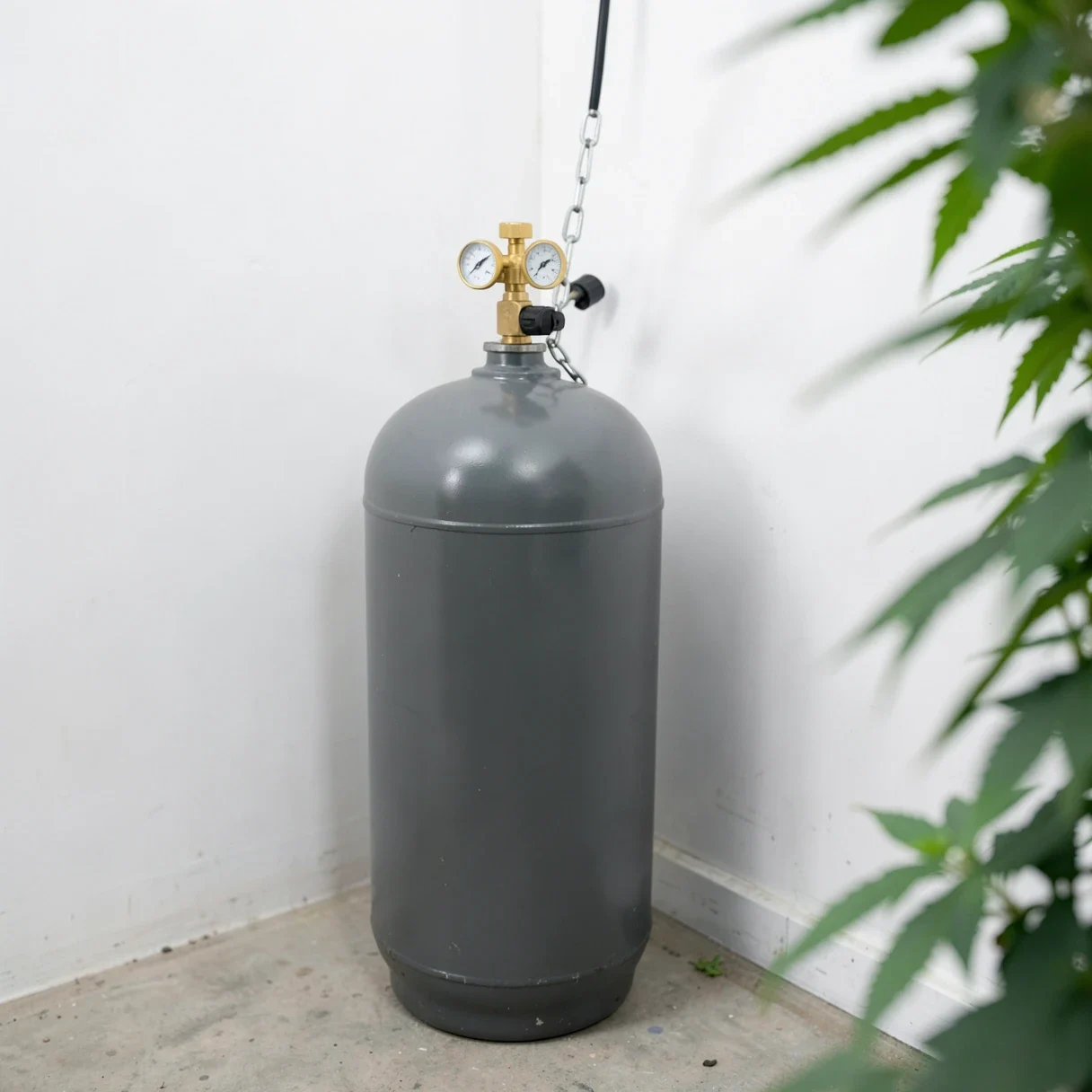
The levels growers aim for with CO2 for cannabis sit far below workplace limits. Mistakes happen when a solenoid sticks open on a tank in a small closed room, or a burner runs short of air.
NIOSH lists the warning signs of too much CO2 as headache, dizziness, restlessness, shortness of breath, sweating and a raised heart rate. If you feel any of them, leave the room and air it out.
For scale, a 2026 study of a 2,000 sq ft (186 m²) medical cannabis room in Oklahoma recorded average CO2 of about 980–1,090 ppm, with peaks above 2,200 ppm. It stayed under the NIOSH limit the whole time. Enrichment done properly isn’t dangerous. A failed valve is.
Two pieces of kit are non-negotiable:
If you want to see what CO2 for cannabis can do, start with genetics that already yield heavily indoors. White Rhino is rated 700–900 g/m² in our catalog, Great White Shark 500–800 g/m², and Bubble OG 500–700 g/m². Northern Lights Skunk and Blue Dream are both rated 500–650 g/m². So is Mac’s own Neptune’s Wedding. And since the only cannabis CO2 yield trial we found used high-CBD plants, a CBD strain like Harley Quinn (650–700 g/m²) is the closest match in type. Our list of high-yield cannabis strains has more.
About 1,000–1,200 ppm while the lights are on, paired with strong light of around 1,000–1,400+ PPFD. 1,200 ppm is the level that raised yield by about 40% in high-CBD plants in the Utah State dissertation. We couldn’t find evidence that going higher adds anything for cannabis.
Not that anyone has shown for cannabis. We couldn’t find a cannabis study that measured flowering time under CO2. Photoperiod plants flower on long nights, so the light schedule and the strain set the clock. Using CO2 for cannabis mainly adds mass.
Usually not, if the tent exhausts through a carbon filter, because the fan removes the gas almost as fast as you add it. CO2 for cannabis makes sense in a sealed room where the AC and dehumidifier handle the climate and the exhaust stays off while you dose.
They release some CO2, but you can’t control how much. We found no independent measurement of what a CO2 bag actually puts out. In any space with an exhaust fan, the output is far too small to hold a useful level.
No. Plants don’t photosynthesize in the dark, and CO2 builds up on its own overnight as they respire. Set your controller to follow the lights.
We found no study showing it does. The evidence for CO2 for cannabis is about yield, meaning more grams. Higher THC percentage isn’t part of it. More bud at the same potency still means more total THC per harvest, but the percentage on a lab test comes from genetics and harvest timing.
CO2 for cannabis is a finishing tool, not a starting one. In a sealed room with strong light and a dialled-in climate, holding 1,000–1,200 ppm while the lights are on is a well-supported way to add weight once light is maxed out. The one cannabis trial we found, in high-CBD plants, reported about 40% more yield at 1,200 ppm. In a tent that exhausts through a carbon filter, it’s mostly money vented outside. Buy a real NDIR sensor and add a CO alarm if you burn fuel, and don’t expect it to make your weed any stronger. For the rest of the grow, our cannabis growing guides cover light, climate and feeding.
Shop cannabis seeds | Cannabis light intensity guide | Maximizing THC potency
Want to keep learning? Browse our full library of cannabis growing guides — everything from germination to harvest, in one place.
Ready to grow? Browse premium seeds from Lighthouse Genetics:
Designed & Built by Wynne Web Design