You just harvested a beautiful pound. The buds are dense, frosty, loaded with the sharp gas-citrus-pine aroma that made you fall in love with the strain. Two weeks later the jars smell like hay. The color faded. The flavor is flat. What happened? You got the drying temperature for cannabis wrong.
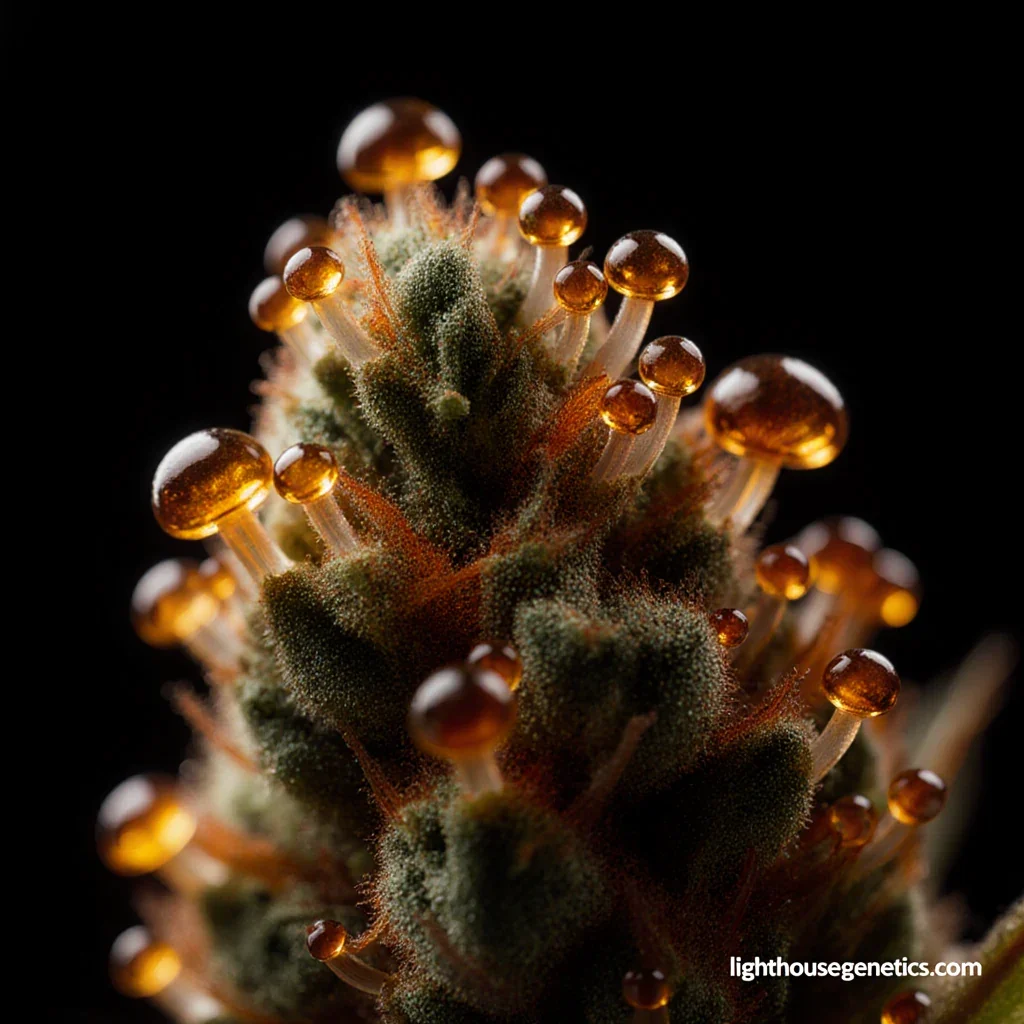
Terpenes are fragile — they are volatile organic compounds that literally evaporate when heat and dryness push them past their boiling point. The cannabinoids are sturdier, but not bulletproof. Get the drying temperature for cannabis wrong by even 10 degrees, and you can lose 30-50% of what made your weed special. Every grower who ever stored weed learns this the hard way. Dialing in the right drying temperature for cannabis is not guesswork — there is real science on exactly what numbers to hit.
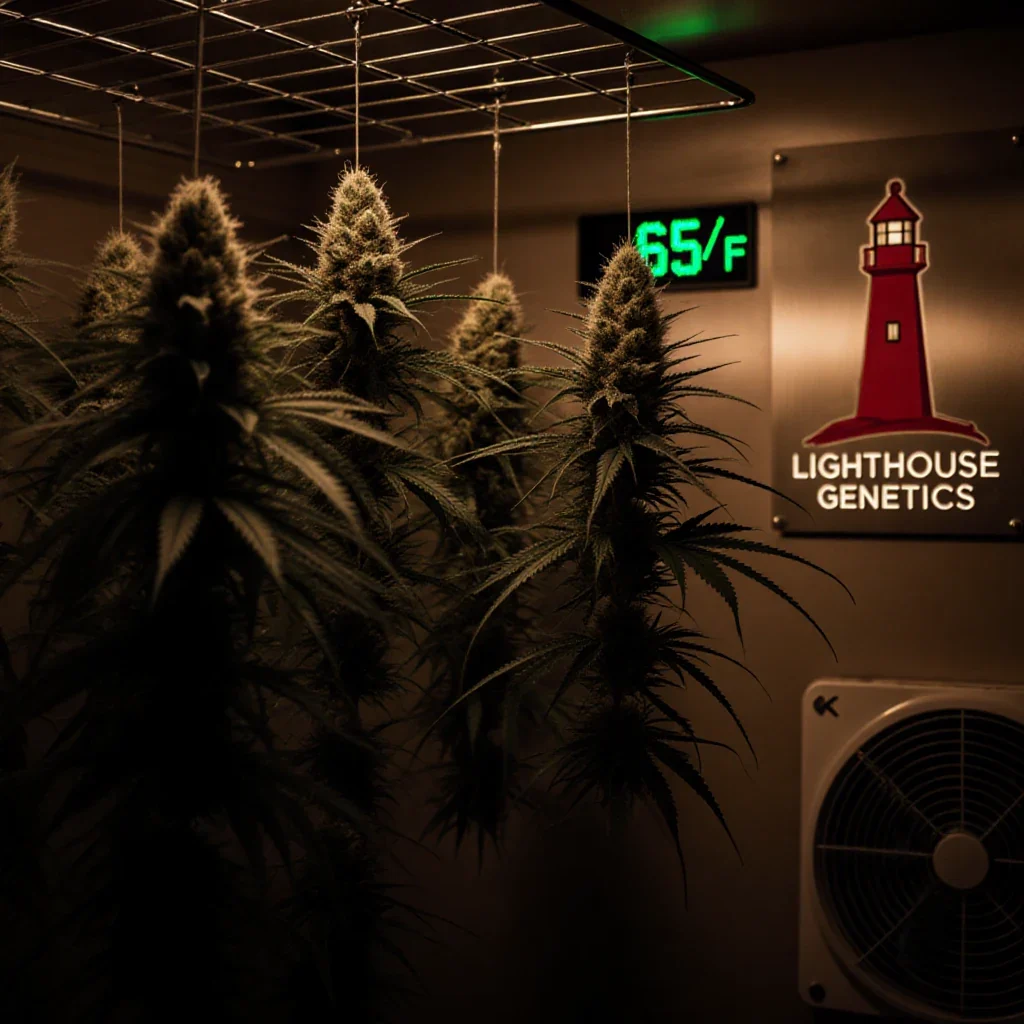
The best drying temperature for cannabis terpenes is 60-68°F (15-20°C) with 55-65% relative humidity, over 10-14 days in a dark, well-ventilated room. This range preserves the widest band of monoterpenes (the most volatile and flavor-defining terpenes) while still allowing moisture to leave the bud gradually enough to prevent mold. Going above 72°F accelerates terpene loss. Going below 40% RH dries too fast and locks chlorophyll into the bud, giving the hay-like smell. The window is narrow, low, and slow — and yes, it really does matter that much.
Terpenes are the aromatic compounds that give each strain its distinctive smell and taste. Limonene (citrus), myrcene (earthy-mango), pinene (pine), caryophyllene (pepper), linalool (lavender) — these are the molecules doing the work. Chemically, they are volatile organic compounds. Each terpene has a boiling point, and many of them start evaporating at room temperature.
Here are published boiling points of the main cannabis terpenes, roughly ordered by fragility:
The absolute boiling point numbers are a bit misleading for drying. What actually matters is that volatile molecules evaporate at a much lower temperature than their boiling point — just more slowly. At room temperature (72°F), cannabis buds are losing limonene and myrcene the entire time. At 85°F, they are losing them two or three times faster. The right temperature is simply one low enough to slow that loss to a crawl, paired with enough airflow to move moisture out without baking the resin. That pairing is what makes a good drying temperature for cannabis actually work.
In 2024, Birenboim and colleagues (senior author Shimshoni) published “In Pursuit of Optimal Quality: Cultivar-Specific Drying Approaches for Medicinal Cannabis” in Plants (13:1049). They compared traditional open-air atmospheric drying against controlled-atmosphere drying with different gas mixtures at a single controlled temperature (15°C) — the commonly cited 15-21°C range from prior cannabis-drying literature. Results: controlled-atmosphere drying preserved or increased monoterpene content relative to the fresh starting point, while traditional open-air drying caused monoterpene degradation and allowed mold infestation. Controlled-atmosphere drying also cut total drying time by roughly 60% compared to open-air drying. The takeaway: at low controlled temperature, atmosphere matters — reducing oxygen exposure protects volatile terpenes.
A 2021 study by Chen, Wongso, Putnam, Khir and Pan on hot-air and infrared drying of industrial hemp (Industrial Crops and Products) showed the opposite end of the curve. They tested temperatures from 40°C up to 90°C (104°F to 194°F). Cannabidiol itself was surprisingly stable — CBD retention stayed between 83.8% and 98.6% across the entire tested range. Terpenes were the fragile component: total terpene retention dropped from 82.1% at the lowest tested temperature to just 29.9% at 90°C, with monoterpenes hit hardest. The earlier Ross and ElSohly (1996) baseline paper in Journal of Natural Products documented the underlying volatility chemistry that explains why.
The consistent message across this research on drying temperature for cannabis: slow, cool, controlled. It is not just about heat — it is about preventing the conditions that accelerate loss. Fast airflow at 75°F is worse than gentle airflow at 65°F. Dry (35% RH) air at 65°F is worse than humid (60% RH) air at 68°F.
Based on the research and accumulated best practices, a proper dry room — dialed in to the right drying temperature for cannabis — hits these targets:
Hit those numbers and you preserve the terpene profile that makes your specific strain worth growing. This matters especially for aroma-forward cultivars like Orange Creamsicle, Forbidden Fruit, and Frosted Grape Shoes — strains bred for a specific terp profile that a bad dry will flatten into generic weed smell. This is the whole reason the right drying temperature for cannabis matters so much for terp-forward strains.
Different cultivars have slightly different drying temperature for cannabis sweet spots, though they all fall within the 60-68°F range:
60-68°F (15-20°C) at 55-65% relative humidity, over 10-14 days. This preserves the volatile monoterpenes (limonene, myrcene, pinene) that define each strain’s smell and flavor.
Technically yes, but you will lose terpenes. A 4-5 day fast dry at higher temperature retains maybe 40-60% of the terpene profile a proper 12-day dry preserves. Not worth it for personal use — the wrong drying temperature for cannabis at any speed costs you flavor.
Below 45% RH, buds dry too fast on the outside while the inside is still wet. This traps chlorophyll (producing the “hay” smell), makes the bud harsh to smoke, and accelerates terpene loss. You cannot undo this in cure.
Freeze-drying (lyophilization) is an emerging technique that preserves terpenes better than any conventional method. Recent research has shown freeze-drying can preserve significantly more of certain cannabinoids and terpenes than ambient drying, though the exact magnitude varies by cultivar and conditions. The equipment is expensive for home growers, but commercial producers are adopting it.
They are linked — together they determine vapor pressure deficit (VPD), which controls how fast moisture leaves the bud. Both need to be right. Temperature usually has more direct impact on terpene evaporation; humidity controls the speed of drying overall.
If you can hold the temperature at 60-68°F and the humidity at 55-65% with the tent closed, yes. Most grow tents run warmer than this range even with lights off — check with a calibrated thermometer/hygrometer. Empty grow tents with gentle exhaust are actually excellent dry rooms because they are light-tight.
Specialized low-temperature fridge drying (around 60°F in a humidity-controlled wine fridge) is a growing trend. Done right it works. Done wrong (regular fridge too cold, or too dry) it produces worse buds than a proper room dry. Humidity control is the hard part.
The best drying temperature for cannabis terpenes is 60-68°F at 55-65% RH, over 10-14 days, in the dark with gentle airflow. This is not guesswork or folklore — the peer-reviewed research on cannabis drying, combined with the underlying volatility chemistry of individual terpenes, all point to the same window. Go too hot or too dry and you lose the compounds that make your strain special. Go too slow or too humid and you risk mold. The sweet spot is narrow and it is worth hitting.
Drying is the stage where most growers lose quality they already paid for in genetics, light, and nutrients. Get it right and everything else you did matters. Get it wrong and none of it does. Start with genetics worth preserving — browse our full seed catalog for high-terpene strains. If you are just getting started, our germination guide, seed storage guide, and nitrogen feeding guide cover the fundamentals. The plants do 95% of the work — do not undo it at the finish line.
Want to keep learning? Browse our full library of our cannabis growing guides — everything from germination to harvest, in one place.
Ready to grow? Browse premium seeds from Lighthouse Genetics:
Designed & Built by Wynne Web Design